






















![Kingdom Hearts Collection [I-III] Review](https://gazettely.com/wp-content/uploads/2026/10/Kingdom-Hearts-Collection-I-III-1-360x180.webp "Kingdom Hearts Collection [I-III] Review: KHII Holds Steady as Newer Entries Fluctuate 40")

There is a particular quiet that precedes a storm, a stillness born not of peace but of immense, coiled pressure. It is the silence of the overlooked, the unheard, the women who have been relegated to the footnotes of their own lives. This is the state of potential energy we find in Beth (Joanna Scanlan), a teacher so thoroughly worn down by personal and professional indifference that she is methodically planning her own exit. The air in her home is thick with this quiet.
Yet, as physics dictates, energy is never destroyed, merely transformed. For Beth, that transformation from silence to sound comes via a ringing telephone. The call from her friend Jess (Lorraine Ashbourne) is a lifeline disguised as an absurd question: “D’you want to be in a rock band?” This is the catalyst for Riot Women, a series that charts the messy, glorious conversion of untapped human potential into the kinetic, world-altering force of punk rock. Set against the backdrop of West Yorkshire, it is an exploration of what happens when the women society has muted decide to turn up the volume.
A Chorus of Discontents
The series is built around its ensemble, a collection of women whose lives are symphonies of quiet desperation. At its heart is Beth, whose journey from the brink of self-annihilation to a rediscovered sense of self provides the narrative’s emotional ballast. Joanna Scanlan’s performance is a marvel of controlled depth, conveying a fragility so profound it seems crystalline while simultaneously hinting at a core of formidable resilience.
Beth’s despair is not theatrical; it is a heavy blanket of exhaustion, a sociological condition reflecting the erasure women often face in their later years. Her choice to play the keyboard is symbolic; she provides the foundational chords and harmony upon which the band’s louder, more chaotic elements can build. In her unlikely, quasi-maternal bond with the group’s lead singer, Kitty, she finds a new purpose: anchoring a soul even more adrift than her own.
If Beth is the anchor, Kitty (Rosalie Craig) is a force of nature. She is the raw, volatile energy the band desperately needs, a singer with a voice that could strip paint and a past that could fill a library of tragedies. Rosalie Craig’s performance is a breakout, a star-making turn that perfectly balances the aggressive, leopard-print armor of the punk archetype with the shivering vulnerability of a lost child.
Kitty is a fascinating paradox: her immense voice gives her power, yet she is emotionally inarticulate, her trauma expressing itself in bursts of chaos. She is the embodiment of the riot grrrl spirit, a character whose chaotic presence grants the other, more repressed women permission to finally access their own rage.
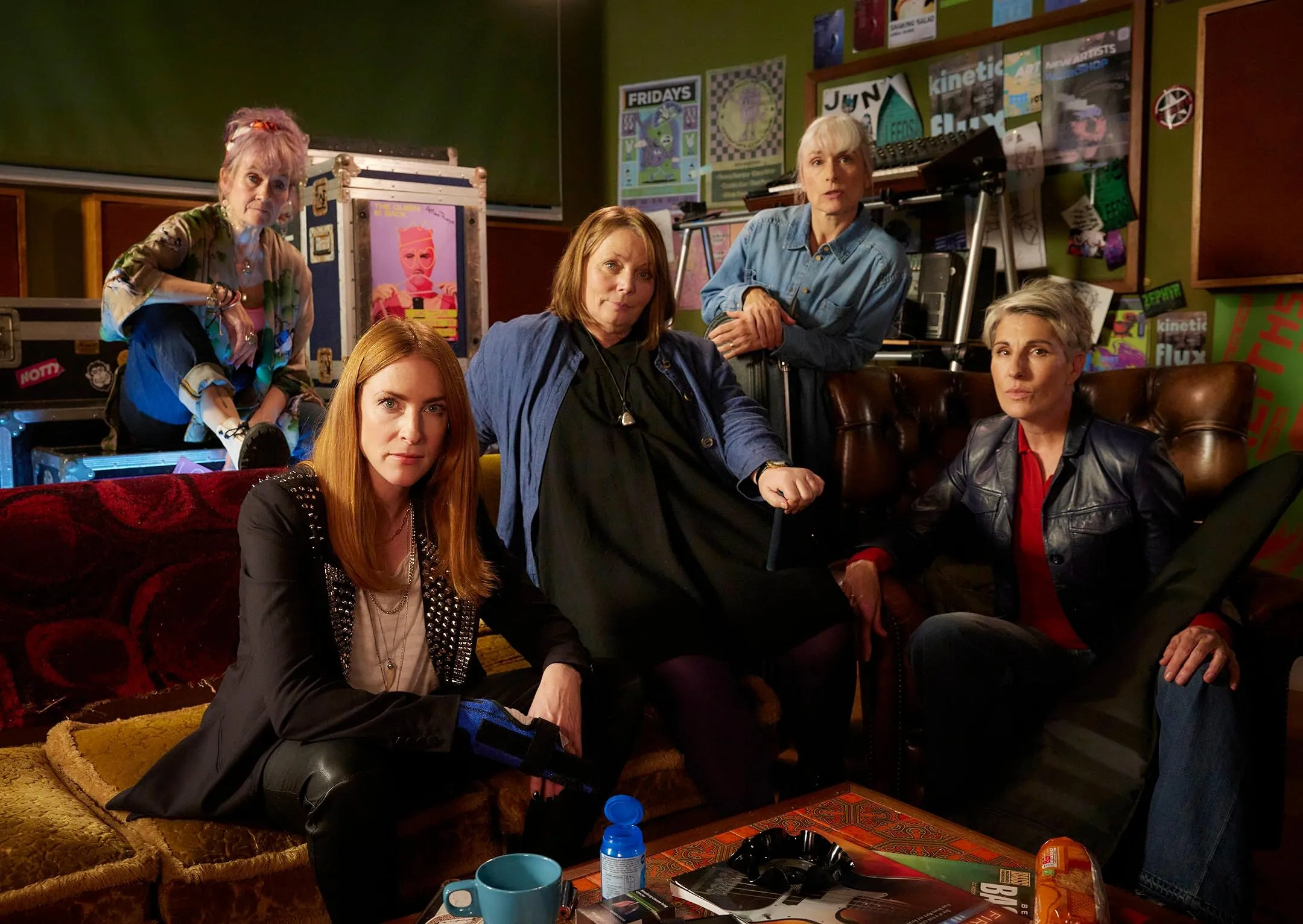
The quintet is completed by a trio of masterful performances. Tamsin Greig portrays Holly, a career police officer whose identity is inextricably linked to her uniform. Her impending retirement is not a peaceful sunset but an existential cliff edge, complicated by the slow, heartbreaking fade of her mother’s dementia. Lorraine Ashbourne’s Jess, the pub landlady who kickstarts the whole affair, is a portrait of performative cheer masking deep loneliness.
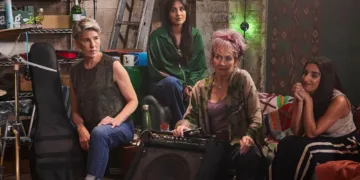
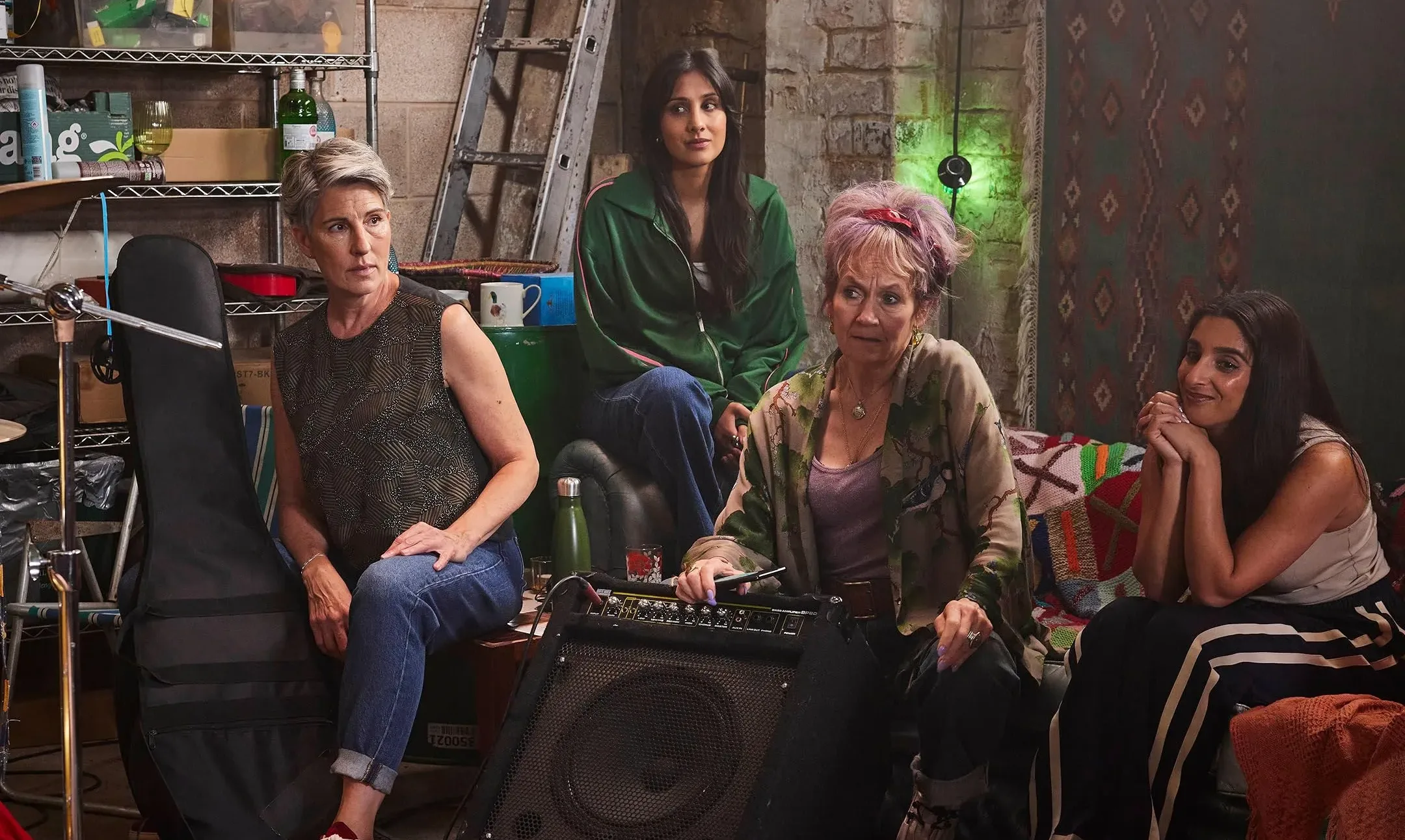
She exists at a social hub, pouring drinks and witnessing lives, yet remains fundamentally separate. Then there is Amelia Bullmore as Yvonne, the anxious midwife whose clinical, ordered professional life is a stark contrast to her own frayed inner world. Together, they coalesce in the band’s rehearsal space, a scruffy, liminal room that becomes their sanctuary, a place beyond the reach of familial duty and societal expectation where they can, for a few hours a week, simply be.
An Anatomy of Anger
The central thesis of Riot Women is that for many middle-aged women, invisibility is not a feeling but a physical reality. It is a kind of domestic camouflage, a social magic trick where they slowly disappear before everyone’s eyes.
The decision to form a punk band is a direct, confrontational response to this phenomenon. Punk, with its ethos of amateurism and its celebration of raw expression over technical skill, is the perfect genre for their rebellion. It does not require permission or polish. It only requires something to say. The act of making loud, aggressive, and often discordant music is a powerful reclamation of space, a sonic insistence on their own existence.
The show’s handling of menopause is relentlessly, almost clinically, direct. It is presented as a significant life event with a host of destabilizing physiological and psychological symptoms. This is a radical act for a primetime television drama, dragging a historically taboo subject into the light. The series refuses to treat hot flushes or brain fog as comedic fodder for a cheap laugh.
This dedication to realism is both its greatest strength and a minor weakness. At times, the dialogue can feel less like natural conversation and more like a public service announcement, a televisual consciousness-raising session that sacrifices dramatic subtlety for didactic clarity. One applauds the intent while occasionally wishing for a slightly lighter touch.
Beyond the personal, the series offers a sharp critique of the societal structures that place the burden of care squarely on women’s shoulders. We see the unrelenting, exhausting reality of tending to parents with dementia and managing adult children who still take more than they give. Wainwright’s script is crucial for its refusal to romanticize this labor.
Caregiving is shown not as a beatific act of love but as a grueling, often thankless job that erodes one’s own life. This connects to a broader truth about the vast, unacknowledged economy of unpaid work that keeps society functioning, a system powered by the quiet, steady depletion of women like Beth, Holly, and Jess.
Wainwright’s Wry Symphony
The dialogue throughout the series is pure Sally Wainwright: a fast, witty, and deeply authentic symphony of Northern English speech. It is a testament to her ear for the way real people talk, especially how they use humor as a shield and a scalpel. Characters navigate the most harrowing of circumstances (a parent’s frightening dementia spell, a confrontation with an abusive ex) with a dry, cutting remark that does not diffuse the tension but instead sharpens its edges. This gallows humor is a survival tactic, a way of looking into the abyss and offering a wry observation about the view.
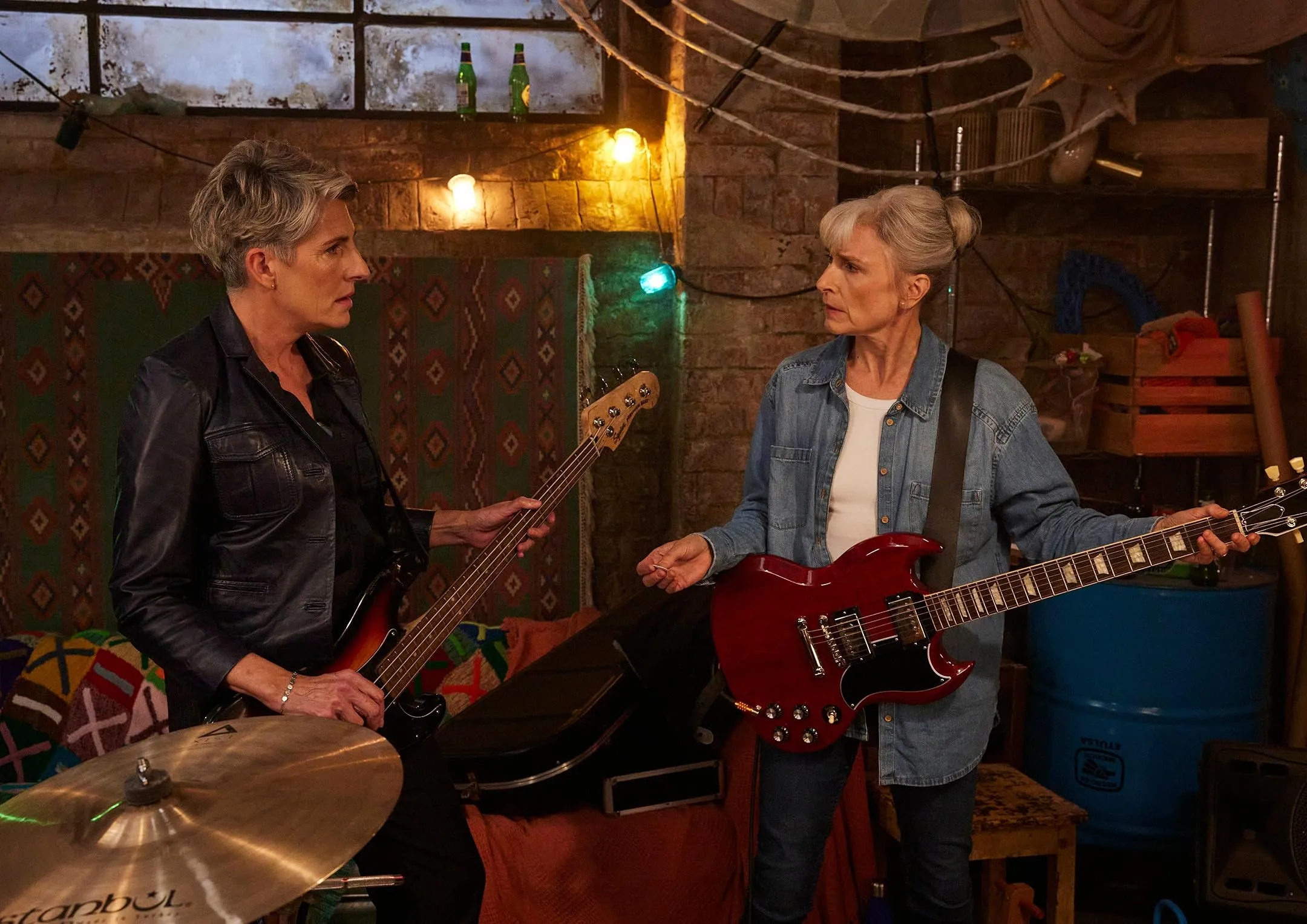
The series is a fascinating exercise in tonal dissonance. It yokes a dark, psychologically astute drama about despair and trauma to a much lighter, almost crowd-pleasing narrative about a local talent show. The gears often grind during the shift from a scene of profound emotional devastation to one of almost slapstick band practice.
And yet, this structural awkwardness feels strangely honest. Life itself is not tonally consistent. The profound and the ridiculous are constant, often unwelcome, bedfellows. The show’s refusal to smooth out these bumps creates a texture that is messy, unpredictable, and ultimately more true to life than a more seamless production might have been.
Music is the narrative’s engine. The original songs, with their on-the-nose lyrics and three-chord simplicity, are not meant to be chart-toppers. They are meant to be emotionally true. Their lyrical directness might seem unsophisticated, but it reflects the characters’ own nascent attempts to articulate a lifetime of frustration. Punk was built for this, a genre that validates the primal scream. The songs function as audible diary entries, charting the group’s journey from hesitant complaint to a full-throated, collective roar of defiance.
No Quiet Endings
The band, in the end, is the vehicle. The true destination is the fierce, resilient, and life-affirming solidarity the women find with one another. It is in the shared laughter over a missed chord, the silent understanding during a moment of grief, and the collective strength they discover in their shared noise. They save themselves by saving each other.
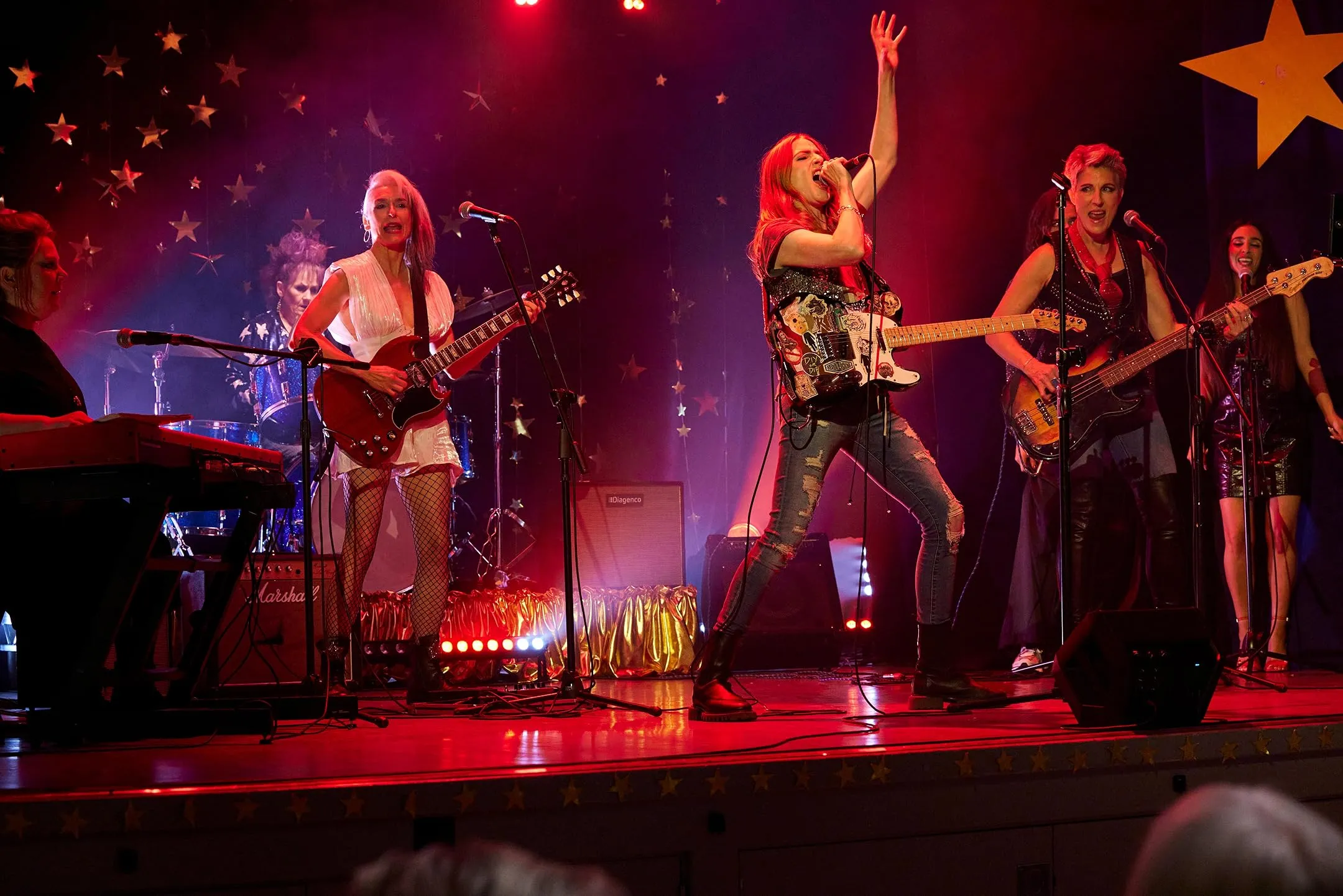
Riot Women serves as a powerful refutation of the cultural mandate that women should age gracefully and quietly. It suggests a more audacious alternative: to age with fury, with passion, and with a guitar turned up as loud as it can go.
It is a raw, funny, and deeply moving piece of television. The series leaves a lasting impression as a glorious and necessary celebration of the second act, asserting that it is never too late to make your own damn noise.
Riot Women is a six-part British television drama series created and written by Sally Wainwright. The series centers on five menopausal women—a teacher, a police officer, a pub landlady, a midwife, and a shoplifting freeloader—who come together to form a makeshift punk-rock band to enter a local talent contest. The band becomes a catalyst for change as the women, who feel increasingly invisible, find a powerful and riotous voice to confront midlife challenges like demanding jobs, difficult parents, complicated marriages, and the menopause. The series premiered on BBC One and BBC iPlayer in the UK on October 12, 2025, and is also available to watch on BritBox in the US and Canada.
Full Credits
The Review
Riot Women
Riot Women is a triumphant, necessary roar of a series. Propelled by Sally Wainwright’s sharp, witty script and a powerhouse ensemble cast, it tackles female rage, aging, and invisibility with raw honesty and dark humor. While its tonal shifts can be jarring and its messaging occasionally heavy-handed, the sheer force of its performances and the power of its central theme of solidarity make it vital, moving, and unforgettable television. It’s a defiant and glorious anthem for the overlooked, celebrating the revolutionary act of making a scene.
PROS
- Stellar ensemble cast, featuring career-defining performances from Joanna Scanlan and Rosalie Craig.
- Sally Wainwright's signature dialogue is authentic, sharp, and brilliantly witty.
- A raw and unapologetic exploration of menopause and female invisibility, subjects rarely given such a serious platform.
- A powerful and affirming message about the strength and necessity of female friendship.
CONS
- Abrupt tonal shifts between dark, psychological drama and light-hearted comedy can feel jarring.
- The explicit messaging, particularly on menopause, sometimes sacrifices subtlety for didacticism.
- The plot occasionally relies on narrative conveniences to bring the characters together.