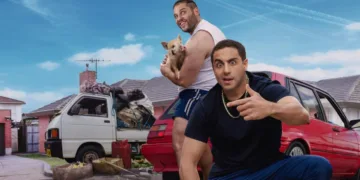


















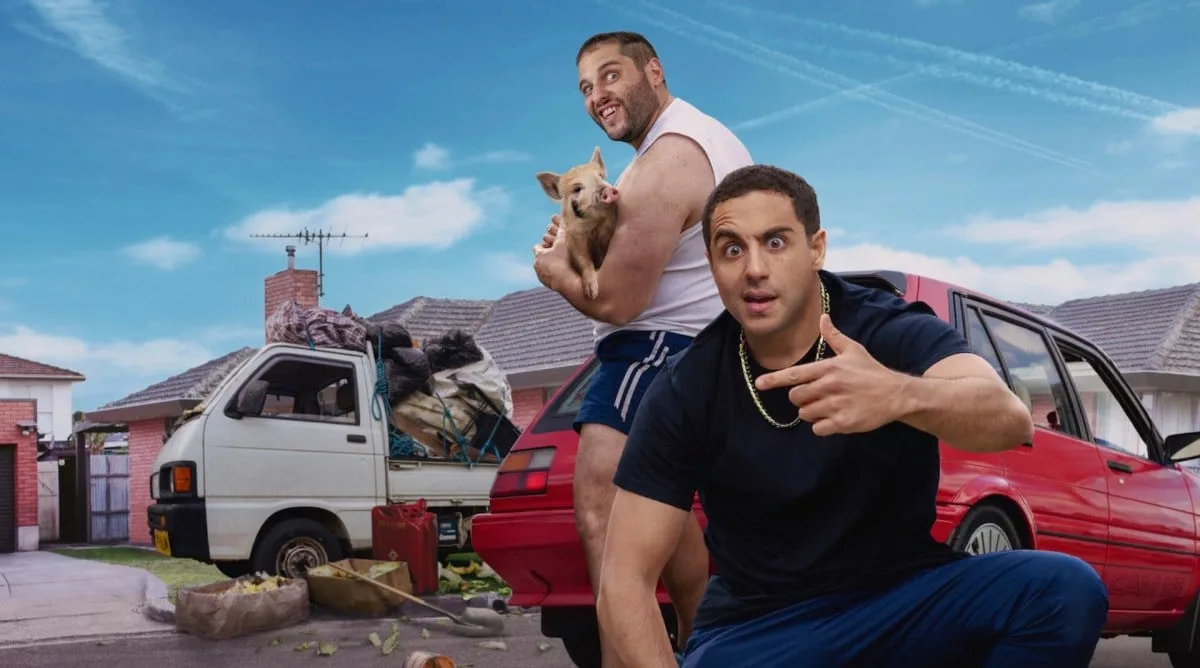

The series Son of a Donkey arrives as the latest expansion of the world the Theo and Nathan Saidden created under their Superwog persona. After cultivating a large online following, the brothers translated their crude-comedy characters into a previous series called Superbro. This six-episode entry returns its focus to the central pair: the short-tempered Theo and his loyal, equally chaotic friend Johnny.
The series wastes no time setting two central pressures in motion. Theo’s explosive road rage produces a major traffic fine that threatens the seizure of his dilapidated but cherished car. That financial threat propels the primary plot and provides a clear material stake for the episodes to orbit.
At the same time, the show sketches a dysfunctional household in which Dad has taken to dumpster diving for family food. That habit fractures his relationship with Mum and escalates into a medical emergency when he suffers sudden, severe kidney failure. Across the six episodes the family structure frays while Theo and Johnny cycle through increasingly ill-conceived schemes to raise money.
The Narrative of Controlled Chaos
Son of a Donkey favors slapstick, high-velocity action, and exaggerated physical comedy. The show leans on shouting, rapid movement, and broad violence with an almost cartoon quality. Coherence is often secondary to escalation. The series stages literal, startling outcomes such as a man’s organs failing after a garbage feast and a domestic argument broken by Mum swinging a glass vase. Such moments arrive with theatrical force and little interest in slow causal unpacking.
The opening sequence sets the tonal baseline. Theo’s lane-change dispute with another driver triggers a revenge plot that includes tampering with red-light cameras. That act functions as the inciting incident and then as the structural engine behind the show’s financial predicament. The writing frequently accelerates from cause to consequence rather than lingering on intermediate detail. Consequences land quickly and with considerable severity, which pushes the protagonists into a repeating pattern of bold, poorly planned responses that generate new disasters.
The comedy rests firmly in low-brow material. Scripts deploy abundant bodily-function jokes, modern Australian slang, and steady profanity. This commitment to shock value requires a tolerance from viewers who favor cruder humor. Theo and Johnny are scripted as intensely moronic; their stupidity supplies the show’s momentum. The pair lose a job at a burger joint after attempting to clean the oil fryer with a vacuum cleaner.
Paradoxically, they later display highly specific, niche knowledge when they blunder into the chain’s corporate headquarters, speaking in mock-technical terms about things like hydrosorbitol and a cooking-oil fat rating labeled TPM. That mismatch between broad incompetence and sudden technical-sounding precision is a recurring device. A thin layer of social observation about consumption and labor appears in a few beats, but the series largely prioritizes spectacle and immediacy.
Character Dynamics and Performance
Characters are configured as broad comedy types built to collide and create chaos. Theo and Johnny act as the show’s twin engines of destruction; impulsive, short-sighted choices generate the obstacles the pair then attempt to navigate. Theo’s attachment to his “little girl” car supplies a singular, tangible objective: he must raise the money to prevent the impoundment of his prized Corolla. Johnny’s poor judgment and lack of common sense amplify Theo’s volatility. The two adopt a bodybuilder’s swagger while possessing no physical strength, a mismatch that underlines their inflated self-image.
Nathan Saidden gives a physically committed, often extreme performance as Dad. The role pushes primal behavior, ranging from smashing through doors to threatening to steal his son’s organs in a hospital. Dad’s insistence that he can subsist on scavenged dump food becomes grotesque and then medically consequential. The performance depends on grunts, shouting, and a physical-comedy style that tests the limits of believability. That wholeheartedness in execution could be singled out for special recognition for its commitment to the absurd.
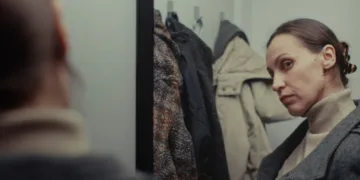
Theo Saidden’s portrayal of Mum in drag supplies the series with its relative voice of sanity. Mum reacts to the household’s collapse with despair and removal from the scene. Her suggestion that a nurse put her husband in a coma reads as a darkly comic line and also gives the role emotional weight that anchors some of the farce. The family exists in clear crisis, with tensions edging toward divorce.
Scenes such as Dad striking Theo and accusing him of “rotten genetics” shift tonal registers so that moments feel both tragic and ridiculous. Exchanges are often calibrated to provoke the next gag rather than to produce gradual psychological change, which keeps relationships locked in repeated cycles of arguing and fighting.
Structural Shift and Production Values
Structurally, the series moves away from the Saiddens’ earlier episodic sketches toward a single, ongoing narrative stretched across six episodes. The through-line is explicit and narrow: prevent the car from being impounded by raising money to pay the fine. That objective gives the six-part arc cohesion. Pacing remains brisk; new obstacles arrive continuously and force improvisational solutions that typically collapse into fresh complications. The extended format trades some of the pause and texture of shorter sketches for sustained forward motion.
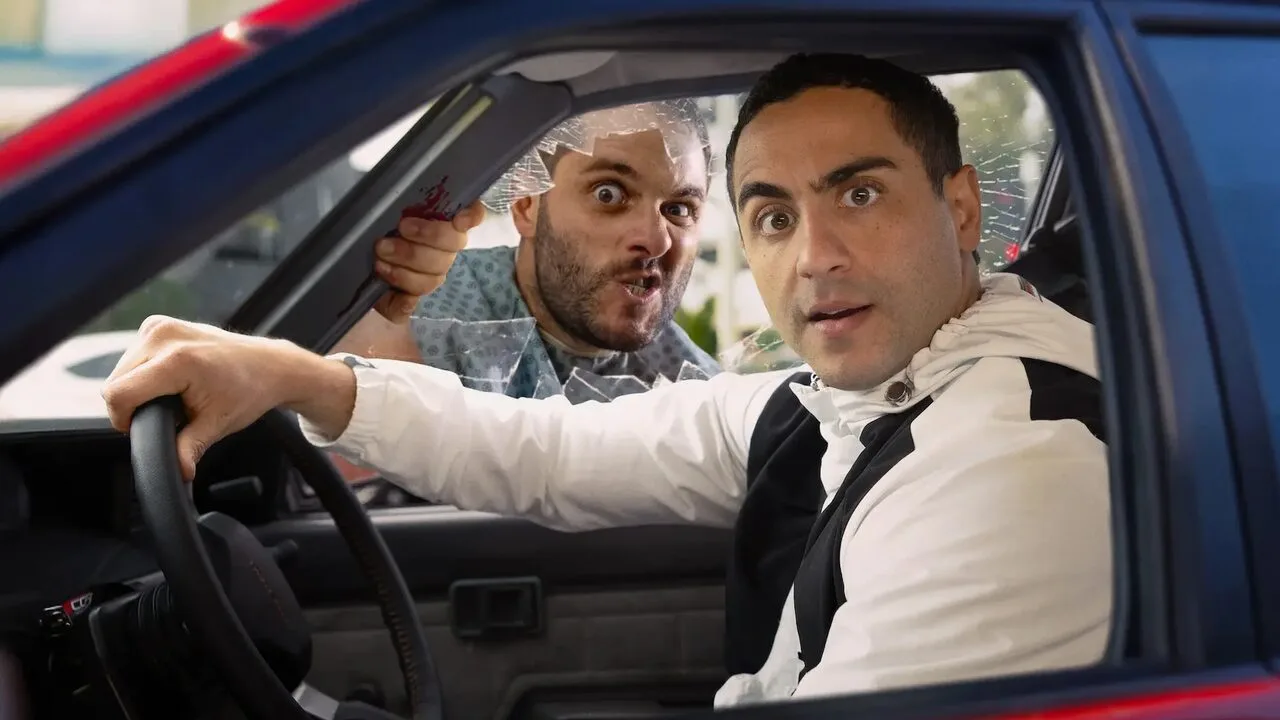
Production values show visible improvement in select areas, especially in set-piece staging. Several chases and fights are staged with striking framing and convincing camerawork, at times approaching Hollywood-level cinematography, including a sequence where a character crashes through a window. Those visual choices amplify the spectacle of the physical comedy. The series undercuts cinematic polish with grounding reminders of base-level gag work, such as a laundry basket explicitly labeled “Poo Stained Undies,” which reasserts the show’s lowbrow sensibility.
That emphasis on large-scale action and extended set-pieces brings a cost in narrative texture. Jokes often aim for immediate impact rather than layered payoff. Earlier, shorter work from the Saiddens sometimes offered multiple hidden pleasures for attentive viewers; in this extended form the series frequently chooses obvious, surface-level laughs. The creators present a louder, more straightforward version of their established comic identity rather than retooling that identity.
The Saidden brothers remain the series’ writers and stars, preserving creative control and a consistent tonal palette. Their approach follows a pragmatic production instinct: if it ain’t broke, don’t fix it. Within the limits they set, the show functions structurally and delivers the loud, high-energy crude comedy that will satisfy their sizable fan base.
Son of a Donkey is the new Australian comedy series created by brothers Theodore and Nathan Saidden, the duo behind the popular YouTube and ABC series Superwog. The six-episode season premiered on October 30, 2025, and is available to stream worldwide on Netflix. The series follows Theo as he attempts to navigate adulthood after leaving home, but quickly finds himself battling massive traffic fines, financial scams, and the escalating chaos of his dysfunctional family, including his father’s medical emergency and his mother’s desperation.
Full Credits
Title: Son of a Donkey
Distributor: Netflix
Release date: October 30, 2025
Rating: N/A (Not officially listed, but contains strong language and mature humor)
Running time: Approximately 30 minutes (per episode, 6 episodes total)
Director: Theodore Saidden
Writers: Theodore Saidden, Nathan Saidden
Producers and Executive Producers: Nathan Saidden, Theo Saidden, Mike Cowap, Antje Kulpe, Emma Fitzsimons, Elia Eliades, Laura Waters, Chris Loveall
Cast: Theodore Saidden, Nathan Saidden, Loraine Fabb, Daniel Reader, Matthew Crosby, Toby Derrick, Sotiris Tzelios, Sara Ellis Holland, Christopher Farrell
The Review
Son of a Donkey
Son of a Donkey successfully translates the Saidden brothers’ high-velocity, low-brow chaos into a cohesive, extended narrative structure. While the increased focus on big, expensive set-pieces sacrifices some of the earlier work's character-driven nuance, the show delivers its signature brand of aggressive slapstick and exaggerated absurdity with exceptional commitment. The performances, especially Nathan Saidden’s Dad and Theo Saidden’s Mum, anchor the anarchy with volatile energy. It is a show made by and for its core audience.
PROS
- Maintains high-speed, escalating momentum across all six episodes via a strong central conflict.
- Features surprisingly cinematic shots and Hollywood-level quality cinematography during action sequences.
- Provides a grounding, emotionally desperate counterpoint to the male chaos, noted as a highlight.
- Nathan Saidden's performance as Dad is a tour-de-force of grotesque, physical absurdity.
CONS
- The extended, single storyline format sacrifices the subtle, layered humor of earlier, episodic work.
- The extreme focus on crude, bodily function jokes and constant shouting may alienate wider audiences.
- The narrative primarily uses the characters' sheer stupidity as the sole engine for conflict.
- The series does not innovate the comedic style; it just makes it bigger and louder.