














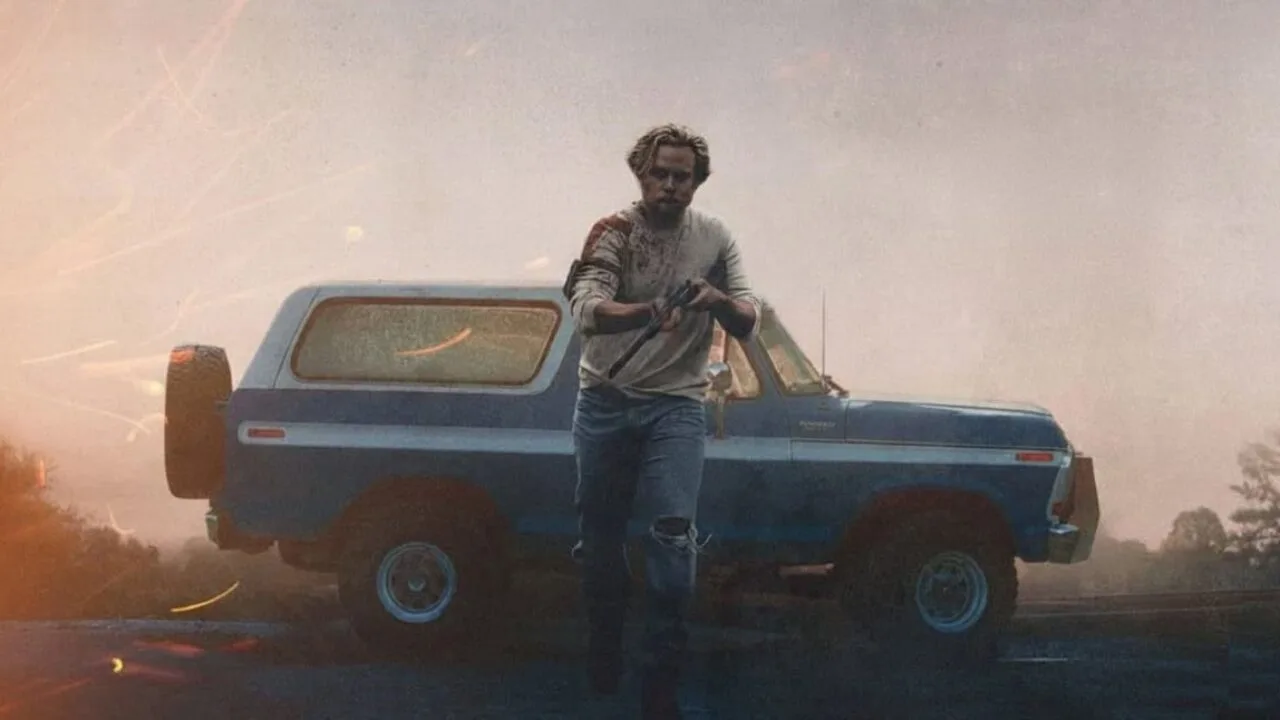

The weight of legacy sits heavy in Violent Ends. John-Michael Powell’s Southern Gothic crime thriller inhabits that weight and feels crushed beneath it. The year is 1992, and rural Arkansas registers in the film through pine-scented air and a persistent sense of historical grievance. Lucas Frost (Billy Magnussen) wants erasure from the ledger of the Frost crime family. His attempt at a clean life proves fatal.
His fiancée Emma (Alexandra Shipp) becomes collateral damage in a sloppy robbery arranged by his own kin. Her death severs the thread that held Lucas away from revenge and pulls him back into a calibrated cycle of familial destiny. Powell stages this inevitability against the unforgiving geography of the Ozarks, using authentic locations as a stark backdrop for a tragedy that feels predetermined.
The Calibration of Anguish: Performance and Persona
Billy Magnussen anchors the film by shifting registers from his more accessible, sometimes comedic work into this taciturn lead. Lucas Frost speaks little; his trauma lives under a rigid posture and a face kept deliberately still to contain a bitter, smoldering anger. Magnussen sketches both a latent capacity for violence, the rattlesnake impulse, and a persistent remorse lodged beneath the surface.
The bruised dynamic between Lucas and his half-brother Tuck, played by Nick Stahl, supplies the film’s most persuasive psychological tension. Stahl composes a lived-in portrait of a man whose brief attempts at normalcy buckle under private weakness. Their uneasy alliance becomes the narrative’s clearest source of emotional complexity.
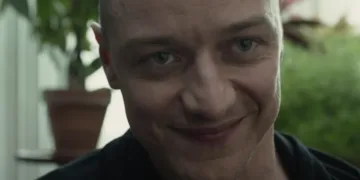
Sid, the antagonist played by James Badge Dale, registers as a study in raw menace. Dale commits to a performance of controlled volatility that reads as almost gleefully sociopathic. Sid’s manner and habits, down to an unfortunate, highly distracting haircut and a catalogue of crude personal tics, amplify his threat value rather than diffuse it. He moves through scenes with a swagger that makes him feel resistant to easy critique.
By contrast, Emma receives a thin treatment. Alexandra Shipp’s charisma is evident, but the script reduces Emma to the sentimental figure whose death functions as narrative propulsion. She exists chiefly as the dead wife motif, a motivation device rather than a fully drawn person whose loss alone would justify Lucas’s profound descent.
The Topography of Dread: Technical Execution and Genre
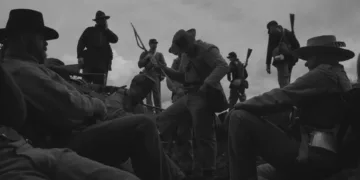
Powell’s direction and Elijah Guess’s cinematography immerse the audience in a steady atmosphere of dread. The visual palette skews dour Appalachian gray, occasionally pierced by sharp contrasts that suggest expressionistic framing in the neo-noir thriller lineage. Light and shadow do more than model surfaces; they underline emotional and moral decay. The film’s aesthetics evoke a genuine sense of Southern frontier grit and a noir inheritance that leans on chiaroscuro-like tensions between illumination and obscurity.
The filmmaking, however, struggles with narrative density. The opening leans on an overlong wall of historical text that showers the viewer with minutiae about the Frost family’s past drug wars. That early informational weight bleeds into a second act whose pacing becomes torpid. The script insists on treating the killer’s identity as a mystery even though the images present suggestive visual evidence.
The result is a prolonged posture of suspense that often feels performative. Violence in the film is staged with a commitment to realism, especially in the gun battles, and those sequences avoid sensational gloss. This commitment makes the combat feel viscerally real, which is admirable.
The sustained brutality sometimes reads at odds with the film’s philosophical gestures toward cyclical retribution, creating a tension between thematic intent and the pleasures of immersive, harsh action. The result is technical proficiency and visual richness that stop short of producing a truly fresh narrative revelation because the story relies on familiar beats and an overwrought register of angst.
The title derives from a line about violent delights and their corresponding ends, a framing that establishes a fatalistic ethic. The film gestures toward a philosophical reckoning with generational retribution, an attempt to measure how inherited violence shapes choice and consequence. This ethical frame appears across character arcs but does not always find consistent dramaturgical support.
The Underexplored Contradiction: The Mother and the Law
The film’s most promising, and most underused, figure is Darlene (Kate Burton). She is Lucas’s mother and a no-nonsense cop who wears a badge in a county dominated by her family’s criminality. That tension — a law officer embedded in the clan she must police — invites serious ethical inquiry. The screenplay reads past those questions, confining Darlene to a narrow maternal-investigative function instead of testing her allegiance against the ceaseless violence and drug running that define her kin.
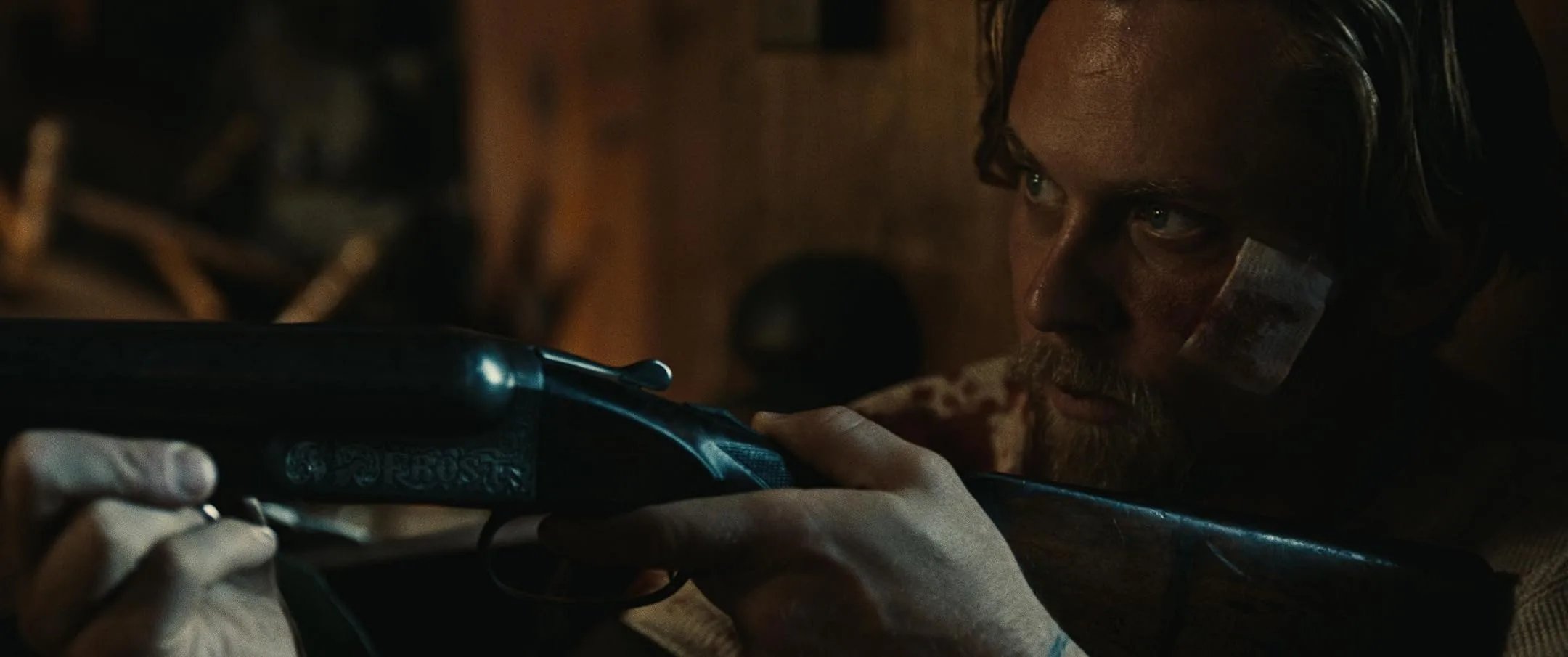
Burton brings determined weariness to the role and makes Darlene feel palpably engaged. The plot’s architecture, though, makes the character feel reverse-engineered. She remains peripheral to the core murder investigation until a single final-act plot exigency requires her intervention.
That structural choice reduces a potentially rich moral figure to a conduit for exposition rather than a participant in the ethical gray zones the film gestures toward. The omission highlights a larger tendency in the screenplay: preference for advancing a familiar plot over probing the tangled loyalties and self-destructive solidarity of a family that both sustains and consumes its members.
The film’s assets are many: committed performances, a textured Southern visual register, and a willingness to stage violence as stark reality. Those elements produce moments of genuine intensity. Yet the work contains persistent mismatches between aesthetic ambition and dramaturgical follow-through, between lines of moral inquiry and the film’s readiness to let exposition and familiar plotting dictate pace. The result leaves the viewer with strong sensory memories and a sense of thematic promise that the screenplay repeatedly declines to explore in full.
The movie Violent Ends is a Southern crime thriller set in the Ozark Mountains. It premiered in theaters on October 31, 2025, distributed by IFC Films. The story follows Lucas Frost, a man determined to escape his infamous crime family’s violent legacy, who is forced back into a cycle of retribution after the brutal murder of his fiancée.
Full Credits
Title: Violent Ends
Distributor: IFC Films
Release date: October 31, 2025
Rating: R
Running time: 1 hour 52 minutes
Director: John-Michael Powell
Writers: John-Michael Powell
Producers and Executive Producers: Vincent Sieber-Smith, Undine Buka, Catherine Fegan-Kim, Alex Kim, Billy Magnussen
Cast: Billy Magnussen, James Badge Dale, Alexandra Shipp, Nick Stahl, Kate Burton, Ray McKinnon, Matt Riedy, Jared Bankens
Director of Photography (Cinematographer): Elijah Guess
Editors: Mark Gasparo
Composer: Anthony Willis
The Review
Violent Ends
Violent Ends is a visually impressive, technically competent neo-noir thriller grounded by the intense performances of Billy Magnussen and James Badge Dale. It successfully establishes a grim, fatalistic atmosphere in its Southern Gothic setting. However, its adherence to familiar revenge tropes and a frustrating refusal to explore the most fascinating ethical contradictions—particularly the character of Darlene—leaves the material feeling derived. It possesses the aesthetic power of a great crime drama but lacks the necessary narrative invention to stand alongside its genre inspirations. A powerful mood piece, if a slightly predictable one.
PROS
- Billy Magnussen and James Badge Dale deliver intense, stabilizing performances.
- Vivid, authentic Southern Gothic mood established by the Ozark setting.
- Effective cinematography, utilizing a grim palette and expressionistic framing.
- Nick Stahl delivers a genuinely lived-in, wounded portrait of the half-brother Tuck.
- The violence is rendered as brutal and realistic rather than sensationalized.
CONS
- The second act is hampered by an artificially extended mystery regarding the killer.
- Emma is thinly defined, serving primarily as the "dead wife" inciting event.
- The cop-mother Darlene, the film’s most intriguing contradiction, remains severely underdeveloped.
- The narrative relies heavily on clichéd revenge story beats.