























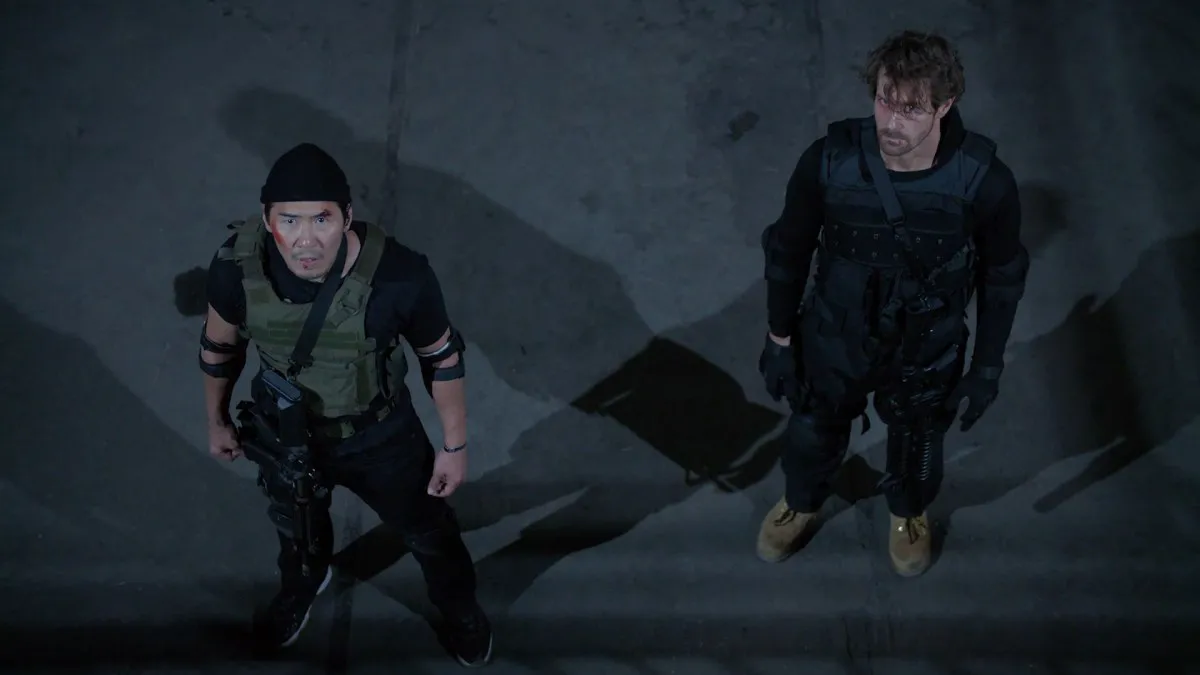

James Cullen Bressack’s The Workout arrives as a low-budget independent action thriller aligned with classic revenge tradition. The film lays out its premise with speed. Former Army Ranger Wyatt, played by Peter Jae, records a fitness routine with his pregnant wife, Becca. Mob associates invade the gym.
The attack turns fatal. Becca dies, the baby survives through an emergency C-section, and Wyatt slips into a coma. The story pivots when he wakes. He partners with his brother-in-law, Levi, played by Josh Kelly, a fellow former Ranger, and pursues an extralegal mission against those responsible. A terminal brain condition presses on Wyatt’s time and mind, so the hunt for justice doubles as a race against erasure.
The Scrutiny of Surveillance Aesthetics
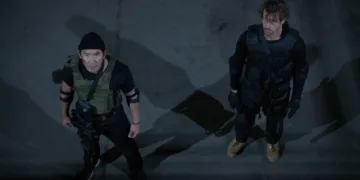
The film plants its flag on a persistent found-footage design. Image streams arrive from phones, security feeds, and body-worn micro-cams sourced through a shadowy tech contact. The approach trades the clean geometry of traditional action staging for raw immediacy. Fights break into jagged bursts of motion that feel intrusive and unstable, like evidence captured in the wrong moment.
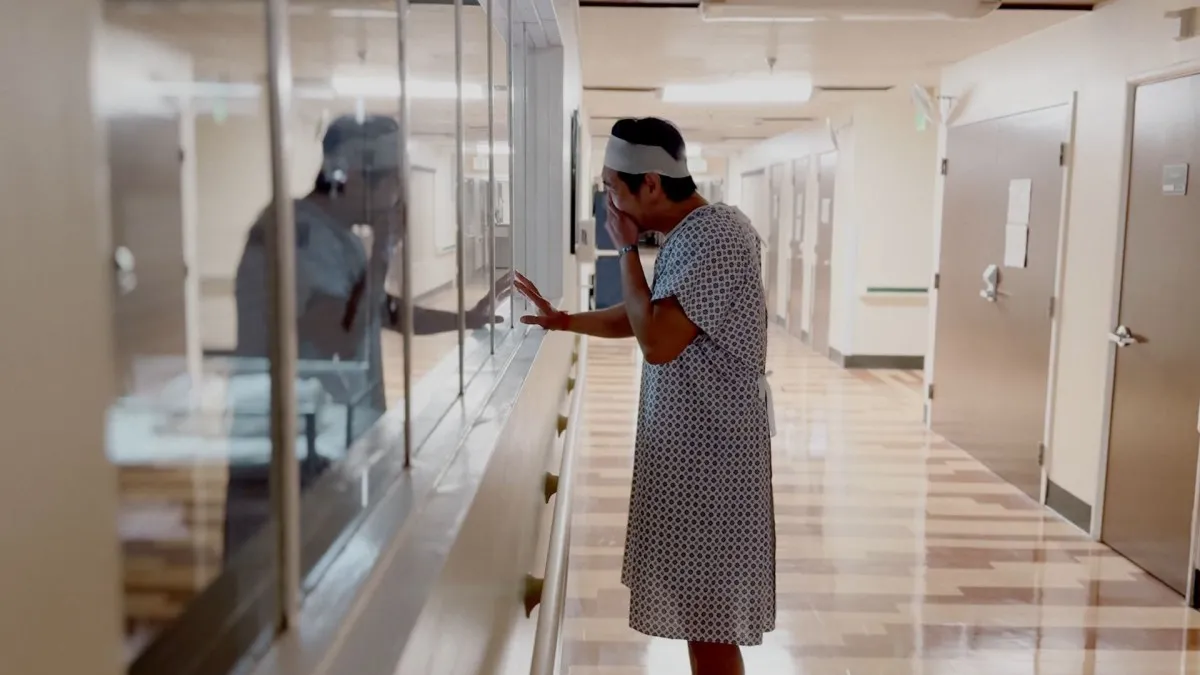
The commitment to point-of-view raises questions of narrative logic. Who is filming a given shot, and why, becomes a recurring puzzle. A POV appears when a character shows no visible camera. A body-cam angle appears during an MRI. The formal frame cracks in the finale, where the film shifts to conventional coverage.
The choice to record vigilantism as a “video diary” for Wyatt’s infant daughter adds a queasy layer of self-documentation and legacy construction. Rapid-fire cutting intensifies velocity yet muddles clarity, and several action exchanges lose the measure of the performers’ physical work.
The Weight of Grief and the Archetypal Ensemble
Peter Jae anchors Wyatt with restraint and resolve. Grief sits under the eyes; purpose carries the stance. His direct-to-lens monologues form the emotional spine, tracing a man trying to hold onto memory while shaping a last, punishing form of justice. Josh Kelly’s Levi operates as the stable partner, a capable presence defined by unwavering loyalty. Their conversations do the job and sometimes repeat beats, yet the bond registers.
Character depth yields to propulsion. Jae pushes to enrich the role, while much of the ensemble stays thin on the page. Ashlee Evans-Smith, as Tank in the final act, adds welcome physical credibility. Antagonists arrive as stock Mafia figures. They function as mechanisms in the revenge machine, targets to keep the plot in motion. They present danger rather than fully rendered noir shades.
Direction, Momentum, and Scale
Bressack approaches the material with conviction. The result carries a rough texture common to productions outside the studio system. Forward motion serves as the key structural strength. A brief runtime keeps the track tight and the familiar beats moving, leaving little room for drift.
Technical choices reveal the limits of scale. The film often looks cheap. Visual effects struggle, and practical blood work lacks impact. The script, co-written with David Josh Lawrence, undercuts tension with flat dialogue. The Workout positions itself squarely inside the revenge-thriller template. The format choice reads as a bold swing, yet the overall design stays close to established genre architecture.
Across these sections, the film’s visual grammar points back to noir lineage even as it adopts surveillance textures. The fixed lenses of security views and the jitter of body cams create a world of observation, not contemplation. Moral certainty remains elusive. Recording one’s own retribution for a future child suggests a rough philosophy of legacy built on images and injury. Wyatt’s failing memory turns identity into a leaking vessel, and the project of justice becomes a way to stamp an imprint before the light goes dim.
Tension arises from pace more than from elaborate set pieces. The edit pushes momentum, the structure resists detours, and the audience feels the time pressure that defines Wyatt’s choices. The style manipulates perception through angle and proximity, less through clean composition than through the feeling of surveillance catching the wrong frame at the right second. A dry aside writes itself here. If every camera is a witness, the film keeps inviting the question of who that witness serves. The law. The avenger. The future viewer.
The Workout speaks in the grammar of revenge, borrows the vocabulary of found footage, and keeps its focus on motion. The neo-noir shadows remain mostly conceptual, more a label than a fully articulated visual system. What endures is the push forward, the clock ticking, and a protagonist trying to fix meaning before memory slides away.
The found-footage action thriller, The Workout, premiered in limited theatrical release in the U.S. in August 2025. It details the violent mission of former Army Ranger Wyatt Park, who—after a mob hit kills his pregnant wife—teams up with his brother-in-law to seek vengeance, documenting his final months due to a terminal brain injury. The film was distributed by Anchor Bay Entertainment for its limited theatrical run, with VOD and Blu-ray releases handled by Insurgence following in October 2025.
Credits
Title: The Workout
Distributor: Anchor Bay Entertainment (Limited Theatrical), Insurgence (VOD/Blu-ray)
Release date: August 27, 2025 (US Limited Theatrical)
Director: James Cullen Bressack
Writers: James Cullen Bressack, David Josh Lawrence
Producers and Executive Producers: James Cullen Bressack, Jarrett Furst, Ben Stobber, David Josh Lawrence (Producers); Valentina Cau, Mario Niccolo Messina, BJ Hendricks, Gregori J. Martin, James Rundquist (Executive Producers/Co-Executive Producers)
Cast: Peter Jae, Galadriel Stineman, Josh Kelly, Ashlee Evans-Smith, Kristos Andrews, Augie Duke, David Josh Lawrence, BJ Hendricks
The Review
The Workout
The film is an ambitious, if structurally uneven, attempt to revitalize the familiar revenge thriller through a relentless POV lens. Peter Jae anchors the narrative with a committed performance, exploring the philosophy of filmed retribution with raw focus. However, the production's budgetary limitations and the inconsistent application of the found-footage gimmick ultimately compromise the visual storytelling. While the film maintains strong forward momentum, it struggles to transcend its generic framework, delivering intensity without securing lasting cinematic resonance.
PROS
- Peter Jae delivers a committed, emotionally grounded central performance.
- The found-footage aesthetic provides moments of raw, visceral action immediacy.
- A lean runtime ensures the plot maintains strong, engaging forward momentum.
- The addition of Ashlee Evans-Smith as Tank adds significant physical credibility to the final act.
CONS
- Inconsistent and often illogical application of the found-footage gimmick (e.g., unexplained POVs).
- Rapid-fire editing mandated by the style frequently obscures the action choreography.
- Production values are visibly cheap, particularly concerning practical blood effects.
- The script contains subpar dialogue and relies heavily on generic mob stereotypes for antagonists.