























![Kingdom Hearts Collection [I-III] Review](https://gazettely.com/wp-content/uploads/2026/10/Kingdom-Hearts-Collection-I-III-1-360x180.webp "Kingdom Hearts Collection [I-III] Review: KHII Holds Steady as Newer Entries Fluctuate 40")
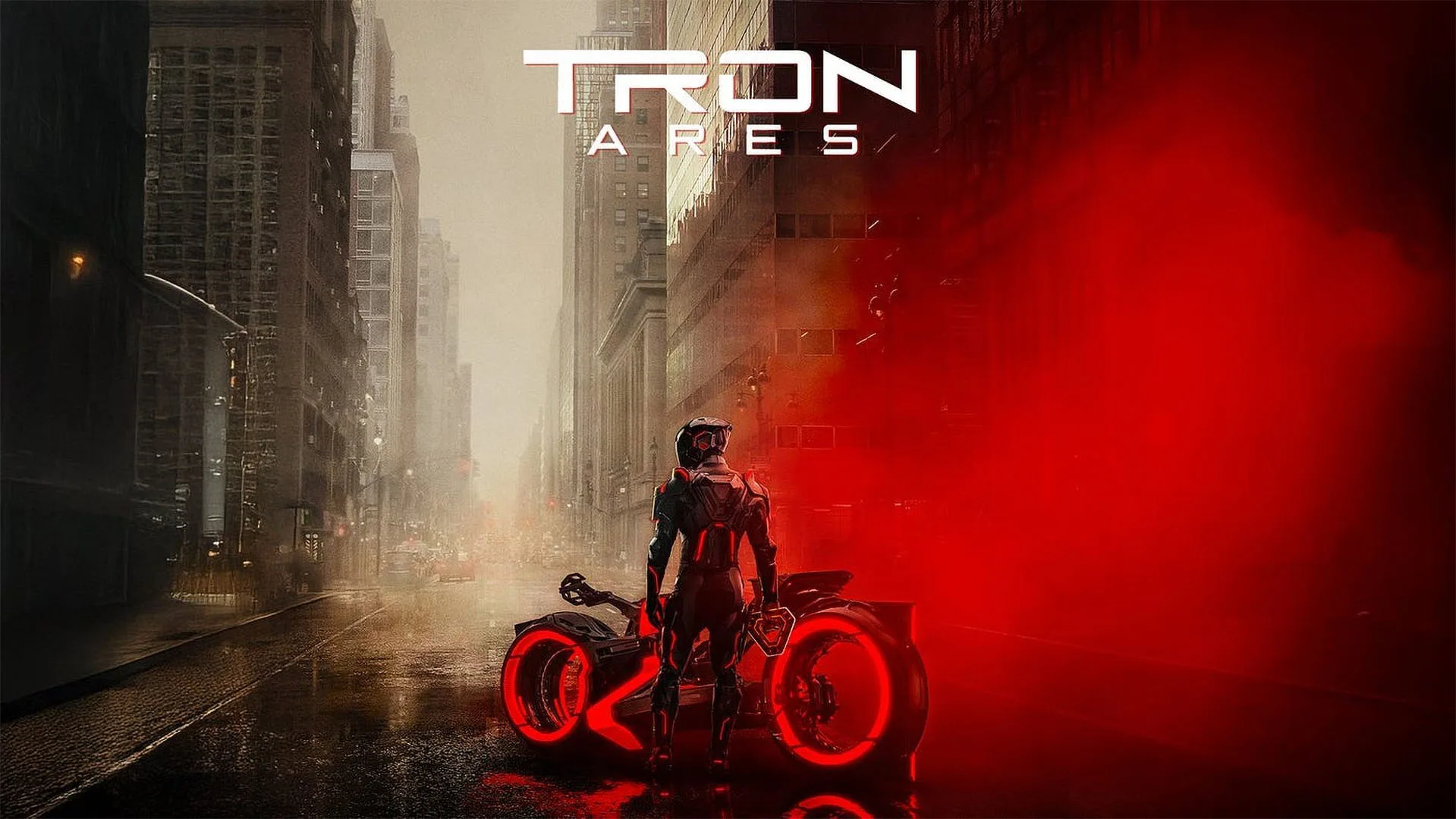

The Tron franchise has, for decades, operated on a simple premise of ontological tourism: a human user gets pulled through the screen into a digital frontier. Tron: Ares executes a fundamental inversion of this concept. The ghost now exits the machine. Instead of us visiting its world, its denizens are now spilling into ours, rendered into physical matter through a process of high-tech alchemy.
This digital diaspora is centered on the pursuit of a “Permanence Code,” a kind of digital philosopher’s stone that allows programs to exist in our reality for more than a fleeting 29 minutes. The code becomes the prize in a war between two tech ideologies. One is the techno-utopianism of ENCOM CEO Eve Kim, who dreams of 3D-printing orange groves.
The other is the techno-fascism of Dillinger Systems’ Julian Dillinger, who dreams of 3D-printing indestructible soldiers. At the center of this dispute stands Ares, a sentient security program given flesh, a warrior caught between the directives of his creator and the strange, un-coded sensations of a newly acquired physical existence.
Premise and Moral Compass
Tron: Ares shifts the franchise’s mystery outward by allowing digital creations to appear within the ordinary world. Joachim Rønning stages a premise that reads simple on paper and complicated in practice: ENCOM engineer Eve Kim (Greta Lee) carries a fragment of code that can render virtual constructs permanent in meatspace (call it techno-animacy), while Julian Dillinger (Evan Peters) wants to convert that capacity into marketable force.
Jared Leto’s Ares arrives as a designed protector with a limited operational window; his tactile discoveries — a raindrop, a melody, a small mercy — become the film’s moral axis. The movie trades some of the series’ pure neon abstraction for denser city textures and an aggressive low end in the score. It delivers striking images and a steady appetite for spectacle.
It also asks a simple social question with complex implications: who should hold tools that can turn thought into hardware, and what happens when institutions answer that question with profit or power?
How It Looks and Sounds
The film composes in light. Neon primaries cut against deep black to form a readable visual grammar: ribbons of light become directional punctuation, Recognizer silhouettes read as nouns, and light-cycle linework acts like a verb. Materialization is treated as an event with weight — sparks, particulate residue, an audible failure when imported matter degrades — which helps sell the conceit that code can acquire mass.

Jeff Cronenweth frames chases with compressed cityscapes and gives sensory beats their own tight, patient closeups. Wide lenses allow race choreography to remain legible; macro work renders Ares’ sensory moments intimate in a way that yields emotional currency. Sometimes the camera prioritizes momentum over strict spatial clarity, and a few set pieces ask the eye to assemble cause and effect. That is a conscious stylistic choice; it will delight some and mildly frustrate others.
Production favors practical sets to give objects and actors purchase. Where CGI takes over a few moments read flatter, but the practical-CGI seam is generally handled with care. The film’s 29-minute de-resolution rule plays as a tangible phenomenon: flaking edges, brittle polymers, remnants that behave like corrupted memory. If you opt for stereoscopic projection depth enhances freeway sequences (and yes, the film lets Ares appreciate an 80s synth hook) and makes the light ribbons feel dangerously close.
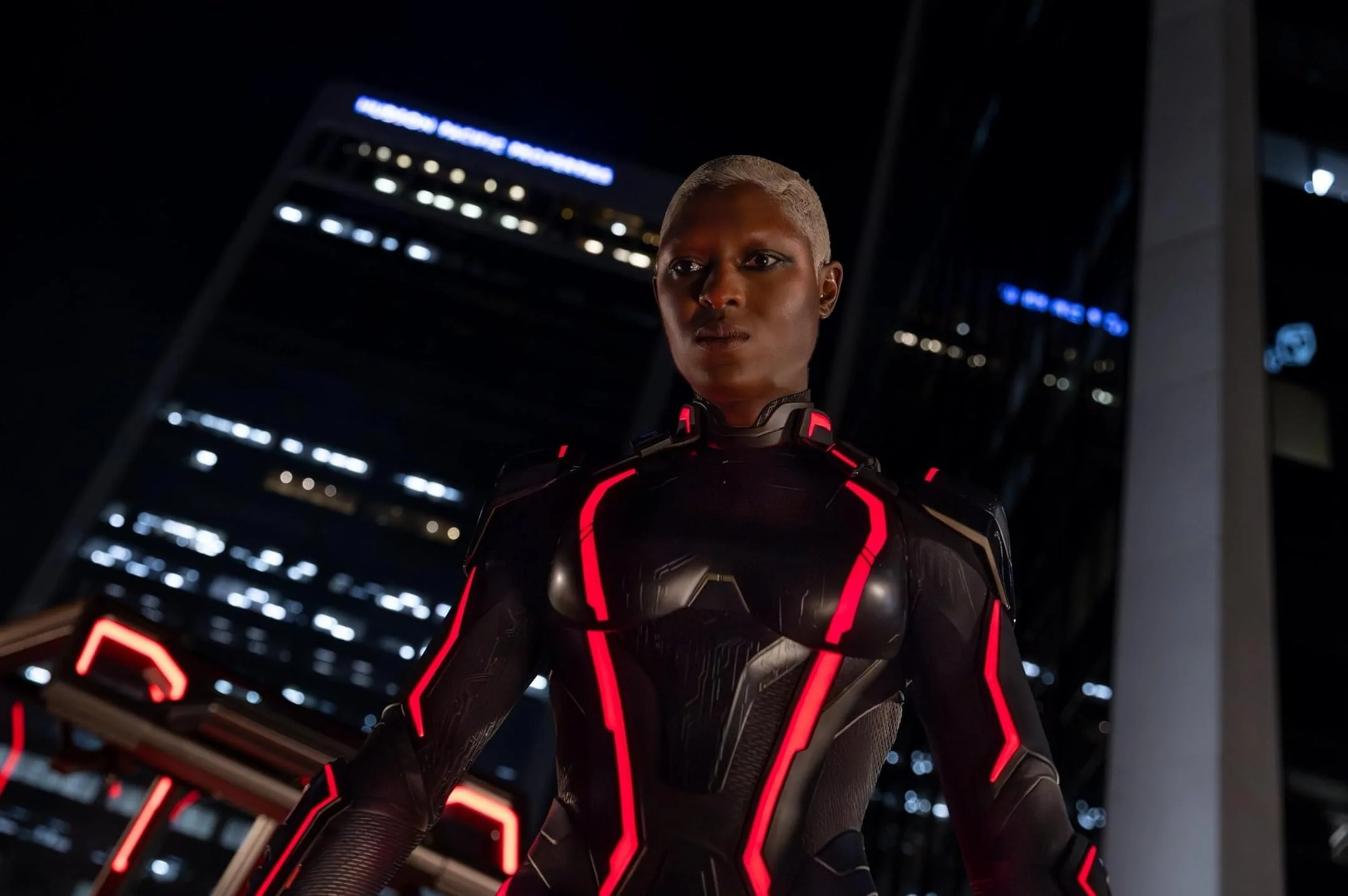
Costume and texture function as shorthand for corporate identity. ENCOM’s blue-white signaling suggests stewardship; Dillinger’s palette feels sharp and predatory. Suit surfaces catch rim light in ways that translate allegiance without exposition. Sound drives physical experience. The score’s low end converts streets into bodily sensation. That choice empowers action but can swallow quieter dialogue. Diegetic sounds (rain on skin, the whisper of a particle laser) act as humanizing counters to industrial force.
Standout sensory beats to remember while writing: Ares’ first full materialization, filmed like a creature arriving into weather; and a light-cycle chase in wet asphalt and neon that insists on concrete danger.
Rules, Ruptures and the Ideas at Play
Narrative architecture is straightforward: permanence code, a raid, Ares’ divergence, a contest over control. The three acts hit recognizable beats and the 29-minute lifespan for materialized constructs functions as both metronome and metaphor about limits. The rule mostly holds and supplies tension. Occasionally the screenplay asks the audience to accept a shortcut for the sake of spectacle. Your appetite for that bargain will shape how much you enjoy the movie.

Pacing alternates between immediate, fast set pieces and quieter interludes that try to render interior change. The film leans on visual inference rather than expository lectures: montage, match cuts, and recurring motifs carry much of the worldbuilding. When the movie trusts the viewer to read images it often rewards attention. When it reverts to on-the-nose dialogue, the tone flattens.
Ares’ arc is the ethical heart. His curiosity is elemental, not rhetorical. Small sensory registers become moral stepping stones; a raindrop functions as evidence that interior life can accrete from tiny inputs. The screenplay frames his growth on archetypal bones that recall Frankenstein and Pinocchio, and those bones supply familiar shape without feeling derivative.
Corporate appetite supplies the antagonist. Julian embodies commodification and a militarized imagination; Eve imagines social uses, from restoring crops to housing. The permanence code becomes a device to ask who should possess tools that remake reality. The question will feel timely to viewers attuned to debates about rapid prototyping, generative systems, and the asymmetry of control.
Nostalgia operates unevenly. Callbacks read as ritual in some scenes and as branding in others. The film mostly uses franchise iconography to supplement argument rather than to replace it. A few secondary arcs receive provisional closure rather than full reckoning; some moral ambiguities are left open, which invites thought but can feel like delayed accounting.
A revealing scene to unpack: Ares refuses an order and the camera lingers on a micro-gesture — a fingertip under rain, a pause — while the soundtrack recedes. Interior life is shown as accumulation rather than announced.
People and Programs
Ares is constructed through economy. Jared Leto favors micro-timing and calibrated physicality. He tilts his head, pauses, reads a sensation, and those small choices sell an arc from instrument to agent. When the script gives him big, declamatory lines the delivery can seem compressed; that tension between tactile learning and rhetorical flourish is a persistent curiosity.
Greta Lee roots Eve in compact moral gravity. She carries grief without spectacle and makes decisions that feel credible even when the script simplifies motive. Her rapport with Ares forms through low-key exchanges: demonstration, a shared look, a discrete act of trust. Those moments are the film’s emotional currency.
Jodie Turner-Smith’s Athena is disciplined and kinetic. She is most interesting when allowed to act without explanatory dialogue. Evan Peters plays Julian with entitled charm and corporate slickness; the role calls for a specific sociopathic energy and he supplies it. Gillian Anderson’s brief interventions offer institutional caution and reframe scale.
Supporting players such as Hasan Minhaj and Arturo Castro add tonal ballast and remind the audience that real people must live with these technological consequences. The emotional geometry orbits a triangle: instrument, idealist, enforcer. When private beats interrupt spectacle the film deepens. Those beats are unevenly placed, but the actors often do more with less.
Performance beats worth citing: the weather reaction that registers in a single closeup, Eve’s quiet invocation of memory, and Athena’s single-minded pursuit whose human cost lingers in small faces.
How the Film Is Put Together
Rønning favors kinetic clarity. He stages sequences with geometric intent and an appetite for momentum. That gives the film an athletic pulse. The trade-off is that reflective beats sometimes feel abbreviated to preserve momentum.
Editing constructs rhythm with alternations of pulse and release. Montage and match cuts convert computational logic into cinematic pattern. Some transitions between the Grid and reality are elegantly done; a few feel abrupt, as if connective tissue were trimmed for tempo.
Photography treats light as material. Rim light sculpts faces and suits in a way that reads like moral coding. Camera choices sell texture and emphasize space as a character. Practical production design pays dividends: tangible sets give performers purchase and help CGI elements sit within environment.
Sound mixing is muscular. Low frequencies make action bodily. That visceral approach heightens impact and occasionally obscures speech. Script choices favor emblem and image over dense explanation. The payoff is cinematic inference; the cost is a few clarity gaps.
Who Should See It and Why
This film will repay viewers who prize sensory architecture, physicalized ideas, and a meditation on agency rendered in image. If design, sound and the problem of who controls new tools are your interests, you will find material to chew on. If you need tidy plotting and exhaustive moral accounting you may leave wanting.
See it on a large screen with a strong sound system (or a very loud living room) so the materiality of light and bass can register. The movie performs best when it trusts image to make the argument and when it lets small human gestures supply ethical weight.
Tron: Ares is the third installment in the science fiction action film series, serving as a standalone sequel to 2010’s Tron: Legacy. The movie centers on a highly sophisticated program named Ares, who transitions from the digital world of The Grid into the real world, forcing humanity to face its first true encounter with advanced A.I. beings. The film is directed by Joachim Rønning and features an original score by Nine Inch Nails. Distributed by Walt Disney Studios Motion Pictures, Tron: Ares is scheduled for theatrical release on October 10, 2025.
Full Credits
Director: Joachim Rønning
Writers: Jesse Wigutow, David DiGilio, Jack Thorne
Producers and Executive Producers: Sean Bailey, Jared Leto, Emma Ludbrook, Jeffrey Silver, Steven Lisberger, Justin Springer, Russell Allen
Cast: Jared Leto, Greta Lee, Evan Peters, Jodie Turner-Smith, Hasan Minhaj, Arturo Castro, Gillian Anderson, Jeff Bridges, Cameron Monaghan, Sarah Desjardins
Director of Photography (Cinematographer): Jeff Cronenweth
Editors: Tyler Nelson
Composer: Trent Reznor, Atticus Ross, Nine Inch Nails
The Review
Tron: Ares
Tron: Ares is a sensory machine whose ethical sparks are intermittently shorted. It delivers striking design, tactile effects, a forceful score, and genuine moments of surprise, while its script and some character work wobble under spectacle. See it loud and large if you want to feel the film as much as think about it.
PROS
- Striking visual design and coherent visual grammar
- Practical sets and tactile VFX that sell weight
- Forceful, body-forward score and sound design
- Quiet, restrained turn from Jared Leto that trusts small gestures
- Greta Lee supplies emotional ballast and steady presence
CONS
- Uneven script and sporadic pacing
- Action sometimes noisy at the expense of spatial clarity
- Supporting characters underwritten at points
- Occasional plot conveniences that strain the film’s own rules