















Sheep crop the immaculate lawns of a grand country estate, a glossy tableau of Sorrentino-like luxury that signals the film’s satirical bite from the first frame. Two Neighbours arrives as a confident, prickly debut from director Ondine Viñao. The film retools Aesop’s Avaricious and Envious for the present, using that spare moral frame to examine wealth, ambition, and social resentment.
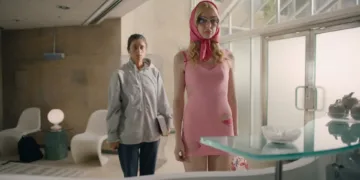
Its central clash pairs two young women from opposing worlds. Stacy (Chloe Cherry), a pampered socialite intent on launching her body-positive line “Stacy’s Undies,” commands the party with effortless entitlement. Becky (Anya Chalotra), a struggling writer marked by insecurity, enters this elite circle as an outsider who must keep her footing.
Their rivalry unfolds across an extravagant party hosted by Stacy’s father, Mr. Peterson (William Hope), where status games pass for conversation and desire feeds the room. The event acquires a supernatural hinge with the arrival of The Genie (Ralph Ineson), whose intervention concentrates the story’s view of heedless want and its violent aftershocks.
The Rot Beneath the Veneer
Two Neighbours studies envy and greed as contemporary afflictions shaped by internet chatter, misogyny, and meme logic. The film targets unexamined privilege and hungry aspiration, aligning itself with recent “Eat the Rich” entries.
The Peterson clan and their coterie appear as stock figures of inherited capital: the domineering father, a wife dulled by pills, a vain daughter drawn as a cartoon, and the odious failson Sebastian (Jake Simmance). This household models entitlement in its most abrasive register.
The party functions as a pressure chamber for hierarchy, a room of wolves and sheep where the roles are understood before anyone speaks. Becky finds herself edged out of sight line after sight line, present yet peripheral. The portrait of this milieu favors bright, cutting exaggeration over fine psychological shading, a high-definition caricature that exposes the hollowness behind the lacquered surfaces.
Aesthetic Command and Structural Dissonance
Ondine Viñao’s control of craft gives the feature a gleaming finish. Production design draws clean borders around the characters’ worlds. Stacy inhabits a mansion rendered as a cavernous pink and purple showpiece, a space that calls to mind a John Singer Sargent painting.
Becky’s life sits in a dingy, roach-ridden flat under Brooklyn Bridge. The camera roves through the estate to register scale, and lighting tucks intrigue into shadowed corners where secret exchanges can occur. The images reach a fevered clarity in the final wish sequence.
The film unfolds across six titled chapters, including Second Place and Entirely Predictable But Still Heartbreaking. This segmented approach meets a pacing problem that leaves stretches of slack, a feeling that the piece began as something shorter.
Flashpoints of inspired chaos cut through the drag, with a club sequence that jolts the rhythm and a precise musical sense that threads the rooms. The soundtrack ranges from the melancholy Where Have All The Flowers Gone to a sharp INXS needle-drop. Jim Williams underscores the spiral with a harpsichord-led score that grants a baroque edge to the rising frenzy.
Disparate Styles and Undeveloped Rivalry
Performance styles pull in different directions. Chloe Cherry leans into cartoon precision, shaping Stacy as a pouty, petulant study in surface. Anya Chalotra tempers Becky with a quiet register that reads as lived-in, a watcher who crosses the party with wry amusement and low-burn disdain. The gap between these modes, amplified by the Peterson grotesques around them, creates jarring tonal shifts that also underline class distance.
The ensemble around them lands with authority. Ralph Ineson anchors The Genie with a gravelly threat tailored to the figure, an energy that stamps his scenes even with limited screen time. Taz Skylar, as Chadwick, supplies slick charm that holds firm without parody. Joseph Millson, as Mark, Becky’s father, proves persuasive in the sharp turn from warmth to obsequious eagerness in the company of millionaires.
The core conflict between Stacy and Becky, however, rarely gathers the density it seeks. They read as emblematic figures of privilege and precarity who harbor a mutual dislike, rather than as rivals whose history pushes them toward an inevitable collision. The magical endpoint lands with less force than the film prepares for, a finale that feels partially unearned given how thinly their antagonism develops across the night.
Two Neighbors is a 2025 dark comedy and satire directed by Ondine Viñao. The film had its world premiere in competition at the Edinburgh International Film Festival (EIFF) in 2025. Following its festival circuit run, the film is expected to secure a broader distribution, likely through a theatrical release or acquisition by a major streaming platform, but details on where to watch it currently depend on its eventual release deal.
Credits
Director: Ondine Viñao
Writers: Ondine Viñao, Jordan Johnson
Producers and Executive Producers: Ivy Freeman-Attwood, Sean Croft, Kian Benjamin, Brendan Brulon, Briar McQuilkin, Jordan Johnson
Cast: Anya Chalotra, Chloe Cherry, Ralph Ineson, Taz Skylar, William Hope, Jake Simmance, Zoe Telford, Joseph Millson
Director of Photography (Cinematographer): David Wright
Editors: Sam Sneade
Composer: Jim Williams
The Review
Two Neighbours
Ondine Viñao's debut is a visually stunning, aggressive satire that successfully modernizes an ancient fable. Its technical execution is remarkable, featuring bold production design and sharp visual flourishes. The film's energy, however, often suffers from inconsistent pacing and structural drag, making the viewing experience uneven. While the performances are vivid, the core rivalry between Stacy and Becky lacks the sustained emotional depth needed to fully justify the final dramatic conclusion. It delivers striking cultural critique and confident direction, making it an ambitious work despite its flaws.
PROS
- Highly polished visuals and confident direction from Viñao.
- Sharp aesthetic contrast in production design (mansion vs. flat).
- Effective critique of privilege, ambition, and online resentment.
- Excellent, memorable turns from Ralph Ineson and Joseph Millson.
CONS
- The film occasionally drags and feels structurally long.
- The central rivalry between the leads lacks necessary depth.
- Performance styles of the lead actors and supporting cast do not always mesh.
- Focus on certain story threads is occasionally lost.