




























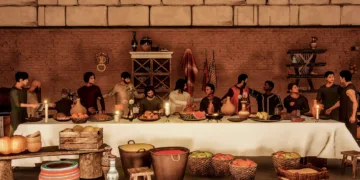


Glowmade’s King of Meat arrives at a peculiar crossroads in gaming’s ongoing negotiation with live service models, user-generated content, and the commodification of play itself. Developed by former LittleBigPlanet veterans and published by Amazon Games Studios, this co-op action platformer transforms the fantasy kingdom of Loregok into a televised bloodsport where up to four players compete in dungeons filled with traps, enemies, and platforming challenges.
The game’s satirical game-show framing, blending medieval aesthetics with contemporary corporate culture, reads as both self-aware commentary and unintentional prophecy of its own precarious market position. Priced at €29.99 and structured around a dungeon creation system where players build and share levels, King of Meat positions itself somewhere between Super Mario Maker’s collaborative creativity and Fall Guys’ chaotic multiplayer mayhem.
The tone skews deliberately absurd, with animated cutscenes and persistent commentary threading through the experience. Available across PC and consoles with crossplay support, the game represents Amazon’s latest attempt to establish legitimacy in a live service landscape it has repeatedly struggled to penetrate.
Combat as Performance: The Mechanics of Attention
The combat system in King of Meat operates as a deliberate performance for an invisible audience, mechanizing the relationship between spectacle and survival in ways that mirror reality television’s manipulation of human behavior.
Each weapon carries its own skill tree unlocked through challenge completion, ranging from traditional medieval swords to deliberately anachronistic choices: electric guitars that electrocute enemies, magic knuckle dusters, and literal firearms existing inexplicably within a fantasy setting. This tonal dissonance between genre conventions and absurdist inclusions reflects a broader cultural shift where coherence matters less than novelty, where the juxtaposition itself becomes the point.
Players equip primary and secondary weapons, creating combinations that feel strategic despite the game’s accessible surface. The combo system functions as the core feedback loop, rewarding chained attacks by filling an audience excitement meter. Execute elaborate streaks and virtual crowds erupt, your score multiplies, and the game validates your performance. This system exposes the transactional nature of modern multiplayer design: you perform, the game applauds, dopamine flows. The mechanics are transparent about their manipulations, which grants them a strange honesty.
Glory Moves serve as ultimate abilities charging through combat, offering effects from team-wide healing to a belch attack launching enemies and teammates off platforms. Another example summons a horse leg from nowhere to stomp foes. These absurdist touches attempt to distinguish King of Meat from genre peers, though they function mechanically similar to special attacks in countless other titles. The novelty is purely aesthetic.
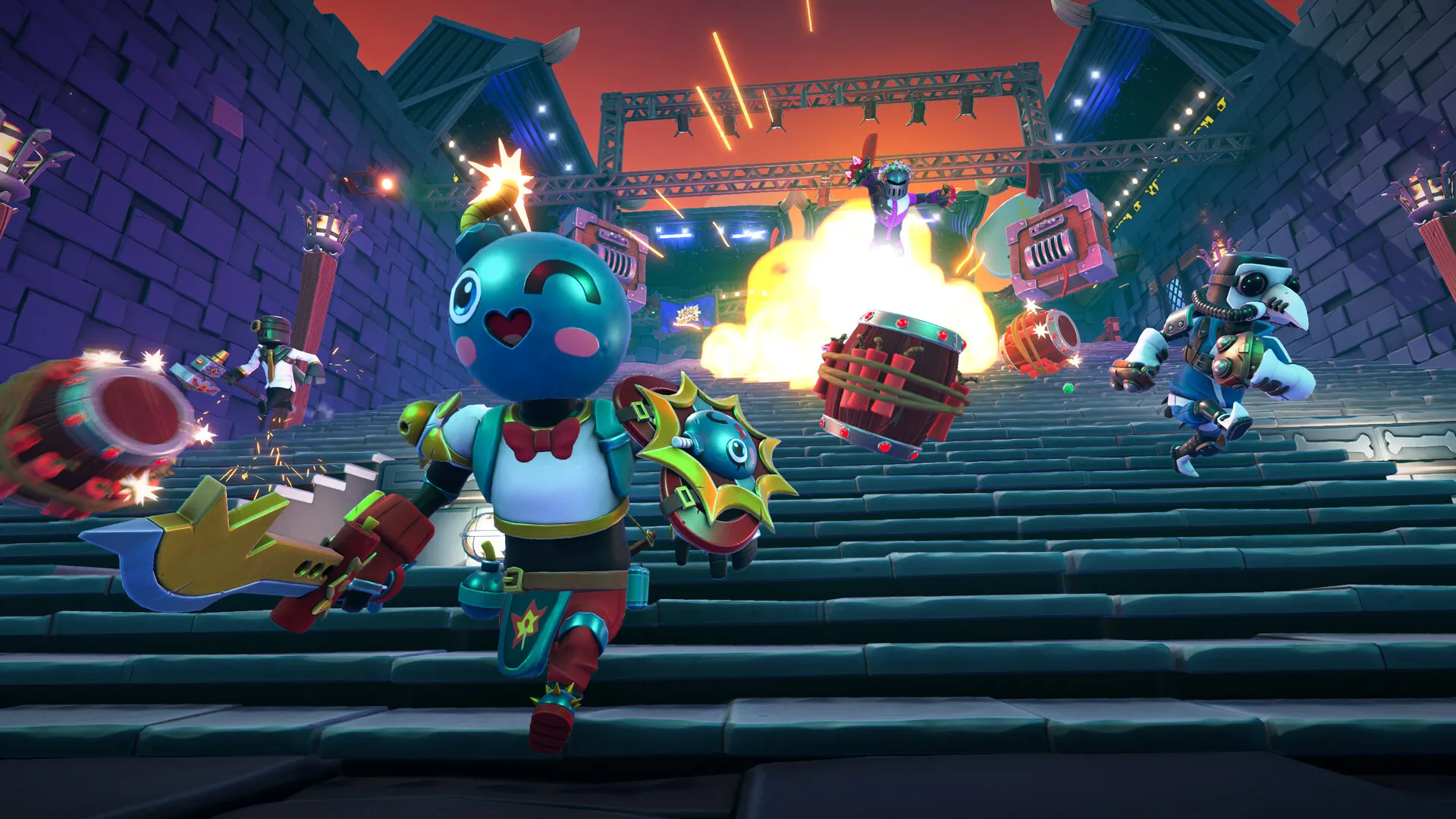
The gameplay loop centers on Komstruct Koliseums where players navigate obstacles while fighting. Stages hide treasures, chests, and platforms requiring multiple players to access. The respawn system christened “Meat Phoenix” stations literally reconstitutes players from canned meat, transforming death into another opportunity for visual comedy.
Limited respawns per map create stakes, though rarely enough to generate genuine tension. Multipliers reward speed and efficiency while punishing thorough exploration, creating friction between the game’s treasure-hunting objectives and its time-sensitive scoring. Puzzles integrated into levels range from sequential switch-hitting to shooting specific targets, offering variety that feels adequate rather than inspired.
The combat walks a careful line between accessibility for casual players and depth for those seeking mastery. This represents sound design philosophy for a game courting broad audiences, though it also means the system lacks the complexity to sustain extended engagement for mechanically-focused players.
The Platform Problem: When Movement Betrays Design
The platforming mechanics expose King of Meat’s most glaring contradiction: a game aesthetically and tonally built for frenetic chaos hamstrung by movement that feels sluggish and imprecise. Character speed registers as notably slow, as though wading through resistance rather than sprinting through challenges.
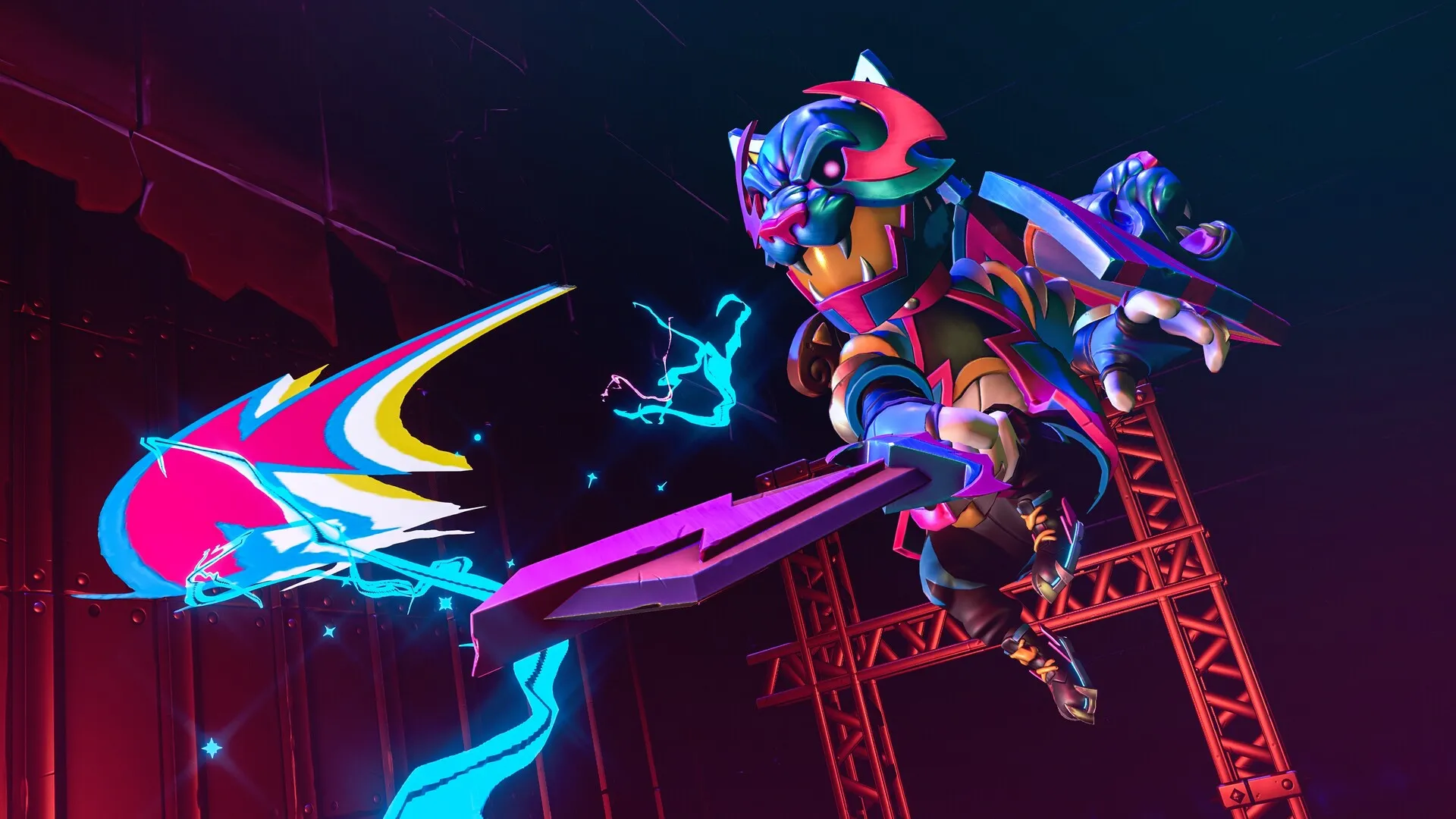
Jumping carries a floaty, indeterminate quality that transforms spike pits and moving platforms from skill checks into frustrating gambles. The physics system itself works as intended, with exaggerated reactions where spinning blades and pendulum hammers launch players dramatically based on impact speed. These moments can generate comedy, though they more often produce irritation when precision matters.
Online latency compounds these issues, adding inconsistencies to jump timing and directional input detection. Playing a platformer where you question whether failure resulted from your mistake or connection instability fundamentally undermines trust in the mechanical contract between player and game. This becomes especially problematic given the game’s online-only structure and absence of local multiplayer.
The progression system divides content across three leagues: League Tryouts functioning as disguised tutorials with basic frameworks and simple puzzles, Global League housing the main content with complex coordination challenges, and Imperial League offering extreme difficulty for mastery-seekers. Tryouts can feel perfunctory, their pedagogical purpose transparent to the point of tedium.
The Global League represents where the game finds its identity, presenting puzzles requiring genuine coordination between players. The stage selection interface displays popularity ratings and community-voted descriptors like “Challenging” or “Deadly,” though these subjective labels can mislead as often as they inform.
Stage hazards borrow liberally from gaming’s established vocabulary: pendulum hammers recall Dark Souls’ Sen’s Fortress, spinning blades evoke countless action platformers, thin platforms and rotating obstacles feel archetypal rather than innovative. The game assembles these elements competently without transcending their familiarity.
The difficulty balance presents King of Meat’s most destabilizing quality. Some levels permit completion without a single death, others present punishing gauntlets where all lives vanish within seconds. This inconsistency stems from the mixing of developer-created content with community submissions, creating wild quality variance. Some player-designed levels demonstrate thoughtful construction, others exist seemingly to inflict maximum frustration.
A voting system attempts to filter experiences, though it proves insufficient against the volume and variability of user-generated content. Certain puzzles and platforms demand multiple players, rendering solo play less challenging and more outright punitive. This design choice betrays the game’s core philosophy: King of Meat demands sociality, and without it, exposes its mechanical limitations.
The LEGO Kit Paradox: Assembly Required
The dungeon builder represents King of Meat’s most substantial offering and its most revealing contradiction. The system provides robust tools comparable to Super Mario Maker or Fortnite’s creative modes, utilizing pre-designed rooms rather than ground-up construction. Players access extensive decorative objects, enemy varieties, special effects, and logic systems capable of producing complex puzzle mechanics. The ability to test dungeons from any point instantly proves invaluable, eliminating the tedious iteration cycles plaguing earlier creation-focused titles.
Uploading and sharing creations functions smoothly, establishing the infrastructure for community engagement. This positions the dungeon builder as the game’s beating heart and primary long-term appeal. The interface achieves accessibility while maintaining impressive depth, a balance easier described than executed. Yet this strength illuminates the game’s fundamental vulnerability: King of Meat functions as a toolkit awaiting activation by its community. Without that community, the tools sit dormant.
Character customization provides extensive control over armor pieces, accessories, and decals. Players can attach stickers and decorations to cosmetic items, creating hybrid aesthetics mixing medieval and modern elements. Traffic cones paired with knight helmets, sweatpants beneath armor plating. These combinations should feel dissonant but achieve a cohesive absurdity within the game’s established visual language. Cosmetics avoid predatory pricing relative to in-game currency acquisition, suggesting restraint rare in contemporary live service monetization. The customization system invites experimentation that can consume hours, functioning as its own satisfying loop separate from core gameplay.
The solo content reveals where King of Meat’s multiplayer focus becomes liability. A story mode featuring developer-created dungeons with narrative segments exists, its parody humor ranging from mildly amusing to grating depending on tolerance for self-aware comedy. The solo experience feels hollow and repetitive, exposing limited enemy and puzzle variety once the novelty fades. Dungeons balanced for multiple players transform solo attempts into exercises in frustration rather than adjusted challenges. Technical issues including mid-match crashes compound these problems, though these may resolve post-launch.
The audiovisual presentation demonstrates production values exceeding typical mid-tier releases. Animated cutscenes achieve genuine quality, fully voiced with running commentary from The Commentator, voiced by Al Doyle with energetic commitment that avoids annoyance through tonal variety and timing. The soundtrack services the medieval game show concept without producing memorable compositions. The hub world, Ironclaw Plaza, populates itself with distinct NPCs using splash screen introductions reminiscent of Hades’ character presentations, establishing personality efficiently. The visual style successfully synthesizes absurd elements into coherent aesthetic identity. Sound effects deliver satisfying feedback, weapon impacts register appropriately, and audience reactions provide the intended dopamine triggers.
The accessibility features deserve acknowledgment: menu narration, text-to-speech chat, customizable subtitles, fully remappable controls, options for photosensitive users disabling screen flashes. This commitment to inclusive design exceeds expectations for a release at this budget level, suggesting values beyond pure commercial calculation.
The game’s long-term viability remains its most pressing question. Success depends entirely on attracting and maintaining a player base, standard for live service titles but especially critical for games centered on user-generated content. The decision to sell King of Meat as a paid product rather than free-to-play presents a significant barrier in a market where audiences expect this model. The game lacks the lightning-in-a-bottle quality that transformed Rocket League or Fall Guys into cultural phenomena. Low pre-launch awareness and industry traction suggest marketing failures or resource limitations. Similar titles like Meet Your Maker and Dreams struggled to maintain audiences despite quality, demonstrating that execution alone cannot guarantee success in oversaturated markets. The live service landscape functions as a winner-take-all economy where most entries fail regardless of merit.
Verdict: Quality Without Guarantees
King of Meat delivers substantial content for its price point. The combat proves more engaging than initial impressions suggest. Creation tools excel and customization offers depth. Playing well-designed levels with friends generates genuinely enjoyable experiences. Yet platforming issues and difficulty inconsistencies create friction that undermines these strengths. The solo experience lacks substance, feeling like placeholder content awaiting multiplayer activation.
For groups of friends seeking co-op games with creative elements, King of Meat warrants recommendation. Solo players or those expecting polished platforming should look elsewhere. The game’s survival depends on factors beyond its control: whether streamers adopt it, whether communities coalesce, whether Amazon commits to sustained support. These remain open questions. King of Meat represents a competent execution searching for an audience in a market that may have moved past its moment. The concern is less whether the game deserves success than whether success remains possible under these conditions.
The Review
King of Meat
King of Meat assembles quality components into a framework dependent on community participation it may never achieve. The combat surprises with unexpected depth, creation tools impress with their scope, and playing with friends delivers chaotic enjoyment. However, sluggish platforming undermines moment-to-moment engagement, difficulty swings wildly between trivial and punishing, and solo content feels skeletal. The paid model in a free-to-play dominated space likely dooms its prospects regardless of merit. Recommended cautiously for dedicated co-op groups willing to gamble on uncertain longevity.
PROS
- Surprisingly deep combat with varied weapon types and skill trees
- Excellent dungeon creation tools with intuitive interface
- Extensive character customization with fair cosmetic pricing
- Strong accessibility features
- High-quality animated cutscenes and voice acting
- Satisfying combo system with meaningful progression
CONS
- Painfully slow movement speed and floaty jumping mechanics
- Wildly inconsistent difficulty across levels
- Hollow solo experience clearly designed for multiplayer
- No local co-op despite party game design
- Paid pricing model limits potential audience growth
- Success entirely dependent on building active community