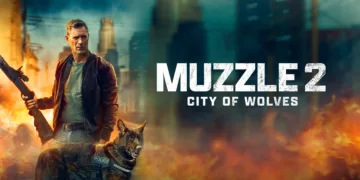











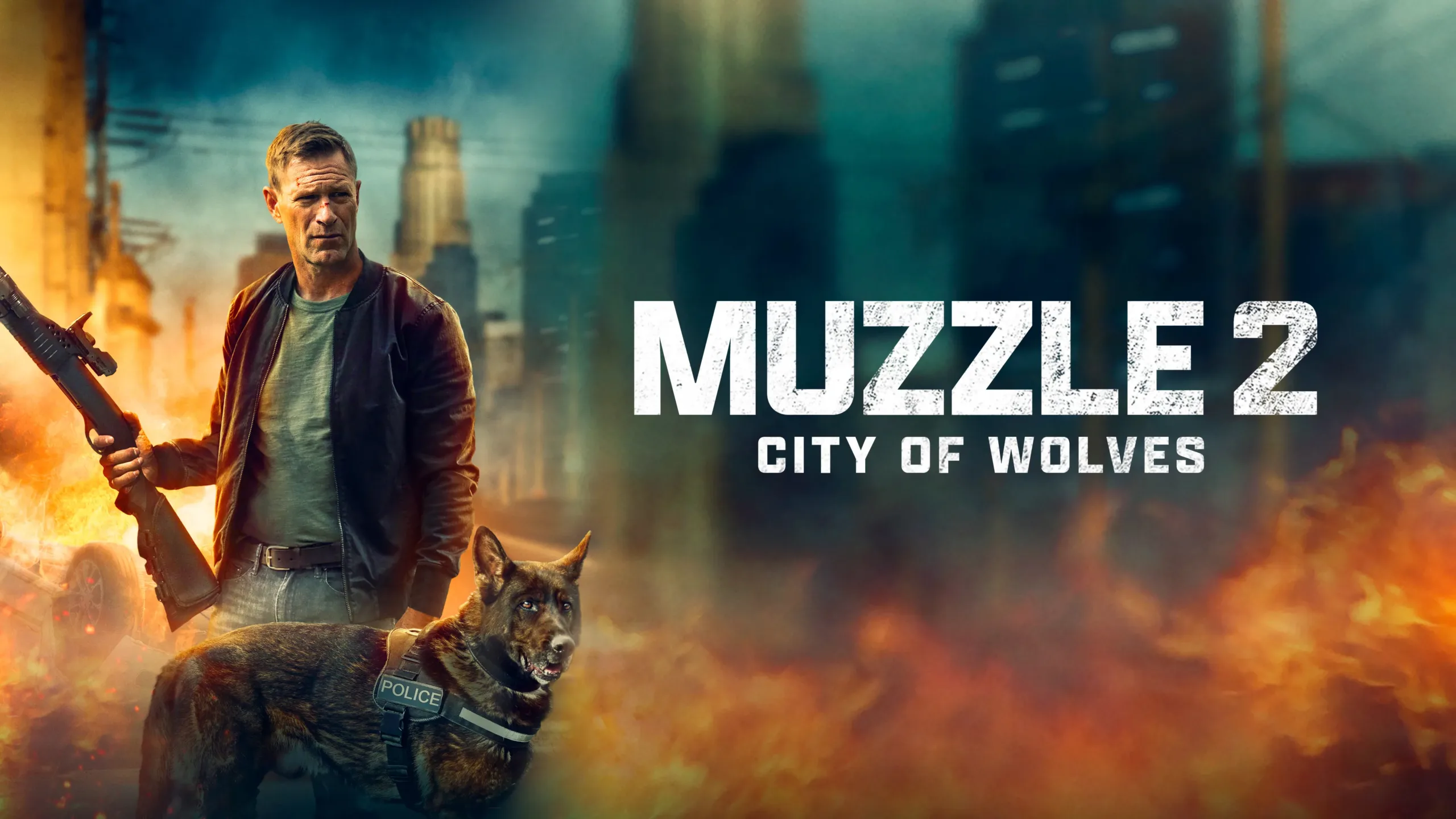

“Muzzle: City of Wolves,” directed by John Stalberg Jr. and led by Aaron Eckhart as Jake Rosser, presents a grim thriller built around the lingering cost of violence. Jake, a veteran and former K-9 officer, begins the film in retirement, trying to hold on to a fragile calm. He lives with his wife Mia (Tanya van Graan), their infant son, and his K-9 partner Socks, and the film initially frames this domestic space as a carefully assembled refuge.
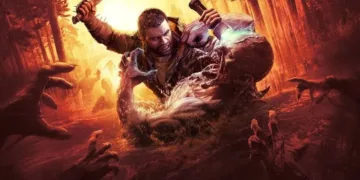
That refuge disappears almost immediately. A planned home invasion and explosion, arranged by the drug cartel Jake previously injured, tears through the house and destroys his attempt at normal life. The attack forces him to drop his civilian pose and return to the skills that defined his past. With a new K-9 partner, Argos, he is pulled back into a brutal struggle against a powerful cartel network and a ring of corrupt local officials. The film sets a relentless, somber mood and repeatedly underlines the emotional and physical damage created by this conflict.
Eckhart’s Wounded Antihero
Aaron Eckhart carries the film with a performance that hinges on both physical intensity and emotional detail. The action scenes rely on his presence, yet the version of Jake Rosser shaped by the film depends more on his quiet, wounded moments. The script approaches Jake’s Post-Traumatic Stress Disorder (PTSD) through a darker, more grounded lens that tries to move away from simple action-movie shorthand. Eckhart presents a man whose inner calm rarely holds, even in the scenes that aim for quiet.
Jake works as a hero marked by contradiction. He functions as an efficient killer and a deeply violent figure, and at the same time his strongest commitment is to his family and to the dogs he works with. The film positions him as an antihero, a man pulled between affection and brutality.
Mia (Tanya van Graan), by comparison, receives far less shaping. The film sketches her as a threatened wife, and short flashbacks to marital strain try to suggest deeper trauma, but she never gains the detail suggested for Jake. This thin support around him weakens the emotional force of the narrative.
The Architecture of Action and Aesthetic
The film presents itself as a serious action thriller that sometimes reaches for large-scale spectacle. It includes intense gunfights and carefully staged practical explosions, including an early set piece that violently breaks apart Jake’s domestic life. The structure, however, does not stay locked to constant action.
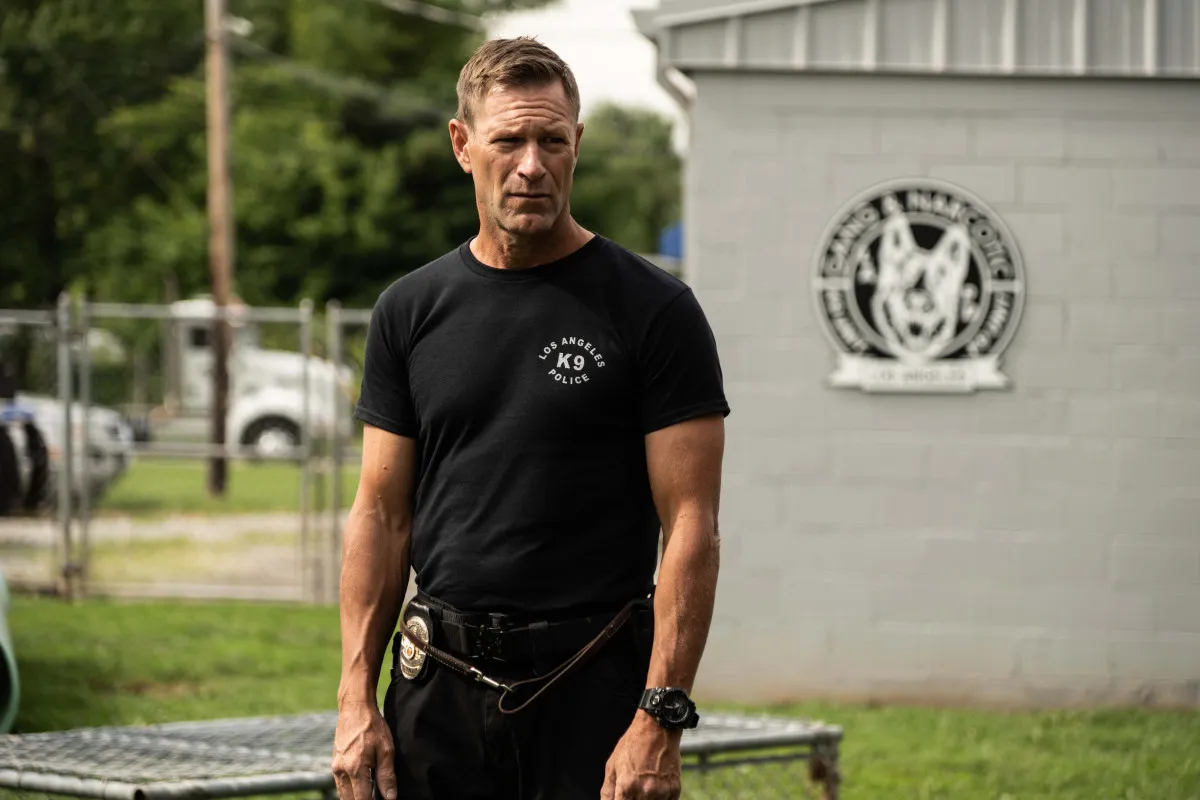
From a visual and rhythmic standpoint, the camerawork, editing, and staging of the action have been described as subpar, clumsy, and lacking inspiration. These choices work against the attempt to create a truly thrilling experience.
This limited energy in the technique leaves the film feeling muted. The stated 90-minute running time can seem longer because of the heavy tone and irregular pacing. In comparison with other contemporary K-9 action films that have shaped global trends, this one does not deliver the same propulsive, kinetic rush, and it can feel unsatisfying for viewers who hope for high-intensity spectacle.
Antagonists, Political Tensions, and Plot Gaps
The cartel leader who drives the revenge plot stands out as a major weakness in the story structure. He appears mainly as a distant voice on the phone, written as a cartoonish figure with unrealistic foresight who proves ineffective. His final scene arrives quickly and without impact, and the film loses the chance for a strong climax.
Corrupt Officer Beekman (Karl Thaning) has stronger dramatic potential. He comes across as relentless, and his reason for serving the cartel, the protection of his own family, gives his role a sense of tragedy. Yet the film rarely gives him the space to build on that possibility, and his plans usually collapse.
The story also adds a divisive political strand in which Jake is falsely labelled a white-supremacist terrorist. A later scene heightens this thread by giving a conspiracy theorist a long, unchallenged speech. This material has attracted criticism as a confusing addition that pushes the plot toward incoherence and can be read as a careless way of treating real-world extremism, which pulls focus away from the revenge narrative.
The Canine Partnership and Unrelenting Cruelty
Jake’s connection with his dogs functions as the emotional core of the film. The sudden, shocking death of his first partner Socks becomes the spark for his renewed quest for vengeance. His relationship with his new K-9 partner Argos is framed as special, with the dogs presented as a close pack that attack and protect in many of the action scenes.
The film commits to a harsh, unforgiving tone. It sets its story in a world saturated with cruelty, an idea reinforced by the philosophical opening line about human violence. The violence level is high, with cartel dogs used for terrible acts and equally disturbing brutality aimed at animals.
The script avoids softening these details. It includes forced suicide in the form of Russian roulette, sustained gun violence, and gruesome images of corpses arranged as shrine-like displays. This constant severity protects the serious tone and leaves the audience with a bleak view of the cycle of violence the film portrays.
Muzzle: City of Wolves is a 2025 American action thriller film that serves as a sequel to the 2023 movie Muzzle. The film premiered in a limited theatrical release in the United States on November 14, 2025, distributed by RLJE Films and IFC Films. Starring Aaron Eckhart as the haunted ex-K-9 officer Jake Rosser, the story follows him and his new K-9 partner Argos as they are drawn back into a violent world after a ruthless gang targets his family for revenge. The movie is rated R for strong/bloody violent content and language, and has a running time of approximately 90 minutes.
Credits
Title: Muzzle: City of Wolves
Distributor: RLJE Films, IFC Films
Release date: November 14, 2025
Rating: R
Running time: 90 minutes
Director: John Stalberg Jr.
Writers: Jacob Michael King, Carlyle Eubank, John Stalberg Jr.
Producers and Executive Producers: Kyle Ambrose, Delon Bakker, David Frigerio, John Stalberg Jr., Ford Corbett, Nathan Klingher, Joshua Harris, Arianne Fraser, Delphine Perrier, Henry Winterstern, Carlyle Eubank, Patrick Alach, Dallas Sonnier, David Guglielmo, Tim O’Hair, Michael Weiss, Kyle Smithson, Ruthanne Frigerio, Greg Friedman, Jatin Desai, Mark Fasano, Joey Suquet, Phil Hunt, Avi Haas
Cast: Aaron Eckhart, Tanya van Graan, Karl Thaning, Nicole Fortuin, Adrian Collins, Hakeem Kae-Kazim, Dean Goldblum, Grant Ross, Dominique Maher
Director of Photography (Cinematographer): Pieter Vermeer
Editors: Bella Erikson
Composer: Paul Gallister
The Review
Muzzle: City of Wolves
Muzzle: City of Wolves is a tough, uneven sequel. Aaron Eckhart's committed portrayal of Jake Rosser's trauma gives the film its necessary weight and humanity. However, the production struggles with inconsistent technical execution, leading to a sometimes clunky viewing experience. While the K-9 partnership provides emotional grounding, the weak, cartoonish antagonists and a strange, distracting political subplot undermine the coherence of the core revenge story. It is a serious, often brutal thriller that lacks the necessary focus and cinematic polish to be truly successful.
PROS
- A committed, physical, and sensitive portrayal of a veteran dealing with severe PTSD.
- The emotional bond with Argos provides genuine weight and is central to the action.
- The film avoids lightheartedness, attempting a mature examination of violence's consequences.
- Contains some strong sequences, including effective practical explosions.
CONS
- Camerawork, editing, and action choreography are often subpar and clunky.
- The cartel leader is a thin, cartoonish villain with an unsatisfying plot resolution.
- The strange political element involving false accusations feels incoherent and unnecessary.
- Characters like Mia and Officer Beekman lack sufficient dimension or screen time.