
























![Kingdom Hearts Collection [I-III] Review](https://gazettely.com/wp-content/uploads/2026/10/Kingdom-Hearts-Collection-I-III-1-360x180.webp "Kingdom Hearts Collection [I-III] Review: KHII Holds Steady as Newer Entries Fluctuate 37")




Dan Trachtenberg extends his surprising custodianship of the Predator franchise after Prey and the narrative expansion of Killer of Killers. Predator: Badlands marks an audacious shift. The old pattern of a human squad squaring off against an apex alien stalker gives way to a brisk sci-fi adventure across an interstellar stage. The film frames the hunt as a proving ground, a contest of will and code.
The core conceit places Dek, a Predator, a Yautja, in the lead. The camera aligns with a former antagonist and treats him as the figure to follow. Dek, tagged as the runt by his kin, commits to a near-suicidal quest for honor. His target is the Kalisk, an unkillable behemoth on Genna, a lethal world whose very name feels like a plaque on a warning sign.
The Sociology of the Misfit Duo
Humanizing a creature famous for silence and cold precision is a tall order. The film threads that needle. A subtitled Yautja prologue maps Dek’s emotional terrain, sketching a familiar domestic pattern, a stern father, an ambivalent brother, Kwei, and a burning need for recognition.
Dimitrius Schuster-Koloamatangi, inside heavy prosthetics with CG refinement, locates pride and vulnerability in the eyes, the small movements that let a six-foot performer read as small among his own species. Dek fits the archetype of the ostracized warrior, a pattern that travels across cultures and centuries. The drive recalls Naru in Prey, which suggests the series runs on the same dramatic fuel, a fight for standing inside a tribe, or a clan, that behaves like a tribunal.
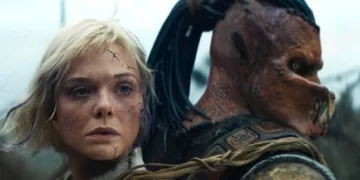
Thia, played by Elle Fanning, accelerates Dek’s growth. She is a Weyland-Yutani synthetic who enters the story in two pieces after an encounter with the Kalisk, still talkative, still buoyant. She plays the foil, a cheerful metronome of commentary, then a literal backpack, a portable exposition engine clipped to Dek. Fanning leans into disarming charm, human-styled warmth next to Dek’s tribal, prickly economy. The Weyland-Yutani tag drops the hunt into a wider constellation of corporate ambition, a reminder that the Alien-adjacent galaxy runs on contracts and extractive logic.
Their pairing reads like a seminar in cross-species pedagogy. Thia calls Dek a tool. Dek treats Thia as background noise. Necessity binds them. That tether presses on Dek’s inherited definition of weakness. Thia reframes that concept as a survival instrument, empathy as a designed, sometimes manipulative, mechanism. The partnership demonstrates how logistics can knock the teeth out of prejudice. The old proverb applies here in a sci-fi register, a shared existential risk quiets social friction, then teaches both sides the grammar of compromise.
Genna: The Ecological Gauntlet
Genna arrives as a complete, hostile system, a true terra incognita where temperature, terrain, and teeth attack with equal vigor. World-building gets specific, razor grass among the flora, a bestiary of hunters and hazards that sell the idea of a lived-in survival story. The film treats Genna’s lethality like a frontier tale transposed into orbit. The planet reads as the first antagonist, a sprawling snare that resents footprints.

Action design reflects the PG-13 certification and uses it as a constraint with purpose. Most of the brutal, efficient impacts fall on synthetic bodies, white synth blood painting the frame, or on monstrous fauna whose biology answers with immediate recoil. The franchise’s merciless edge remains visible while access widens for a broader audience. Dek moves with tactical economy, folding classic Yautja tools and opportunistic environment use into a style that screams maximum payoff per strike.
The tone tilts toward pulp adventure, the energy of an earnest 1960s sci-fi paperback. That posture suits a two-hander. The goal is propulsion, a thrum that prizes motion over pure dread. The craft backs the concept. Sarah Schachner and Benjamin Wallfisch supply a buoyant, rousing score. Jeff Cutter’s cinematography gives the alien vistas a tangible weather, air you can feel. Creature work lands with authority. A minor nit appears in a few close shots on Dek’s face where digital smoothing softens the practical textures, a moment where mandibles and pixels negotiate the same space.
The Philosophical Taxonomy of the Hunter
Dek’s struggle doubles as a study of rigid social codes policed by family. He wants proof of Yautja identity, then enters an alliance that tests the least flexible parts of that identity. The script turns the chase into a philosophical prompt, what is a code if it walks a warrior into self-annihilation.

Thia’s angle on engineered emotion presses against Dek’s training, empathy framed as weakness from birth and as software in her case. The term survival programming starts to feel accurate, a phrase that captures instinct, custom, and circuitry in one basket.
The film names a Yautja Codex and folds in cultural detail that reframes the species as a governed society, not a free-floating nightmare. The Weyland-Yutani link, Thia, Tessa, the pulse rifle, sits in the weave with a light touch. The worldbuilding carries a smart umbrella effect, a connective tissue that recalls early shared-universe logic where a single institution ties separate stories into a coherent map without swallowing them.
Fanning plays two roles, Thia and her colder, fully functional sister, Tessa. The pairing sets warmth beside corporate efficiency and lets the film test manufactured identity. Labels like sister promise solidarity. The film shows how those labels can hide a contest of purpose. Bud, a small and cuddly alien, echoes Dek’s moves and turns the Predator into a reluctant mentor. The trio behaves like a skewed family unit that grows by mimicry, bargaining, and borrowed courage.
A Thesis on Franchise Utility
Predator: Badlands lands as a successful gamble. The franchise proves range beyond horror. By shifting the point of view, Trachtenberg mounts a pulpy, character-driven science fiction adventure with teeth. That reframing creates space to study the old pillars of the series, the outsider’s claim to worth, the meaning of hunter, the recurring gravity of the kill, from a fresh angle that does not throw the past in the bin.

The strength sits in a single move, commit to a large structural risk, then hold fast to the prior film’s spirit. Prey pared the thing down to clean survival anchored by a human underdog. Badlands embraces complexity in lead and landscape, recasting the hunt as a spiritual trial, a contest of ethos as much as muscle. Both entries point to the same rule, focus on a motivated figure the audience can track, any species, any world. The signal here feels strong. The Predator sandbox reads as wide terrain, far more fertile than a string of earthbound reruns suggested.
Now the meta layer. The film treats honor codes like cultural operating systems. That connects to long histories of rite-of-passage thinking, to the way clans, guilds, and corporations define value, punish deviation, and promote a narrow image of worth. Dek’s arc watches that machine in miniature, then modifies it through contact with a partner built for persuasion. The idea travels easily to social life, to military training, to any institution that sanctifies endurance. Badlands names the cost of such sanctity, then sketches a path where code bends without shattering. Call it adaptive honor, a phrase that fits the Yautja and the rest of us.
The film also touches the politics of extraction. Weyland-Yutani hovers like a ledger. The corporation’s presence frames survival as a line item. Thia’s charisma and Tessa’s austerity present two faces of the same economic program, emotional engineering for cooperation, and cold calibration for compliance. That split mirrors real debates about designed empathy in modern systems, how institutions teach care as a function and prize efficiency as an ethic. The script lets that tension ride without turning the story into a thesis defense. It simply keeps the ledger in view while the blades flash.
Finally, a quick term of art. Badlands practices values-driven spectacle, set pieces that measure character rather than only scale. Dek’s victories count because they resolve conflicts inside a code, inside a family, inside a society that writes honor in the language of pain. Thia’s words test that code. Tessa’s presence enforces it. Bud’s mimicry refracts it. Genna punishes mistakes with the indifference of weather. The Kalisk stands as the objective that makes all those systems collide. By the end, the film demonstrates that this franchise can shift perspective, widen its map, and still keep the red thread of the hunt intact.
Predator: Badlands is the latest installment in the long-running Predator franchise, continuing the creative direction established by Dan Trachtenberg with Prey. The film takes an audacious swing by shifting its focus entirely to a Predator protagonist, Dek, an outcast seeking redemption by hunting the ultimate beast on a deadly alien world. It features a unique, character-driven buddy-adventure plot as Dek forms an unlikely partnership with Thia, a damaged synthetic created by the infamous Weyland-Yutani corporation, an element that firmly ties the film into the expanded Alien universe. The movie was released exclusively in theaters on November 7, 2025 by 20th Century Studios, and is expected to be available for streaming on Disney+ at a later date.
Credits
Title: Predator: Badlands
Distributor: 20th Century Studios
Release date: November 7, 2025
Rating: PG-13
Running time: 107 minutes, 115 minutes
Director: Dan Trachtenberg
Writers: Patrick Aison, Brian Duffield, Dan Trachtenberg, Jim Thomas, John Thomas
Producers and Executive Producers: John Davis, Brent O’Connor, Marc Toberoff, Dan Trachtenberg, Ben Rosenblatt, Lawrence Gordon, Jim Thomas, John Thomas, Stefan Grube
Cast: Elle Fanning, Dimitrius Schuster-Koloamatangi, Rohinal Nayaran, Michael Homick, Reuben De Jong, Cameron Brown
Director of Photography (Cinematographer): Jeff Cutter
Editors: Stefan Grube, David Trachtenberg
Composer: Sarah Schachner, Benjamin Wallfisch
The Review
Predator: Badlands
Predator: Badlands succeeds by risking everything. Trachtenberg's decision to shift the protagonist and the setting reanimates a flagging franchise. The film trades pure suspense for a surprisingly heartfelt buddy adventure, using the hostile world of Genna to forge a profound, unexpected kinship between the isolated Yautja and the resilient synthetic. It is a smart, pulpy evolution of the series' core themes.
PROS
- Successfully centers the narrative on Dek, the Predator "runt," fostering genuine empathy.
- Excellent odd-couple chemistry and thematic contrast between the stoic Dek and the charismatic synthetic, Thia.
- Planet Genna is meticulously detailed, functioning as a complete, hostile ecosystem.
- Integrates Weyland-Yutani and the Yautja Codex gracefully, deepening the franchise mythology.
CONS
- Some close-up digital shots of the Predator's mandibles occasionally appear less convincing than the rest of the effects.
- The shift toward sci-fi adventure with occasional humor may divide fans accustomed to the series' pure horror/suspense roots.
- The focus on action and character lessens the suffocating terror of the original film's stalking premise.







