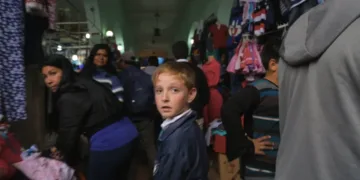











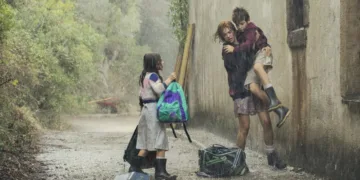










Clarisa Navas’s The Prince of Nanawa grows out of an accident of production. The project began as a short TV report on the marginalization of native Guaraní speakers along the Argentina Paraguay border and changed course when the crew met nine-year-old Ángel Stegmayer in the town of Nanawa. Ángel insisted on being interviewed, and that interruption becomes the spine of the film.
Navas and her collaborators return to him over roughly a decade, tracking his path from sharp-tongued child to young father at around eighteen. The running time of 212 minutes reflects a wish to immerse the viewer in his world. Nanawa, shaped by informal trade and by the lively yet contested survival of the Guaraní language, serves as the stage. Navas presents the material as a cinematic coming-of-age tale, a bildungsroman tied to the cultural complexity and economic stagnation of the border region.
Time, Agency, and the Unfolding Narrative
The film’s clearest structural device is its use of time. Over 212 minutes, the passing years function as a narrative engine, replacing the compressed arcs of conventional drama. The unscripted material lets us watch Ángel’s physical and mental changes accumulate, from charismatic boy to young adult already carrying heavy responsibility.
His first appearance sets that pattern: a “Tintin quiff,” the urgent line “I’m nine years old, but I have feelings,” and a torrent of talk that mark him as a distinctive presence. Navas treats him as a co-creator, and the credits list him on the production’s “Creative Team.” She gives him a camera or phone so that he can frame his own surroundings, often small daily details or scenes of young romance.
A brief black frame announces each of these inserts, and his images supply an unfiltered thread inside the larger portrait. The town’s smuggling routes and the bridge serve as visual counterparts to Ángel’s difficult movement from childhood into adulthood.
The Ethics of Chronicling Intimacy
The relationship between filmmaker and subject becomes a second narrative line. Over years of visits, Navas and her crew build a bond with Ángel that plays on camera like an extended family, with hugs and with the crew helping after Nanawa’s frequent floods.

That intimacy turns prickly. As he enters adolescence, especially in the film’s second half, Ángel grows resistant to the camera, and the power dynamic shifts. He blurs the line between subject and director, challenging the crew and at times trying to take control.
This intimacy brings ethical questions to the surface. Navas and her team sometimes challenge Ángel’s views, confronting his internalized misogyny and reacting with alarm when he considers joining the police. The film leaves these interventions in the cut, so the director’s responsibility becomes part of the story.
It also includes highly personal material, such as WhatsApp audio messages, to keep the narrative continuous and to show how fragile their connection grows during the pandemic pause. The choice to record and present such intimacy around a developing minor pushes the viewer to consider what kind of consent Ángel and his mother could offer across so many years.
Context, Critique, and the Weight of the World
The Prince of Nanawa builds its story on the physical and cultural terrain of its setting. Nanawa relies on informal cross-border trade, and the film presents this area as one the Paraguayan state often forgets. Ángel’s life story carries an anthropological charge, since his routines and frustrations point to wider patterns of socioeconomic stagnation and institutional neglect affecting young Latin Americans in marginal zones. His early anger at punishment in school for speaking Guaraní underlines the cultural strain inside that world.
The film concentrates on identity and vulnerability. Across the span of the shoot, we watch Ángel move from lively “gringo” child to premature adult who needs income from construction work or smuggling. The narrative includes personal turning points, such as his reunion with an older brother, which reshape his sense of self. Navas closes this portrait on a deliberately open ending. The lack of a tidy emotional beat matches life’s untidiness, highlights Ángel’s ongoing fragility, and still leaves room for the optimism he carries through a harsh social environment.
El Príncipe de Nanawa is a long-term documentary that follows its central figure, Ángel Stegmayer Caballero, over nearly ten years, from the age of nine into early adulthood. Argentinian director Clarisa Navas first met Ángel in 2015 while filming a piece on the marginalization of Guaraní speakers near the border town of Nanawa, Paraguay. The three-and-a-half-hour film serves as an intimate coming-of-age portrait set against a complex socioeconomic backdrop. Premiering on the festival circuit in April 2025 and earning the Grand Jury Prize at Visions du Réel, the film’s availability will primarily depend on its ongoing festival run and future distribution deals, as it is not currently available on a major streaming platform.
Credits
Title: The Prince of Nanawa (El Príncipe de Nanawa)
Running time: 212 minutes (3 hours, 32 minutes).
Director: Clarisa Navas
Writers: Clarisa Navas
Producers and Executive Producers: Eugenia Campos Guevara, Sofía Paoli Thorne, Jerónimo Atehortúa, Paulo Roberto de Carvalho
Cast: Ángel Omar Stegmayer Caballero
Director of Photography (Cinematographer): Lucas Olivares, Clarisa Navas
Editors: Florencia Gómez García
The Review
The Prince of Nanawa
The Prince of Nanawa is a demanding yet essential cinematic undertaking. Director Clarisa Navas expertly leverages the longitudinal form to build a profound portrait of an individual identity forged under systemic pressure. While the extensive runtime occasionally allows the pacing to meander in its second half, this is a necessary cost for capturing such unscripted, complex authenticity. The film succeeds as a raw coming-of-age story and a vital piece of anthropological critique regarding Latin American marginalization. It is a powerful exercise in documentary trust and transparency that earns its length.
PROS
- The decade-long structure makes time a core narrative element, capturing a profound, unscripted character evolution.
- Ángel is positioned as a dynamic co-creator, providing an unfiltered, intimate perspective through his own footage.
- Functions as a vital critique of systemic neglect and cultural challenges in the Nanawa border region.
- The film openly addresses the friction and complexity of the filmmaker-subject bond, including the use of raw, sensitive communication (like WhatsApp audio).
CONS
- The 212-minute length is significant; the second half, following Ángel's adolescence, experiences meandering and pacing issues.
- The level of intimacy captured, particularly around Ángel's early adult milestones (like becoming a father), raises necessary ethical questions about the scope of filming a minor.