












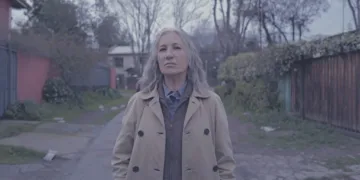












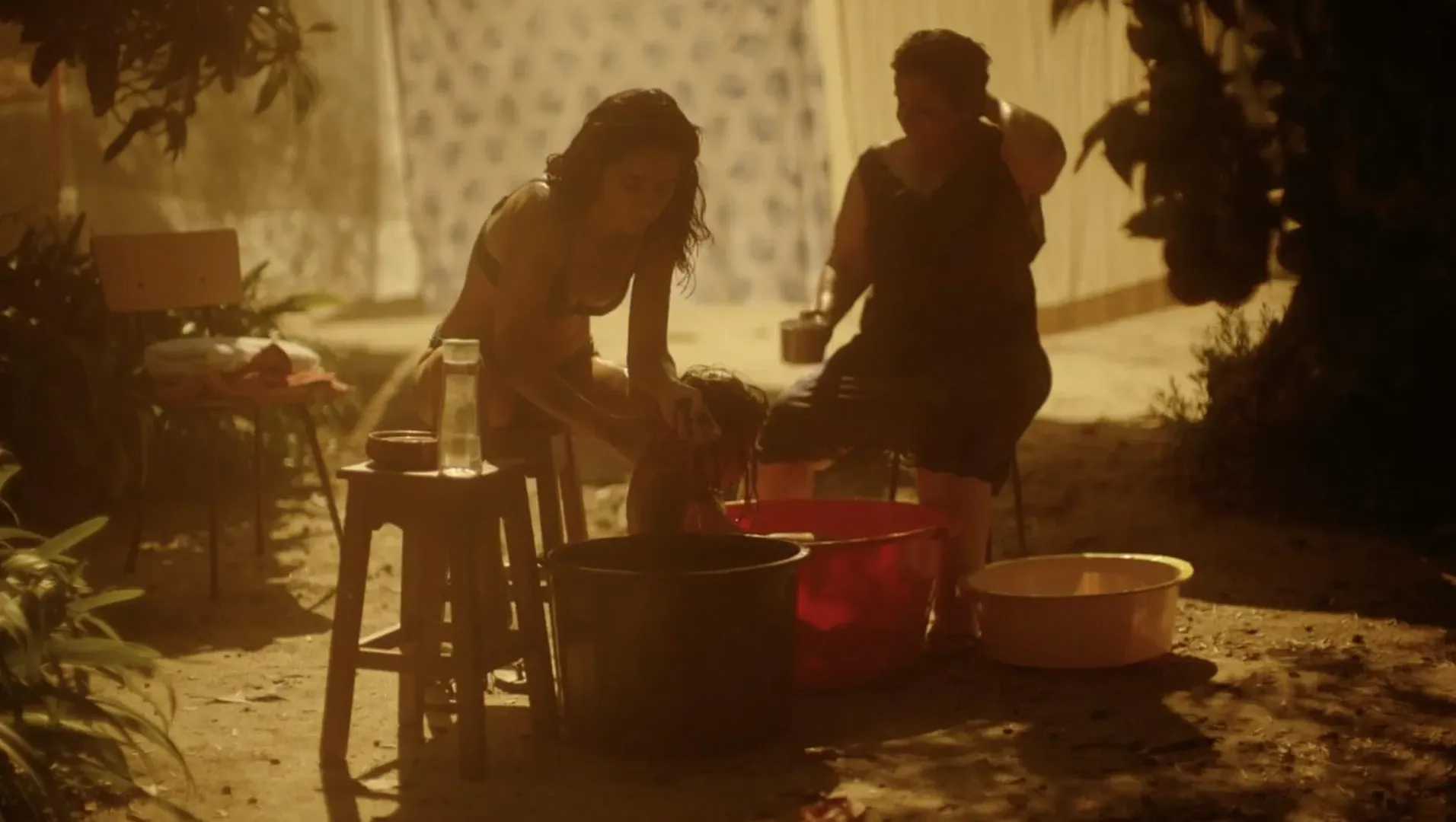

João Nuno Pinto’s third feature, 18 Holes To Paradise, shapes a fierce and elegant social satire that speaks directly to a global conversation about environmental decay and class conflict. The drama unfolds in the drought-stricken Alentejo region of southern Portugal, where the stately but aging family estate, Lagariça, becomes the focal point. Three adult siblings gather there to decide the fate of the property, now targeted by developers who plan an 18-hole golf course.
The core struggle lies between the pull of family memory and the lure of financial gain. That debate plays out under the immediate threat of a raging wildfire that moves steadily closer. The ecological danger, paired with suffocating heat that seems to seep into every frame, intensifies the psychological warfare among the relatives. The film engages directly with questions of responsible land stewardship and the destructive momentum of elite-driven development, capturing a portrait of privilege in visible decline.
The Prism of Perspective: Entitlement and Empathy
The film adopts a clear three-chapter structure, each segment aligned with the perspective of a key woman, which builds a layered view of the estate and those who claim it. This narrative framework reveals different degrees of entitlement and a consistent distance from the world beyond the family walls.
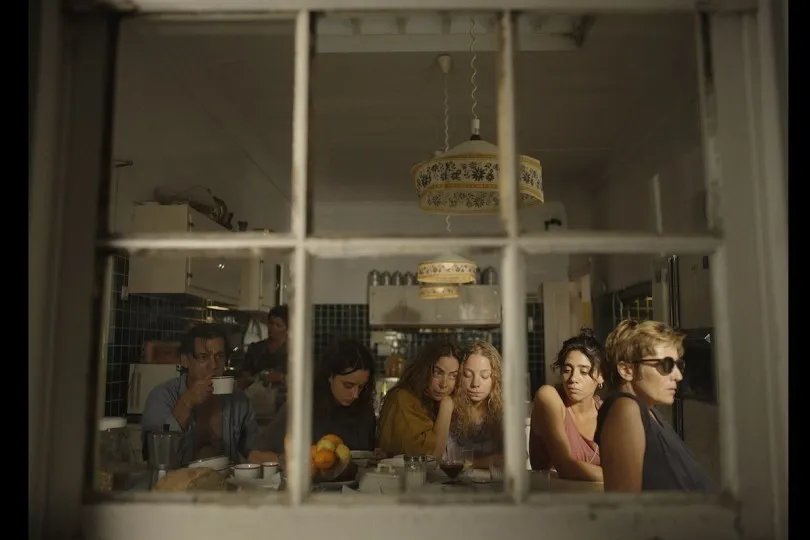
Francisca, one of the adult daughters, anchors the first chapter. Her gaze rests on nostalgia and emotional attachment to her childhood home. Her efforts to preserve the estate are bound up with the preservation of her memories. That connection appears early in the prologue, where her careless behavior leads to a fatal bird strike, a small but telling sign of an instinctive disregard for the land she insists she loves.
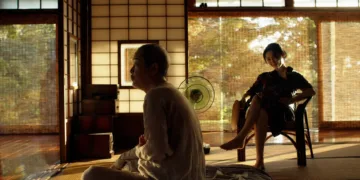
The second chapter reshapes the story around Catarina, the chic author. Her viewpoint carries deep distaste and a cool, detached sense of entitlement. She reads the estate only through its signs of decay, from cracked pool tiles to broken furniture. Preoccupied with her personal battles, she argues for the sale and refuses to acknowledge the worsening catastrophe outside the property.
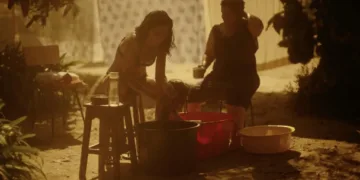
Her inner negativity spreads across her perception of the world, so the entire environment seems decomposed. The final chapter shifts to Susana, the housekeeper’s daughter. This change in vantage point exposes the siblings’ greed and ignorance with sharp clarity. Susana focuses on the injustice faced by her mother, Alma, who spent decades raising these children and now faces homelessness without a dignified retirement.
A Microcosm of Global Inequality
18 Holes To Paradise operates as a precise critique of entitlement to wealth, land, nature, and the labor of the working class. The siblings argue over a multi-million-euro sale, while Susana fights for something far smaller but morally weighty: secure retirement for her mother. Lagariça becomes a miniature version of a wider collapsing world. The film traces a class conflict in which wealthy heirs benefit from past and ongoing exploitation, while the working class, represented by the locals who actively battle the fire, must absorb the damage.
Arguments over issues like an old family chair reveal how trivial the rich siblings’ concerns feel next to the direct, life-threatening danger that staff and community members face. Requests for basic decency meet indifference or irritation.
That strain in social relations mirrors the ecological emergency pressing in from outside. The oncoming wildfire, the drought, and the water shortages link clearly to the environmental impact of development projects such as water-hungry golf courses and unsuitable crops driven by external profit. Economic harm to the land unfolds alongside the social harm inflicted on the people who depend on it.
Cinematic Symbolism and Visual Dissonance
Pinto’s direction guides the film through shifting tonal registers, moving from languid, heat-heavy states where characters appear half-stunned to bursts of high tension when nerves give way. The design of these shifts echoes other cinematic studies of decaying privilege, including Lucrecia Martel’s La Cienaga, which the film directly recalls. Ginevra Nervi’s relentless, percussive score heightens this pressure. The visual atmosphere matters just as much. Thick smoke stains the air a hellish red, and drifting ash gives certain scenes a hallucinatory quality that matches the characters’ growing panic.
From a formal standpoint, the film presents a mixed visual experience. The choice of a 4:3 aspect ratio has attracted debate, with some viewers describing the image as cropped rather than carefully framed to express confinement, which produces a sense of visual fracture. Even with this tension, 18 Holes To Paradise reaches its peak in a striking final sequence.
The climax plays out in ultra slow motion, where raw panic and terror emerge with painful clarity, and the last remnants of the characters’ social masks fall away. This scene unfolds in front of a mural that depicts a long history of colonial rapine. That image ties the family drama to generations of exploitation and emphasizes that the present-day class struggle around Lagariça grows from a much older pattern of abuse and privilege.
The feature film 18 Holes To Paradise is a Portuguese, Italian, and Argentinian co-production that premiered on the festival circuit in 2025. It is a compelling social satire that unfolds in the drought-stricken Alentejo region of southern Portugal, focusing on a family gathering at their old estate, Lagariça, to decide whether to sell the land for a golf resort while a wildfire rages nearby. As it is a recent film that premiered at major festivals like Tallinn Black Nights, details on a wide commercial release platform (like Netflix or HBO) are not yet confirmed, and its availability depends on its arthouse distribution deals.
Credits
Title: 18 Holes To Paradise (Original Title: 18 Buracos para o Paraíso)
Distributor: Alpha Violet (International Sales), Wonder Maria Filmes (Production Company)
Release date: 2025 (Premiered at film festivals like Tallinn Black Nights)
Running time: 108 minutes (or 1 hour 48 minutes)
Director: João Nuno Pinto
Writers: Fernanda Polacow
Producers and Executive Producers: Andreia Nunes, Roberto Cavallini, Debora Nischler, Laura Huberman, Ramiro Pavón
Cast: Margarida Marinho, Beatriz Batarda, Rita Cabaço, Jorge Andrade, Luisa Ortigoso, Günther Götsch, Rita Redshoes, Filomena Gigante
Director of Photography (Cinematographer): Kamil Plocki
Editors: Rosario Suárez, João Nuno Pinto
Composer: Ginevra Nervi
The Review
18 Holes To Paradise
18 Holes To Paradise is a powerful, uncompromising study of generational entitlement set against the backdrop of ecological collapse. Director João Nuno Pinto uses the confined space of the estate and the three shifting perspectives to expose the profound moral blindness of the landowning class. While some aesthetic choices concerning framing feel disjointed, the film's tense atmosphere is consistently gripping. It stands as a vital, globally resonant allegory about the immediate cost of indifference when the world is literally on fire. This film is a significant piece of contemporary cinematic commentary.
PROS
- Provides an uncompromising critique of class, entitlement, and exploitation.
- The three-chapter, shifting perspective narrative is a highly effective storytelling device.
- The omnipresent heat, drought, and approaching wildfire create relentless physical and psychological stress.
- The final segment provides a grounded, emotionally resonant core that clarifies the stakes of the conflict.
- The ultra slow-motion final sequence is arresting and strips the characters bare.
CONS
- Some critics noted an inconsistent aesthetic and jarring color grading.
- The use of the 4:3 aspect ratio appears poorly implemented (cropped, unbalanced).
- The first half of the film is sometimes described as slow, chaotic, or failing to find its footing immediately.
- The film attempts to address numerous issues, and some feel it remains superficial in certain areas.