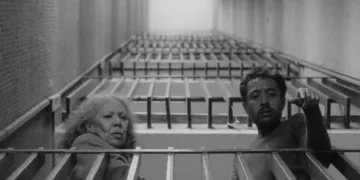





























We Shall Not Be Moved (No Nos Moverán), Pierre Saint-Martin’s blistering feature debut, stands like a mausoleum carved from bitter memory. Shot in black and white, this chamber piece seals us inside a single Mexico City apartment, a cramped stronghold that mirrors the inner airlessness of its inhabitant, Socorro (Luisa Huertas). She is a veteran lawyer with a rasp of smoke in her lungs and poison on her tongue, a woman who has let five decades of fury calcify into routine.
One purpose governs her days: retribution against the soldier who killed her brother Coque during the 1968 Tlatelolco massacre. History hangs in the room like dust that never settles, yet Socorro’s private grief is the real terrain being mapped here. Guilt keeps her moving in circles, rage keeps her awake, and the present becomes a corridor that always leads back to the same locked door in the past.
The Titan of Tattered Grace
The film’s existential pull rests on Luisa Huertas, whose performance lands with the force of weathered stone. Socorro carries a lifetime of hurt in her posture, her body and spirit marked by an injustice that never found a resting place. Huertas sustains a constant, simmering anger; her eyes meet the audience like a rebuke, as if our act of watching trespasses on a life lived as punishment.
This devotion to vengeance has made her bonds brittle. She remains in an apartment choked with documents, waiting for a return that will never arrive, keeping vigil over an absence that has shaped her into severity. Saint-Martin lets her cynicism curdle into satirical black comedy, using her cruelty as a dark mirror held up to a national moral order.
During a few drunken hours with her daughter-in-law, Lucia, another Socorro flickers into view. Beneath the lawyer’s armor, the outline of someone who once loved dancing and many lovers still lingers, proof that grief can bury joy without fully erasing its ghost.
The Poison of Perpetual Memory
We Shall Not Be Moved builds its themes on revenge as a looping, self-feeding toxin. Hatred takes the form of a chosen illness, a poison stored in the body that corrodes the host long before it reaches its target. The Tlatelolco massacre stands behind the plot like a bruise that never fades, coloring every detail of Socorro’s psychological portrait.

The film implies that Mexico’s wounds stay open because the corruption and abuse of power that enabled the original atrocity remain in place. Vengeance appears here through a stubbornly human scale: an aging woman struggling through daily life, far from the grand theatrics of organized crime or high authority. César Gutiérrez Miranda’s black-and-white cinematography sharpens this world into hard edges and harsh certainties, a visual language suited to someone who sees life in terms of debts unpaid.
The recurring image of doves slides from pure white innocence toward a common gray, a quiet moral note that stains everyone in reach of this story. Saint-Martin mixes raw intensity with satirical comedy, then turns that mixture toward the morally compromised corners that ordinary people keep tucked away.
Absence of Absolution
The supporting characters echo inside Socorro’s suffocating orbit. Her son, Jorge, lives under the gravity of her expectations, and her giddy, loyal pseudo-assistant Sidarta (José Alberto Patiño) supplies a counterweight to her severity. Sidarta becomes a conduit for the maternal energy Socorro cannot express cleanly, absorbing her frustration with devotion that borders on tragic. The film presses on questions of justice and forgiveness with a philosopher’s impatience for easy answers.
It refuses simple absolution. Memory must stay fixed, endured without surrendering to despair, and forgiveness sits outside this moral calculus. Still, the certainty of Socorro’s decades-long crusade begins to fray. A plot twist tied to the target’s identity knocks her faith off balance, forcing her to look at the possibility that her life has been built on unstable ground. When she turns to criminals for help, she steps into her own compromise, confirming the shift from white dove to gray.
This ethical descent shapes the final act, which offers a kind of resolution while softening some of the earlier ferocity. The push toward redemption feels overly cinematic, missing the harsher weight the subject seems to demand. The ending leaves an ambiguity in the air, and the film seems content to let that uncertainty stand: a question about healing that refuses to close.
We Shall Not Be Moved is a 2024 Mexican satirical black comedy-drama film that premiered at the Toulouse Cinelatino Film Festival on March 14, 2024, and was released commercially in Mexico on July 24, 2025. Directed by Pierre Saint-Martin in his feature debut, the film stars Luisa Huertas as Socorro, a headstrong, elderly lawyer obsessed with finding and taking revenge on the soldier who killed her brother during the 1968 Tlatelolco massacre in Mexico City. The story is a dramatic and absurd exploration of historical trauma, guilt, and the pursuit of justice, set primarily within Socorro’s black-and-white apartment. The movie was also selected as Mexico’s official submission for the Best International Feature Film at the 98th Academy Awards.
Credits
Title: We Shall Not Be Moved (No nos moverán)
Distributor: Pimienta Films, Varios Lobos
Release date: March 14, 2024 (Toulouse Premiere), July 24, 2025 (Mexico Theatrical Release)
Running time: 100 minutes (1 hour 40 minutes)
Director: Pierre Saint-Martin
Writers: Pierre Saint-Martin, Iker Compeán Leroux
Producers and Executive Producers: Víctor Léycegui, Male Gil
Cast: Luisa Huertas, Rebeca Manríquez, José Alberto Patiño, Pedro Hernández, Agustina Quinci, Juan Carlos Colombo, Gabriela Aguirre, Alberto Trujillo
Director of Photography (Cinematographer): César Gutiérrez Miranda
Editors: Roberto Bolado, Raúl Zendejas
Composer: Alejandro Otaola
The Review
We Shall Not Be Moved
We Shall Not Be Moved is a powerful, uncompromising character study that transmutes a national trauma into an existential portrait of consuming rage. Luisa Huertas's monumental performance anchors a film that bravely blends satirical darkness with profound grief. While the final act introduces some moral ambiguity that slightly diminishes its thematic force, its sharp critique of unhealed wounds and the corrosive nature of vengeance resonates deeply. It is a vital examination of resistance that accepts shades of gray over easy absolution.
PROS
- A commanding, magnetic performance that anchors the film's emotional and philosophical weight.
- The film successfully frames the 1968 Tlatelolco massacre as a catalyst for an individual, existential crisis, making the historical personal.
- Effective use of black-and-white cinematography and the confined chamber setting to heighten the sense of psychological entrapment.
- Successfully integrates satirical black comedy and cynicism with intense drama, offering a complex, sardonic view of morality.
- The narrative avoids facile solutions, insisting on the importance of an unmovable memory.
CONS
- The final plot developments and conclusion feel too cinematic and may diminish the raw, intense power established earlier, lacking the full forcefulness expected of the subject.
- The nearly exclusive focus on the apartment setting, while stylistically intentional, may feel stifling or tedious to some viewers.
- The film's intense focus on unrelenting rage and bitterness makes it a heavy, demanding viewing experience.