
























![Kingdom Hearts Collection [I-III] Review](https://gazettely.com/wp-content/uploads/2026/10/Kingdom-Hearts-Collection-I-III-1-360x180.webp "Kingdom Hearts Collection [I-III] Review: KHII Holds Steady as Newer Entries Fluctuate 37")



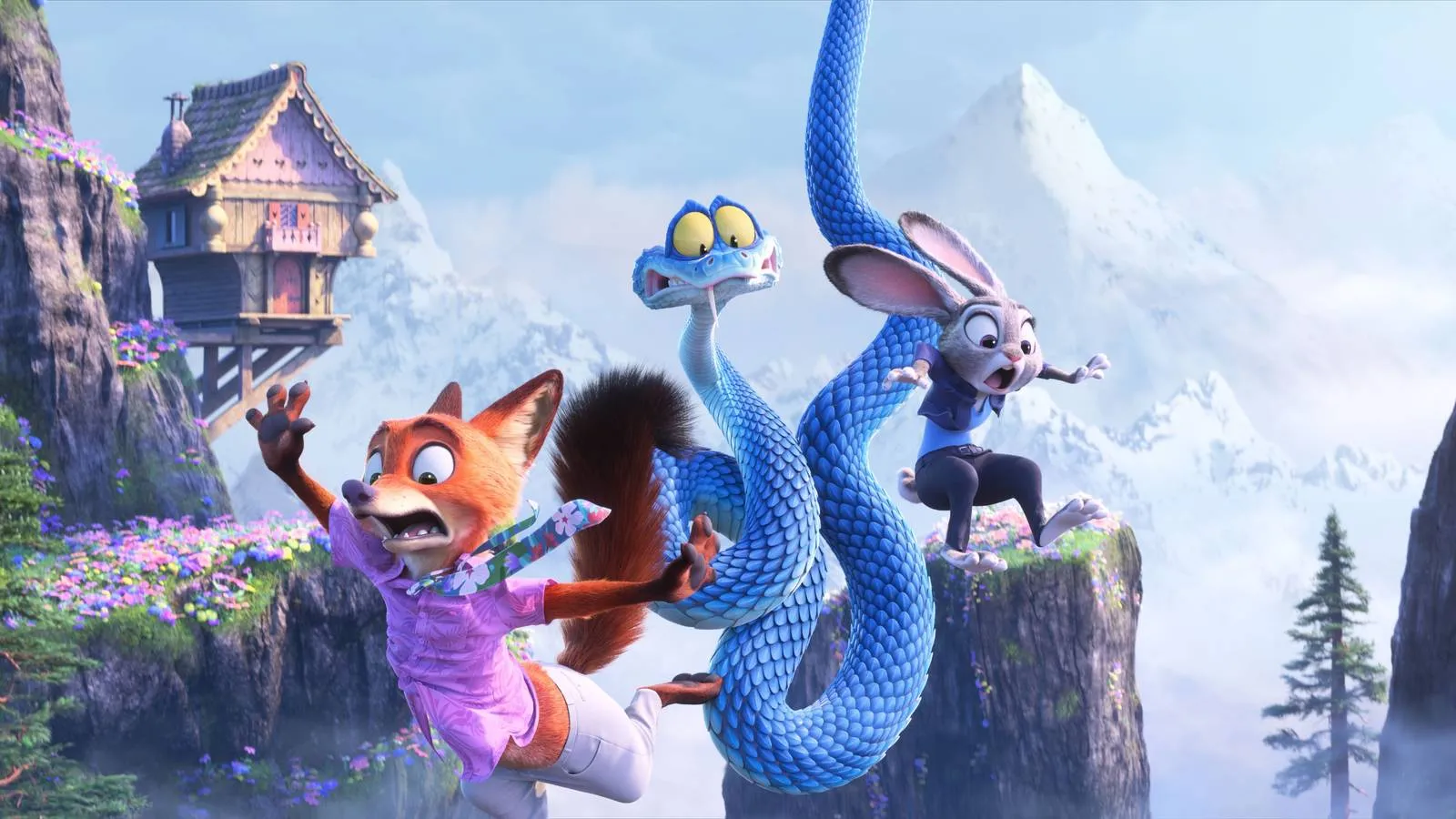

The animated feature sequel often invites repetition, yet Zootopia 2 behaves like a second volume in an ongoing social chronicle. The return to this luminous, vertically layered metropolis functions as a commercial project and as a fresh intensification of the original film’s philosophical inquiry into contemporary civic life. We meet again Judy Hopps (Ginnifer Goodwin), the rabbit whose idealism still radiates with clarifying energy and occasional glare, and Nick Wilde (Jason Bateman), the fox whose dry pragmatism steadies their alliance.
They move through Zootopia, a city founded on the promise of parity between predator and prey, while its foundations keep long-standing structural inequalities buried in plain sight. The premise quickly shifts beyond basic crime work.
Judy and Nick confront a new city-wide mystery that compels them to dig through the darkest strata of their society’s origin story, questioning the viability of a utopia that depends on selective memory. The film sustains the required humor and kinetic thrills while affirming the franchise’s capacity for sustained, conceptually sharp storytelling.
The Shifting Shadow of the Buddy-Cop Genre
The sequel’s structural strength rests on the internal discord between its leads, using the buddy-cop framework as a device for both comedy and existential strain. The opening movement immediately sketches out the friction inside the ZPD’s most publicized partnership. Judy and Nick, still glowing from their initial victory, exhibit policing philosophies that collide at the level of method.
Judy rushes forward, driven by a fierce, near reckless devotion to swift justice; Nick prefers careful preparation, his cynical wit acting as a brake on her habit of bending rules. A smuggling operation ends in chaos, the sharply staged “Amoose Bouche” catering van pursuit, which deposits them in front of Chief Bogo (Idris Elba). His ultimatum threatens the breakup of the duo. For Nick, the possible separation carries an existential charge; for Judy, it shakes her self-understanding as a barrier-breaking officer.
Their mandated therapy session with Dr. Fuzzby (Quinta Brunson) extends beyond a recurring punchline. The scene plays like a tightly timed chamber piece that frames their opposition in a single office. Judy talks through the session without checking in with Nick, choosing action and speed over shared strategy. The sequence defines their narrative task: to demonstrate that a partnership built on difference can withstand institutional scrutiny.
The subsequent plot steers the film into a darker noir lineage. The central mystery begins with the theft of a crucial historical artifact, a sacred journal displayed during the Zootenial Gala. This event, hosted by the aristocratic Lynxley family, descendants of Zootopia’s founders, operates as a glamorous yet decayed threshold into the city’s obscured past.
At this gathering, the film introduces Gary De’Snake (Ke Huy Quan), a presence who immediately divides opinion. He holds knowledge that connects the missing journal to the city’s intricate infrastructure, the climate walls, and to the long, systematic ostracization of reptiles and sea mammals. The journal, initially treated as a museum piece, reveals itself as a sharply focused legal and political document that records generational exclusion.
When the Lynxley patriarch, Milton Lynxley (David Strathairn), frames Judy and Nick for the theft, their status shifts with brutal speed. They become fugitives and must leave behind the authority of the ZPD to chase a deeper civic conspiracy. The stakes rise, pressing them into the literal and figurative shadows of the metropolis. The pacing tightens into near-constant motion.
Action sequences, including the high-speed car pursuit and the visually elaborate, turbulent passage through the water-filled Tube system, operate as showcases of kinetic design. The plotting grows intricate, with layers of intrigue, yet the central tension stays fixed on the survival of Judy and Nick’s connection, a bright axis in a progressively dark world.
The Psychology of the Partnership
The film concentrates its emotional energy on tracking the development and testing of the Judy-Nick relationship. Their bond forms the story’s emotional fulcrum, a source of warmth set against the chill of systemic critique. Judy’s relentless drive defines her, rooted in a lifetime of being underestimated. That heat often clashes with Nick’s drier, more observational perspective, the residue of years spent outside legal structures.
Their early conflict stems less from distaste than from opposing ethical reflexes, Judy placing her faith in systems and Nick relying on lived experience. The adventure functions as an accelerated seminar in negotiation, forcing them to close this gap through immediate, life-or-death choices. Compromise becomes a survival skill, strengthening their professional alliance and hinting at a deepening personal loyalty. Ginnifer Goodwin supplies Judy’s bounding, determined optimism, which matches with Jason Bateman’s delivery of sharp, secretly affectionate sarcasm. Their vocal interplay gives the classic clashing-partners template a precise comic rhythm.
The supporting ensemble offers fresh philosophical and comic angles. Gary De’Snake stands out as the most significant new figure. Ke Huy Quan’s voice work registers as a quietly exact performance. The pit viper is biologically dangerous, yet his manner radiates gentle optimism and an almost childlike hunger for connection. His repeated request, “Permission to hug?” becomes a running motif. The gap between his lethal physical facts and his tender personality visualizes the film’s central moral claim about appearance and identity. His arc concentrates the prejudice allegory into a single, emotionally focused thread.
The story also introduces figures who occupy the city’s margins. Nibbles Maplestick (Fortune Feimster) arrives as a scene-stealing beaver and conspiracy podcaster whose breathless, information-heavy patter steers the heroes through the urban underworld. Nibbles personifies the paranoia that feels necessary inside a system built on secrecy. At another point on the moral spectrum, Pawbert Lynxley (Andy Samberg), the awkward and less ruthless heir of the villainous clan, offers aid that becomes a key pivot in the plot, suggesting that personal conscience can pierce institutional loyalty.
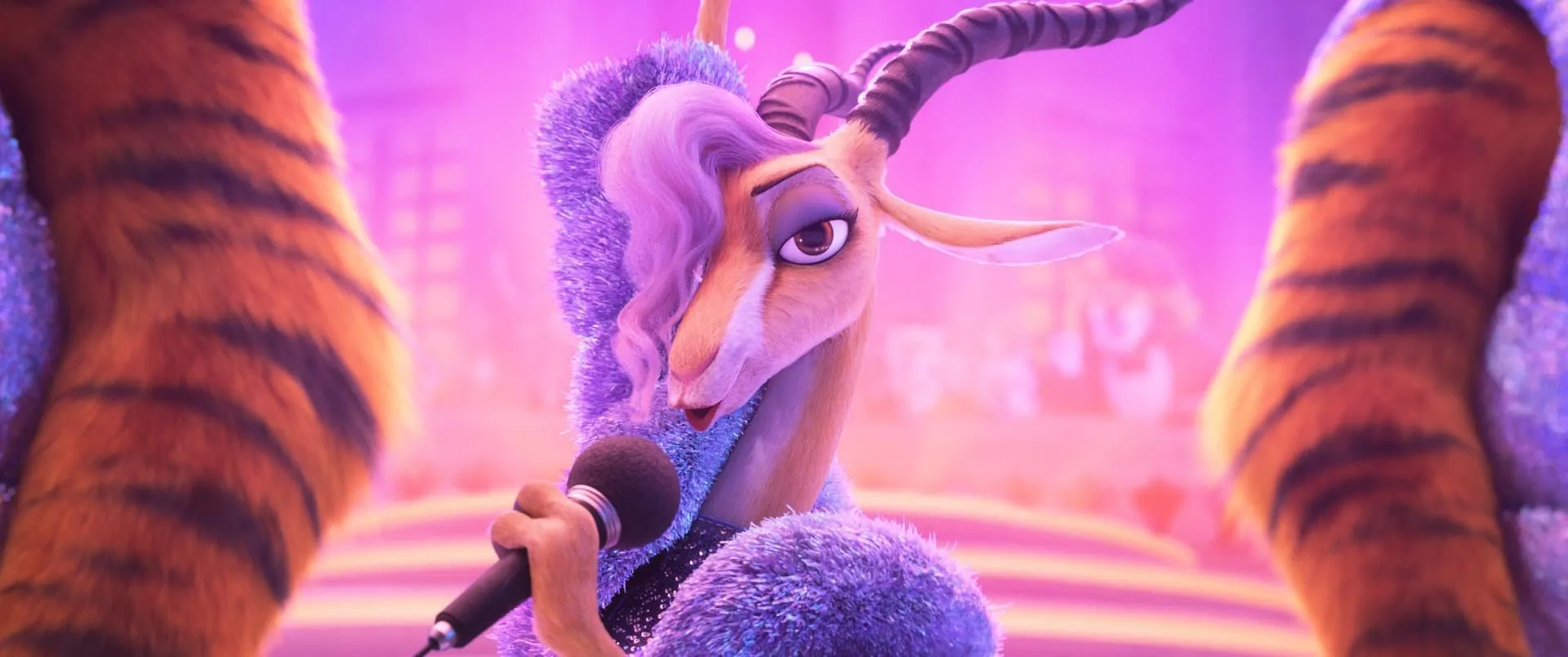
The film sustains its streak of wry political satire through smaller roles. Mayor Brian Winddancer (Patrick Warburton), a horse crowned with a luxuriant mane, arrives as an actor-turned-politician whose emptiness plays as a steady source of dry humor. He stands in for the polished surface so often elected to represent public confidence. Familiar figures such as the unhurried Flash the Sloth, the imposing Mr. Big, and Gazelle (Shakira) maintain continuity with the earlier film. David Strathairn’s performance as Milton Lynxley sharpens the portrait of an elegant patriarch whose corporate ruthlessness powers the city’s structural inequality.
Choreography of Light and Space
The visual architecture of Zootopia 2 builds on the first film’s technical precision and confirms Walt Disney Animation’s current level of craft. The rendering of the animal population feels meticulous, with photoreal textures in the fur and finely calibrated expressions in the character design, especially in the tension and release in Judy’s ears. The images give the city a tactile density. This is animation that invites frame-by-frame study.
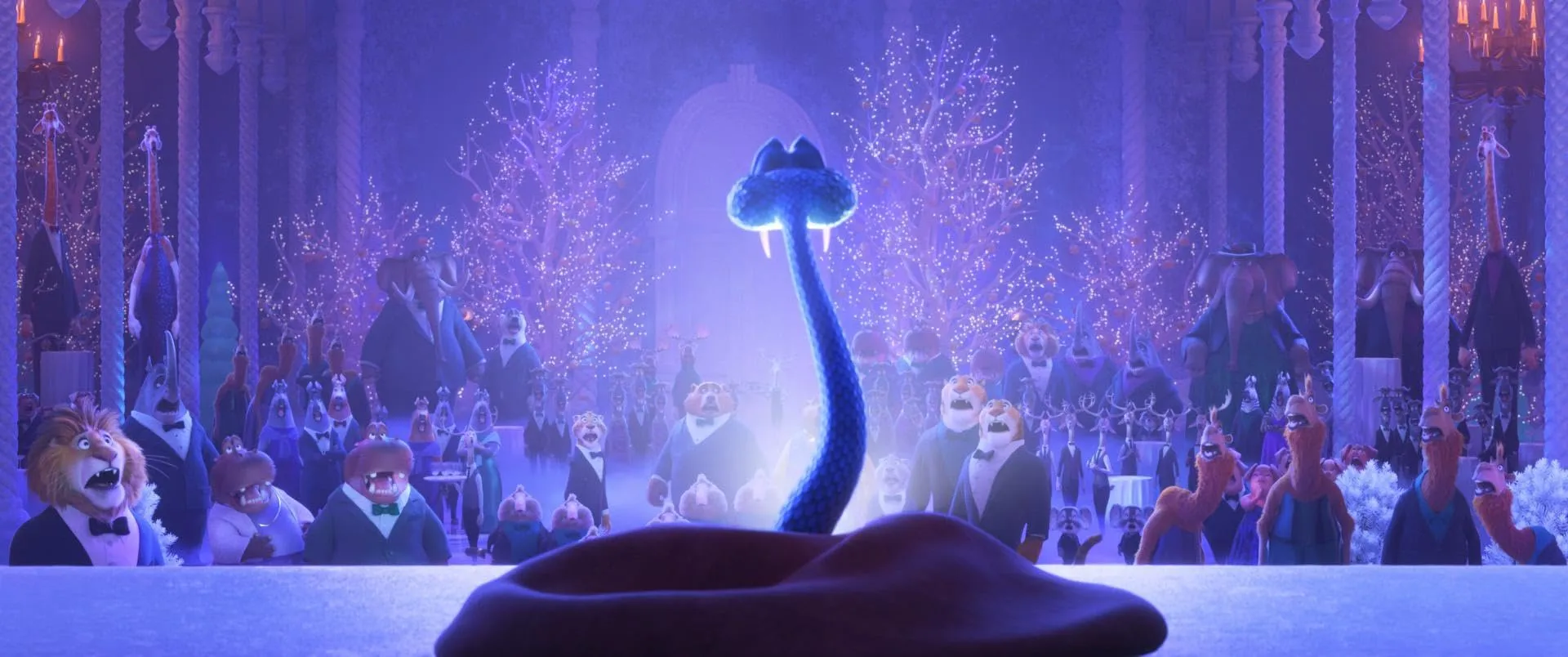
Cinematography turns the sprawling urban geography into a stage for high-intensity set pieces. Camera movement during action often adopts a kinetic, gliding style that carves out a dizzying sense of vertical and horizontal space. The water-filled Tube chase serves as a signature sequence, a visually dazzling run that uses liquid environments to produce surprising bursts of velocity and carefully modulated chaos. Lighting shifts across locations to recalibrate emotional tone. The glittering Zootenial Gala unfolds in harsh, high-key illumination that emphasizes its performative sheen, while the city’s hidden territories receive lower-key, expressive lighting that matches their secretive purpose.
One of the film’s most striking gestures of visual empathy builds around Gary De’Snake. At select moments, the framing aligns with his perception, presenting the world through pit-viper heat sensors. Warm, radiating fields of color replace standard depth cues. The audience receives brief, intimate access to the viewpoint of a marginalized figure, as the film converts his biological reality into a soft, non-threatening visual language. This expressionistic framing operates as a sophisticated storytelling device that attempts to erode ingrained bias through form.
The sequel extends the world-building along political and geographic lines. New habitats enter the frame. The Marsh Market and the coastal districts designed for marine mammals appear as busy yet geographically secluded communities. These spaces present lives that flourish on the physical and social periphery, enjoying openly “joyful” routines beyond the official core of Zootopia. The Reptile Hangout, likened to a New Orleans-style speakeasy, offers a protected refuge and confirms that the “excluded” have created rich cultures outside the dominant narrative. These environments widen the map of the city’s power arrangements and support the idea that Zootopia’s celebrated unity always rested on selective inclusion.
Humor threads through the frames and lines of dialogue. The script packs the backgrounds with sharp animal puns and contemporary pop-culture nods, including references to streaming platforms, horror cinema, and prestige television. This layered comic track keeps the film buoyant while the thematic material grows increasingly philosophical.
Allegories of Identity and Exclusion
Zootopia 2 refines the series’ social argument. The first film examined direct prejudice between predator and prey; this chapter turns to the slower, harder-to-see mechanisms of systemic exclusion and historical revisionism. The story works from the premise that the removal of one prejudice leaves space for another to establish itself.
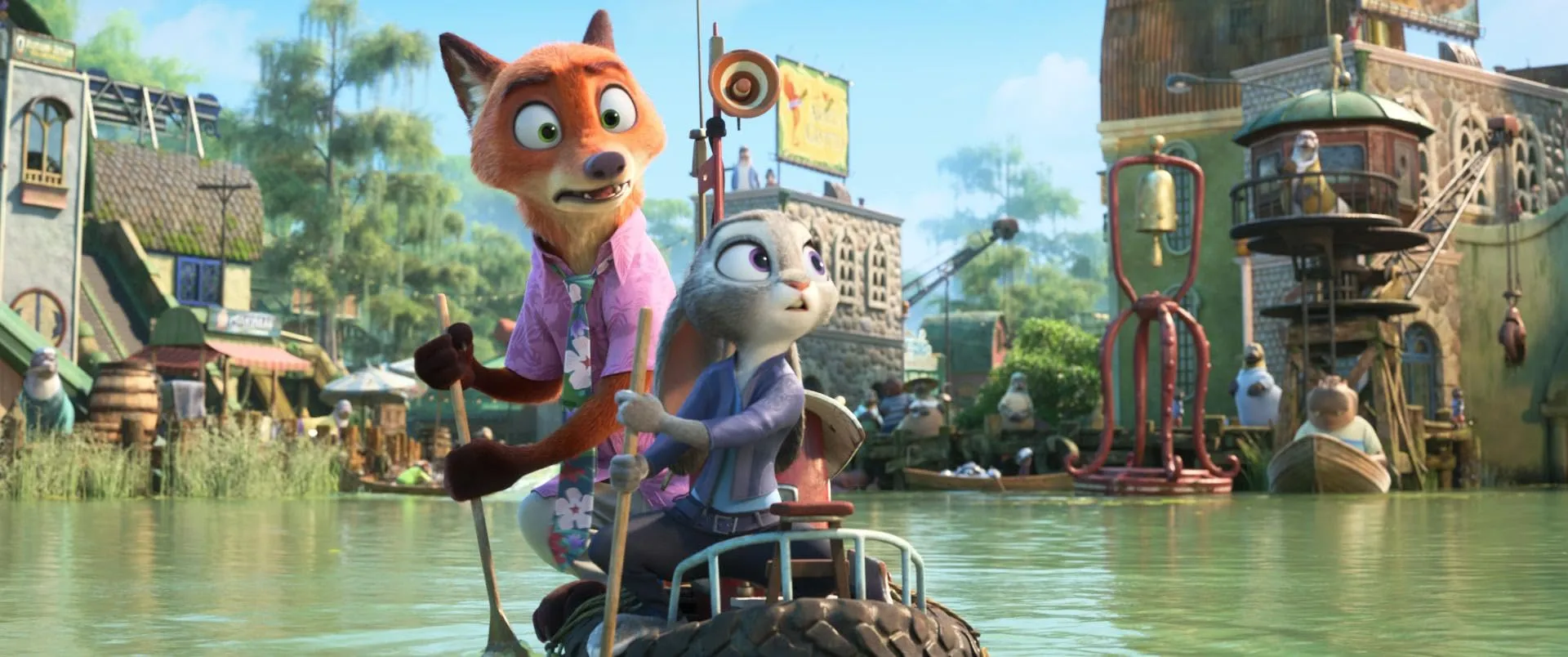
The narrative uncovers a foundational dispossession beneath the city’s utopian story about itself. The experience of reptiles and sea mammals, pushed to geographic and social margins, operates as a clear allegory for displacement and entrenched class hierarchy. The wealthy Lynxley family, descendants of the founding figures, retain their dominance by literal control of climate, which keeps the excluded species outside the city’s main zones. The film poses a pointed question: who constructs the rules, and for whose comfort.
This critique forces Judy to confront her own loyalties. Her steadfast attachment to the ZPD meets direct challenge when the evidence exposes the institution’s complicity in preserving the grand lie. Her path requires a step outside the official police structure, a turn toward life as a fugitive, to pursue a version of justice that matches her idealism. The film argues that the pursuit of truth sometimes calls for an ethical break with institutional protocol, suggesting that genuine justice can exist beyond the badge and its procedures. The idea marks a mature thematic step for the franchise.
The central message stays clear and warm. Complex political currents run through the plot, yet the narrative holds fast to themes of acceptance, curiosity about others, and personal loyalty. The focus on Judy and Nick’s evolving friendship, and on their willingness to embrace each other’s sharp differences in service of a shared truth, provides emotional definition for the film’s ethical ambition. The result is a sincere attempt to carry a significant moral statement inside a structure built from bright, energetic animated adventure.
Zootopia 2, the sequel to the Oscar-winning animated feature, is a buddy-cop comedy and adventure film produced by Walt Disney Animation Studios. It is scheduled to be released in the United States on November 26, 2025, right in time for the Thanksgiving holiday movie season, and will be distributed by Walt Disney Studios Motion Pictures. Picking up after the events of the first film, the movie finds police partners Judy Hopps and Nick Wilde facing a new, city-wide mystery that forces them to confront a historical conspiracy regarding the city’s origins and the systematic exclusion of reptiles and marine mammals. Following its theatrical run, the film is expected to be available for streaming on Disney+.
Full Credits
Title: Zootopia 2
Distributor: Walt Disney Studios Motion Pictures
Release date: November 26, 2025
Rating: PG
Running time: 108 minutes
Director: Jared Bush, Byron Howard
Writers: Jared Bush
Producers and Executive Producers: Yvett Merino
Cast: Ginnifer Goodwin, Jason Bateman, Ke Huy Quan, Fortune Feimster, Andy Samberg, David Strathairn, Idris Elba, Shakira, Patrick Warburton, Quinta Brunson, Danny Trejo
Director of Photography (Cinematographer): Nathan Warner, Brian Leach
Editors: Fabienne Rawley, Jeremy Milton
Composer: Michael Giacchino
The Review
Zootopia 2
The film is a successful sequel that deepens its world's complexities, transforming the initial predator/prey allegory into a thoughtful critique of systemic, historical exclusion. Its genre blend of neo-noir mystery and buddy-cop comedy is executed with relentless energy and dazzling animation. The core relationship between Judy and Nick provides an emotional anchor, allowing the film to deliver a mature message about fighting for justice outside compromised institutional boundaries. This is highly compelling, sophisticated animation.
PROS
- Shifts focus from individual bias to systemic corruption and historical exclusion (e.g., reptiles/sea mammals).
- The Judy-Nick partnership remains the emotional core, tested and strengthened through required compromise.
- Especially Gary De’Snake (Ke Huy Quan), who perfectly embodies the film's conflict between perception and identity.
- The animation is technically brilliant, expanding the world with intricate new locations like the Marsh Market and the Reptile Hangout.
CONS
- The twisty plot, while ambitious, is slightly less focused than the original film's streamlined mystery.
- Some core messages regarding acceptance feel like a soft retread of the original's concepts, despite the new setting.
- The overall conspiracy and the identity of the corrupting forces are telegraphed early for adult viewers.
- Some moments rely too heavily on extended chase sequences rather than deeper engagement with the social issues raised.







