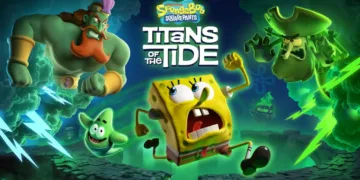

























SpongeBob SquarePants: Titans of the Tide keeps the series active in video games and rides the renewed enthusiasm for 3D platformers sparked by Battle for Bikini Bottom Rehydrated and The Cosmic Shake. This outing builds that momentum into a larger-scale conflict rooted in the everyday absurdity of Bikini Bottom life.
The story opens during a Krabby Patty sale at the Krusty Krab, which draws the attention of King Neptune and the ghoulish Flying Dutchman. A petty disagreement over waiting in line escalates into a supernatural disaster when the Dutchman releases a curse that turns Bikini Bottom’s citizens, SpongeBob included, into miniature ghosts.
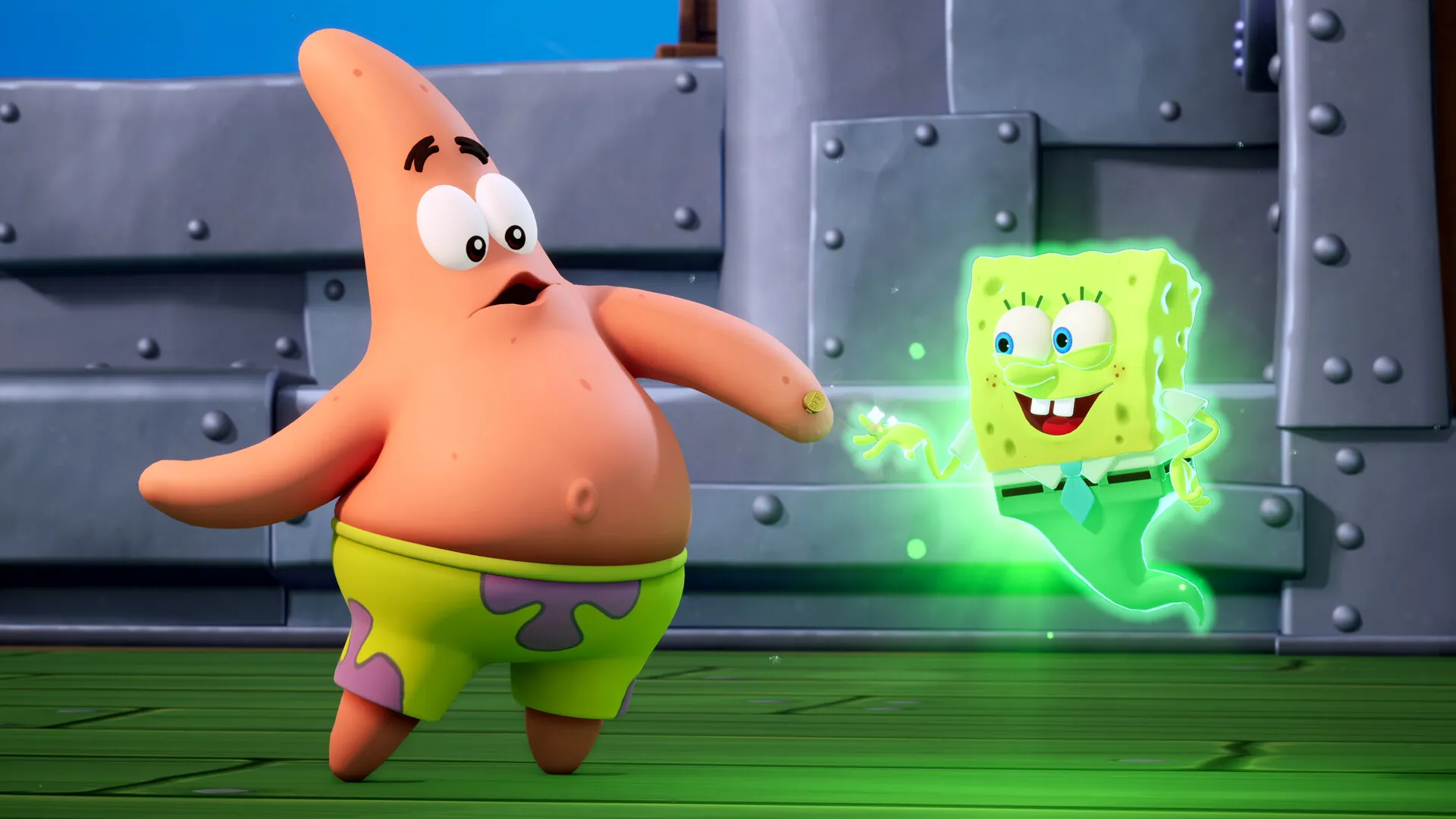
The plot ties that set-up quickly to a core mechanical hook. When Patrick makes contact with the ghostly SpongeBob, the pair realize that their BFF Rings let them swap instantly between their regular bodies and a specter-like state. This reality-warping ability shapes the game, assigning the simple duo the task of lifting the curse and restoring stability beneath the waves. The premise frames a light, goofy adventure that matches the animated series’ affection for lowbrow, deliberately silly comedy.
The Yin and Yang of Gameplay Mechanics
Constant switching between SpongeBob and Patrick drives the action and underpins platforming, combat, and puzzle solving. Stage layouts often ask players to jump back and forth between the two characters to handle hazards in the environment.
SpongeBob’s moveset focuses on vertical mobility and precision. His Karate Kick allows him to home in on targets or zip toward floating red foot signs, which helps him keep height and cover longer gaps. His bubble skills provide situational tools, trapping enemies or briefly freezing rotating platforms during puzzle segments. Patrick fills the role of heavy hitter and interaction specialist.
He can pick up and hurl hefty objects like crates and explosive barrels, which play a key part in solving environmental puzzles, smashing boulders that conceal secrets, and taking down enemies. Patrick also uses a burrow move for treasure hunting and dodging attacks, along with a ghost grapple that supports rapid traversal and quick openings in combat.
Also Read
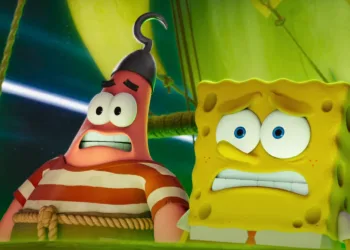




Watching how the two heroes complement one another gives the action a defined rhythm. Patrick often comes across as the more directly useful and powerful character, while SpongeBob supplies movement tricks that shape how players approach space.
The most satisfying sequences arrive when players smoothly combine their abilities, chaining character swaps, jumps, throws, and grapples to clear complex arrangements of platforms and foes. The adventure plays out across a set of distinct locations reached from the Krusty Krab airship hub. Players visit new areas and recognizable spots such as Jellyfish Fields, King Neptune’s Palace, and Atlantis City, which gives each stop its own identity.
Script, Style, and Technical Execution
The story feels like an extended episode of the television show stretched into game form. Jokes land with regularity, with the script leaning on familiar callbacks and visual comedy, including a memorable gag in which Mr. Krabs’ neck stretches to absurd length during a cutscene. The straightforward structure keeps the narrative easy to follow while it supports the humor and action.
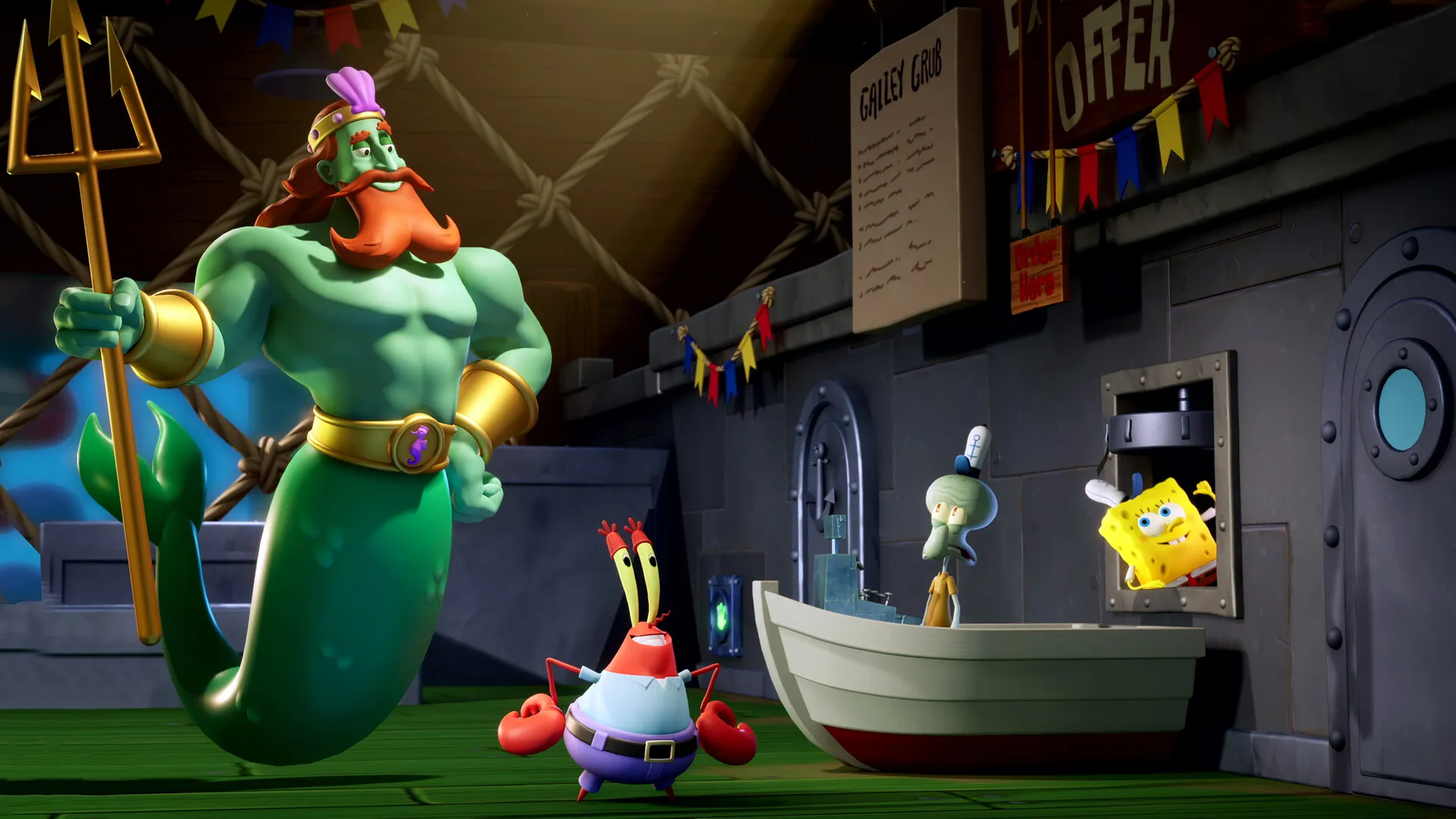
Presentation gains a great deal from the return of the original voice cast, including Tom Kenny, Clancy Brown, and Brian Doyle-Murray. Their energetic performances give the game a strong sense of authenticity and help the punchlines and character banter feel true to the series. On the visual side, Titans of the Tide uses a colorful, cartoon-style 3D look, and the cutscenes feature a loose, rubberhose-style animation quality that reflects the show.
Audio work follows the same philosophy. The music leans on cheerful, Hawaiian-flavored tunes built around ukulele and lap steel guitar that fit the Bikini Bottom setting. Certain technical aspects, however, weaken that foundation. Audio mixing can feel rough, with NPC chatter sometimes cutting through at odd volumes, and repeated voice lines during play can grow noticeable.
Technical polish presents further problems. The camera frequently feels unwieldy during fights and platform-heavy sequences, leading to positional irritation that recalls aging 3D platformers. Other small issues, such as slow texture pop-in and a sense of instability on some platforms, point to presentation that lacks refinement.
Length, Difficulty, and Design Polish
Titans of the Tide aims for an easy breezy ride that welcomes younger players. Challenge stays low; combat revolves around basic slap and spin attacks, and puzzles rarely tax the player, usually asking only for simple observation to place objects or hit pressure pads. Generous health pickups in the form of underpants appear all over each level, which keeps the risk of death minimal.
The main campaign wraps up in roughly six hours. That running time prevents the more inventive two-character platforming concepts from growing into their full potential, so they register as clever ideas that pass by quickly. Pacing also suffers from a sizable detour in Jellyfish Fields that functions as an extra chapter. The section contains a fun boss encounter, yet it feels disconnected from the primary quest and interrupts the story’s momentum.
Replay value rests on collecting 30+ treasure chests and hunting down coins that unlock costumes for SpongeBob and Patrick that call back to the show. The currency system undercuts that loop. Quest rewards and chest payouts grant so many coins that casual pick-ups lose any sense of reward.
Hidden content can also frustrate, since some secrets require players to grab specific small arrangements of coins scattered through the environment. The central body-swapping mechanic has real sparkle, but combat, puzzles, and the technical layer sit at a basic level, fail to set a new benchmark for the series, and leave Titans of the Tide feeling like a slippery sidestep for the franchise, far from a genuine improvement.
The Review
SpongeBob SquarePants: Titans of the Tide
SpongeBob SquarePants: Titans of the Tide delivers a charming, if basic, platforming adventure fueled by a genuinely humorous script and pitch-perfect voice acting. The dual-character swapping system provides creative platforming moments, but the short runtime means these ideas are never fully developed. Unpolished technical aspects, including a clumsy camera and repetitive combat, hold it back from greatness. While a fun, accessible outing for fans and families, it stands as a serviceable but ultimately modest entry in the platforming genre.
PROS
- The script feels like a classic extended episode of the TV show.
- Features the authentic, high-quality performance of the original voice actors.
- Swapping between SpongeBob and Patrick offers creative platforming challenges.
- Vibrant, cartoonish 3D graphics capture the look of the series.
CONS
- Unreliable camera and performance hiccups (stuttering, slow loading).
- The main story is brief, leaving gameplay mechanics underdeveloped.
- Slapdash fighting that lacks imagination and depth.
- Minimal challenge in platforming, combat, and puzzles.
- The narrative flow is hampered by extraneous segments.