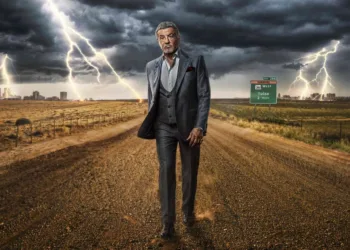





















The past is a foreign country, and we keep buying return tickets with the same hustle: arrive, appraise, strip the place down to what can be carried. Brad Cavallopoulos, played by Peter Bundic, steps into a sun-drenched Greek hamlet in 1987 wearing American corporate ambition like protective plating. His aim stays clean and clinical. He plans to evict his Uncle George and liquidate his late mother’s home to plug a gap in his father’s finances. Heritage becomes a commodity, solvency becomes the prayer.
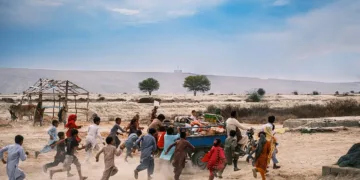
The village will not cooperate with that kind of arithmetic. Celebration hangs in the air, and so does the stare of Gorgo, a ward of the house who carries the land’s stubborn pulse in her posture. She and the local culture begin working on him right away, sanding down his certainty through proximity, ritual, and the simple embarrassment of being watched by people who belong to a place.
Director M. Achilles stages the impact with a sly touch. The first shape looks like comedy, a displacement story built from familiar parts, then the mood curdles into something fevered. The “fish out of water” frame loosens. What remains is a man with a rigid reality that starts to crack, and the crack widens every time the older world insists on being stranger than his categories can hold.
The Grain of Memory
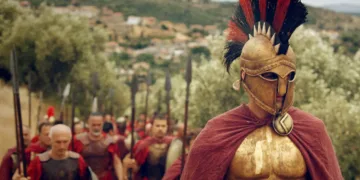
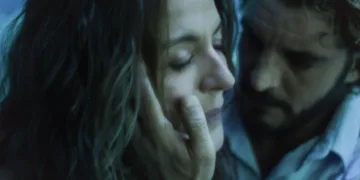
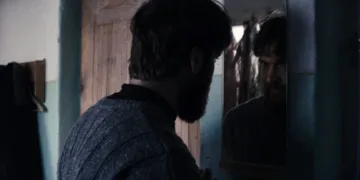
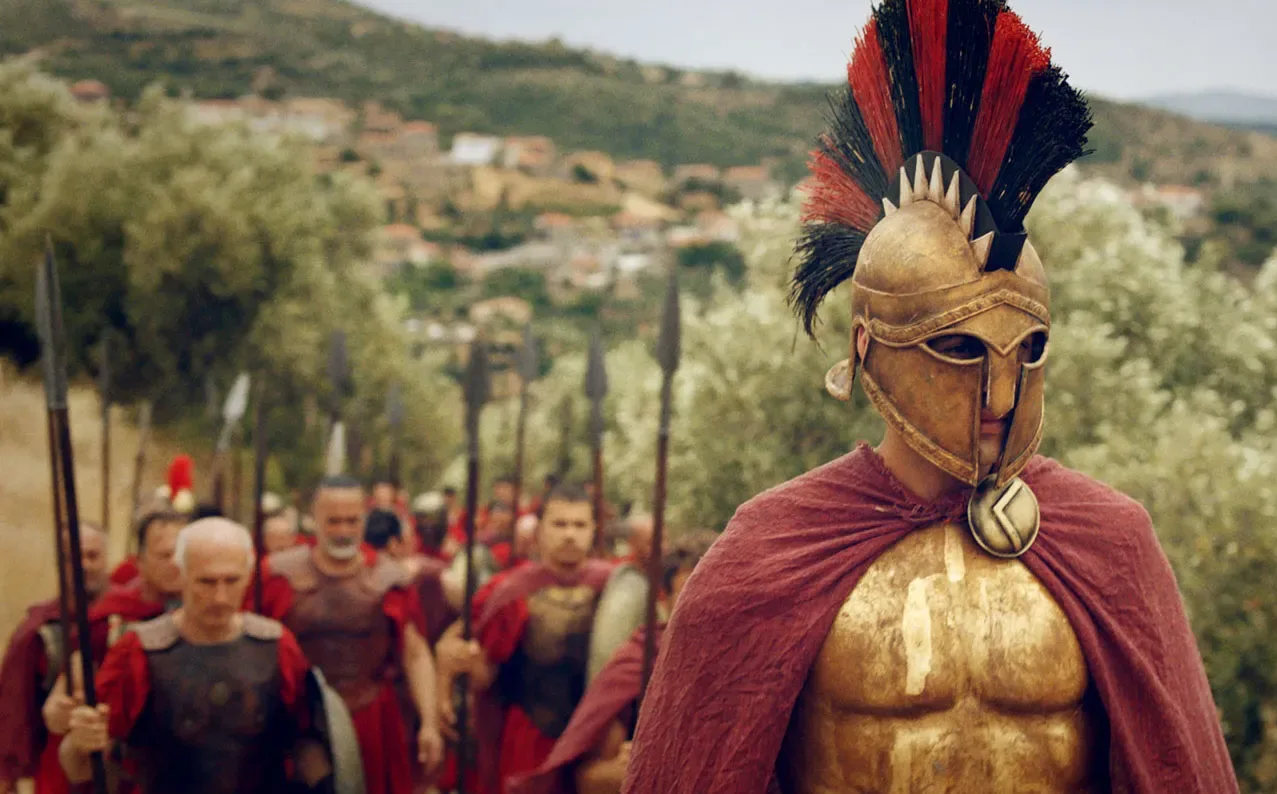
The image wears the texture of a shoebox photograph, rubbed thin by time and fingers. Grain sits on the frame like dust that refuses to be cleaned away, and the film stock keeps a tactile, bruised quality that makes 1987 feel physically present. The commitment to that year lands as a kind of vow. A Spartan helmet and Walkman headphones share the same visual sentence, ancient metal pressed beside late-eighties plastic, history and pop culture locked in the same nervous smile.
Cinematographer Giannis Fotou watches the landscape with appetite. The camera drifts across panoramas that register as presence, not backdrop, as if the terrain carries breath and opinion. The location joins the drama as an active force, pushing against Brad’s attempt to treat the place like an asset.
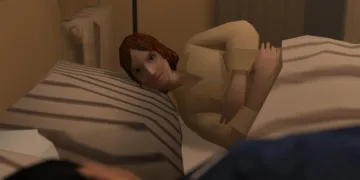
Here the film slips into its stranger register. Magical realism seeps into the frame. Dreams of warriors step into daylight and refuse to stay quarantined in sleep. Giannis Zaganelis’ score leans into that permeability, Greek instrumentation turning the air porous, guiding the story toward a space where waking logic loosens and myth takes the wheel.
The Architecture of Awkwardness
Peter Bundic plays Brad as a jolt of kinetic discomfort, a body in constant negotiation with itself. The character reads as chronically inhibited, perhaps neurodivergent, perhaps simply cut off from the rhythms that make connection feel natural.

The performance carries tension in its joints and its pauses. Awkwardness becomes a form of self-harm, an edge he keeps finding with his own hands. That severity gives his later spiral into fanaticism a grim plausibility. The film plants the seed early: a man who cannot live inside ordinary intimacy may reach for something harsher that promises shape.
Across from him stands Georgia Mesariti’s Gorgo, steady in a way that feels older than persuasion. She holds sweetness and iron in the same gaze, carrying a “spirit of Sparta” that Brad covets without comprehension. Uncle George and the surrounding cast bring levity that plays like a chorus, their warmth and laughter framing Brad’s tightening tragedy. The chemistry between Brad and Gorgo functions as the film’s gravity, keeping the pieces in orbit even while the protagonist begins to vibrate toward rupture.
The Chaos of Belief
The story fractures in the third act. The romantic comedy skeleton buckles under the weight of a manic crusade, and Brad’s need for meaning swells into something that looks like destiny from the inside and disaster from the outside. He mobilizes the village for an armed march on Athens, a “big fat Greek mess” of ambition and absurdity, where desire for purpose becomes a public spectacle.
In that escalation, the film presses on the friction between the hollow promises of capitalism and the bloody allure of tradition. It argues for an “old ways” vitality, a pulse that modern life has worked hard to smother, and it shows how easily that pulse can be mistaken for salvation. The final movements wander.
At one hundred minutes, the film loses tightness and drifts toward abstraction, scenes moving with the restless logic of conviction rather than the clean logic of plot. The looseness carries a rough honesty. The film leaves the viewer in the wreckage of Brad’s delusions, sitting with the question of what people do when meaning feels scarce and myth feels available. The result lingers after the credits, strange and imperfect, like a dream you cannot fully interpret and cannot fully forget.
A Spartan Dream is a romantic adventure film infused with magical realism that tells the story of Brad, a Greek-American who travels to his ancestral village to sell the family home, only to be swept up in the local culture and a newfound obsession with ancient history. The movie was released on August 15, 2025, in select theaters and simultaneously on digital platforms. You can watch it on major VOD services including Amazon Prime Video, Apple TV, Google Play, Fandango at Home, and YouTube Movies.
Full Credits
Title: A Spartan Dream
Distributor: Freestyle Digital Media
Release date: August 15, 2025
Running time: 97 minutes
Director: M. Achilles (Michael A. Nickles)
Writers: Leonidas G. Demas, George Demas
Producers and Executive Producers: Michael A. Nickles, Lilette Botassi, Dimitris Hatzivogiatzis, Leonidas G. Demas, George Demas
Cast: Peter Bundic, Georgia Mesariti, Katerina Didaskalou, Renos Haralambidis, Nikos Tsergas, Kostas Koroneos
Director of Photography (Cinematographer): Giannis Fotou
Editors: Lambis Haralambidis, Lydia Antonova
Composer: Giannis Zouganelis
The Review
A Spartan Dream
A Spartan Dream acts as a feverish collision of nostalgia and madness. It rejects the safety of its genre to pursue a stranger, more difficult path. While the narrative structure eventually buckles under its own ambition, the film remains a singular artifact. It stands as a messy, beautiful disaster that demands attention, even if it defies easy categorization. The experience is flawed yet undeniably potent for those willing to accept its strangeness.
PROS
- Tactile, grainy 1980s visual aesthetic
- Daring integration of magical realism
- Hypnotic cinematography that elevates the setting
- Unflinching, intense lead performance
CONS
- Narrative logic unravels in the third act
- Pacing drags as the story becomes abstract
- Abrasive protagonist may alienate some viewers