




























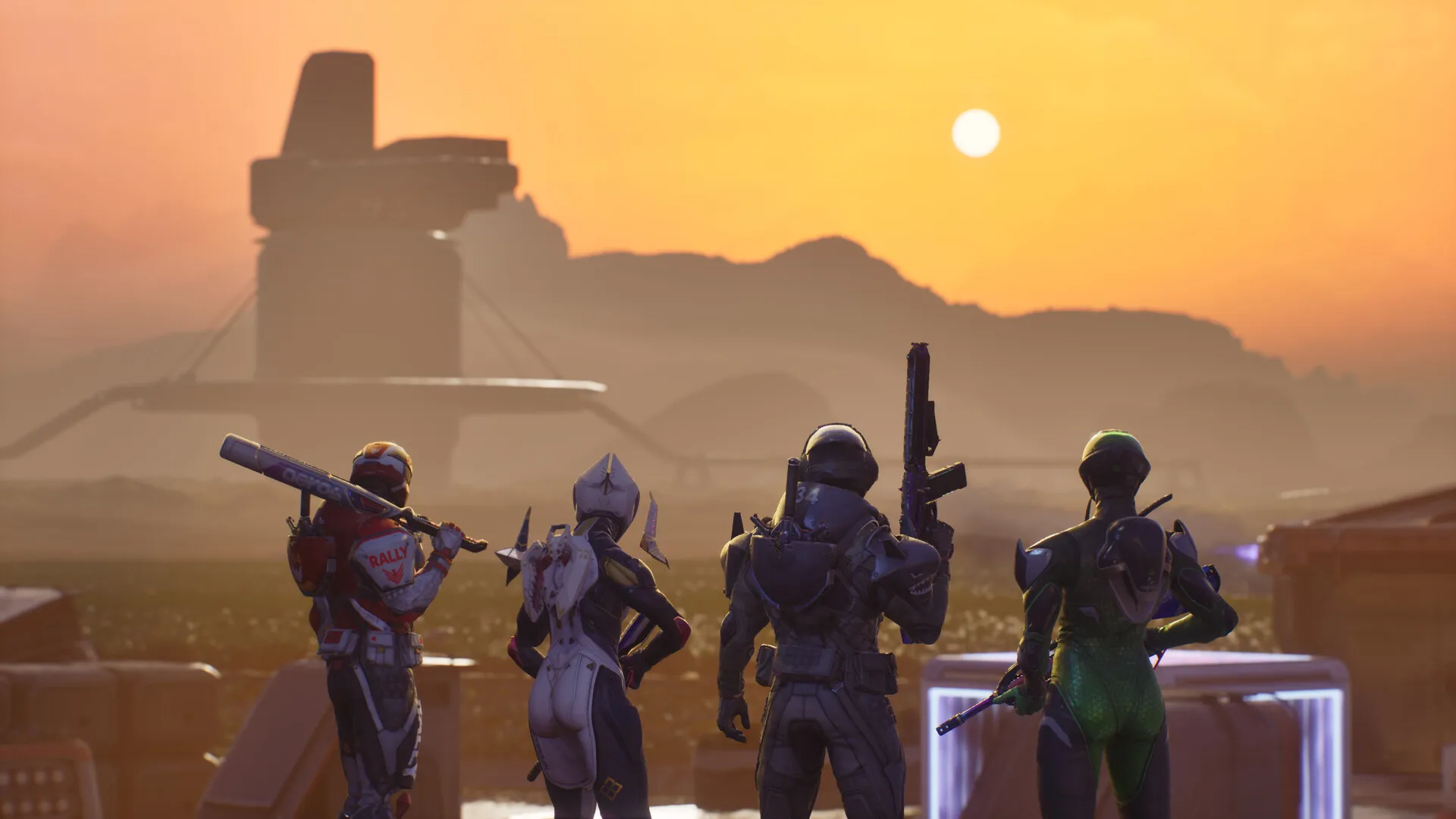

The leap from scrappy underdog to genre heavyweight can scrub away the quirks that made the first climb worth watching. Splitgate 2 lands as a carefully packaged contender, shaped to live beside the big names. 1047 Games has polished its “Halo meets Portal” pitch into something sleeker, trading the original’s gritty, industrial feel for a pristine, high-fidelity hero-shooter finish.
This sequel carries itself like a AAA release. Its visual language moves away from utilitarian spaces toward saturated color, clean silhouettes, and a look built for esports readability. The portal hook still separates Splitgate 2 from the pack on paper, yet the experience now leans harder on fluid movement and faction synergies.
The tech upgrade is clear in motion: performance feels smooth in a way the first game never reached. That precision comes with a specific kind of flattening. The game often reads like a product tuned to please as many playstyles as possible, and that tuning can make the identity of the earlier version feel distant.
Gunplay, Movement, and the Portal Problem
Movement is the clearest win in Splitgate 2. The physics tuning creates a loop of sprinting, sliding, and jetpacking that plays with the cadence of a rhythm game. Momentum carries cleanly, and the responsiveness invites chaining slides into jumps in a way that makes traversal feel like its own reward. The Titanfall comparison fits for the way skilled players can string actions together and keep control while airborne. Mid-flight direction changes add another layer of expression, and the ceiling for mastery shows up quickly once you start pushing speed and spacing.
The guns feel far more conservative. The shooting model leans into hip-fire dominance in the Halo 5 mold, favoring steady tracking over snap reflexes. It works, yet much of the arsenal lacks a strong acoustic or tactile fingerprint. Carbines, assault rifles, and SMGs behave like familiar templates from years of shooter iteration. They function, they kill, and they rarely surprise.
Power weapons provide the shake-up the sandbox needs. The “Splitstream,” a pair of submachine guns that merge into a heavy minigun, flashes the kind of playful invention that the rest of the armory holds back. When one appears, the tempo of a fight shifts immediately, and players have to make fast decisions about positioning and timing to avoid getting shredded.
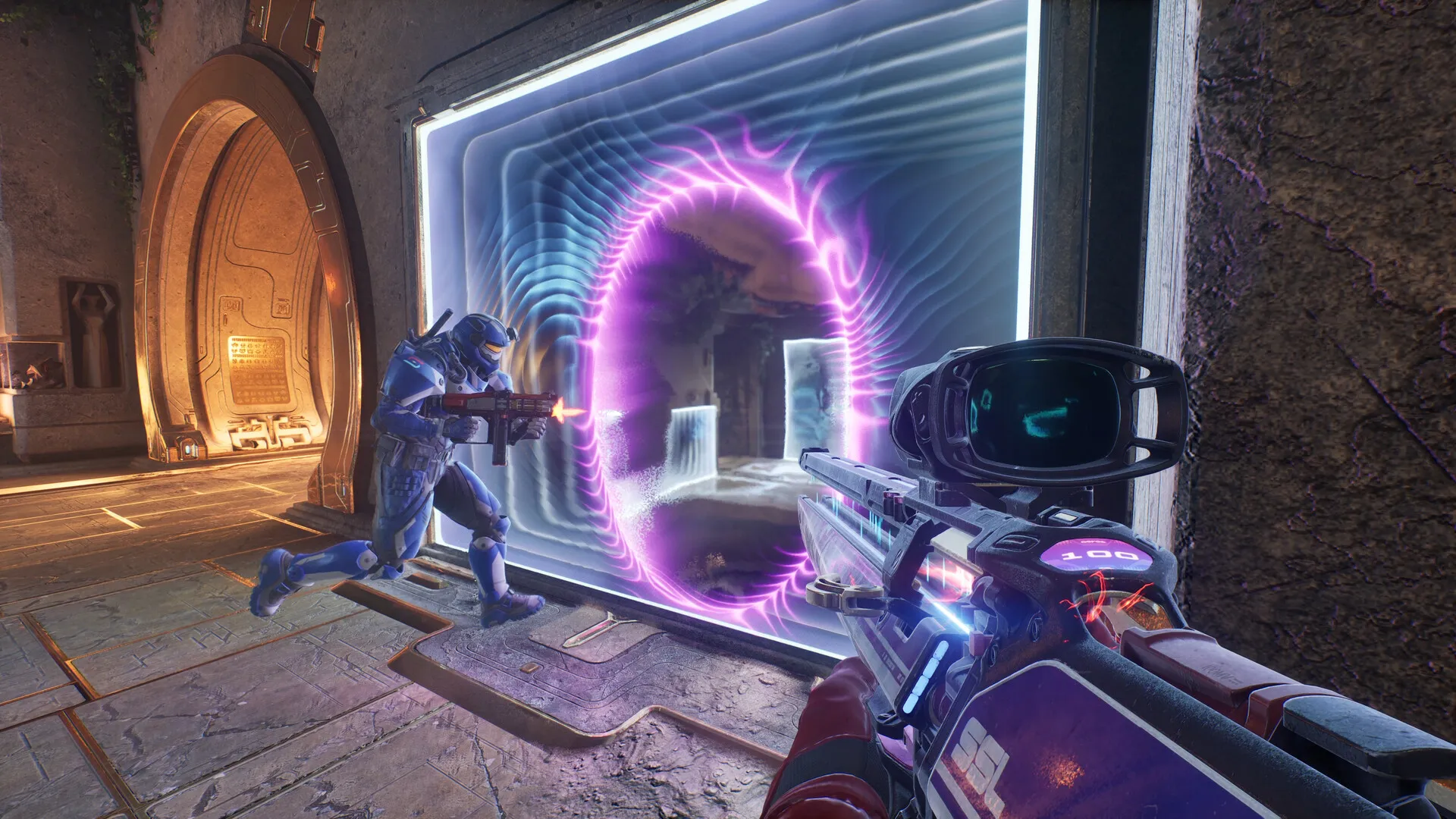
Portals are where the most divisive change sits. 1047 Games has streamlined deployment to the point where it often feels frictionless, with context-sensitive placement and near-instant execution replacing the older game’s fumble-prone setup. Ease of use sounds like a straight upgrade, yet it reshapes the risk-reward calculus. Time-to-kill is low and weapons are extremely accurate, so a clean sightline and steady tracking frequently outperform a portal plan that takes even a beat to set up.
That balance nudges portals into a narrower role. They frequently serve as mobility and reset tools, not the primary engine for creative aggression. Map geometry reinforces the shift. Viable portal surfaces appear less frequently, and they sit in safer, more predictable lanes. The “think with portals” loop that once enabled weird angles and physics-bending kills now points toward linear A-to-B routing. You use portals to get back into the fight faster or to disengage when a push goes bad, and the game rarely pressures you to build an outplay around them. Splitgate 2 still hands players a tool with genius potential, then builds spaces that reward the simple, repeatable option.
The Faction System: Hero Shooter Integration
Factions mark the biggest structural change for the series. The arena purity where every player starts with identical capability is gone, replaced by three classes: Aeros, Meridian, and Sabrask. Team composition matters more than it used to, and match flow now depends on how those kits mesh.
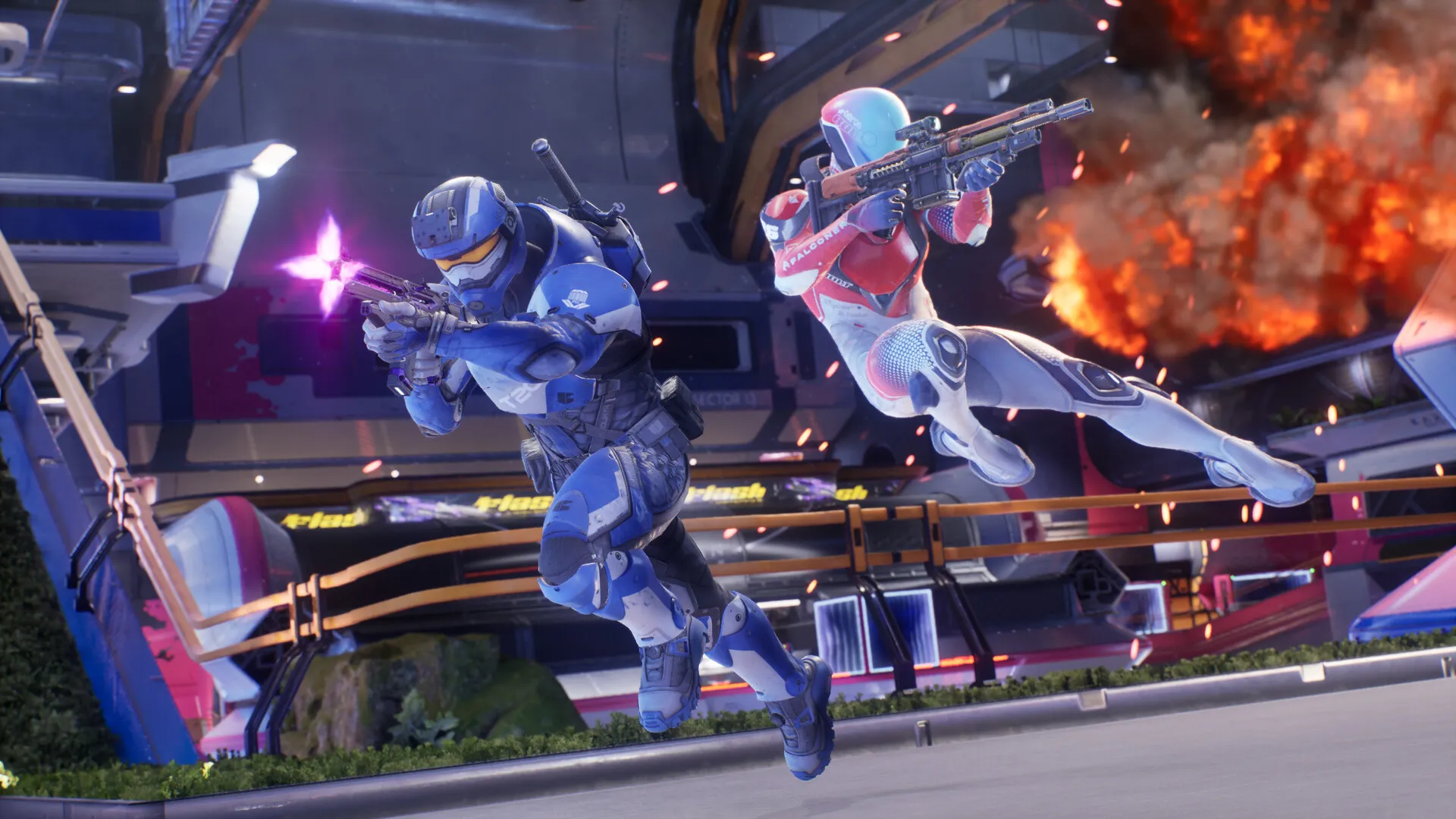
Aeros is built for speed. Its kit focuses on movement and reload buffs, pushing a playstyle centered on aggressive flanks and rapid backline pressure. Meridian fills an information-and-support role. “Hypersight” effectively gives wallhacks, and that information can break an ambush before it lands. With health regeneration buffs in the mix, Meridian plays like the stabilizing piece in a coordinated group. Sabrask leans into the tank fantasy through space control, using “Smart Walls,” one-way shields that let friendly fire pass while stopping incoming damage.
These abilities shape fights in a major way. A scan or a shield timed well can tilt an engagement before anyone fires a shot. That adds tactical texture, and it pushes communication around cooldowns into the center of moment-to-moment decision-making. It also changes the feel of individual agency. Duels now hinge on aim, positioning, and the state of both players’ abilities, with readiness and timing carrying as much weight as raw mechanical sharpness.
Progression adds another pressure point. As you play, you unlock faction-specific attachments and perks, creating a grind loop that encourages sticking to a role. The hook is obvious, and it gives players reasons to keep queuing. It also creates uneven footing. A veteran Sabrask player can bring statistical advantages into a match that a new player simply does not have.
Competitive identity shifts with that system: matches become partly about build optimization and unlocked perks, not purely about execution in a clean start. Variety increases, and the series’ competitive DNA changes with it, moving away from quake-like symmetry and toward the familiar territory of ability-driven shooters.
Map Design and Visual Identity
Splitgate 2’s visual direction swaps the predecessor’s gritty bunkers for a “neo-Y2K” look. Maps lean hard into pinks, blues, and stark white surfaces, with a vibe that recalls a big-budget sports arena or a futuristic race track. Visibility and clarity benefit from this approach, which supports competitive readability. The trade-off is atmosphere. The spaces often feel like polished set pieces without much sense of history or purpose, leaving the world clean, sterile, and easy to forget.
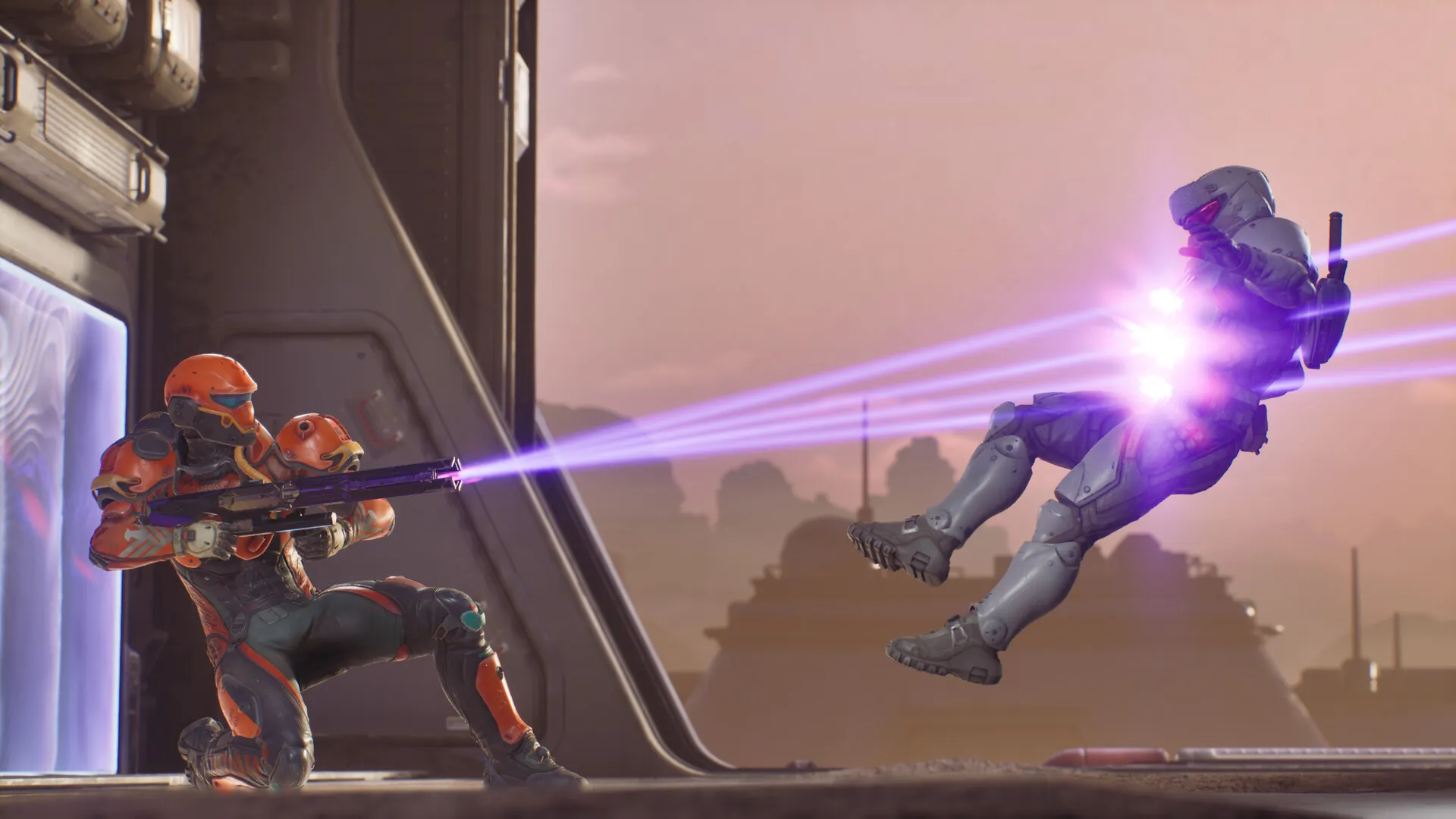
Layout priorities follow the same philosophy. Geometry favors fairness, with symmetrical structures designed to avoid one side gaining a built-in advantage. Symmetry also brings predictability, and that predictability pairs poorly with a mechanic that once rewarded strange discoveries.
Portal surfaces in key vantage areas feel limited, and the placements that do exist tend to be large, obvious, and positioned to reduce risk. In the first game, finding a tiny sliver of portal wall high above the map could swing a match. Here, portal use often follows the rails the designers set down, shaping creativity into a more controlled pattern.
Map size adds friction. Smaller maps keep pacing frantic, and the movement system feels electric in tight spaces where engagements stack quickly. Larger maps struggle to sustain that same loop. When firefights thin out, the environments can feel empty, and long runs through wide corridors emphasize portal constraints. Without frequent surfaces to chain movement and momentum, traversal becomes sprinting through quiet space while waiting for the next fight. The sterile art direction makes those lulls feel louder, since there is little environmental storytelling to occupy the downtime.
Game Modes: Arena Purity vs. Battle Royale Chasing
Standard arena modes remain the safest home for players who want the core Splitgate feel. Team Deathmatch, Domination, and King of the Hill work best because they compress the action. Respawns keep the cycle tight, objectives funnel teams into contact, and the movement mechanics get to do their best work. “Splitball” and “Takedown” stand out as highlights, leaning into physics and high-stakes combat to create emergent moments that read as distinctly Splitgate.
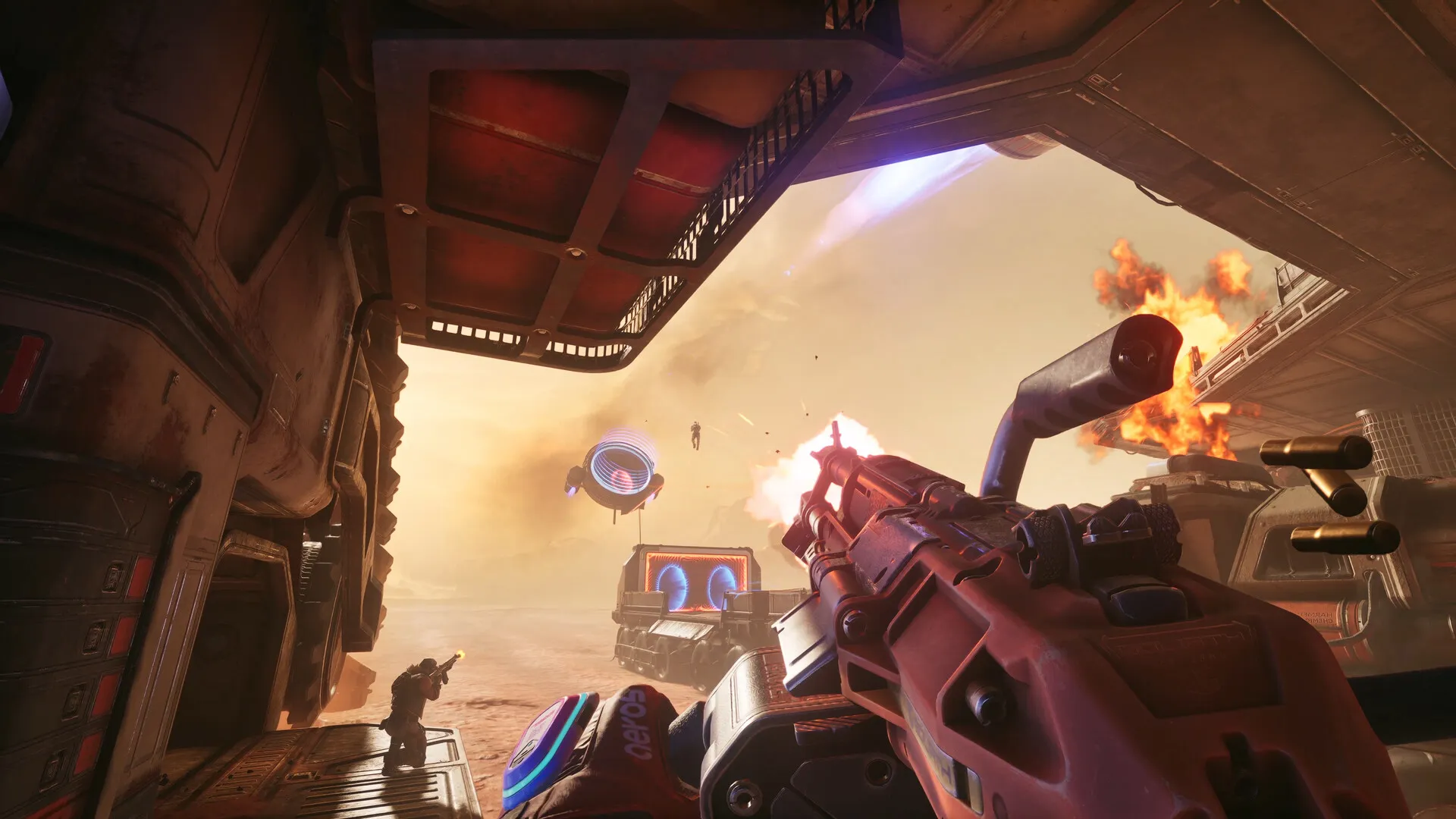
Battle Royale tells a different story. It plays like a late grab for an audience that already moved on from the peak of the trend, and the mode feels bolted on. Pacing swings between long stretches of looting and messy, hard-to-read finales. The loot loop drains energy from what wants to be a fast action game, sending players into scavenging behaviors that break the flow of movement and fighting. Too much time goes into staring at the ground for upgrades, and too little goes into using the game’s signature systems.
The portal decision in Battle Royale amplifies the problem. Cooldowns and usage limits land on the mechanic that separates Splitgate 2 from Warzone or Apex Legends. Restricting portal access reduces the distinctive edge in the mode that needs it most. The Battle Royale map structure adds another drag. It reads like a patchwork of smaller arenas connected by tunnels, lacking a cohesive geography and clear landmarks. The mode ends up feeling like a separate project made by a different team, with far less polish and intent than the arena suite.
Monetization and Progression
Going free-to-play demands monetization, and Splitgate 2 approaches it with a heavy hand. The store pushes cosmetic bundles with eye-watering pricing. Some prices shifted after community backlash, yet the anchor pricing still sits high. Skins and weapon coatings can cost as much as full indie games, and that valuation creates a disconnect that can make players feel viewed as revenue first.
The Battle Pass does little to soften that impression. Much of it is filler, stacked with banners, sprays, and icons that many players will ignore. The rewards that feel worth chasing sit deeper in the track, demanding significant time. Weapon progression raises sharper concerns. Leveling guns to unlock attachments like recoil reduction or faster aim-down-sight speeds gives long-time players a real advantage. These are stat changes that affect performance in match conditions, and new players step into fights with weaker versions of the same tools.
That design turns mastery into arithmetic. Skill growth still matters, yet the loop also asks you to grind until your numbers climb and your weapon handles better. The system can feel hollow, built for retention targets rather than player satisfaction. Daily log-ins start to look like obligation, driven by challenge completion and gated unlocks instead of the pull of the match itself. By adopting the most exhausting habits of the modern live-service model, Splitgate 2 risks burning trust with the community that helped build the series in the first place.
The Review
Splitgate 2
Splitgate 2 is a technically impressive shooter that trades its distinct identity for mass-market trends. The movement is sublime, offering a kinetic rhythm few competitors can match. However, the sanitized art style, generic gunplay, and sidelined portal mechanics leave the experience feeling hollow. The addition of a lackluster Battle Royale and aggressive monetization further dilutes the package. It is a polished product that works perfectly but lacks the rebellious spirit that made the original special. It checks every box on a corporate spreadsheet while forgetting the soul.
PROS
- The combination of sprinting, sliding, and jetpacking creates a fluid, kinetic rhythm that feels best-in-class.
- The game runs smoothly with high fidelity, a marked improvement over the original.
- Weapons like the "Splitstream" (dual SMGs) offer satisfying bursts of chaos.
- Classic modes like Splitball and Takedown effectively utilize the physics engine.
CONS
- The visual style feels sterile and corporate, lacking the industrial grit of the first game.
- The signature mechanic is now a secondary traversal tool rather than a tactical necessity.
- The new mode suffers from bad pacing, a patchwork map, and restrictive portal mechanics.
- Weapon attachments unlocked through grinding provide statistical advantages to veteran players.
- High cosmetic prices and a filler-heavy Battle Pass feel exploitative.