





















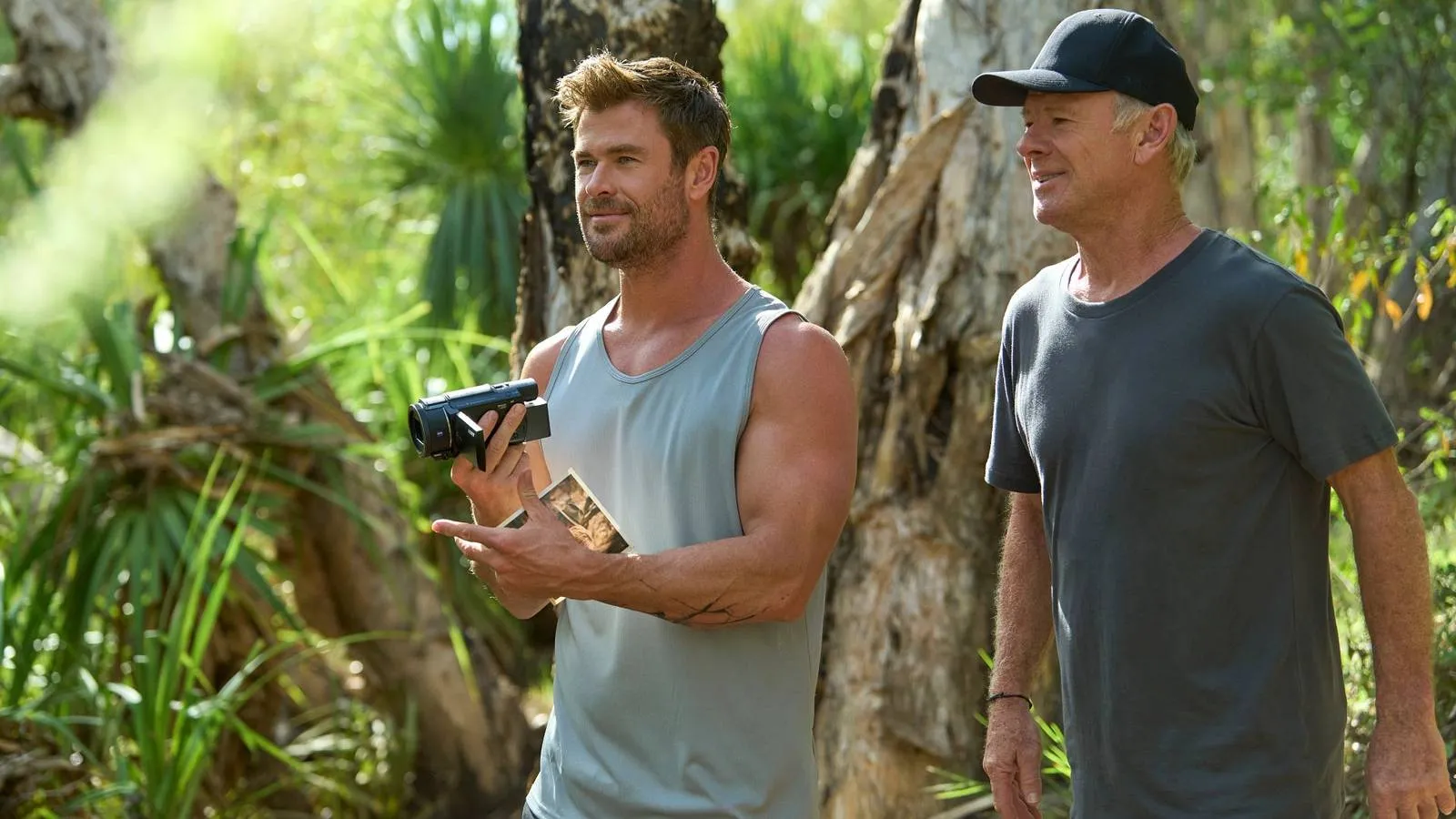

The documentary Chris Hemsworth: A Road Trip to Remember begins with a small, treasured photograph that places the story far from Hollywood. Chris Hemsworth looks at an image of his father, Craig, gazing at his young son with deep affection. That single frame sets the film’s priorities. It treats fame as background and keeps the camera on a family bond that predates it. The central pressure arrives in plain language: Craig has early-stage Alzheimer’s.
A father-son motorcycle trip that once read as simple adventure gains a new urgency, shaped by the fear of memories slipping away. Their route carries them through key places in Australia, from a reconstructed childhood home in Melbourne to the harsh openness of the Northern Territory outback. The film follows this movement as an attempt to hold onto connection while time feels thinner, powered by a son trying to help his father keep a shared past within reach. Love, steady and stubborn, drives the narrative forward.
Architecture of Memory and Emotional Cartography
The film steps outside a standard documentary flow by building a clinical method into its storytelling. Clinical psychologist Dr. Suraj Samtani appears to explain Reminiscence Therapy, framed here as the use of familiar spaces and objects to spark memory and support cognitive health.
The therapy becomes part of the film’s structure, shaping scenes and guiding what the camera chooses to prioritize. This alignment between medical practice and visual storytelling comes through most strongly during the recreation of the family’s 1990s Melbourne home. The production team reworks the space with meticulous attention, matching posters and furniture to Craig’s remembered world.
When Craig walks into the recreated interior, the shift is immediate. His posture and energy lift, and his face brightens as details return. The film holds on these moments long enough to show the mechanism at work: an environment built to invite recognition, a person responding in real time, emotion arriving as the visible payoff. Craig speaks about making wooden planes for his boys, a memory resurfacing through contact with a space designed to meet him where he is. The sequence functions like a repeatable design logic: place, trigger, recall, release.
The illness interrupts that pattern just as quickly. After hearing that his wife, Leonie, is joining them, Craig soon asks again, “Where’s Leonie?” The repetition lands hard because the film has already shown what reconnection can look like. The question exposes how fragile those gains are, and it captures the grief and helplessness Chris and Leonie carry as witnesses to a loss unfolding in front of them.
The Cultural Geography of Self
The documentary treats the Australian landscape as an element of identity, in line with strains of regional cinema where place and self remain tightly linked. The story moves from the recognizability of Melbourne suburbs into the distance and isolation of the Northern Territory outback.

The film uses this shift to scale the stakes outward while keeping the emotional focus intimate. The house recreation narrows attention to interiors and objects. The outback opens the frame into wide horizons that feel indifferent to human control, echoing the sense of facing a disease that reaches across families and borders.
Cinematography reinforces that push and pull. The film moves between expansive drone shots and close, unguarded images that play like private recordings, including footage shot by Chris himself. That range of perspective makes the trip feel both public and personal, a documented route and a family moment happening in real time.
Their destination is Bulman, a remote Aboriginal community tied to Chris’s early happiness and to Craig’s earlier working life as a respected buffalo wrangler. Returning there carries weight beyond sentiment. It reconnects them to a period when Craig stood in Chris’s eyes as a hero, grounded in a place that shaped their sense of who they were together. The film’s scenes with old friends from the local Indigenous community have a quiet directness. They show belonging as something formed through relationships and shared history, anchored to specific ground.
The documentary also acknowledges Chris’s genetic predisposition to Alzheimer’s, information tied to his Limitless series. That detail changes the emotional temperature of the trip. Craig’s condition remains the immediate reality, and the film allows it to cast a longer shadow, turning the ride into an anxious meditation on aging and wellness. Craig becomes both the father Chris remembers and a mirror held up to a possible future Chris cannot ignore.
Grief, Connection, and Cross-Media Humanity
The film draws its strength from linking a private crisis to themes that travel across cultures: grief, loss, love, and the struggle to stay present when memory frays. It tracks a shift in Chris’s posture toward the problem, moving from the impulse to repair what is slipping away to the work of sustaining connection in the moments still available. That change reads as emotional maturation shaped by circumstance, and it keeps the film from drifting into sentimentality.
Dr. Samtani’s presence helps the documentary explain core ideas about brain health, including social connection and social bridging, while keeping the tone human. The information arrives through conversation and observation, and the film uses the trip itself as a demonstration, letting shared movement, shared tasks, and shared conversations carry the point. Science and feeling sit side by side without competing for control of the story.
Director Tom Barbor-Might’s framing stays clear and intentional, circling back near the end to the location associated with the opening photograph. That return gives the film a sense of completion, strengthened by a concise runtime of under an hour that keeps the experience focused. The closing mood rests on a plain truth the documentary earns through its scenes: showing up matters, honesty matters, and love asks for patience, plus the steady choice to walk beside someone even when the path feels unfamiliar and hard.
Chris Hemsworth: A Road Trip to Remember is a deeply personal documentary special that premiered on National Geographic on November 23, 2025, and became available for streaming the following day on Disney+ and Hulu. The film follows actor Chris Hemsworth as he takes an emotional motorcycle journey across Australia with his father, Craig, who has been diagnosed with early-stage Alzheimer’s disease. Inspired by his own genetic risk factors, Chris designs the trip as a therapeutic “road trip back in time,” revisiting significant places and people from their past to explore the power of reminiscence therapy and social connection as tools for protecting brain health and combating cognitive decline.
Full Credits
Title: Chris Hemsworth: A Road Trip to Remember
Distributor: National Geographic, Disney+
Release date: November 23, 2025 (on National Geographic), November 24, 2025 (streaming on Disney+ and Hulu)
Rating: TV-14
Running time: 45 minutes / 50 minutes (approx.)
Director: Tom Barbor-Might
Producers and Executive Producers: Hannah Cooney, Tom Watt-Smith, Peter Lovering, Arif Nurmohamed, Jane Root, Darren Aronofsky, Ari Handel, Benjamin Grayson, Chris Hemsworth, Brandon Hill, Bengt Anderson, Simon Raikes, Tom McDonald
Cast: Chris Hemsworth, Craig Hemsworth, Dr. Suraj Samtani, Leonie Hemsworth
Director of Photography (Cinematographer): Jim Jolliffe, Craig Parry (mentioned in credits)
Editors: Greg Vince
The Review
Chris Hemsworth: A Road Trip to Remember
Chris Hemsworth: A Road Trip to Remember transcends the usual celebrity vehicle, offering a deeply affecting and intellectually resonant exploration of memory, love, and loss. By elegantly blending clinical insight with the raw vulnerability of a father-son relationship, the film provides a powerful, universal reflection on family legacy and the fragility of the human mind. The masterful use of Australia’s cultural landscape and the sensitive visual storytelling make this brief documentary profoundly memorable and essential viewing.
PROS
- Provides a raw, honest look at Alzheimer's from the perspective of both the patient and the loved ones.
- Effectively uses Reminiscence Therapy as a storytelling mechanic, creating compelling, real-time emotional results.
- Excellent cinematography that contrasts intimate close-ups with the vast, symbolic Australian setting.
- Successfully integrates Australian geography and community (e.g., Bulman) to ground the personal journey in a larger sense of identity.
CONS
- The sub-hour length can feel too short given the complexity and emotional weight of the subject matter.
- While muted, Chris Hemsworth's star power and resources occasionally create a gulf between the viewer's experience and the film's premise.
- Concentrates primarily on the father-son dynamic, potentially leaving out deeper explorations of other family members' coping mechanisms.