

























![Kingdom Hearts Collection [I-III] Review](https://gazettely.com/wp-content/uploads/2026/10/Kingdom-Hearts-Collection-I-III-1-360x180.webp "Kingdom Hearts Collection [I-III] Review: KHII Holds Steady as Newer Entries Fluctuate 37")



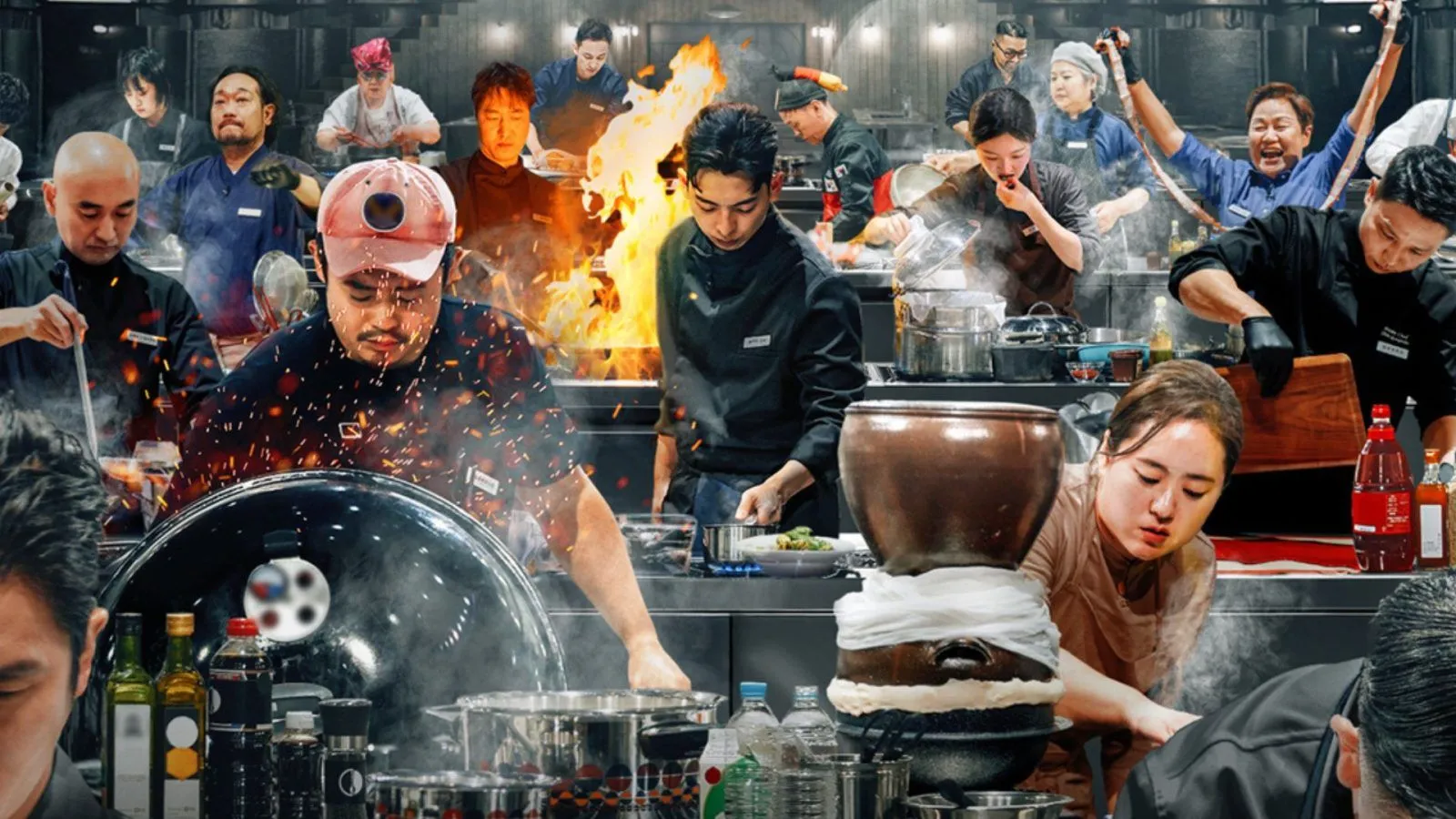

The second season of this South Korean production lands with its eyes locked on hierarchy: the social rules that decide who gets labeled “excellent,” who gets seen, and who gets remembered. Its “Black Spoon” and “White Spoon” divide turns that hierarchy into a literal casting system. Eighty skilled chefs, introduced through functional aliases, make up the Black Spoons.
They are restaurant owners and local masters who operate outside public fame. Eighteen White Spoons sit on the other side, framed as Michelin-starred legends and international icons. The kitchen tension grows out of that imbalance, where prestige walks in wearing a name tag and experience walks in wearing a mask.
The judges sharpen that imbalance further. Returning judges Paik Jong-won and Anh Sung-jae operate as two competing definitions of authority. Paik carries the confidence of commercial success and the instincts of a populist restaurateur. Anh brings the severity of South Korea’s only three-star Michelin practitioner. The set’s sheer scale signals major investment in reality TV as a headline format, built to feel urgent and expensive.
This season’s pacing embraces the streaming-era appetite for immediacy. It moves quickly from theatrical introductions into a high-speed elimination phase that demands technical control under extreme pressure. The show frames “merit” as something measurable in minutes and mouthfuls, then asks viewers to watch how that promise holds up inside a stratified industry.
Procedural Subversion and the Hidden Risk
Season two introduces instability through the “Hidden White Spoons,” a twist that weaponizes reputation by putting it on trial. Former competitors Choi Kang-rok and Kim Do-yun return, yet they do not step straight back into the elite bracket. They compete alongside the Black Spoons in the opening round. The move rewires sequel logic. Familiar faces have to earn their standing again, in public, under the same time pressure as everyone else.
The rule governing their survival is blunt: both judges must agree. Unanimous approval keeps a Hidden White Spoon in play. A split decision triggers immediate dismissal. That double-approval requirement creates a distinct kind of jeopardy, because it forces a contestant to satisfy two value systems at the same time. It also highlights an industry contradiction the show keeps circling. The series sells evaluation as clean and decisive, then concentrates enormous power in the hands of two gatekeepers whose tastes and standards do not align.
Their return also changes the numbers in a very literal way. If a Hidden White Spoon advances, the slot count available to Black Spoons can rise from eighteen to twenty. The competition becomes a shifting math problem, where one person’s second chance alters someone else’s pathway. During the primary elimination, eighty-two chefs get exactly 100 minutes to serve a plate meant to define their career.
That density pushes the judges toward instinct and pure flavor because there is no time for long deliberation. Background and biography fall away under the clock. The dish has to speak fast, and it has to speak clearly. The promise is equal footing. The reality is a pressure chamber where reputations exist, yet rules refuse to protect them.
Personal Identity and Technical Precision
The Black Spoon roster carries personal identity into the arena through temporary nicknames that point to specialties. Those labels function like branding, yet the skills on display signal seasoned professionalism. Brewmaster Yun stands out as an example of artisanal dedication. She distills her own soju on set to make sure her pairing lands with precision. Her process places traditional craft on the same stage as competitive spectacle, suggesting a turn toward hyper-local expertise as a form of credibility.
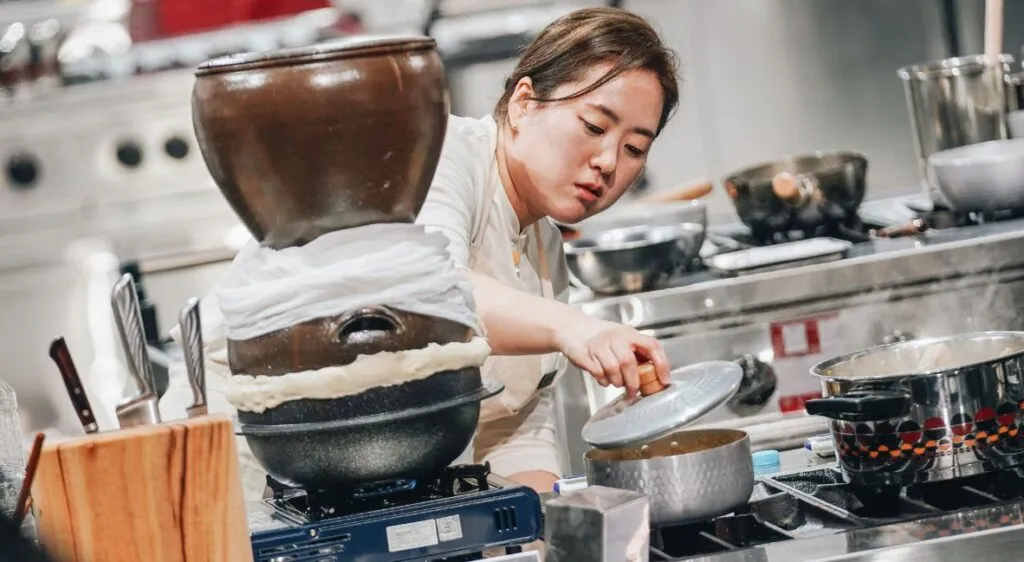
French Papa provides a different kind of personal grounding, explaining that cooking remains his primary connection to his son. The show treats these details as more than ornamentation. They shape how the audience reads a contestant’s choices, what risks feel meaningful, and what the word “career” weighs in a 100-minute window.
The series keeps returning to a quiet question: who gets to be known as a person, and who gets reduced to output? The Black Spoons arrive largely anonymous to the public, while the White Spoons enter framed by status and legend. That imbalance becomes a representation issue inside the genre itself, where visibility often tracks prestige.
The craft on display stays intensely technical. Some contestants bring custom noodle machines into the arena. Others reach for rare regional ingredients such as Wonju beef tongue or Gapyeong pine nuts. The judges respond through their own philosophies. Paik seeks the soulful, satisfying qualities that make a restaurant dish succeed with diners.
Anh measures intellectual clarity and physical execution, breaking dishes into component decisions. The presence of international restaurateurs and former colleagues of the judges among the Black Spoons pushes the season toward parity. The show makes a pointed case that talent lives in many places, while fame collects in only a few. The distance between a “hidden” master and a “celebrity” chef often comes down to branding and public access, not culinary ability.
The Objective Lens of Blind Evaluation
As the season moves deeper into its later rounds, production design leans hard into the idea of objective judgment in a world built on name recognition. The 1:1 battles use blindfolded judging to remove the influence of a chef’s history. Without visual cues of rank, Paik and Anh have to trust their palates. The choice reads like a direct strike at the culinary cult of personality, where reputation can overpower the plate and media presence can become a substitute for proof.
The show’s visual language has been upgraded to match that pursuit of fairness. A massive, high-tech regional map reveals secret ingredients, replacing the simpler setups from the previous season and tying the competition to the geography of South Korean food production. It is a slick flourish with a serious implication: ingredients have origins, and craft has roots, even inside a televised arena built for spectacle.
Editing stays fast and rhythmic, with episodes frequently cutting at peak tension to keep momentum high. The series pairs that intensity with a kind of aesthetic calm that lets the viewer watch professionals work. The camera lingers on plating like it carries real stakes, treating presentation as a disciplined art form rather than a garnish for drama.
Strategy adds psychological pressure in the selection process, where Black Spoons choose their White Spoon rivals, turning matchmaking into a test of nerve. The season’s success comes from taking craft seriously while keeping the tempo of a survival drama, and from using reality-TV mechanics to expose how status is manufactured, defended, and occasionally punctured under a blindfold.
Culinary Class Wars Season 2 premiered on December 16, 2025, continuing the high-stakes tradition of the South Korean culinary survival genre. Currently available for streaming exclusively on Netflix, this season raises the intensity of the competition between “Black Spoon” underdog chefs and “White Spoon” culinary legends. With new episodes releasing weekly through January 2026, the series explores the intersection of professional status and technical mastery in a massive, high-budget kitchen arena.
Full Credits
Title: Culinary Class Wars Season 2
Distributor: Netflix
Release date: December 16, 2025
Rating: TV-14
Running time: 60–80 minutes per episode
Director: Kim Hak-min, Kim Eun-ji
Writers: Mo Eun-sol
Producers and Executive Producers: Kim Hak-min, Kim Eun-ji, Yun Hyun-joon
Cast: Paik Jong-won, Anh Sung-jae, Choi Kang-rok, Kim Do-yun, Lee Jun, Son Jong-won, Sam Kim, Raymon Kim
Director of Photography (Cinematographer): Hong Jung-pyo
Editors: Studio Slam Editing Team
Composer: Park Gyo-yeon, Seok Seung-hee
The Review
Culinary Class Wars Season 2
This season successfully strips away the artificial polish of celebrity to focus on the raw mechanics of talent. By forcing elite figures to defend their rank through blind evaluations, the show creates a rare space where skill dictates status. It provides a sharp look at how expertise functions when removed from the protection of a brand. This production serves as a high-stakes meditation on professional excellence that feels both earned and grounded. It stands as a superior example of the competitive genre.
PROS
- Blind evaluation rounds ensure fairness by removing reputation bias.
- The high-budget presentation respects the technical labor of the chefs.
- The use of regional ingredients highlights local heritage with precision.
- The tension remains focused on the craft rather than manufactured drama.
CONS
- Initial episodes contain long introductions that delay the action.
- Heavy reliance on cliffhangers can disrupt the viewing rhythm.
- The sheer number of contestants makes early connections difficult.







