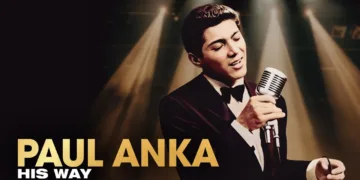






















Paul Anka’s name carries across seven decades of American pop culture, a career line that resists the familiar story of rise and collapse. John Maggio’s documentary Paul Anka: His Way treats that span as an experiment in self-designed identity, a study in how a performer builds and protects a persona over time. The film follows a life driven by relentless professional will.
It frames his story as an epic of continuous, calculated adaptation that begins in the turbulence of 1950s teen idol hysteria and moves toward the position of premier global composer. The perspective stays tightly aligned with the subject. Anka sets the tempo of the narrative, guiding the account with the ease of a seasoned storyteller who has rehearsed his best lines for decades.
The film’s structure operates on a precise dual track, aligned with two distinct temporal planes. One thread follows the octogenarian Anka on a recent world tour and records the disciplined energy required for late-career performance. The other thread cuts through time with a dense array of archival material that flares up like sudden memory, charting his path from adolescence forward.
This design presents a man locked in an ongoing existential conversation with his own history, constantly weighing the mass of his legacy against the pressure of the present moment. The film marks his early triumphs with hits such as “Diana” and “Lonely Boy,” while giving equal weight to the off-stage work that reshaped his status. Songs like “My Way” for Frank Sinatra and “She’s a Lady” for Tom Jones define that second axis of power. The focus never drifts far from Anka, whether as architect of the music, visible figure on stage, or tireless entrepreneur.
Adapting to Survive the Spotlight
Anka’s professional path appears as an intricate lesson in strategy rather than a simple unfolding of talent. The early portion begins with a sixteen-year-old from Ottawa arriving in New York. He carries one hundred dollars, then lands with sudden force when “Diana” erupts. The film positions him as a central presence in the post-crooner pop field, standing shoulder to shoulder with figures like Frankie Avalon.
A key advantage receives clear emphasis: Anka writes his own material. That choice places him ahead of his peers in a business defined by disposability. He sees the temporary nature of teen stardom with unusual clarity. The film stresses that this market is unstable and built to age out. He holds his own publishing rights, a creative and financial anchor that gives him a rare degree of control.
With that base secured, the documentary follows a decisive, carefully judged shift. Anka moves out of the fleeting teen marketplace and into the more sophisticated adult environments of Las Vegas and the Copa, entering the orbit of the Rat Pack. They recognize him, with a slightly amused tone, as “The Kid.” This migration reads as a survival move that lengthens his working life.
The most severe challenge to that strategy arrives with the British Invasion. The film frames this as a monumental break in musical taste that threatens to erase his sound from radio. Anka refuses to vanish. He turns fully to the role of master composer and answers the guitar-driven wave with the timeless anthem “My Way.” The documentary presents this choice as the moment that sets his name among the fixed stars of American music.
His control of intellectual property emerges as a decisive factor. The film traces how that control leads to decades of striking earnings from compositions. The story behind the theme for The Tonight Show Starring Johnny Carson appears as a near-mythic example of his business intelligence. The career map stretches from early work for Buddy Holly through present-day collaborations with artists like Drake and Doja Cat. This stretch of time signals a drive that refuses stasis or retirement. The portrait reads like an architectural plan for continuous professional reinvention, lit from within by equal parts calculation and appetite.
The Architecture of Memory
Maggio’s stylistic approach builds a visual system that feels both exhaustive and sharply controlled. The documentary draws deeply from rare archival footage, with particular emphasis on the 1963 National Film Board of Canada short Lonely Boy. That reservoir of history allows the film to avoid the usual dependence on static, explanatory talking-head interviews.

Instead, the viewer receives a kinetic, forward-moving narrative steered by Anka’s own charismatic, assertive voiceover. The camera language leans on contrast. High-definition present-day images sit beside grainy material from the 1950s and 60s. The effect recalls expressionistic framing, an almost noir-style distortion of reality that suggests the blown-up scale of early fame.
During the world tour sections, lighting design becomes a philosophical tool as well as a practical one. The stage lights carve Anka out of the surrounding darkness and underline the persistence of the showman. The large-scale concerts carry a sense of theatrical spectacle that underscores his continuing vitality. His voice still lands with force, and the film presents a body that holds the stage without visible hesitation. The camera observes his disciplined routine, including the daily olive oil and lemon ritual that serves as a quietly comic counterpoint to the grandeur of the performances. It looks like the least glamorous special effect in the film, a small domestic act that keeps the machinery running.
Anka’s performance style remains kinetic. The film records dramatic walks onto the stage and his ongoing desire to move directly into the crowd, to “press the flesh” with the people who fill the seats. Bill Burr, one of the voices on hand, sums up the strange energy of this spectacle with a line: “This guy’s eight decades in and he has the excitement of a young man.” The documentary threads in commentary from figures such as Frankie Avalon, Irving Azoff, and Jason Bateman, yet the gravitational pull stays with Anka under the lights.
Editing provides the primary instrument of tension management. The cutting pattern between past and present creates a rhythm that binds memory to the live moment, keeping the historical material tethered to the image of an artist still working. The film manages to shape an octogenarian’s retrospective gaze into something that feels as charged as a psychological thriller, with the audience drawn to small shifts in tone and gesture instead of car chases.
The Price of Unwavering Self-Determination
The title His Way functions as a direct statement of method and philosophy. It signals a narrative controlled by its subject and styled as a celebratory portrait. The result has the polish of an authorized biography, shaped from the inside by the person under examination. The film openly embraces that arrangement. The philosophical core sits in an inquiry into the cost of total professional commitment. One clear question echoes through the edit: what price does unwavering self-determination extract from a private life?
The documentary addresses the strain that Anka’s work placed on his first marriage to Anne de Zogheb with clear language. The breakup links directly to his refusal to accept her request that he step away from constant touring. The film draws a subtle distinction here. Fame itself does not receive the blame for the dissolution of the marriage.
The destructive force comes from Anka’s intense focus on the work, his need to perform and create without pause. He appears primarily as a professional entity, a “show business animal” whose identity fuses with unbroken exposure to stage lights. His energy flows entirely into the craft of entertaining, into the nights onstage and the deals that keep that machine funded.
An earlier comment from Sammy Davis Jr., preserved in the documentary, sharpens this portrait. Davis notes that Anka “cares about his art craft. He cares about what songs he writes.” The film places that remark as a kind of key. Passion fuels the scale of his success and at the same time rises up as the dominant force that overshadows intimate bonds.
Across the running time he appears as both artist and astute businessman, a strategist who holds on to creative and financial authority over his catalog. The closing impression is of a figure who lives under a bright, harsh spotlight of his own construction, a man who selects the stage as his true home and accepts the ethical and emotional cost that comes with that decision.
The HBO Original documentary, Paul Anka: His Way, premiered on Monday, December 1, 2025, charting the seven-decade career of the iconic Canadian-American singer-songwriter. Directed by Emmy-winning filmmaker John Maggio, the film operates as both a road movie, following Anka on his recent world tour, and a living biography, featuring extensive archival footage. It explores his transformation from a 1950s teen idol to a globally renowned composer, responsible for classics like “My Way” and the theme for The Tonight Show Starring Johnny Carson. The documentary is available for streaming on HBO and Max (formerly HBO Max). The running time is approximately 1 hour and 40 minutes (100 minutes).
Full Credits
Title: Paul Anka: His Way
Distributor: HBO / Max
Release date: December 1, 2025
Running time: 100 minutes
Director: John Maggio
Writers: John Maggio
Producers and Executive Producers: Monica Berra, John Maggio, Caroline Kimmel, Irving Azoff, Lawrence Mestel, Randy Lennox, Jo Henriquez, Charlie Corwin, Laura Michalchyshyn, Sam Sniderman, Dorin Razam-Grunfeld, Zachary Herrmann
Cast: Paul Anka, Frankie Avalon, Bill Burr, Jason Bateman, Irving Azoff, Alicia Anka, Michele Dahl
Director of Photography (Cinematographer): Justin Zweifach
Editors: Seth Bomse
Composer: Paul Anka
The Review
Paul Anka: His Way
Paul Anka: His Way is a meticulous self-portrait, less a documentary and more a command performance. The film excels as a comprehensive chronicle of strategic ambition and career longevity. While it prioritizes celebration over critical distance, its dual-timeline structure and wealth of archival footage make it a dynamic watch. This is a fascinating examination of a showman whose life is indistinguishable from his work.
PROS
- Exceptional use of rare, historical archival performance footage.
- The dual timeline structure is kinetic, blending past history with current tour energy.
- A unique study in professional adaptability across seven decades of music industry shifts.
- Anka's sustained vocal talent and showmanship are clearly and impressively captured.
CONS
- The narrative lacks external critical perspective, feeling heavily controlled by the subject.
- Focus on professional achievements outweighs deep introspection on personal sacrifices.
- The hagiographic approach diminishes exploration of potential setbacks or complexities.