































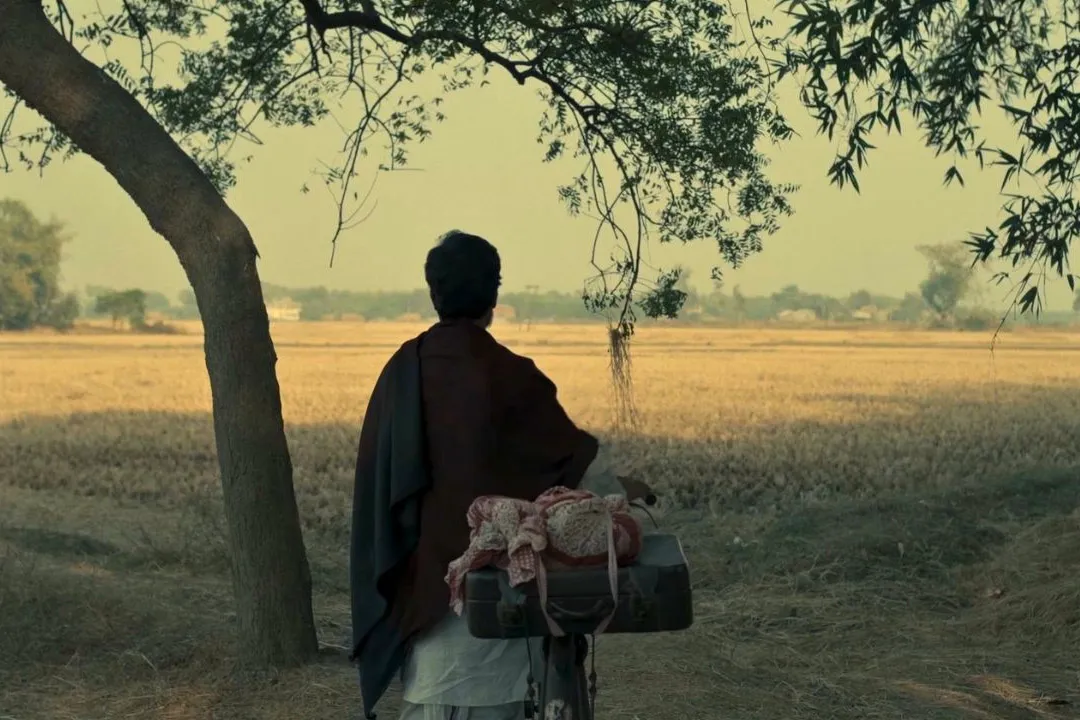
The Exile places us in rural Bengal in the late 1960s, and it locks onto that setting with impressive clarity across an 82-minute runtime. Samman Roy’s independent, micro-budget production opens with Gouranga, a man frozen in place after the sudden death of his wife, Phoolmoni. The early scenes carry the weight of that loss in their pacing and in the quiet that settles around him. In his village, concern turns forceful.
Neighbors fixate on his isolation and the way he disappears into books, treating his depression like a problem the community can solve through pressure. Elders push him toward employment, insisting he return to daily routine. That insistence becomes the spark for movement. Gouranga leaves to find his friend Nibaran in Moshagram, a decision that pulls him away from people and into the woods. The film first captures how suffocating a village’s watchfulness can feel, then shifts toward the raw solitude of the wilderness.
Literary Roots and the Architecture of Grief
Samman Roy draws from a 20th-century Bengali horror lineage, and the film signals an affinity with the atmospheric writing associated with figures such as Bibhutibhushan Bandyopadhyay. The Exile leans on local folklore and treats it as lived texture, part of the soil and the air, not a decorative reference.
The title frames exile as an inner condition, a psychological distance that shapes how characters see themselves and how others position them. Several figures carry their own version of that separation. Some retreat from reality into private coping rituals. Others end up isolated through social expectations that tighten around them.
That thematic groundwork supports the story’s shape. The narrative begins in the register of social drama, tracking the plain weight of mourning and the village response to a man who no longer fits the expected rhythm. As the film progresses, the surface realism thins and metaphysical horror takes over. The transition feels rooted in the landscape and in the myths attached to it, so the supernatural reads as part of the rural world’s emotional vocabulary.
The witch Gouranga encounters in the forest works as an external form for internal damage. She embodies psychological and spiritual torment, giving Gouranga’s guilt and his inability to release the past a physical presence that can follow him. The result is a focused study of trauma’s ability to reshape perception, turning familiar spaces into hostile terrain.
Technical Precision and Auditory Dread
The Exile’s craft shows how a small budget can still support precise filmmaking choices. The cinematography stays sharp and moody, building a visual language that treats village textures and forest density with equal attention. In the final act, lighting and composition take on extra force. Low-light scenes in the woods use shadow and framing to suggest something nearby that refuses clear visibility, creating threat through absence and partial revelation.
Sound design carries just as much weight. The placement of “Rosh Nai Re” lands like a stain that lingers after the notes fade, shaping memory inside the scene rather than functioning as simple accompaniment. A Tagore song becomes a hinge in the film’s structure, marking a firm line between the village’s realist drama and the supernatural movement that follows.
These choices show a strong grasp of how audio cues can guide anxiety, especially in horror traditions that rely on suggestion. Arghya Roy and Arpita Dey provide the emotional grounding that keeps these techniques connected to character. Their performances give the script a lived-in quality, sustaining investment in internal struggle while the external world bends into something increasingly unstable.
The Rhythm of Independent Cinema
The film moves at a slow tempo that fits its independent character. Much of the first half stays with dialogue and everyday village interactions, letting conversations accumulate until Gouranga’s stagnation becomes palpable. The extended exchanges may remind some viewers of mumblecore, with long stretches where the surface subject of a scene matters less than the awkward emotional weather underneath it. The dialect sometimes registers as slightly artificial for a 1960s setting, yet the choice keeps attention on character and on the social dynamics inside each conversation.
Tension grows out of small hopes and the protagonist’s lingering guilt, not from loud set pieces. The Exile favors psychological deterioration and a steady tightening of mood. Its micro-budget reality shows up in the reliance on dialogue-heavy scenes, and the film turns that constraint into style, committing to atmosphere as its main engine.
That places it in conversation with international slow-burn horror, where dread builds through rhythm, environment, and the gradual warping of perspective. The restrained opening demands close attention to Gouranga’s inner life, and that attention pays off in a climax shaped by accumulated unease, built step by step rather than delivered through sudden shocks.
The Exile is a Bengali-language psychological folk horror film that follows a grieving man in 1960s rural Bengal who encounters supernatural forces while confronting his own past. After gaining recognition as a winner at the NFDC Film Bazaar in 2023, the film had its official premiere on digital platforms and through select distributors on September 19, 2025. Viewers can currently watch the film on platforms such as Amazon Prime Video, Tubi, and Fandango at Home.
Full Credits
Title: The Exile
Distributor: Buffalo 8, AK Studios
Release date: September 19, 2025
Rating: TV-14
Running time: 82 minutes
Director: Samman Roy
Writers: Samman Roy
Producers and Executive Producers: Awadhesh Kumar, Prateek Bagi, Abhijit Kumar Barua, Shaunak Sur, Matthew Helderman, Luke Taylor
Cast: Arghya Roy, Arpita De, Adrita De, Soumya Majumdar, Pradip Ray, Awadhesh Kumar
Director of Photography (Cinematographer): Shubhadeep Bag
Editors: Samman Roy
Composer: Aador Das
The Review
The Exile
The Exile succeeds as a moody piece of folk horror that prioritizes atmosphere over cheap shocks. The initial sections move at a slow pace, yet the technical precision and emotional depth of the lead performances ground the narrative. It effectively honors traditional literature while maintaining a distinct independent voice. The film captures the stillness of grief before transforming it into a sharp, psychological nightmare. It serves as a strong debut for Samman Roy and a refreshing entry in the regional genre.
PROS
- Sharp and moody cinematography that maximizes the budget.
- Effective use of traditional music and soundscapes to build dread.
- Grounded, nuanced performances by the main cast.
- Faithful recreation of the 1960s rural Bengal atmosphere.
CONS
- Slow tempo in the opening acts might test some viewers.
- Specific dialogue choices can feel artificial for the historical period.
- The limited scale of the production shows in a few transitions.