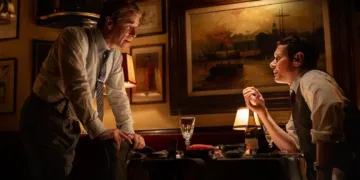


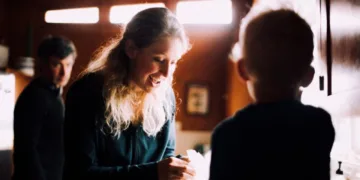




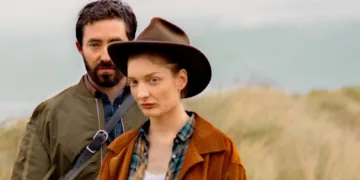









The title The Mother, the Menacer, and Me announces a tidy chain of influence, then immediately starts to pull it apart. At first glance the film seems to foreground the corrosive energy of Nancy (Lorraine Bracco) and the eerie fictional presence of the Menacer, yet the real gravitational point is the final word: the “Me,” Eddie Mathews (James Austin Kerr). The movie keeps circling this misdirected emphasis, following a devoted but perpetually cash-strapped independent filmmaker who operates in the decidedly unromantic setting of Pewaukee, Wisconsin.
His professional life runs on artistic urgency, while his personal life sits under the harsh, constant scrutiny of Nancy, his mother-in-law. On top of that surveillance come the demands of caring for his pregnant wife, Anna (Christine Spang), and their young son, Billy.
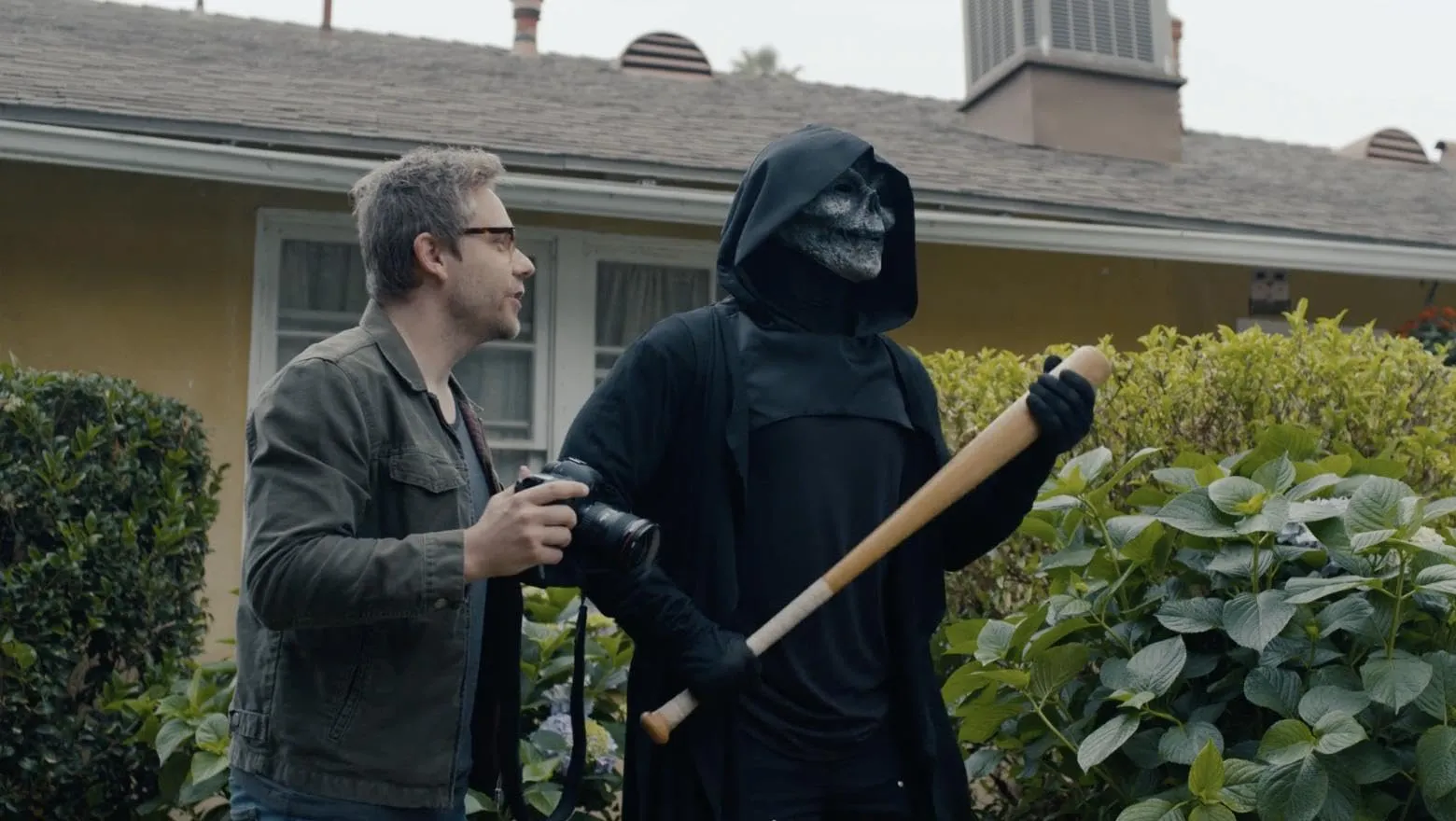
Eddie’s artistic obsession, a horror pilot titled Killing Karens, supplies the engine for his professional anxiety. The project functions as a form of vigilante revenge narrative. It features the masked figure known as the Menacer and grows out of a racial slight directed at his best friend, Joe Adcock (Alfonso Caballero), years earlier. Eddie races to finish the pilot for a prestigious film festival whose grand prize promises a development deal, a golden ticket that might finally remove him from Cheesehead country.
The film works in a tone of light comedy, held together by an earnest sentimentality that stops its regular cynicism from hardening into real cruelty. The story tracks the spirit of bootstrap cinema, told with a modest Midwestern temperament that hides the scale of Eddie’s ambitions.
The Dreamer’s Dilemma: Debt, Desire, and the American Suburb
The picture builds its central conflict around a familiar cultural rule: society keeps repeating that people may chase creative goals at any age. That rule takes on a strained, slightly sugary quality once it attaches to Eddie. He is married, waiting for a second child, and already deep in financial instability. Every artistic plan passes through the filter of heavy family obligation.
This is far from the romantic idea of the young “struggling artist.” The film instead presents a man trying to slip away from the closing grip of middle-class debt and suburban inertia. Viewers feel a split response. We want his dream to succeed, while at the same time his financial recklessness and patchy work ethic make the criticisms from Anna and Nancy sound painfully reasonable.
Nancy acts as the sharp-tongued, skeptical counterweight who keeps the drama on edge. She channels the social demand for economic security, reading Eddie’s filmmaking drive as a hobby that endangers her daughter’s future. Lorraine Bracco lends this apparently simple role a nervous undercurrent. Beneath the quips, she projects deep maternal fear about the family’s prospects. Anna begins in a position of support, then the grind of daily life wears down that loyalty. Geography becomes the new pressure point. The possible Hollywood development deal requires a move, and Anna must weigh her husband’s career against the pull of home, familiar streets, and extended family.
Eddie’s directorial venture, the making of Killing Karens, provides the story’s concrete machinery. Life on set plays like a portrait of low-budget desperation and scruffy creativity. The film itemizes the comic yet desperate strategies Eddie uses to raise money (including trips to sell bodily fluids), the constant scavenger hunt for props, and the chaos created by casting problems, such as the arrest of the original Menacer actor.
This portrait of amateur filmmaking reads as a salute to DIY aesthetics, underlining the sincerity of Eddie and Joe’s shared artistic belief even when all available evidence suggests they lack marketable skill. The movie lands because it treats their financial fragility, their obsessive hunt for a perfect signature kill, and their dependence on local performers as absurd and quietly affecting at the same time.
The Fraternal Bond and the Weight of Professionalism
James Austin Kerr carries the emotional and narrative load of the film with an easygoing presence. His performance keeps Eddie engaging. Kerr’s natural charm recasts a man who often dodges responsibility into someone who can still invite sympathy. The casting works as a moral guidepost for the film, even while the character’s flaws remain visible.

Lorraine Bracco’s inclusion adds a sly layer of meta-commentary. Her presence, tied to a career that signals professional success, quietly marks the gulf between Eddie’s scrappy, credit-card-based ambition and the distant realm of established industry achievement he chases. Bracco’s work is carefully tuned, catching the truth of Nancy’s exhausted resignation while preserving the humor of her obsessive porcelain gnome collection.
The marriage between Eddie and Anna (Christine Spang) is sketched with sarcastic, blunt realism that pins down the wilder story beats. Their conversations carry the shorthand of a long relationship under financial strain and clashing priorities. Another of the film’s key strengths lies in the relaxed, brotherly rhythm between Eddie and his friend Joe (Alfonso Caballero). Their friendship forms the genuine emotional motor of the narrative, a non-judgmental zone where Eddie’s dream can stay alive. Joe stands as confidant and co-conspirator, proof of the enduring power of a shared childhood fixation.
The ensemble around them thickens the slightly heightened yet recognizably small-town world. Brian Tichnell’s Kevin, the apparently dim brother-in-law living in the garage, shifts over time from comic bully to unexpectedly helpful presence. Leah Remini’s late-arriving cameo as festival director Karen Brazo Fuerte injects a sharp burst of jaded, industry-specific absurdity. Together, the supporting performances help construct a coherent environment in which even the broadest caricatures feel emotionally connected to the same universe.
Style, Genre, and the Authenticity of Local Humor
Director Jon Salmon’s history as a successful cinematographer shows up in the movie’s smooth technical surface. That polish creates an ironic charge. The finished feature looks controlled and professional, while the film within the film that Eddie struggles to complete remains chaotic and rough. The visuals capture the quiet air of Pewaukee, a suburb that seems designed to smother outsized Hollywood dreams. Only during the scenes devoted to the production of Killing Karens does the visual language change, adopting a bloody, bargain-bin horror style for comic impact.
The film plays as a quirky, tender comedy that orbits horror culture. It sidesteps the darkness and intensity of conventional horror, choosing a breezy, light watch instead. That decision keeps the film open to a wide audience, even as its jokes grow out of a tightly regional dialect. The script leans on Wisconsin-specific flavor, from local burger chains to named townships and particular accents. The tradeoff feels clear. Certain punchlines may lose force for viewers unfamiliar with that microclimate, yet the specificity resists the flattening effect of generic American regional comedy and gives the movie a distinct Midwestern personality.
The film succeeds, even during stretches when the plot machinery feels a little too convenient or easily predicted. Its chief impact lies in its capacity to function as emotionally connected cinema, comfort food tuned to viewers who know the independent film grind firsthand or by proximity. Strong performances and an unflagging sense of likability keep the piece steady. The film’s central purpose is to craft a sentimental ending for a man with delayed dreams, favoring the glow of family affection over a strict, unsparing audit of his bad choices.
The Mother, the Menacer, and Me is a dark comedy that premiered on the film festival circuit in 2025 and will be available to watch digitally on VOD platforms starting December 11, 2025. The film follows struggling independent horror director Eddie Mathews as he attempts to complete his passion project, Killing Karens, all while managing his growing family and living under the roof of his highly critical mother-in-law, Nancy.
Full Credits
Title: The Mother, the Menacer, and Me
Distributor: Ghost to the Post Productions (Production Company), Available on VOD (Digital Release Platform)
Release date: December 11, 2025 (Digital/VOD)
Running time: 91 minutes
Director: Jon Salmon
Writers: Chris Carvalho, Chris Plaushin
Producers and Executive Producers: Tony Estrada, Chris Carvalho, Chris Plaushin
Cast: Lorraine Bracco, Leah Remini, James Austin Kerr, Christine Spang, Alfonso Caballero, Kellan Tetlow, Brian Tichnell, Jeremy Luke, Monica Bhatnagar
Director of Photography (Cinematographer): Matthew Chavez
Editors: Peter Cabada Hagan
Composer: Katy Jarzebowski
The Review
The Mother, the Menacer, and Me
The Mother, the Menacer, and Me excels as a warm, funny examination of creative ambition colliding with adult responsibility. The film leverages the unique aesthetic of low-budget filmmaking to tell a universal story about sacrifice and perseverance. While its sentimental leanings soften the edge of its central conflict, the strength of the amiable lead performance by James Austin Kerr and the sharp comic relief from Lorraine Bracco ensure the picture remains engaging and deeply felt. It is an effective, charming tribute to the dreamer operating outside the Hollywood perimeter.
PROS
- Excellent, amiable lead performance by James Austin Kerr.
- Lorraine Bracco’s performance adds professional weight and nuance.
- Authentic portrayal of chaotic, low-budget filmmaking.
- Strong, natural chemistry between the lead and his best friend, Joe.
- Effectively blends comedy with genuinely heartfelt familial conflict.
CONS
- Relies heavily on regional humor (Wisconsin in-jokes).
- The sentimental tone occasionally simplifies complex issues of financial responsibility.
- Plot points concerning the protagonist's age and timing feel convenient.
- The overall narrative structure is predictable.
- Not a true horror film, which might disappoint some genre fans.