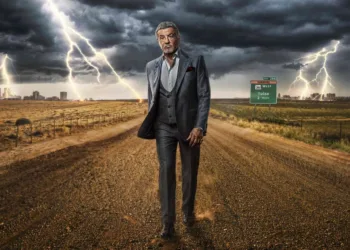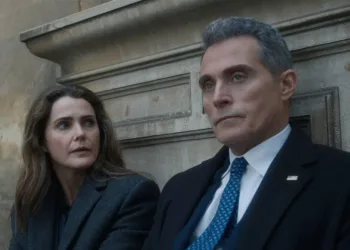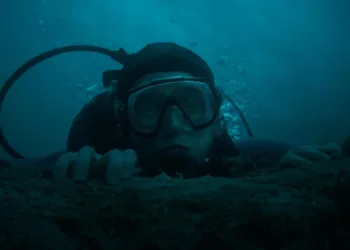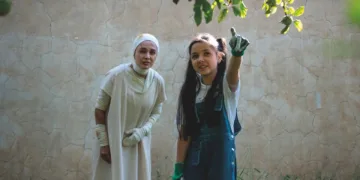














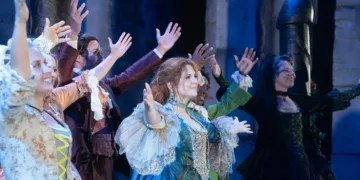







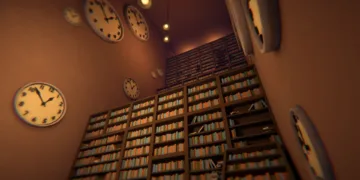



The studio backlot is traditionally a space of constructed artifice, yet in Shahram Mokri’s latest work, Black Rabbit, White Rabbit, it becomes a stage for an existential crisis. Mokri, an Iranian filmmaker known for structural experiments in films like Fish & Cat, tests linear storytelling here and stretches it until it almost tears.
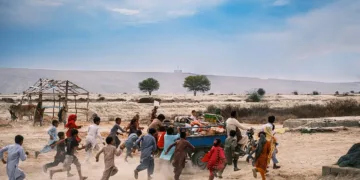
The film unfolds across the sun-baked, chaotic grounds of a Tajik film studio, a world where every scene and every moment seems subject to revision. The core architecture functions as a meta-cinematic puzzle, designed to collapse the line that separates reality from theatrical illusion.
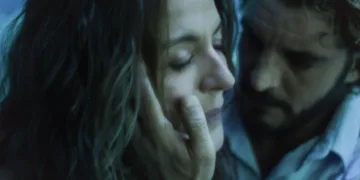
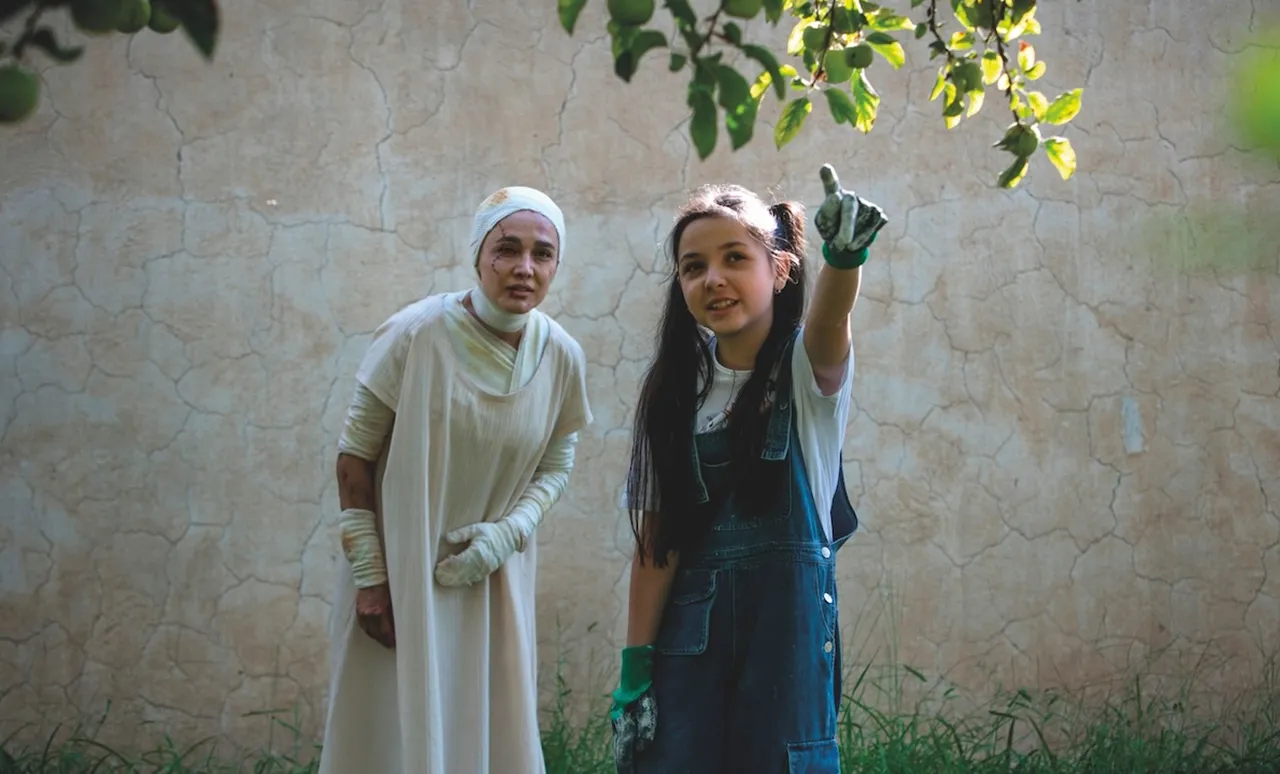
The viewer follows three threads that grow increasingly entangled: Sara, a woman whose bandaged body hints at a car crash and possible supernatural insight; Babak, a weary prop master struggling to locate the film’s director; and an ambitious actress seeking a chance to perform. Their fractured stories connect through a single antique revolver. This object appears early and establishes the main tension, an ominous visual promise in line with the principle of Chekhov’s gun. Thriller mechanics sit in the foreground and serve as a vehicle for a dense reflection on how stories are built and controlled.
Choreography of Collapse and Formal Mechanics
Mokri builds his structure around repetition, yet the design goes far beyond a simple time loop. The film behaves like a narrative Möbius strip, with continuity traded for cycles that twist, intersect and fold back into each other. Lines of dialogue return, scenes reappear, and pivotal instants surface again from slightly shifted vantage points, until temporal order and situational context feel unreliable.
This intricate pattern grows out of the setting. Two separate productions occupy the same backlot at once, a grim, claustrophobic domestic drama with Sara in the lead role and a large, meticulous remake of the Iranian epic Hezar Dastan. The film lingers on the friction between these parallel shoots.
The cinematography, managed by Morteza Gheidi, turns this atmosphere of chaos into a precise visual system. The camerawork favours fluid, extended takes with a handheld intimacy. The movement resembles a demanding ballet, carefully choreographed to carry the frame from constructed interiors to the backlot’s exposed infrastructure and then back into the world of performance.
At times the camera tracks a character from what appears to be a real corridor directly into the bustling environment of a soundstage. The continuous motion turns spatial flow into the main engine of the film’s ambiguity, and the viewer’s sense of space and time steadily loosens.
The film asks its audience to surrender to this structural disorder. The confusion about whether a scene belongs to set life, staged performance or some recurring dream forms a stylistic principle, a deliberate disruption of continuity. That uncertainty keeps the viewer in a state of anxiety, so that each new transition arrives with a small jolt. When elements of magical realism surface, they feel less like decorative flourishes and more like fault lines in the image. Objects behave as if they possess awareness, figures in oversized rabbit costumes drift through the frame and Sara at times seems to emit a pale, ethereal light.
These images function as glitches in the system, brief exposures of how fragile the constructed world has become, and they hint at machinery that operates beyond human intention. Mokri shapes his elaborate form into an analytical tool, one that inspects the act of storytelling while still maintaining the momentum of a thriller. The extended running time suits that project, and the coordination required to keep several realities in motion gives the film its energy.
Themes, Fatalism, and Cinematic Ancestry
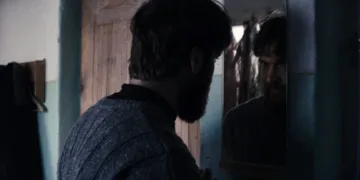
Underneath this elaborate surface, the film conducts a philosophical and ethical inquiry. It operates as a self-conscious study of authorship and creative hierarchy, cataloguing the work, much of it invisible, that sustains a single finished image. Babak, the anxious prop master, becomes the most tangible expression of that labor.
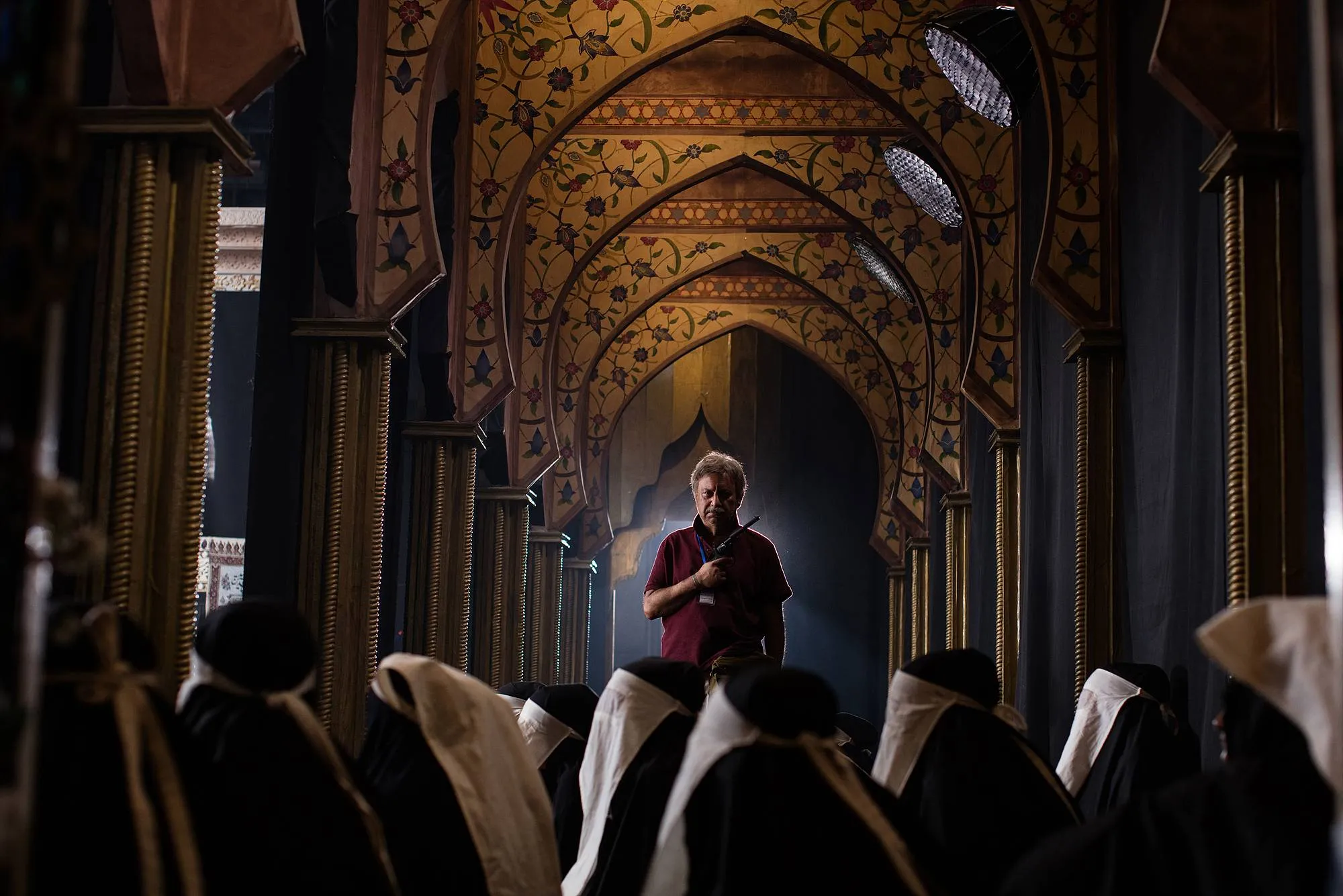
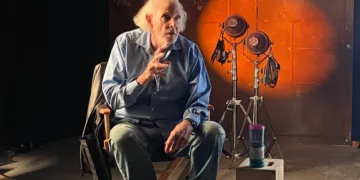
His constant motion and mounting frustration give shape to the crew’s logistical burden and to the existential fatigue that shadows it. An unseen director within the film bears Mokri’s own name, a sly touch that turns the question of control back onto the filmmaker and introduces a quiet streak of self-mockery into the experiment.
The recurring loops in the story and the steady pressure of the revolver thread sketch out a debate between fate and agency. The characters move through patterns that seem pre-written, pulled along by the narrative obligations attached to a gun that has been introduced and framed with such care.
The film also treats the prop itself as an ethical problem. The unease around this object mirrors the memory of the Rust incident, where a supposed tool of illusion became lethally real. That echo ties the film’s self-reflexive games to a specific historical wound and gives its abstract ideas about representation a concrete reference point.
The central philosophical strain concerns the relationship between fabrication and lived effect. When the domestic set that contains Sara abruptly sheds its walls, Mokri visualises how quickly narrative constructs can spill outward and alter the texture of experience. The film keeps asking where performance ends and consequence begins. That concern gains extra density from the work’s cinephile echoes.
Its recursive spaces recall the impossible architectures of M.C. Escher, and its anxious, dream-frayed mood aligns with the cinema of David Lynch. The piece also functions as a conscious genre exercise, folding neo-noir mystery, absurdist comedy and psychological thriller into a single continuous location. Familiar tropes from these traditions provide scaffolding, and the film lets an inquiry into how stories organise perception take precedence over conventional plot payoff.
The Weariness of the Anchor
The film leans heavily on its ensemble, with Babak Karimi’s turn as the prop master carrying weight. His Babak functions as an emotional reference point, a tired technician whose confusion and fatigue track closely with the viewer’s effort to keep hold of the film’s convoluted design. Karimi threads in a quiet, deadpan humour, the sigh of someone who has run out of patience for metaphysical puzzles yet still has props to deliver. The film’s tone grows out of that balance. Rigorous conceptual play sits beside odd, funny-sad exchanges and brief flashes of Kafkaesque absurdity. Those pockets of comedy keep the experience from settling into purely cerebral exercise.
The considerable length of the film matches the rigor of its concept. Strict attention to its own formal rules and meticulous technical coordination keep the backlot alive as a shifting, legible space. The result feels audacious and imaginative. Viewers who stay with its demands encounter an experience that privileges intellectual stimulation and formal ingenuity over conventional dramatic catharsis. The film suggests that the pleasure lies in observing the mechanisms that shape reality inside the frame and echo outside it. Mokri fulfils his intention to construct a layered, demanding piece of cinema.
Black Rabbit, White Rabbit is a 2025 mystery drama from Iranian director Shahram Mokri, known for his formally demanding cinematic puzzles. The film had its world premiere at the 30th Busan International Film Festival on 21 September 2025, and was submitted as Tajikistan’s entry for the Best International Feature Film at the 98th Academy Awards. While the film has toured the festival circuit throughout late 2025, including screenings at the BFI London Film Festival and the Chicago International Film Festival, its general release date is still pending in many territories. It is a co-production between Tajikistan and the United Arab Emirates.
Full Credits
Title: Black Rabbit, White Rabbit
Distributor: DreamLab Films (International Sales), Deaf Crocodile (U.S.)
Release date: 21 September 2025 (World Premiere at Busan International Film Festival)
Rating: NC16
Running time: 139 minutes
Director: Shahram Mokri
Writers: Nasim Ahmadpour, Shahram Mokri
Producers and Executive Producers: Negar Eskandarfar, Masoud Daliri
Cast: Babak Karimi, Hasti Mohammaï, Kibriyo Dilyobova, Bezhan Davlyatov
Director of Photography (Cinematographer): Morteza Gheidi
Editors: Shahram Mokri
Composer: Peyman Yazdanian
The Review
Black Rabbit, White Rabbit
Black Rabbit, White Rabbit is a technically magnificent, demanding cinematic puzzle. Shahram Mokri uses its Möbius strip narrative and spectacular long takes to explore fate, illusion, and the anxieties of creation. The film is more of an intellectual victory and an artistic statement on filmmaking than a traditionally satisfying drama, rewarding viewers who embrace its structural complexity. It is a vital piece of challenging world cinema.
PROS
- Exceptional long takes and fluid cinematography (Morteza Gheidi).
- Successful use of the Möbius strip and looping narrative, dissolving boundaries.
- Provides a clever, self-aware critique of storytelling and the artistic process.
- Babak Karimi provides an effective, grounding anchor for the audience's confusion.
CONS
- The 139-minute length, particularly the opening, feels stretched.
- The dense layering and numerous subplots can lead to frustrating ambiguity and moments that feel less cohesive.
- The film is more intellectually rewarding than emotionally or conventionally satisfying.
- The complexity and abstract concepts may alienate viewers seeking a traditional, linear plot.