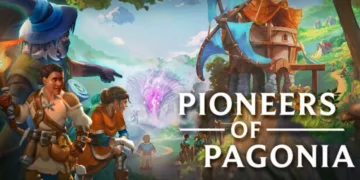




























We open on arrival. A small boat carries a crew of miniature pioneers toward a harsh, broken shoreline, and that first landing sets the tone for Pioneers of Pagonia, a management simulation and city-builder from Volker Wertich, the creator behind the foundational Settlers series.
Pagonia was once a single continent. After a cataclysm, it fractured into many islands and fell behind a magical fog. Your role is clear from the start: take a handful of supplies and a small population, then build them into a settlement that can feed itself, manufacture what it needs, and keep expanding.
The game’s identity comes from its commitment to visible, step-by-step supply chains. Resources, tools, and labor move through processes you can watch in motion. These pioneers show up as workers hauling stone, smelting ore, planting trees, and carrying food from place to place, which gives the settlement a lived-in feel as it grows. Expansion ties directly to discovery through a border system driven by Guard Towers.
Each tower extends your territory, unlocks new ground for building, and opens access to the next set of resources that your current tier depends on. That loop immediately frames the experience: careful construction and planning in the town center, paired with steady pressure to push outward into fogged land that keeps the next materials just out of reach.
The Engine of Civilization: Supply Chain Logistics and Granularity
A functioning town in Pagonia depends on disciplined resource flow, and the game builds that idea into the most basic act of placing buildings. Roads define where you can build, with plots appearing along their edges for new structures. Early on, this keeps planning readable and clean. Later, the same framework can create friction as your settlement gets denser. The placement grid can feel inconsistent, especially with larger buildings such as advanced housing, and attempts to align structures for both efficiency and layout can stall when the system refuses a sensible fit.
Production starts with raw gathering and quickly turns into layered manufacturing. Early staples like wood, stone, and foraged supplies come from simple buildings, then expand into tiered processing. Wood turns into logs and then beams. Ore becomes iron, then tools and weapons. Progress connects to a discovery-based technology system that ties map exploration to your production ceiling.
Finding an iron vein or a quarry that yields stone blocks functions as a mechanical unlock, opening access to higher-tier buildings and more ambitious construction options. That design keeps the map from feeling like scenery. Exploration becomes a requirement for the next stage of your economy.
Where the game earns its depth is in how much control it gives you over production behavior. You can fine-tune what buildings do and how they do it. A Forester can be told to plant only softwood, shaping the wood supply toward specific needs. Workshops can run on made-to-order production to avoid stockpiling, then switch into continuous output during major growth bursts. This level of control keeps resource allocation grounded in deliberate choices, and it supports different play styles without burying you under opaque systems.
The worker requirement system adds another layer of planning that feeds back into the economy. Jobs require equipment, and citizens cannot step into roles until that gear exists. A Guard needs a forged spear. A Forester needs a shovel. That dependency keeps tool production tied directly to workforce growth, so the settlement’s social expansion and its manufacturing priorities move together.
The game reinforces this with readable feedback through the pioneers themselves. Carriers visibly move materials, food, and finished goods across the town, and their behavior becomes a practical diagnostic tool. A traffic jam on a key route reads like a warning light. It points at a bottleneck that needs a road adjustment, a production shift, or better placement.
That strong logistical foundation runs into quality-of-life gaps that add avoidable friction. There is no universal demolish tool. Reshaping an established town means clicking and removing buildings one by one, which turns large redesigns into a slow, repetitive process. Housing has a similar snag. Direct upgrades are not available, so expanding living space means tearing down the current house and rebuilding a larger version. That interrupts population momentum and makes growth feel less fluid than the supply chain design suggests.
Pacing also shapes the experience in ways that can test patience, especially early. Pioneers of Pagonia moves slowly at the beginning, and the time required to complete early milestones can stretch. Even a first Guard Tower, essential for extending territory, can take well beyond fifteen minutes at standard speed.
The game includes a speed-up option, and its frequent use highlights the drag in the early construction tempo. The environment adds more waiting in small increments. Trees and rocks block terrain, and you must manually flag them for removal before building can proceed. These pauses stack up during moments where your plans are ready and the simulation asks you to wait for basic clearing work to catch up.
The Unfolding Narrative and Player Agency
The main structured path is a campaign that runs about 30 hours, and it serves two jobs at once. It provides a narrative frame for a shattered continent, and it teaches systems through play without heavy-handed instruction. Across seven chapters, the campaign introduces new buildings, mechanics, and pressures in a steady progression that keeps the learning curve connected to story objectives. The pioneers travel across islands searching for communication, trade, and unity with other isolated factions, and that effort plays out against growing threats from bandits and thieves.

Objectives shift from mission to mission. Some ask for production targets, such as generating a set number of iron tools. Others focus on locating specific characters or taking control of enemy territory. The structure keeps you touching each part of the simulation through natural demands rather than checklists. As chapters advance, military play gets clearer focus through defensive set pieces and boss encounters. These missions ask you to fortify positions, hold your town through timed assaults, or bring down a single powerful enemy.
The bosses tend to lean on commitment of your full force instead of nuanced tactics, yet they still change the town-building rhythm by introducing spikes of pressure and consequences that land harder because the economic pace runs slower. The story also uses environmental obstacles, including magical fog that blocks exploration, pushing you to find other ways forward through expansion choices and artifact discovery that keep the narrative moving.
Outside the campaign, the game supports long-term play through flexible modes that let you shape the experience around the parts you enjoy. Sandbox includes extensive customization, letting you adjust difficulty and goals to match your preferred pace. You can set map size, choose terrain types like forests, mountains, and meadows, and tweak resource distribution.
Conflict is also a player-facing switch. Enemy presence can be turned off, enemy strength can be adjusted, and objectives can be set around conquest or peaceful building. A Story difficulty option supports relaxed construction by sharply reducing pressure from raids and bandits. That range makes the game approachable for casual city-builders and satisfying for players who want deeper logistical puzzles. A full-featured Map Editor adds another layer of longevity by enabling community-built challenges and custom content.
Defense, Military, and the Scope of Conflict
Combat in Pioneers of Pagonia stays focused on protection and territory security. The military exists to guard your expanding settlement against localized threats, and the key mechanic here is control of land through Guard Towers. Towers extend the frontier of your domain, which matters for build space and access to new resources. As you push farther out, you face raiders, bandits, thieves, and later supernatural enemies such as ghosts and werewolves tied to deeper, magic-influenced regions. The game does not lean into large-scale war against rival cities. The pressure stays rooted in defense, securing routes, and keeping expansion safe.

Unit control stays limited, since the game does not give you fine command over individual actions in the way an RTS does. Tactical texture comes from specialization instead. Different soldier and hero types perform better against certain enemy classes, and that pushes you to maintain a force with variety. Rangers excel against thieves. Units such as Blade Dancers help against heavily armored foes. As your settlement develops, research unlocks higher-tier equipment, including magical swords and wizard units, which adds a fantasy edge to your defensive toolkit and expands the production chains that support it.
The military content can feel heavy in relation to the rest of the economy in certain play setups. If you choose a peaceful map with combat disabled, the range of military buildings and weapon production chains can end up sitting unused, and that exposes a small imbalance in how much of the tech tree leans toward defense infrastructure. In standard play, the system asks you to weigh the ongoing cost of a specialized army against the real risk of raids, tying defense spending directly to the settlement’s economic health.
Visual Identity and Technical Foundation
The game leans into a cutesy, stylized look that reads quickly and gives it a clear identity. That charm comes with careful detail. Zoom in and you can watch pioneers doing their jobs, from a carrier transporting berries to a miner chipping rock. Resource readability is strong, with clear visual differences between types of lumber and various ore-bearing stones. The presentation supports complex management by making the map legible at a glance without sacrificing the pleasure of observing the town at work.

Sound design reinforces a calm tone. Gentle incidental music, bird calls, and subdued industrial noises create a low-stress atmosphere that pairs well with slow-building logistics, even during stretches where you are managing tight supply lines.
Interface organization has improved in meaningful ways. Buildings sit in logical categories, which makes it easier to find what you need without excessive menu friction. Some quality-of-life wants remain, including more hotkeys for frequently used tools such as the road planner and faster switching between build categories.
On the technical side, the game runs smoothly on modern hardware and stays stable even with large settlements. The developers have also warned about potential compatibility issues with certain integrated graphics chips, including Intel UHD and Iris Xe lines, along with Arc graphics cards.
The Review
Pioneers of Pagonia
Pioneers of Pagonia is a deeply engaging, granular simulation that honors the classic lineage of management builders while establishing its own identity through meticulous supply chains and charming visuals. Its strengths lie in the natural tutorial of the campaign and the vast customization offered in the sandbox mode. The commitment to detailed logistics is compelling, but the experience is hampered by critical quality-of-life omissions, particularly the lack of direct housing upgrades and a functional demolish tool, which inject unnecessary frustration into expansion and redesign. It provides endless, rewarding construction for patient players who prioritize logistical depth.
PROS
- Meticulous, detailed supply chain simulation.
- Charming, engaging visual style and detail.
- Campaign effectively serves as a natural, engaging tutorial.
- Extensive sandbox customization and Map Editor for high replayability.
- Granular control over worker output and resource allocation.
CONS
- Lack of a universal demolish tool.
- Inability to upgrade existing housing directly.
- Slow pace of early game development.
- Inconsistent building grid placement for larger structures.
- Terrain obstructions (trees/rocks) add unavoidable waiting time.