
























![Kingdom Hearts Collection [I-III] Review](https://gazettely.com/wp-content/uploads/2026/10/Kingdom-Hearts-Collection-I-III-1-360x180.webp "Kingdom Hearts Collection [I-III] Review: KHII Holds Steady as Newer Entries Fluctuate 37")




Yuba City, California, sits under a hard sun where the peach harvest sets the tempo of daily life. For generations, families have worked these orchards, and Chito lives inside that inherited routine of manual labor. He spends his days in the heat, yet his attention keeps returning to a notebook packed with lyrics.
His music plays like a present-day extension of the Mexican corrido, carrying forward its narrative drive while taking on the clipped cadence of American hip-hop. That musical meeting point reflects the split sense of self many Mexican American young people experience in the Central Valley, where tradition and contemporary influence share the same space.
The story turns when his mother, Mari, faces the looming loss of their family home to bank foreclosure. With their future at risk, Chito leaves the fields and steps into interstate smuggling under the guidance of his uncle, Alfredo. The shift lifts him from a struggling worker into a visible figure within an underground economy. Money starts to ease immediate pressure, yet it also locks him into a life where artistic ambition and illegal work run side by side. The film follows that change as Chito tries to sustain growing musical attention while absorbing the moral price of his new role.
Faces of the New Frontier
JayDee makes his acting debut as Chito, and he brings a relaxed, slightly detached screen presence. The performance leans on stillness and a quiet manner that often fails to carry the fuller emotional turns the script asks for. He feels grounded when the film draws on his identity as a musician, yet his dramatic dialogue lands with hesitation. Daniel Lopez, playing Blunt, injects a needed jolt of charisma. As Chito’s friend and producer, he plays with energy that keeps scenes moving and sharpens the dynamic around the lead.
The supporting cast adds another register of professionalism. Eric Roberts shows up as a careful, calculating kingpin, delivering a seasoned kind of menace that sits apart from the rawer, less polished energy of the younger performers. Uncle Alfredo functions as the hinge between the orchard world and the smuggling world, operating as mentor while also generating moral strain.
The film’s portrayal of women stays conventional, positioning Mari and Candy as conscience figures. Mari holds firm against accepting money earned through illegal work, and Candy connects Chito to faith and the possibility of an ordinary life. Together, they bring the tension inside Chito into focus as his choices pull him further from the values he grew up with.
Framing the Central Valley
Director Michael Greene builds a visual approach tied to the flat, wide geography of Northern California. Aerial shots appear often, aiming for scale by showing the spread of orchards and the distance between rural communities. The imagery anchors the setting, though the cinematography frequently plays as serviceable craft rather than expressive storytelling.
The script depends heavily on voice-over and dense dialogue to advance plot, and that method can slow the natural rhythm of scenes. Characters often state emotions plainly, leaving fewer moments where behavior and silence carry meaning.
The film’s tone moves between the warmth of coming-of-age camaraderie and the pressure of crime drama. That movement produces a divided atmosphere, taking the viewer from light studio sessions to the harsh mechanics of drug trafficking. The production embraces its independent identity through a gritty look that favors lived-in authenticity over gloss. Lighting and sets remain modest, and that restraint contributes to an immediate, close-to-the-ground feeling that fits the grassroots music culture the film wants to capture.
The Rhythm of the Trap Corrido
The film’s strongest material comes through its commitment to trap corrido as a vessel for Mexican American identity. The soundtrack packs in dozens of tracks that shape the characters’ social world and emotional temperature. The songs operate as a bridge between the history of Mexican ballads and the present pressures of urban life, translating older storytelling into contemporary sound and attitude.
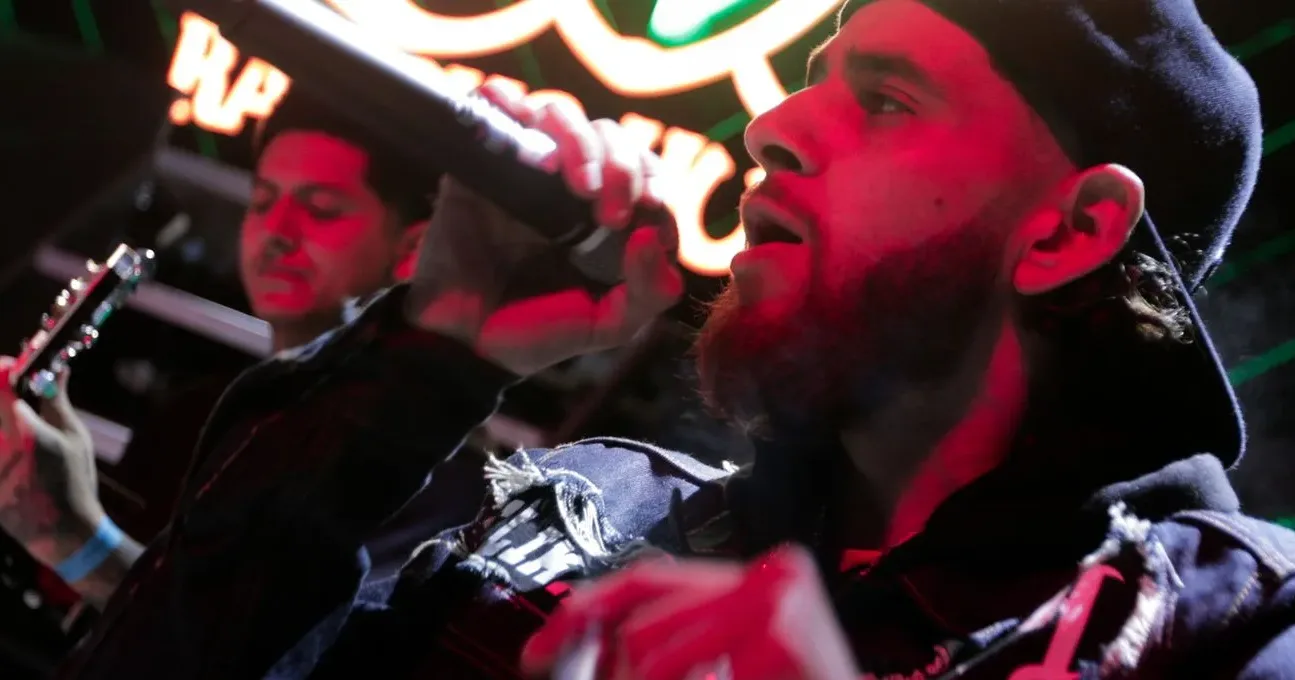
Chito looks most alive during performance sequences, where the actor’s comfort as a musician becomes clear. His intensity at the microphone gives the film its most convincing spark, and those stretches carry an ease that the dramatic passages rarely reach. By placing this specific subculture on screen for a wider audience, the movie echoes a familiar goal of parallel cinema, which often brings marginalized communities into view through everyday texture and cultural detail.
The story also leans hard on a recognizable crime trajectory, and that choice narrows the space available for the creative process and the work of making music. The film emphasizes the value of Latino representation, yet its plotting sometimes falls back on genre habits that blunt its freshest instincts. The scenes that stay closest to the music remain the ones with the most pull, capturing the momentum of a movement still reshaping contemporary storytelling.
Clika was released in theaters on January 23, 2026, marking a significant moment for the representation of Mexican American stories on the big screen. Distributed by Sony Pictures Entertainment, the film is currently available to watch in theaters across the United States. Following its theatrical run, it is expected to be available for digital purchase and rental on platforms such as Prime Video, Apple TV, and Fandango at Home.
Full Credits
Title: Clika
Distributor: Sony Pictures Entertainment
Release date: January 23, 2026
Rating: R
Running time: 82 minutes
Director: Michael Greene
Writers: Michael Greene, Sean McBride, Jimmy Humilde, Ski-Ter Jones
Producers and Executive Producers: Jimmy Humilde, Sean McBride, Ski-Ter Jones, Dave “Foots” Footman, Lalo the Giant, JayDee, Jose Becerra, Roque Venegas
Cast: JayDee, Concrete, Daniel “DoKnow” Lopez, Laura Lopez, Nana Ponceleon, Percy “Master P” Miller, Peter Greene, Eric Roberts
Director of Photography (Cinematographer): Jeffrey Carolan, Ski-Ter Jones
Editors: Tess Karmann
Composer: Michael “Nomad” Ripoll
The Review
Clika
The film succeeds as a cultural artifact while faltering as a piece of cinema. It presents a look at a specific musical movement, yet the execution feels hindered by a rigid script and a lead performance that lacks emotional depth. It captures the sounds of a community while missing the spark that makes its subjects electric on stage. While the soundtrack remains a high point, the surrounding drama relies on familiar tropes that prevent the story from finding a voice.
PROS
- Features a strong selection of tracks that define the trap corrido sound.
- Daniel Lopez provides a necessary spark of energy as Blunt.
- Captures the sun-scorched reality of the Yuba City agricultural landscape.
CONS
- JayDee struggles to bring emotional range to the dramatic requirements of the script.
- The narrative relies on well-worn crime drama clichés and on-the-nose dialogue.
- The women and antagonists are often reduced to functional roles.







