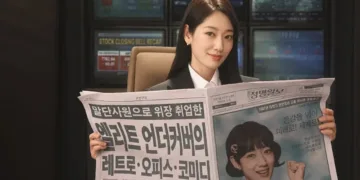

























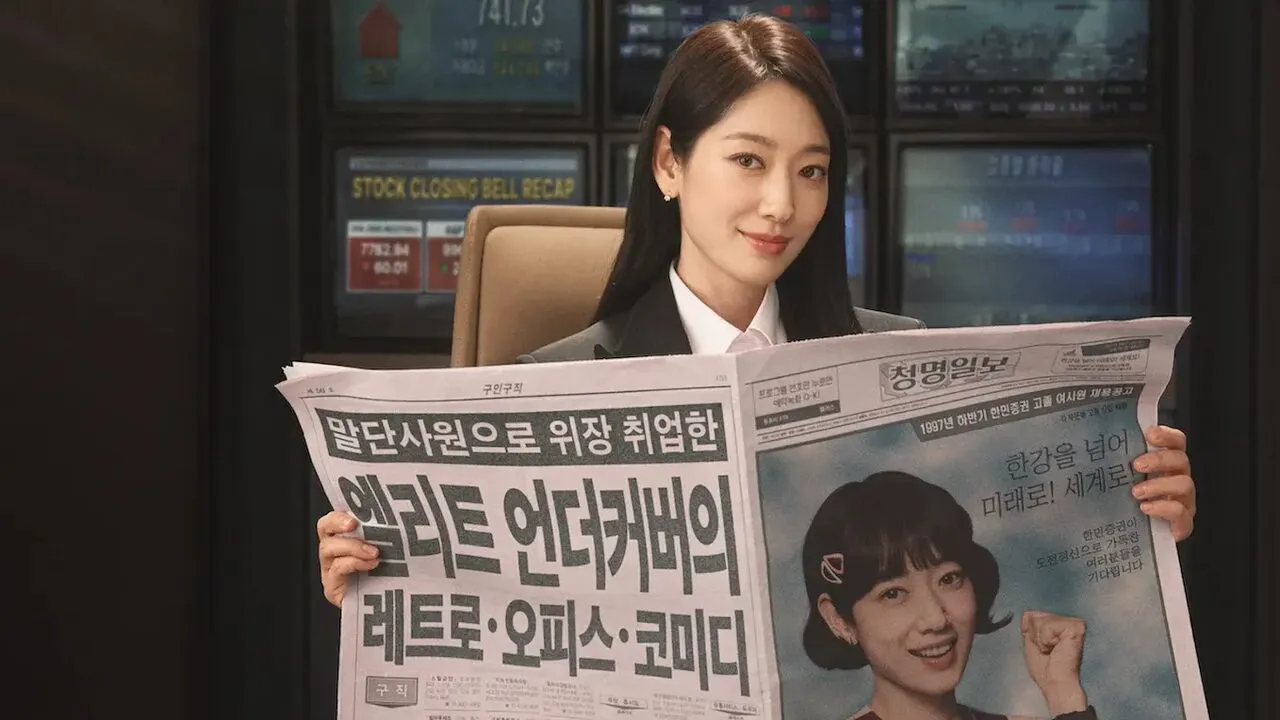

Set in South Korea in 1997, Undercover Miss Hong opens on Hong Geum-bo, a relentless investigator for the Securities Supervisory Board. Branded the “Witch of Yeouido,” Geum-bo moves through an era of financial volatility and institutional corruption with a reputation built on professional integrity. Her case targets a massive slush fund at Hanmin Investment & Securities, then collides with violence.
A key witness dies under suspicious circumstances, and an attempt on Geum-bo’s life follows soon after. With formal avenues closing, she is pushed into an unconventional deep-cover assignment. At thirty-five, she must pass as a twenty-year-old intern inside the company she wants to bring down. From the start, the premise locks the series into two lanes: the pressure of a financial thriller and the awkwardness of a fish-out-of-water workplace comedy.
The Architecture of a Financial Crisis
The show treats 1997 as an active force rather than window dressing. It frames the period as one of frantic economic expansion that hid systemic rot inside major conglomerates, and it uses the texture of the time to make corporate espionage feel physical. StarTAC phones and oversized floppy disks are more than nostalgia cues.
They underline how information could be carried, concealed, and controlled before the digital age made secrecy feel frictionless. That materiality gives the early episodes heft, especially as the plot lingers on the rapid dismantling of Geum-bo’s standing. One moment she holds authority as an empowered team leader, and the next she is shoved into the role of silenced scapegoat. The series makes her professional erasure feel like policy in action, not personal misfortune, and it uses that collapse to justify the story’s sharper turn.
Geum-bo’s adoption of the Hong Jang-mi identity triggers a clear tonal shift, and the change lands because it grows from systemic failure. Her choice to pose as a twenty-year-old intern reads as a last-ditch move for justice after legal channels have been effectively choked. The writing keeps the stakes of a murder investigation present, then squeezes comedy from the absurdity of watching a seasoned professional perform cluelessness inside an office hierarchy.
Geum-bo carries decades of experience, yet she must act like someone still learning the basics of workplace order. That friction powers the tension scene to scene, since the disguise has real consequences. A single mistake in her “youthful” performance can pull her toward the same fatal outcome that took her informant.
Dual Identities and the Politics of the Dormitory
Park Shin-hye steadies the series by making its split identity feel coherent. As Geum-bo, she projects a sharp, pantsuit-clad authority that puts her isolation in a male-dominated field into plain view. The character reads as someone who has stepped around traditional domestic expectations in favor of a career, only to watch that career turn into a trap.

As Jang-mi, the performance becomes a different kind of work. With hip-hop-influenced street style and a higher vocal register, she performs a femininity that the culture marks as “correct” for a younger woman in the late nineties. The disguise becomes social commentary with teeth. The same woman is treated as a threat as an investigator, then treated as harmless as a “girly” intern, and that perceived harmlessness turns into access. The show draws attention to how age, presentation, and workplace status decide who gets seen, who gets heard, and who gets dismissed.
Around her, the supporting characters form a social web that keeps the cover story under pressure. Chairman Kang Pil-beom stands as a looming emblem of corporate greed, and his family carries the emotional wreckage of his legacy. His son, Myung-hwi, moves through a tragic arc, and his daughter, No-ra, plays as rebellious and bubbly, a personality that changes the temperature of scenes even when the business stakes stay grim.
The dormitory introduces Ko Bok-hui, who functions as both an administrative assistant and a roommate, making her a constant tactical problem for Geum-bo. Their dynamic sits inside a larger mystery tied to the anonymous informant “Yehppee,” hinting that the lowest rungs of the corporate ladder may hold the most secrets. The arrival of Sin Jeon-u, a former lover who now has executive power, adds another complication: romance as exposure risk. His presence threatens the careful construction of Geum-bo’s disguise and brings personal history into a mission built on impersonation.
Balancing the Goofy with the Grave
The series leans on familiar workplace comedy rhythms to take the edge off its corporate darkness. Exaggerated physical comedy and sharp sonic punctuation mark awkward beats, especially in the office and the women’s dormitory, where the show creates a sense of worker camaraderie.
There is a faint irony in how these communal spaces offer warmth inside a story about predatory systems. The production also shows restraint. It keeps the comedy from swallowing the slush-fund investigation, and it commits to a slow-burn pace that lets moral vagueness in the corporate world stay in focus. That pacing matters for the show’s social critique, because it frames corruption as environment, not twist.
The visual approach reinforces the tonal push and pull. Hanmin’s boardrooms sit in cold grey, a palette that makes traditional power feel rigid and airless. The youth culture of 1997 arrives in brighter, more chaotic styling that feels like a separate sphere with its own rules.
Geum-bo has to live in both visual languages to survive. Early episodes keep romantic material from dominating, leaving discomfort and mistrust to drive the undercover sections. The result is an atmosphere where even something as casual as a shared meal at a video store carries the pressure of interrogation. The camera’s attention to small, frantic details, the micro-adjustments of posture, voice, and reaction, turns her performance into a visible labor. She is always translating her instincts into a mask that can pass.
Gendered Power and the Weight of History
The series frames Korean corporate life as a gendered structure that punishes women who claim authority. Geum-bo’s early success triggers immediate hostility from her all-male team, and their refusal to work under a female boss speaks to cultural norms enforced through everyday sabotage.
Her undercover assignment becomes a literal form of reinvention required for entry into guarded spaces. It turns a common workplace demand on women, the pressure to reshape presentation to earn legitimacy, into the central engine of the plot. Integrity becomes a liability inside a system designed to shelter those with the most capital, and Geum-bo’s reputation makes her both necessary and disposable.
The 1997 setting intensifies that theme by surrounding the story with a looming financial crisis. The sense of impending doom mirrors Geum-bo’s private struggle to keep her morals intact as institutional ground shifts beneath her. The show links personal ethics to national instability, asking what “clean” work can mean when the economy itself feels compromised.
It argues that the “Witch of Yeouido” sees the truth because she exists as an outsider in every version of her life, the feared investigator, the ignored intern, the woman boxed out by men who protect their hierarchy. By pairing nineties nostalgia with a clear-eyed view of corporate corruption, the series gestures toward continuity across eras. The specifics change, the tools change, the disguise changes, and the pressure to disappear women in plain sight keeps finding new forms.
Undercover Miss Hong premiered on the South Korean network tvN on January 17, 2026, marking a highly anticipated return for lead actress Park Shin-hye. Set against the nostalgic and volatile financial landscape of 1997 Seoul, the series follows an elite investigator who infiltrates a securities firm by posing as a twenty-year-old intern. As of today, January 21, 2026, the series is currently airing new episodes every Saturday and Sunday. Global audiences can stream the show on Netflix, while domestic viewers in South Korea can also access it via the streaming platform TVING.
Full Credits
Title: Undercover Miss Hong
Distributor: tvN, Netflix, TVING
Release date: January 17, 2026
Rating: TV-14
Running time: 70 minutes
Director: Park Seon-ho
Writers: Moon Hyun-kyung
Producers and Executive Producers: So Jae-hyun, Kim Min-jeong, Park Jae-sam, Lee Seung-hee, Park Soo-hwa, Ellen Oh
Cast: Park Shin-hye, Go Kyung-pyo, Ha Yoon-kyung, Cho Han-gyeol, Lee Deok-hwa, Kim Won-hae, Choi Ji-soo, Shin Yu-na
Director of Photography (Cinematographer): Yeom Ho-wang, Gu Ja-hoon
Editors: Jung Il-hwan, Kim Byung-rok
Composer: Park Se-jun
The Review
Undercover Miss Hong
While the premise initially appears to be a standard fish-out-of-water comedy, the series manages to anchor its absurdity in a gritty, historical reality. The exploration of gendered power and corporate survival offers a refreshing depth that balances the frequent "goofy" humor. It is a sharp, atmospheric look at the cost of integrity during a time of national upheaval.
PROS
- A compelling dual-performance by the lead actress.
- Authentic 1990s production design and atmosphere.
- Strong social commentary on workplace gender dynamics.
- Tight suspense regarding the central financial mystery.
CONS
- Overly long pilot episode that feels slightly cluttered.
- Relying on loud, slapstick humor that may feel dated to some.
- A large cast of characters that can be difficult to track initially.