




















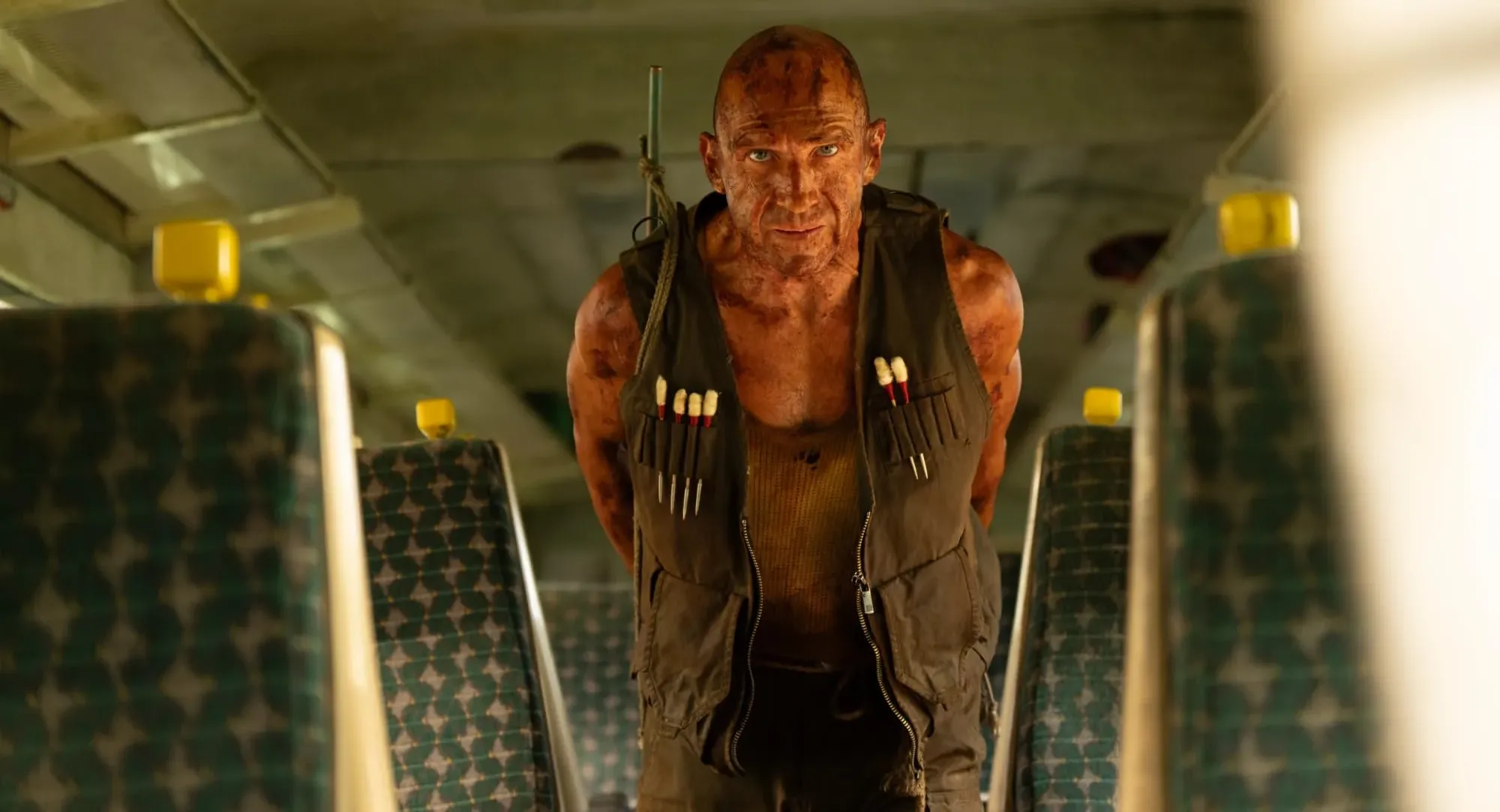

The story picks up with a hard cut from island refuge to the British mainland, drained of comfort and thick with threat. Spike (Alfie Williams) is stranded in a landscape that has outgrown the idea of collapse and settled into a steady-state of predation.
The sprinting infected still exist. Alongside them come the Alphas, hulking evolutionary experiments like Chi Lewis-Parry’s Samson, a walking argument for how far the rage virus can stretch a body before it snaps into a new category. The terrain starts to feel like a living lab, a place where infection spreads through blood and through belief.
Director Nia DaCosta clears away the leftover optimism from the previous installment and installs a new rule: monsters behave with a grim consistency, and people behave like weather. Spike falls into the hands of the Jimmys, a group that makes the early days of the outbreak look tidy, even polite.
The structure splits cleanly in two. Spike is dragged through an enforced indoctrination into a cult of cruelty, while Dr. Ian Kelson (Ralph Fiennes) tends his morbid memorial to the dead. Their paths tighten toward each other with the feel of fate, two competing methods of living after history has been smashed into rubble. It begins in misery. It also feels like the necessary price of admission for a franchise that wants new shapes, not recycled reflexes.
The Lord of the Wigs and the Logic of Cruelty
The Jimmys embody what I’d call “anarcho-nostalgia,” the ritual use of pop-culture debris to build a fresh religion out of rot. Sir Jimmy Crystal (Jack O’Connell) leads them in matching jumpsuits and blonde wigs, a uniform that turns personal identity into a joke with sharp teeth.
Their chosen vibe draws from the ugliest corners of British media memory, then sanctifies the ugliness as a moral code. Crystal formalizes the hierarchy through “Fingers,” a ladder of disciples renamed as versions of him. Identity dissolves first. Obedience follows. This is Crystal’s “Satanic survivalism,” an ideology that treats brutality as a sacrament and performance as proof of belonging.
Spike’s initiation arrives as a knife fight staged in the basin of a drained waterpark, a place built for play that now hosts conversion by violence. The camerawork jitters and stutters, matching the sensory panic of a child watching his personhood get peeled away. The Jimmys keep their cruelty on a leash of doctrine. They say the virus came from “Old Nick” to cull the weak.
They speak the word “charity” while they flay innocent families in farmhouses, a linguistic trick that turns virtue into camouflage. It lands as a nasty mirror of how fast a society can slide into “might is right” once central authority evaporates. The Jimmys operate as a full rejection of the last several millennia of moral progress, dressed up in cheap wigs and delivered with the confidence of people who think cruelty is clarity. (It’s the sort of certainty that has started wars, toppled republics, and sold a lot of terrible tabloids.)
The farmhouse raid is brutal to sit through. Its purpose sits in plain view: aestheticized violence, curated as spectacle. The killings read as a power ritual, staged for the thrill of domination, not for supplies. Crystal’s group treats suffering as content, the final currency in a world where normal money has died and attention has become the new gold standard.
The Ossuary of Enlightenment
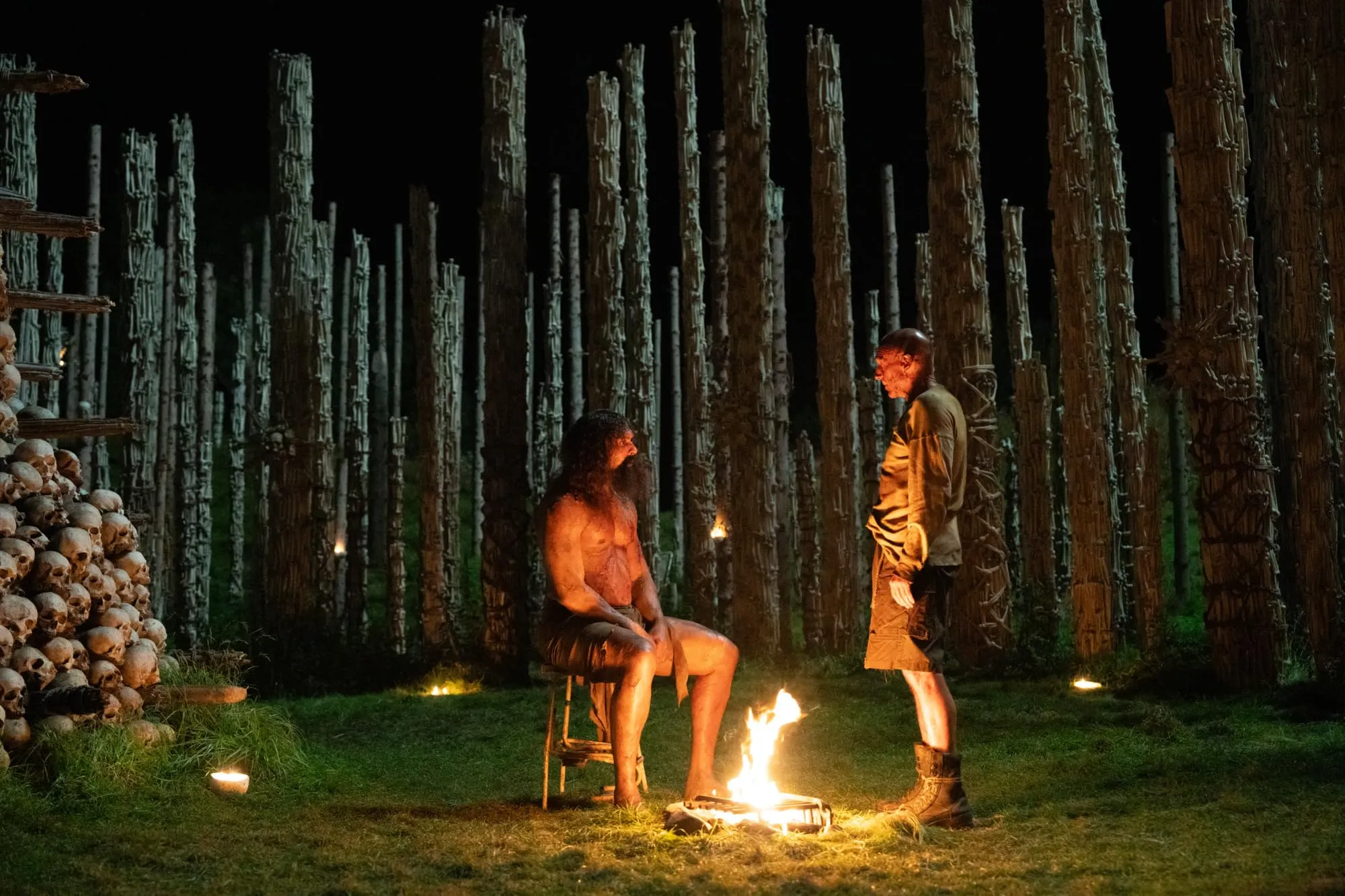
Set against that is the Bone Temple, a structure with the biomechanical nightmare energy of Giger and the ornate devotion of Gaudí. Dr. Ian Kelson has spent years stacking the bones of the dead into tall, slender towers. In the middle of this memento mori sits a pyramid of skulls, blunt in its meaning and strangely formal in its geometry.
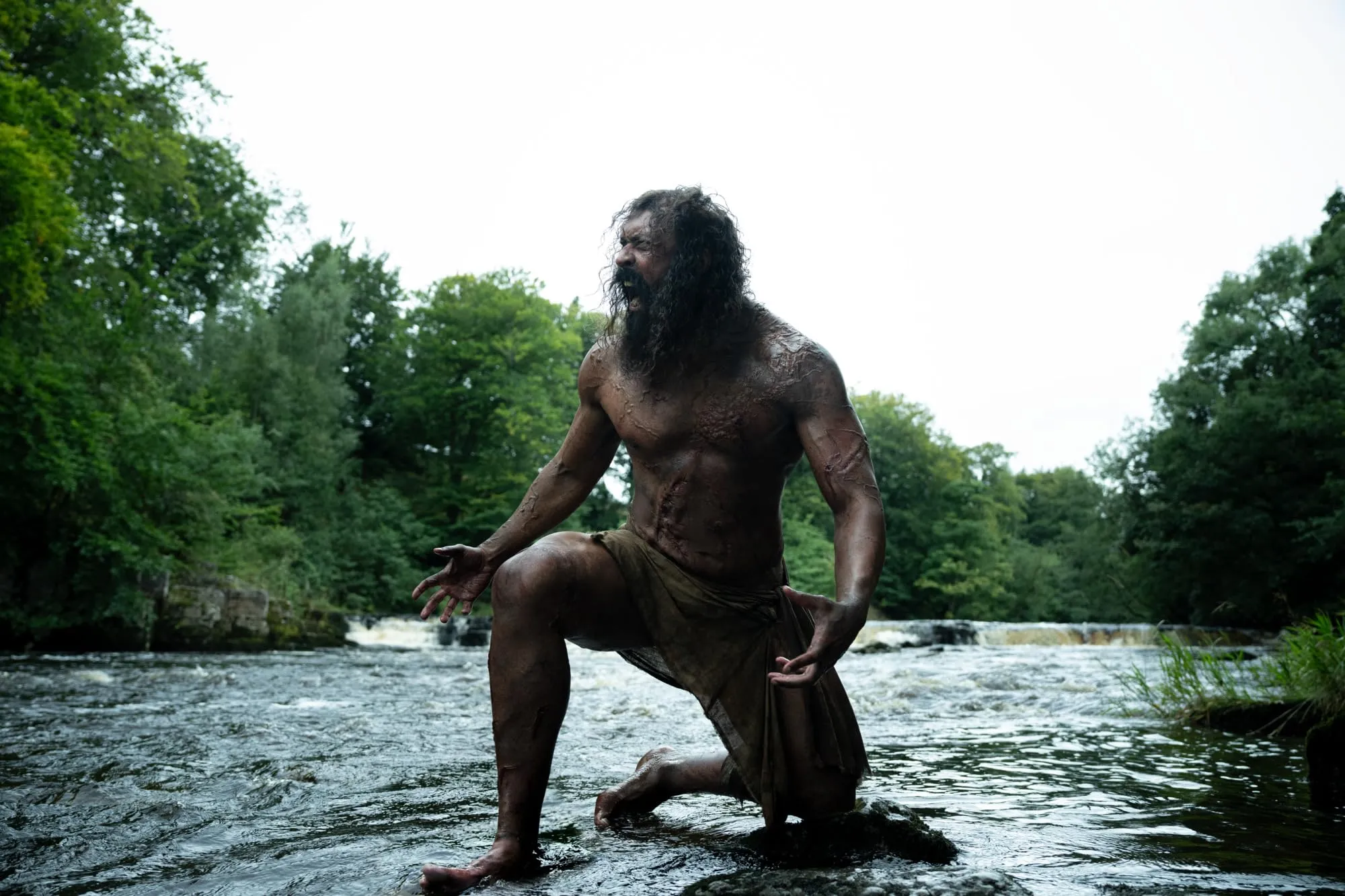
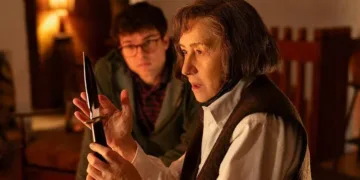
Kelson (Fiennes) lives in a bunker beneath the graveyard, a man literally underground with the weight of the dead above him. He paints himself orange with iodine, a ritual that works as medical precaution and as personal armor, the sort of habit that begins as science and ends as talisman. He stands as the last flicker of the scientific method inside a world drunk on superstition.
Kelson’s relationship with Samson becomes the emotional anchor here. He treats the Alpha giant with morphine. He tries to coax language from a being society has already stamped as a mindless killer. Their arrangement turns into a “morphine-fuelled quid pro quo,” an uneasy experiment in empathy that keeps poking at the border of what counts as human. Kelson’s daily life carries an uncanny domestic calm: Duran Duran and Radiohead spin on a wind-up turntable. He dances in the grass with a zombie.
The imagery has a surreal softness that bites back, a commentary on how the human spirit keeps improvising routines, even in the presence of horror. Kelson keeps his Hippocratic Oath intact. He believes treatment still matters. He keeps acting like medicine belongs to civilization, even while civilization is being replaced by cults and myths and knife-work.
The music choice lands with precision. “Ordinary World” blasting across a field of bones plays as an irony lesson delivered at stadium volume. Cultural artifacts persist. Ethics come under siege. The song becomes a little radio beacon from the past, still singing while the present commits atrocities in broad daylight.
The High Priest vs. The Physician
The performances lift the film beyond gore mechanics. Ralph Fiennes gives Kelson the jittery intensity of a man running on intellect, ritual, and isolation-induced fever. He carries a dry, sloth-like wit, a humor that moves slowly and lands hard. He can laugh inside hopelessness without cheapening it.

Jack O’Connell works as the ideal counterweight. His Crystal is soft-spoken and seductive, a nightmare delivered with polite diction. He flashes rotten teeth like “flint corn” and speaks with a gentility that feels carefully rehearsed and thoroughly insincere. Crystal reads as a stunted adolescent crowned with divine power, the kind of figure history keeps producing when fear becomes a governing system.
Spike remains the vessel for audience trauma, an observing consciousness forced to endure the logic of a new faith. Jimmy Ink (Erin Kellyman) enters as moral friction inside the cult, the person who can see through Crystal’s stagecraft even while trapped within it.
The climax gathers these forces into a showdown that is verbal and physical, a collision between cult ritual and laboratory rigor. Crystal treats Kelson like a rival deity. Kelson reads Crystal as a psychiatric patient in the grip of a messiah complex. The tension holds because both men commit fully to their private cosmologies. Each one believes his story is the only story left.
Samson, in the middle of it all, registers through subtle expressive movement that suggests a prior life. He becomes a silent witness, watching human folly stack up like bones in Kelson’s towers.
The Aesthetics of the End Times
DaCosta shoots the carnage with a polished, almost self-conscious beauty, as if the film knows it is painting frescoes on a collapsing wall. Sean Bobbitt’s cinematography slides between the intimacy of GoPro action and the detached majesty of long shots. The images look incredible.
The lush green landscape of Northumberland frames acts of violence that turn the pastoral into a cruel joke. Ben Barker’s sound design presses the past into the present through “hauntological” echoes of the pre-pandemic world: ghostly trains, children laughing, the audio fossils of normal life resurfacing in a world that no longer deserves them.
Hildur Guðnadóttir’s score moves with propulsion, pushing the film toward a climax that escalates into near-unbearable brutality. The ritualistic crucifixion scene plays as pure “hardcore horror,” calibrated for shock and steeped in the iconography of religious pageantry. It works as a deconstruction of the spectacle of faith, the way ceremony can sanctify cruelty when the crowd wants meaning more than mercy.
The ending drops in a cameo that complicates the film’s nihilism, pointing toward the post-World War II landscape and the pragmatism of the Allies. The implication is grimly familiar: after a descent into darkness, an order returns, compromised from birth, built by people who claim necessity as their excuse.
The film leaves you cold. It refuses easy catharsis. It feels like a mind-bending trek through the ruins of our better nature, with a smirk of dry humor curling at the edges, as if the movie knows the joke and hates that the joke keeps coming true.
The film arrived in theaters across the United States on January 16, 2026, following its initial debut in the United Kingdom earlier that week. Audiences can currently view the production on the big screen in most major cinema chains. This installment follows the grim events of the previous year and focuses on a new set of dangers found on the British mainland.
Full Credits
Title: 28 Years Later: The Bone Temple
Distributor: Sony Pictures Releasing, Columbia Pictures
Release date: January 13, 2026, January 16, 2026
Rating: R
Running time: 109 minutes
Director: Nia DaCosta
Writers: Alex Garland
Producers and Executive Producers: Andrew Macdonald, Peter Rice, Bernard Bellew, Danny Boyle, Alex Garland, Cillian Murphy
Cast: Ralph Fiennes, Jack O’Connell, Alfie Williams, Erin Kellyman, Chi Lewis-Parry, Emma Laird, Cillian Murphy, Aaron Taylor-Johnson
Director of Photography (Cinematographer): Sean Bobbitt
Editors: Jake Roberts
Composer: Hildur Guðnadóttir
The Review
28 Years Later: The Bone Temple
28 Years Later: The Bone Temple is a gnarly, intellectually aggressive bridge that trades pastoral grief for a sensory assault on human depravity. While the plot occasionally feels like a series of vignettes rather than a singular movement, the electrifying tension between Kelson’s scientific optimism and Crystal’s religious lunacy is undeniable. It is a messy, blood-soaked inquiry into the artifacts of civilization.
PROS
- Ralph Fiennes’ nuanced, dignified performance.
- Visceral cinematography by Sean Bobbitt.
- Thoughtful subversion of tropes through the Kelson-Samson bond.
CONS
- Spike’s agency is notably reduced.
- Several torture sequences border on the excessive.
- The episodic structure can feel slightly disjointed.