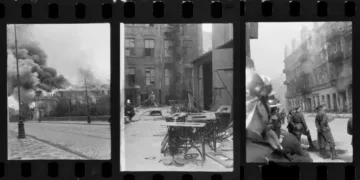













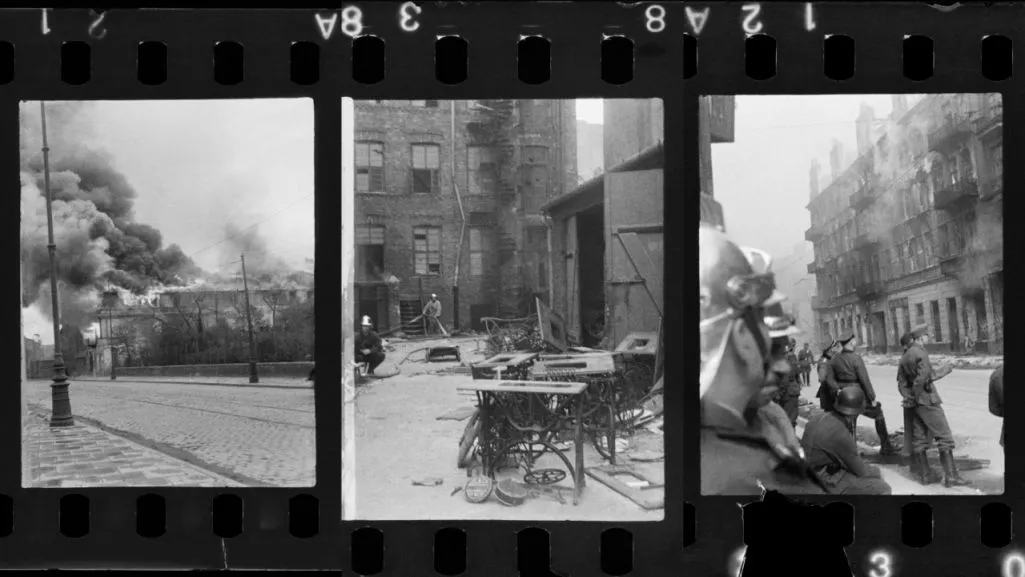

Polish director Jan Czarlewski stages a cinematic meeting with the void in his documentary 33 Photos From the Ghetto. The film builds around a startling archival discovery: a roll of film holding thirty-three previously unknown images shot by Zbigniew Leszek Grzywaczewski.
A Polish firefighter during the 1943 Warsaw Ghetto Uprising, Grzywaczewski worked from a singular, agonizing angle. His photographs offer a rare counter-perspective beside the clinical, curated Nazi propaganda that long shaped the era’s visual record. The story line stretches from the 1939 invasion of Poland through the arrival of the Soviet army, yet Czarlewski keeps the focus tight on the walled district’s localized catastrophes.
The documentary functions as a reclamation of sight. It recasts the viewer as a witness to a clandestine act of defiance, with each frame pressing against the gap between an official archive and an illicit truth. What lingers is the residue after the fire, the kind that settles into the lungs and refuses to leave. The imagery plays like a silent, silver-halide ghost, insisting on its day in court after decades of quiet.
Chiaroscuro of the Burning Walls
The documentary reconstructs the Warsaw Ghetto’s claustrophobia with precision that echoes noir’s visual grammar. The film charts the rapid slide from Nazi occupation into a sealed enclosure where life could be tallied in grams of sawdust-heavy bread. Inside this shadow-drenched world, Grzywaczewski’s role carries heavy moral weight. At twenty-three, he entered with the Warsaw Fire Service, tasked with stopping flames from jumping to the “Aryan” side. That assignment granted him a permit to see what the occupiers worked to erase.
Under the constant threat of summary execution, he documented the systematic annihilation of a people. His camera caught bodies abandoned in gutters and buildings buckling into skeletal husks. The compositions land with accidental expressionism: jagged ruin-lines carve the frame into a visual prison. From a window at St. Sophia’s Hospital, he photographed deportations bound for Treblinka’s gas chambers.
The act of pressing the shutter in that setting reads as its own form of resistance, measured in milliseconds and punished in bullets. You can almost register the frantic pulse of a man hiding a Leica beneath a heavy coat. It becomes an exercise in ethical survival, a forced proximity to atrocity converted into testimony that outlives the perpetrators.
Forensic Gazes and Urban Palimpsests
Czarlewski shapes the second act like a high-stakes detective story. The film follows the 2022 recovery of the long-lost negatives by the photographer’s son, Maciej Grzywaczewski. The strips sat in a family archive, untouched for decades after the firefighter’s death in 1993. Here, the archival process takes on the force of a character, complete with obsessions, dead ends, and sudden flashes of certainty. Historians and archivists submit each frame to painstaking validation, treating grain, shadow, and building seams as evidence.
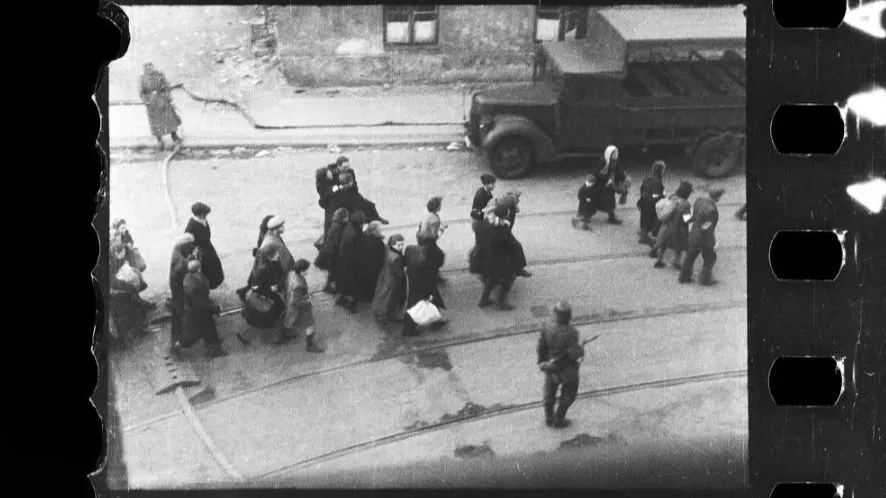
The documentary is at its sharpest when it leans on architecture and pre-war maps to identify the exact places where the photographer stood. The camera lines up present-day Warsaw streets with the pulverized ruins of 1943, turning sidewalks into overlays and intersections into coordinates. A technical thread runs through this work as analysts identify the camera model used, granting material specificity to images that otherwise hover like apparitions. There is dry irony in watching experts argue over a window’s angle while the dead seem to wait just outside the margins.
The rebuilt city and the black-and-white carnage of the negatives produce a jarring psychological jolt. This reconstruction functions like a bridge across a gap in memory, insisting that destruction fails to erase geometry. Even after leveling, the past remains etched into the soil’s lines and measurements. Czarlewski treats Warsaw as a crime scene with a file that never closed, its evidence sealed inside brickwork, street plans, and the stubborn persistence of place.
The Ghost in the Machine
The film’s human charge tightens through the testimony of Roma Laks, whose connection to the Grzywaczewski family brings visceral intimacy. She describes hiding in a small mezzanine while German soldiers paced below. Her presence welds still photographs to lived time, giving the images breath, panic, and physical scale.
The documentary then steers into contentious aesthetic territory through the use of AI and animation to patch damaged sections of film. These digital interpolations generate an uncanny valley effect, bending facial features and introducing a muddied texture that can feel at odds with the source material’s clarity.
The tension spikes when survivors confront these altered images after lifetimes spent trying to seal such memories away. Czarlewski argues for confrontation as necessity. As eyewitnesses die, the film presents the photographs as permanent, unblinking eyes, tasked with holding the line against erasure.
That claim lands with extra weight in a present tense where ethnic persecution continues to recur across the world. Memory appears as a fragile construct that demands upkeep, sometimes through pain. The documentary leaves the viewer facing the ethics of looking straight at horror, along with the danger that comes with looking away.
33 Photos from the Ghetto is a poignant Polish documentary that premiered on HBO and HBO Max on January 27, 2026. The film follows the discovery of 33 previously unseen photographs taken secretly by a young firefighter during the 1943 Warsaw Ghetto Uprising. It premiered to coincide with International Holocaust Remembrance Day, offering a rare civilian perspective on the horrors of the Nazi occupation through meticulous archival reconstruction and personal testimonies. Viewers can currently stream the film on HBO Max.
Where to Watch 33 Photos from the Ghetto 2026 Online


Full Credits
Title: 33 Photos from the Ghetto
Distributor: HBO, HBO Max
Release date: January 27, 2026
Rating: TV-14
Running time: 82 minutes
Director: Jan Czarlewski
Writers: Jan Czarlewski, Carlotta Verny
Producers and Executive Producers: Magdalena Szczawińska, MWM Media
Cast: Michael Berenbaum, Maciej Grzywaczewski, Jerzy Gutkowski, Agnieszka Kajczyk, Romana Laks Kaplan, Grzegorz Kwolek, Zuzanna Schnepf-Kołacz
Director of Photography (Cinematographer): Maciej Jaźwiecki
The Review
33 Photos From the Ghetto
Jan Czarlewski’s documentary is a somber, technically fascinating excavation of memory. While the implementation of AI and certain sensationalist beats occasionally muddy the waters, the sheer historical weight of Grzywaczewski’s photographs is undeniable. It serves as a vital, if flawed, bridge between the clinical records of the perpetrators and the lived reality of the victims. For those willing to navigate its disjointed structure, the film offers a piercing look at a tragedy that continues to echo.
PROS
- The 33 discovered photographs offer a rare, non-propaganda perspective of the uprising.
- The architectural and archival reconstruction of the photo locations is deeply engaging.
- The testimony from Roma Laks adds a necessary and moving human element.
CONS
- The use of software to "enhance" or animate faces often feels disrespectful and visually jarring.
- The documentary’s structure can feel disorganized, making it difficult to follow the historical sequence.
- Some directorial choices feel unnecessarily intrusive when the source material is already powerful enough.