



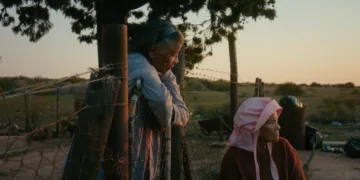


























The smell of dry soil and the metronome click of a milking stool establish the life Shaban and Hatixhe have built. In rural Kosovo, their days carry a familiar, physical pull. They define themselves through the cattle in their care and the land they keep for their three daughters. That sense of security shatters after Shaban’s brother, Liridon, commits a single betrayal that empties the family’s reserves.
He sells off the family’s assets and disappears, leaving an absence the village cannot repair. With their footing gone, the couple moves to Pristina with their children and Shaban’s mother, Nana. The relocation breaks their sense of who they are. They reach the capital as strangers, trying to prove their worth in a city shaped by commerce, not labor.
Their survival now runs through Hatixhe’s sister and her wealthy husband, Alban. The story’s central wound sits in that reversal: the people who once produced are reduced to asking. Pristina becomes the stage where the pride of farm work gives way to the muted indignities of service. The film skips the expected rush of city life and stays fixed on the hard problem of finding somewhere to sleep. The result is a heavy opening mood that clings to what follows.
The Visual Language of Confinement
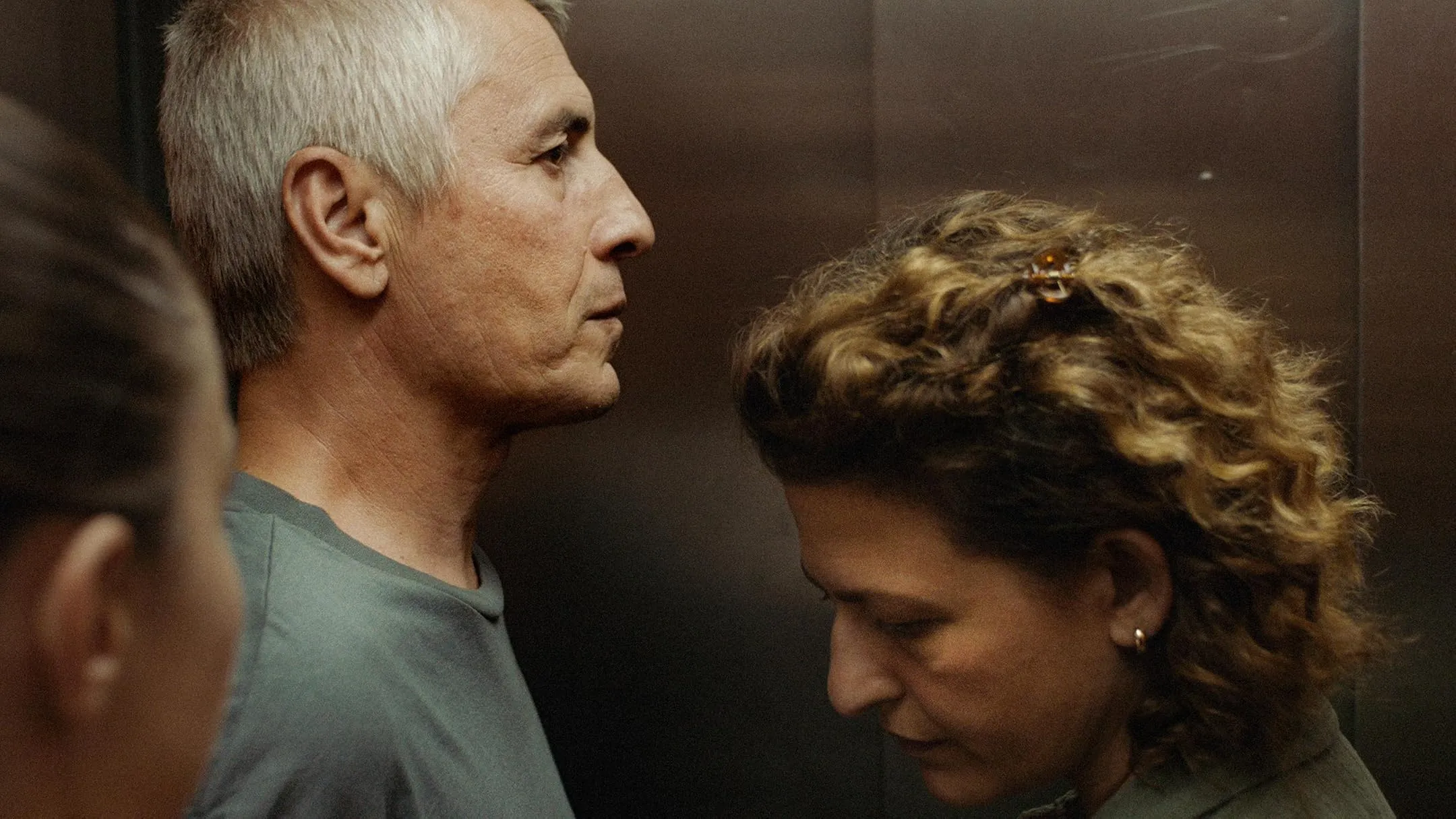
The film’s images pivot from the village’s still, wide compositions to the capital’s unsettled motion. Janis Mazuch tracks that shift through handheld camerawork that stays close to Shaban. The intimacy compresses the frame, and the pressure tightens as city walls close in around the family.
Open skies and red earth give way to clogged traffic and faceless buildings. Inside that gray sprawl, the statue of Bill Clinton rises as a rigid monument to Western ideals. It hangs over the streets like a promise of prosperity that never reaches someone in Shaban’s position. Mario Batkovic’s music reinforces the fracture, pairing traditional folk strains with sharp, modern chords. The clash signals traditions buckling under a new era’s weight.
The film returns again and again to a plain sheet of paper, the Curriculum Vitae, as a quiet emblem of exclusion. It belongs to a professional world where Shaban’s practical competence carries no currency. Between major beats, long fades to black arrive and linger. They function as chapter marks in the family’s displacement, each pause suggesting a small death in the life they used to recognize. Joëlle Alexis’ editing keeps the tension taut, shaping a pace that mirrors the family’s rising panic. The images feel burdened by everything the characters have already lost.
Silences and Structural Tensions
Astrit Kabashi and Flonja Kodheli build their performances out of restraint. Meaning gathers in what goes unsaid, in posture, in the way they take up space, in exhaustion that accumulates scene by scene. Their marriage holds the emotional line of the film: a quiet alliance sustained through whispered conversations in bed. Those exchanges create the last pockets where honesty can exist without punishment, where fear can surface without needing to perform strength.
Their arrival in Pristina also upends the social order inside Hatixhe’s extended family. Hatixhe’s sister, Adelina, and Adelina’s husband, Alban, feel the disruption immediately. Alban offers Shaban work at his nightclub, yet his attitude carries condescension dressed up as sympathy.
He polices appearances and worries that Shaban’s presence as a day laborer will stain the family’s image. That anxiety redraws the relationship between the sisters. Hatixhe becomes caretaker to Adelina’s father-in-law, a job that converts a family bond into a set of duties with an implied price tag.
Nana links the household to the past and serves as its most tangible financial support. Her modest pension becomes the group’s lone dependable income. Shaban, meanwhile, tries to keep faith with his self-image as a “good man,” even as the new conditions refuse to reward it. His politeness reads like a carryover from a rural social code that the city has no patience for. Alban treats that humility as weakness. The film watches Shaban’s spirit wear down in slow increments as he grasps that the values he brought with him cannot shield him here.
The Economic Price of Human Dignity
Hatixhe voices the film’s sharpest assessment when she tells her sister that shame is a luxury. The line clarifies the family’s tactics and pushes back against judgment from relatives who live in comfort. The script keeps returning to the mismatch between Shaban’s abilities and the city’s economy, and Alban’s repeated demands for a resume press on the sore point. For Shaban, the resume remains an enigma. For the city, it functions as an entry ticket.
Scenes of day laborers clustered on street corners show poverty as public ritual. Men wait to have their hours purchased, and the waiting becomes its own humiliation, one Shaban has to share. City life adds traps that carry official names and quiet penalties: bank fees, rental deposits, and other costs that barely register for the wealthy.
For Shaban, they become walls that block any return to stability. The stress surfaces as sleeplessness. He lies awake, looping through the same worry, measuring himself against his inability to provide for his children. He reads the absence of a resume as personal failure, even while the story keeps pointing to a system that refuses to recognize him.
The film frames the modern economy as a place where community obligations have been swapped for transactions. Loyalty bends when money becomes the dominant measure of value. Even assistance from relatives arrives with conditions, turning family support into a ledger of debts. The narrative avoids an easy moral sorting. Survival pressure forces each person to bargain with integrity, and the film stays with that negotiation, scene after scene, until the cost becomes impossible to ignore.
Shame and Money premiered on January 25, 2026, at the Sundance Film Festival where it won the World Cinema Dramatic Grand Jury Prize. This powerful drama follows a rural family forced into the hypercapitalist environment of Pristina after a domestic betrayal. You can currently find it on the film festival circuit, including the Berlin International Film Festival’s European Film Market. Public online screenings were hosted through the Sundance platform in early 2026, while a wider theatrical or streaming release is expected later this year following its successful festival run.
Full Credits
Title: Shame and Money
Distributor: The Yellow Affair, Vicky Bane, Schuldenberg Films
Release date: January 25, 2026
Running time: 130 minutes
Director: Visar Morina
Writers: Visar Morina, Doruntina Basha
Producers and Executive Producers: Fabian Altenried, Sophie Ahrens, Kristof Gerega, Pia Hellenthal, Visar Morina, Eshref Durmishi, Besnik Krapi, Danijel Hočevar, Dritan Huqi, Marija Dimitrova, Marc Goyens
Cast: Astrit Kabashi, Flonja Kodheli, Kumrije Hoxha, Fiona Gllavica, Alban Ukaj, Tristan Halilaj, Abdinaser Beka
Director of Photography (Cinematographer): Janis Mazuch
Editors: Joëlle Alexis
Composer: Mario Batkovic
The Review
Shame And Money
Shame and Money is a quiet, powerful look at economic survival. It avoids easy answers. The film shows how the search for stability can strip away a person's identity. The performances feel lived in. The script is sharp. It highlights the gap between those with a safety net and those without. This film demands patience but offers deep emotional rewards. It provides a sobering look at how modern life can erode the bonds of family.
PROS
- Natural performances from Astrit Kabashi and Flonja Kodheli.
- Sharp visual contrast between rural and urban settings.
- Honest depiction of the psychological toll of poverty.
- Authentic look at family power structures.
CONS
- Slow pacing might test some viewers.
- The ending leaves several questions unanswered.