















Sara Dosa arrives at the 2026 Sundance Film Festival with a documentary shaped by patience and quiet attention. The film keeps its focus on environmental change in Iceland through the story of the Okjökull glacier, a place marked by an especially bleak label. Okjökull became the first glacier officially declared destroyed as climate patterns shifted.
The documentary pauses to define what that declaration means: science calls a glacier “dead” once it stops moving, a literal end to its life as a flowing force. That definition lands with extra force because Dosa frames the subject less as a headline and more as a lived reality that seeps into voice, image, and rhythm.
Andri Snær Magnason guides the viewer through this material, drawing perspective from his book and speaking in a register that feels mournful, measured, and observant. The film stays close to the quiet tragedy of a landscape losing a sense of itself.
Dosa keeps the tempo restrained, letting the weight of melting ice settle over each sequence. What emerges is a record of disappearance that values silence as evidence. The camera returns to the stillness that follows when something immense stops moving. The mood leans toward reflection, with urgency expressed through stillness rather than alarm.
Generational Echoes in the Ice
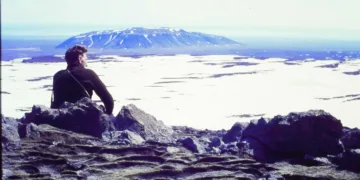
The documentary draws a direct line between human mortality and ecological decline, using family memory to give climate change personal stakes. Magnason brings in archival home movies and photographs of his grandparents, turning the abstract into something domestic and tangible.

His grandfather, also named Andri, and his grandmother spent decades traveling across glaciers in tracked vehicles. The footage and images hold onto an earlier moment when the ice seemed permanent, part of the everyday horizon rather than a vanishing landmark.
Magnason links the physical decline of his elders with the retreat of the frozen peaks. That parallel lands as a recognition of historical timing: he sees himself as the first generation that must say goodbye to these places. The film treats glaciers and human memory as related archival systems.
Each stores layers of history, and each becomes fragile under time’s pressure. By staging this connection through family documents, the film turns scientific loss into ancestral grief that can be felt in gestures, faces, and the passage of years.
Those portraits also point to a specific Icelandic stoicism. The culture shown here carries reverence for the forces of nature, placing ancestors and environments inside one continuous story. When Magnason’s grandfather’s aging appears beside thinning ice, the loss becomes visceral. The film frames it as a domestic tragedy that expands outward until it feels planetary. Rooms and family snapshots take on the scale of mountains because the memories inside them carry the same weight as the landscape outside.
Sensory Records of a Changing Landscape
Dosa and cinematographer Pedro Alvarez Mesa craft a visual approach that captures the spirit of the North through texture and clarity. The film draws a sharp distinction between the grain of old 8mm footage and the crispness of present-day digital images. That shift in format becomes its own form of storytelling, a reminder that time changes both the subject and the tools used to record it.
The modern shots present Icelandic terrain as primordial and severe. Volcanic fields spread across the frame, and snowstorms rage with a force that feels larger than the human figures nearby. The camera also moves into the interiors of the ice itself, revealing caves that resemble natural sculpture. These chambers glow in blue and white, turning the glacier into architecture shaped by pressure, age, and slow movement.
Sound carries equal weight. The film lets the audience hear the loud fractures and groans produced by shifting ice, then moves toward the haunting rush of water streaming from melting edges. Dosa places cameras inside the ice to give a sense of scale and age from within, as if the glacier can be witnessed from its own vantage point. The pacing remains slow and deliberate, echoing the glacier’s movement over time.
Long takes keep the viewer present with the images, mirroring the patience required to notice geological change. Rapid cutting stays out of the way, and the landscape holds the frame long enough to feel like a character with its own tempo. Every image and sound functions as documentation of a state of being that is changing fast.
Letters to a Future Without Ice
The documentary frames itself as an open letter addressed to people who may inherit an Iceland without glaciers. It begins with the sound of a play button on a time capsule, a small mechanical click that sets the theme of recorded memory in motion. Magnason speaks directly to his children, treating the film as evidence intended for generations who may know these places only through screens and stories.
Within the film, scientific data points to a 200-year window before Iceland loses its glaciers. Local glaciologists meet that projection with quiet, resigned strength, a reaction that fits the film’s broader emotional register. The documentary stays with the tension between the permanence of digital records and the disappearance of what they depict. The ice continues to melt while images endure, creating a paradox where preservation becomes inseparable from loss.
Magnason’s narration shifts from mourning toward a muted form of hope as the film observes new life emerging in rocky soil left behind by retreating ice. Flowers and trees appear in ground that once sat under frozen mass. The film treats the act of sharing these stories as cultural survival, a way to carry identity forward even as physical landmarks vanish.
It asks what kind of world is being left behind and frames the present as a pivotal moment of transition. By recording what exists now, the filmmakers hold onto the idea that identity can persist through the people who remember and document it.
Time and Water premiered on January 27, 2026, at the Sundance Film Festival to critical acclaim. Directed by Academy Award nominee Sara Dosa, the documentary serves as a poetic and scientific exploration of the environmental crisis in Iceland. The narrative follows celebrated writer Andri Snær Magnason as he chronicles the disappearance of the nation’s glaciers, specifically the “death” of Okjökull, while weaving in personal family histories and archival footage. As a production of National Geographic Documentary Films, the movie is currently available to stream on Disney+ and through National Geographic’s digital platforms following its limited theatrical and festival engagement.
Full Credits
Title: Time and Water
Distributor: National Geographic Documentary Films
Release date: January 27, 2026
Running time: 93 minutes
Director: Sara Dosa
Writers: Sara Dosa, Jocelyne Chaput, Erin Casper, Andri Snær Magnason
Producers and Executive Producers: Shane Boris, Elijah Stevens, Jameka Autry, Sara Dosa, Carolyn Bernstein, Tim Horsburgh
Cast: Andri Snær Magnason, Árni Kjartansson, Herdís Sigurjónsdóttir, Hulda Filippusdóttir, Jón Sigurður Pétursson
Director of Photography (Cinematographer): Pedro Alvarez-Mesa
Editors: Erin Casper, Jocelyne Chaput, Mark Harrison
Composer: Dan Deacon
The Review
Time and Water
Time and Water is a quiet, profound meditation on the intersection of human memory and geological shift. Sara Dosa skillfully avoids the frantic tone of typical environmental documentaries, opting instead for a domestic lens that makes the loss of Iceland’s glaciers feel like the passing of a family member. While the pacing is slow and the narrative leans heavily on repetition, the film succeeds as a sincere archival effort. It acts as a haunting, visual time capsule that values ancestral storytelling as much as scientific data.
PROS
- Stunning contrast between archival home movies and modern cinematography.
- Emotional depth achieved by linking family history to ecological change.
- Immersive sound design that captures the unique voice of the glaciers.
CONS
- The meditative pacing may feel overly slow for some viewers.
- The central metaphors are repeated frequently throughout the runtime.
- Limited perspective from outside climate scientists or experts.