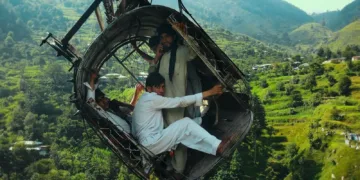





























In the remote stillness of Battagram, the morning of August 22, 2023, opened on the steady hum of a familiar commute. The ordinary sound becomes a cue for dread once two of the three cables supporting a local transport gondola snap with violent finality.
Six schoolboys and two adults remain hanging 900 feet above a jagged Himalayan ravine, kept aloft by a solitary wire that looks tired even before the mind assigns it a deadline. Mohammed Ali Naqvi frames the event as a very specific terror: the Pakistani mountains stand in their vast beauty, and that beauty carries the cold indifference of a silent executioner.
The stakes arrive through a brutal arithmetic of survival, a ten-hour window before the last cord seems likely to surrender under the weight of eight lives. From the surrounding slopes, families watch with a helplessness that hardens into something existential. Their cries vanish into open air. A community is left to study a literal line that could break at any moment, and a figurative line that has always felt thin. The film lingers in this high-altitude purgatory, attentive to the agonizing stillness of a carriage tilted toward the end of the world.
A Mosaic of Impending Absence
Naqvi builds a visual language of panic from a fractured archive of viewpoints. Raw drone footage arrives like an intrusion, gliding toward the sideways carriage and forcing the viewer close enough to read faces meant for private fear. These digital eyes carry a predatory intimacy.
 Grainy cellphone clips from bystanders below answer with tremor and blur, the unstable image matching the chaos of a local emergency turning into a global spectacle. As the 14-hour ordeal stretches into night, recreations wash the rescue in shadow-heavy light that disorients more than it clarifies, as if the film itself cannot fully see what is happening in the dark.
Editor Will Grayburn keeps the 77-minute runtime moving with relentless urgency, and on-screen timers compress human hope into units of seconds. Each tick lands like a heartbeat that refuses to calm down. The score by Sven Faulconer leans into the operatic, pressing the rescue attempts toward a heightened pitch where the air feels thick with the threat of failure. Time becomes the film’s central pressure, an invisible force that tightens around every decision, every delay, every gust of wind that arrives uninvited.
The Hierarchies of Salvation
The rescue operation plays out as a live argument between state authority and local necessity. Police Chief Sonia Shamroz coordinates the official response, directing helicopter teams that fight erratic mountain winds. The institutional machinery carries its own rhythm: protocols, briefings, optics, chain of command. On the ground, civilian volunteers bring a different tempo, one shaped by proximity and urgency. Sahib Khan, a builder known as a sky pirate, moves with desperate grace that has no stamp of approval and no guarantee of safety.
Then Ali Swati appears, a zipline expert with a taste for the public eye, and a second tension takes hold. The film registers a quiet class conflict in the way authority gravitates toward a polished persona while a rougher expertise waits for recognition. This is not presented as a tidy moral lesson. It feels like a familiar hierarchy revealing itself under stress, as if crisis strips away manners and leaves instinct.
The emotional weight gathers in interviews with the fathers, voices heavy with the resignation of people who have looked at death before and learned what it costs to keep speaking. A striking silence forms around the absence of mothers and female relatives. Their place in the story remains mostly off-camera, creating a masculine vacuum where visible struggle dominates and domestic anguish stays unheard. The documentary points toward that gap, then leaves it open, as if it cannot decide how to hold what is missing.
The Architecture of Abandonment
The rickety, locally manufactured cable cars come into view as architecture shaped by neglect. For the children of Battagram, a 5,250-foot journey across a void functions as the route to education, a daily passage that exposes the distance between urban power and rural existence. Naqvi presents these improvised systems as a haunting image of a divided society, and the image carries its own philosophy: a state can feel abstract until a wire is asked to perform the work of governance.
The film leans toward a feel-good story of heroism, and that choice introduces unease. The camera celebrates courage, and courage deserves the attention, yet corruption and missing safety standards hover close to the frame, asking for a longer stare. The documentary seems to hesitate before the rot, then turns back to the rescue as a narrative of endurance and skill.
The frayed wire takes on the force of metaphor, a precarious connection between citizens and a state that notices them at the instant they are dangling 900 feet in the air. The celebration of individual bravery risks softening the structural failure that demanded bravery in the first place.
At the end, the empty gondola sways in the wind, and the motion feels like an afterimage that refuses to fade. The infrastructure remains broken. The questions remain suspended. The film offers relief, then leaves a tremor behind, a sense that salvation arrived in time once, and that the same void will keep opening under ordinary mornings.
Hanging by a Wire is a gripping documentary-thriller that premiered at the Sundance Film Festival on January 22, 2026, as part of the World Cinema Documentary Competition. The film chronicles the harrowing true story of eight people, including six school children, trapped in a dangling cable car 900 feet above a Pakistani mountain valley in 2023. Following its successful festival run, the film is being distributed globally by Universal Pictures Content Group and was made available for limited virtual screenings through the Sundance platform in early 2026.
Full Credits
Title: Hanging by a Wire
Distributor: Universal Pictures Content Group, EverWonder Studio
Release date: January 22, 2026
Running time: 77 minutes
Director: Mohammed Ali Naqvi
Writers: Mohammed Ali Naqvi, Bilal Sami
Producers and Executive Producers: Mohammed Ali Naqvi, Bilal Sami, Ian Orefice, Amanda Spain, Jon Adler, Bonnie McGrath, Helen Parker, Nancy Strang, Aloke Devichand, Arron Fellows
Cast: Sahib Khan, Ali Swati, Sonia Shamroz, Sumaira Khan, Ilyas
Director of Photography (Cinematographer): Brendan McGinty
Editors: Will Grayburn
Composer: Sven Faulconer
The Review
Hanging By A Wire
Hanging By A Wire is a haunting meditation on the fragility of human life and the systemic indifference that leaves it suspended over an abyss. While it masterfully captures the visceral, vertical terror of the Battagram incident, it often retreats into the comfort of heroism rather than confronting the darker political rot that built the wire. It is a compelling, high-altitude thriller that provides catharsis but avoids the deeper excavation of the society that allows such precarity to exist. It remains a gripping, if occasionally polite, portrait of survival.
PROS
- Exceptional use of raw drone and cellphone footage to create immediate tension.
- Concise, brisk pacing that mirrors the urgency of the ticking clock.
- Nuanced exploration of the friction between local "sky pirates" and official military rescuers.
CONS
- Avoids a deep investigation into the structural corruption and infrastructure neglect.
- The musical score occasionally feels overly dramatic, bordering on the manipulative.
- A narrow focus on male perspectives that leaves the broader community experience incomplete.