























Lupin the IIIrd: The Movie – The Immortal Bloodline feels like a pivot for a franchise that has spent sixty years bouncing between slapstick capers and hardboiled noir. This is the first time in nearly three decades the series has returned to a traditional 2D animated theatrical format.
It plays as the payoff to director Takeshi Koike’s very specific line of attack. Over the last decade, Koike has carved out a “Koike-verse” (my label for his sharp-edged aesthetic) built on mature, visceral momentum. This entry operates as a narrative bridge, connecting the smaller, character-focused stories of recent years to the very first 1978 theatrical feature.
The setup draws the crew toward a mysterious island inside the Bermuda Triangle. The move points back to the pulp DNA of the 1960s manga. The stakes register as lethal, and the film treats that as a baseline. The blue-jacket era’s lightness gets dropped in favor of something predatory and tense. The effect lands as an effort to square a long-running icon with a present-day hunger for grit, like the franchise is checking its own reflection and deciding to keep the harsher lighting.
A Graveyard of Industrial Ambition
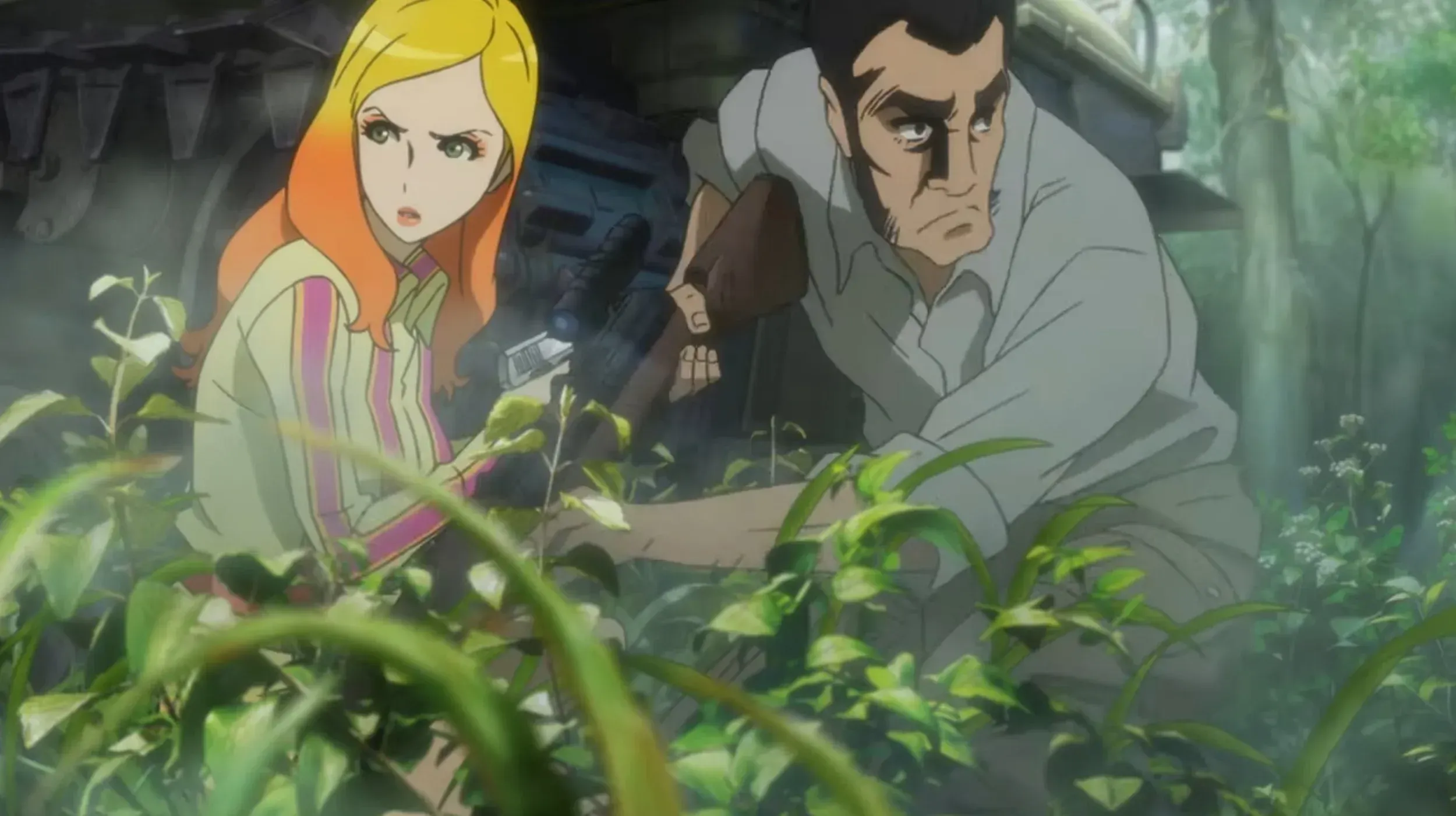
The story kicks off with a violent rupture of domestic calm. Explosives at Lupin’s estate leave behind a map, a literal piece of paper that behaves like a beckoning finger toward whatever waits offshore. That single prompt pulls the gang into an island that functions as a graveyard for 20th-century industrial ambition. Rusting tanks and aircraft carriers sit in the open like abandoned monuments. The place becomes a visual thesis statement for “obsolescence-core,” a landscape where yesterday’s machines rot into scenery.
The island also turns into a psychological trap. A toxic mist hangs in the air with a simple, ugly rule: it threatens to turn the living into mindless “undead” inside twenty-four hours. The clock does what clocks do in thrillers. It squeezes. It pushes. It turns every choice into triage.
That time limit drives a frantic tempo, shifting the film into a desperate scramble for survival. Once the crew arrives, separation hits fast. Each member has to absorb the island’s hostility alone. The structure echoes a familiar modern condition: people stranded inside private crises, trying to stay functional long enough to reconnect with anyone else. The island plays like a character, a surreal purgatory where remnants of war double as shelter. The ticking pressure injects real anxiety into the usual heist framework, and the film seems happy to let that anxiety do the talking.
The Logic of the Impossible
The central conflict hinges on Lupin’s rationalism colliding with Muom, an enemy shaped like an argument against reason. Muom is a physical anomaly with exaggerated proportions, and he carries a maddening talent for surviving point-blank gunshots. He becomes a “metaphysical-wall” for Lupin, the kind of obstacle that refuses to behave like a trick with a hidden mechanism. Lupin treats every con as something that can be solved. Muom treats physics as a suggestion.
Salifa, a young girl who serves as a translator, adds a cold layer of distance to Muom’s presence. Her role makes the villain’s menace feel processed through language, like horror delivered with the calm of customer service. It is an unsettling texture, and the film knows it.
The reappearance of adversaries such as the sniper Yael Okuzaki and the lumbering Hawk creates personal stress tests for Jigen and Goemon. These encounters read less like routine obstacles and more like exams in professional identity, the kind that ask what a person becomes when the job stops feeling like a game. The film keeps pulling the characters toward that question, even when the plot is sprinting.
Lupin’s motivation also tilts into the philosophical. He values the memories tied to his loot more than the gold itself. That framing clarifies his reaction to the island’s mist, which strips victims of their pasts. Theft becomes sentimental. Amnesia becomes the real robbery. (A thief with principles can sound ridiculous until the story makes the principle the point.)
Even Inspector Zenigata gets shoved into a grudging alliance with his prey, a piece of necessary “realpolitik” forged by shared danger. The film can be sharp about survival politics when it wants to be. It also stumbles. Fujiko Mine ends up reduced to a pawn with limited agency, and the choice reads like a slide back into stale, outdated tropes. The film is chasing modern severity in some areas while leaving her stuck in an older drawer.
Analogue Kineticism in a Digital Age
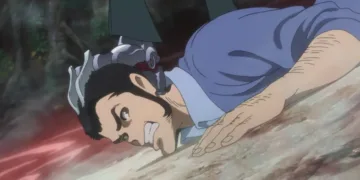
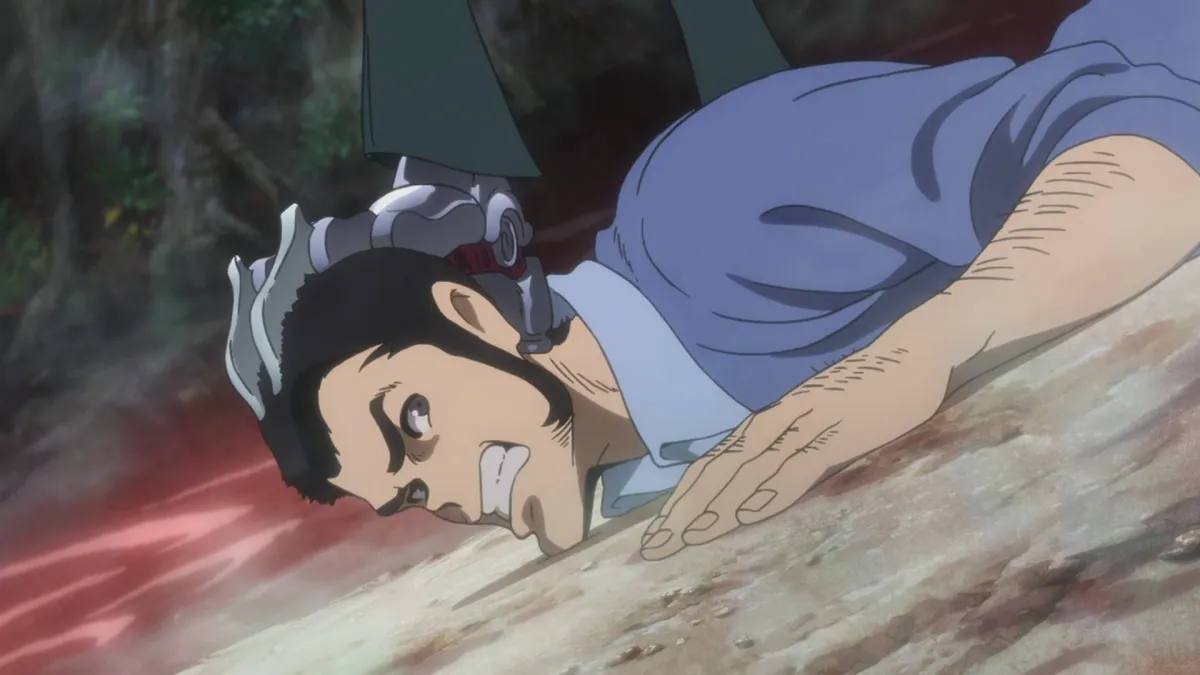
On the visual level, the film plays like a masterclass in “analogue-revivalism.” Veteran artist Kazuhide Tomonaga gives the image a hand-drawn weight that many digital processes fail to reproduce. The action moves with staggering kinetic force. A plane crash early on, followed by high-speed chases, lands with fluid, bone-crunching detail that makes impact feel physical instead of decorative.
As the island takes over, the look turns psychedelic. Blood-red rivers and surreal flora suggest botanical madness, a corrupted nature that feels touched by something supernatural. The environment becomes expressive, like the setting itself is trying to infect the story’s mood.
The score steers away from brassy, upbeat themes associated with the past and settles into a grounded, serious soundscape. It underlines exhaustion. It keeps the characters’ fatigue in the foreground, which matters once the film starts treating damage as cumulative instead of flashy. By the final act, the violence reads as tactile: scrapes, broken bones, and a crew that looks worn down in a way action heroes rarely are.
The film ends by looping straight into the events of the 1978 classic, The Mystery of Mamo. That connection functions as a reward for long-term fans and locks this period into place as a definitive prequel. It frames the characters’ history as a closed circle, spiraling around identity and survival, with the island’s industrial ruins and memory-erasing mist hanging over it like a warning sign about what gets lost when a culture treats people as disposable parts.
Lupin the IIIrd: The Movie – The Immortal Bloodline is the thirteenth theatrical entry in the iconic Lupin III franchise and the first solo film to utilize traditional 2D animation in nearly thirty years. This feature serves as the final installment in director Takeshi Koike’s stylized and gritty “Lupin the IIIrd” saga, bridging the narrative gap between recent specials and the series’ 1978 cinematic debut. The story finds the gentleman thief and his crew stranded on a mysterious island in the Bermuda Triangle where they must outwit an immortal adversary and survive a toxic environment within a 24-hour time limit. Following its Japanese premiere in the summer of 2025, the film saw a limited three-night engagement in North American theaters in early January 2026 via GKIDS and is currently making its way to international screens in the United Kingdom and Ireland.
Full Credits
Title: Lupin the IIIrd: The Movie – The Immortal Bloodline
Distributor: Toho Next, GKIDS, Anime Limited, Piece of Magic Entertainment
Release date: June 27, 2025 (Japan), January 4, 2026 (USA), February 21, 2026 (UK)
Rating: NR, PG
Running time: 93 minutes
Director: Takeshi Koike
Writers: Yūya Takahashi, Monkey Punch
Producers and Executive Producers: Yu Kiyozono, TMS Entertainment, Telecom Animation Film
Cast: Kanichi Kurita, Akio Ōtsuka, Daisuke Namikawa, Miyuki Sawashiro, Koichi Yamadera, Kataoka Ainosuke VI, Aoi Morikawa, Keith Silverstein, Dan Woren, Lex Lang, Cristina Vee, Richard Epcar
Director of Photography (Cinematographer): Jiro Tazawa
Editors: Masato Yoshitake, Takeshi Koike
Composer: James Shimoji
The Review
Lupin the IIIrd: The Movie - The Immortal Bloodline
The film succeeds as a visceral exercise in style. It exchanges the typical levity for a heavy, physical toll that grounds the characters in a way few entries have dared. While the narrative stalls in the middle and the treatment of its female lead remains stuck in the past, the sheer artistic force of the animation carries the day. It is a bold, bruised coda to a specific era of the franchise.
PROS
- Exquisite 2D animation and bone-crunching action sequences.
- Thoughtful exploration of memory and loss.
- Seamless narrative connection to the 1978 film.
- Immersive, surreal island setting.
CONS
- Limited agency and disappointing characterization for Fujiko.
- Janky CGI background elements.
- Pacing slows significantly during the separation scenes.
- Extensive prior knowledge of the OVAs is necessary.