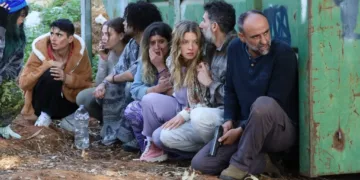


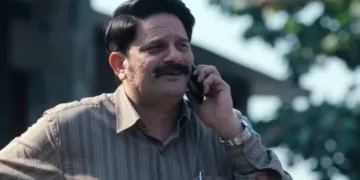








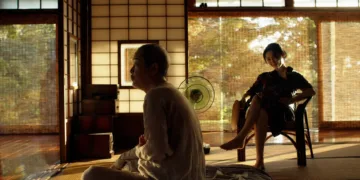






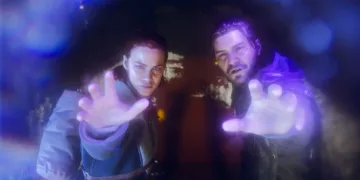



Twelve Hours in October is among the first narrative films to dramatize the events of October 7, 2023. Director Danny A. Abeckaser confines the story to a focused twelve-hour span, using that tight frame to approach a subject that can feel impossible to hold in a single piece of fiction.
The opening lands with immediate force: a terrified phone call from a child to her mother, a domestic emergency that pulls the viewer into the day through one private, intimate point of contact. From there, the film shifts its attention to the Nova music festival and a nearby kibbutz, moving between spaces that start in ordinary rhythms and shared celebration.
Abeckaser introduces a range of fictionalized figures designed to feel recognizable in their small, personal stakes: a couple marking an engagement, another sharing news of a pregnancy, families waking into what looks like a quiet morning. The film makes those early beats readable on purpose, like the first pages of a disaster story where you learn who people are right before the ground gives way.
That rupture arrives fast. Rockets streak across the sky, and the story pivots into the opening stages of a ground assault. Abeckaser filmed on actual locations in pursuit of historical accuracy, and the movie carries itself like a record with an agenda: preserving these moments for the future. The approach aims to humanize a day that often gets flattened into political language, and it tracks the swing from communal celebration to a fight for survival with blunt clarity.
The Visual Language of Chaos
The filmmaking runs on urgency, shaped to echo the frantic tempo of what it depicts. Abeckaser uses familiar narrative beats, then pushes the camera style toward documentary immediacy, creating the sense that the story is unfolding in the same breath it is being watched. That strategy becomes especially pointed when real footage appears near the end, a hard reminder of the reality underneath the dramatization and a jolt that re-anchors what came before.
Cinematographer Barry Markowitz leans into closeness, keeping the images intimate even as the situation expands into terror. Silence becomes a tool, stretched and placed with care to thicken the dread between bursts of noise. The sound design carries the emotional pressure, with environmental violence and panic filling the space that dialogue might usually occupy.
The smaller scale of the production shapes the action, too. Set pieces feel gritty and contained, and the choreography lacks the sleek engineering of a high-budget blockbuster, which can sharpen the rawness of certain moments because the violence reads as messy and immediate.
One decision stands out in a different way: everyone speaks English. That choice changes the texture of the performances. Heavy accents for Israeli and Gazan characters create a noticeable layer of artifice, and the film occasionally loses some of the realism it is working to protect because the language itself calls attention to the construction.
Human Faces in the Fire
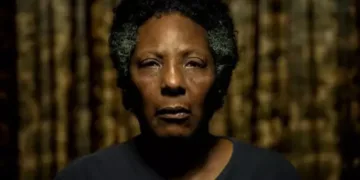
The ensemble brings a strong sense of authenticity, often communicating through physical detail rather than lines on the page. A panicked glance, a locked jaw, a tense posture: the actors register fear in ways that feel instinctive, as if the body is speaking before the script can catch up.

Kosta Kondilopoulos supplies backstories for couples such as Talia and Barak, or Doron and Orly, giving the audience a clear reason to invest in what happens to them. Those introductory moments follow familiar disaster-movie grammar, where personal milestones appear just long enough to make the interruption hurt.
The film then settles into a procedural rhythm that keeps returning to the logistics of the attack. The pace leaves limited room for character growth. I often find that when a movie moves at this speed, people start to read as symbols of suffering, and the messy contradictions that make a character feel lived-in can slip out of view.
The pregnancy news and marriage proposal threads struggle to breathe once the violence dominates the frame, and the scale of the horror has a way of crowding out the intimate arcs the film sets up early. Performances remain committed through the ordeal, yet the writing keeps attention trained on external events, with the interior experience of survival staying more distant.
Perspectives and the Weight of Truth
The depiction of the assault is harsh and difficult to sit through. Home invasions and executions are shown with a directness that can feel like shock therapy, pushing the viewer into confrontation rather than reflection. The film approaches sexual assault through implication, leaving much to the audience’s imagination. That restraint helps the movie avoid sliding into exploitation, and it still acknowledges the reality of atrocities as part of the day’s violence.
The story also makes space for the antagonists’ perspective. Malik and his son appear in scenes that point toward the mechanics of indoctrination, showing how ideas and loyalties move through a family line. Some of these sequences carry scripted speeches that feel built to deliver a fixed message, and those moments can disrupt the immersion the film earns through its more visceral passages.
There is also a tension in the film’s tone. It shifts between the feeling of a raw historical record and the shape of a structured thriller, and that push-and-pull becomes part of the viewing experience. The film presents murderers and victims sharing the same physical world and speaking the same language. The choice streamlines communication for a global audience, yet it complicates the movie’s claim to total realism, especially in scenes where the language draws attention to the film’s construction.
12 Hours in October arrived in theaters on December 14, 2025, to mark a significant anniversary. The film transitioned to digital streaming on January 6, 2026. You can find the production on Apple TV+, Amazon Prime Video, and various video-on-demand services. The story provides a visceral look at a high-stakes historical event through a narrative lens.
Full Credits
Title: 12 Hours in October
Distributor: Deep C Digital, Apple TV+, Amazon Prime Video
Release date: December 14, 2025 (Theatrical), January 6, 2026 (Digital)
Rating: TV-MA
Running time: 1 hour 21 minutes
Director: Danny A. Abeckaser
Writers: Kosta Kondilopoulos
Producers and Executive Producers: Danny A. Abeckaser, Perry Hiiman, Ilan Portal, Maor Benshushan, Mosha Ziv, Emil Fish, Jennifer Dryan Smorgon
Cast: Doron Ben-David, Yaakov Zada-Daniel, Marina Maximilian Blumin, Ariel Yagen, Montana Tucker, Hadar Shitrit, Herzl Tobey, Chanel Omari
Director of Photography (Cinematographer): Barry Markowitz
Editors: Danny A. Abeckaser
Composer: Lionel Cohen
The Review
12 Hours in October
Twelve Hours in October is a harrowing attempt to document a tragedy through the lens of narrative cinema. While the film excels in its raw, documentary-style tension and features grounded performances from its Israeli cast, the decision to use English dialogue and a somewhat procedural script creates an emotional distance. It functions better as a visceral historical record than a deeply nuanced drama. It serves as a stark, difficult piece of shock therapy that prioritizes immediate impact over lasting character depth.
PROS
- Authentic, visceral performances from the lead cast.
- Effective use of silence and sound to build dread.
- Gritty, on-location cinematography adds realism.
- Brave, unflinching look at sensitive subject matter.
CONS
- English dialogue feels unnatural for the setting.
- Limited budget impacts the scale of action scenes.
- Character arcs feel secondary to the procedural plot.
- Occasional stilted dialogue and heavy-handed speeches.