























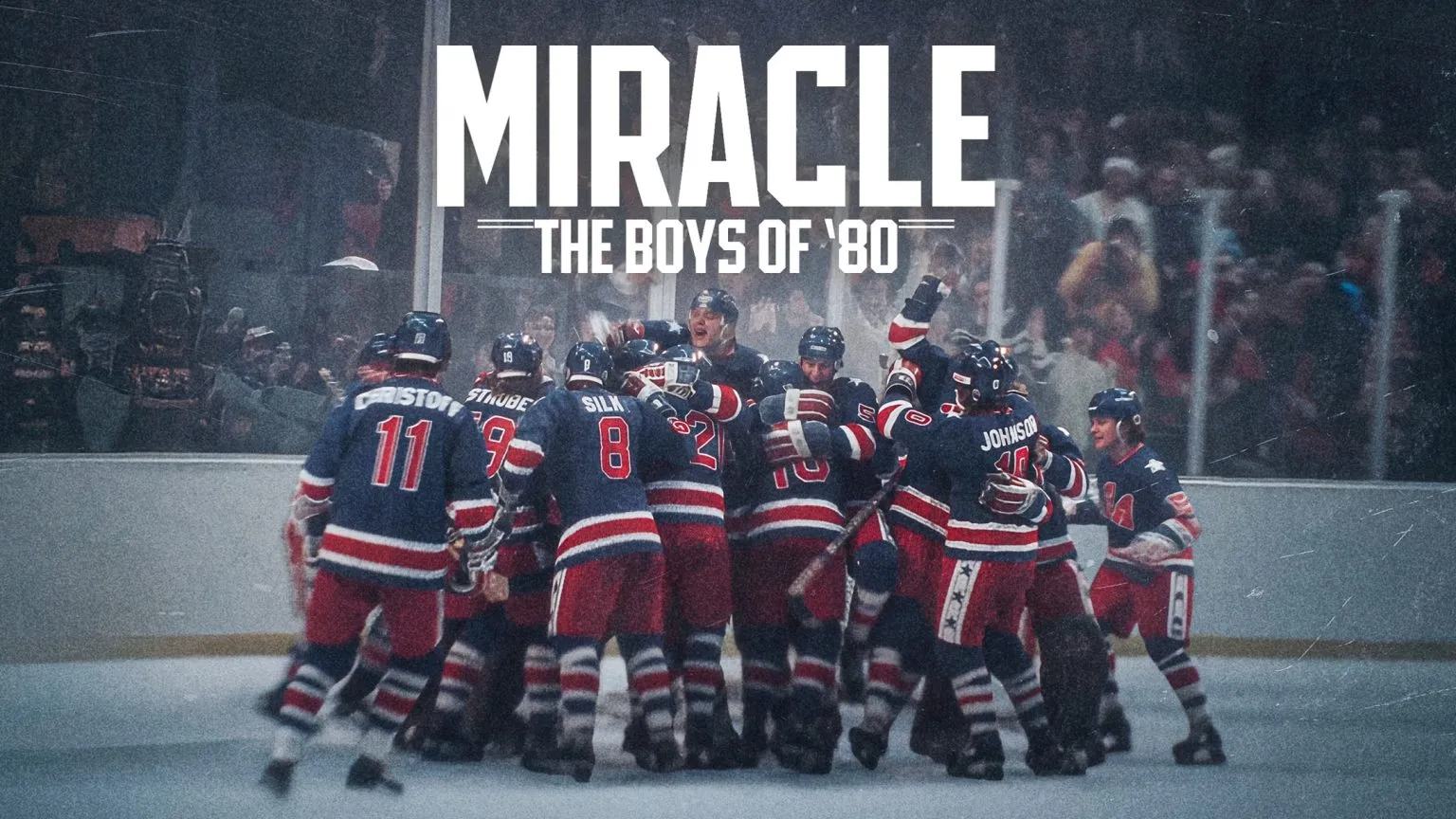

Max Gershberg and Jake Rogal revisit a familiar sports legend in the Netflix documentary Miracle: The Boys of ’80. The film returns to the 1980 Winter Olympics in Lake Placid, New York, where a group of American college players met a Soviet Union team that carried an aura of inevitability.
The game has long held a permanent spot in sports lore, and screen history has already circled it from multiple angles. This documentary arrives forty-five years later with a narrower, more intimate goal: it gathers the surviving members of that roster and asks them to sit with what the story has become.
Its key framing device is simple and effective. The players come back to the same rink, take seats together in the stands, and watch the original broadcast alongside archival material. The choice turns the arena into a viewing room where private recollection and public record share the same air.
The film plays as a historical account, and it also tracks what time does to a victory that has been repeated until it feels carved in stone. The tone stays measured. Rather than leaning on constant triumph, the camera studies the men watching their younger selves, letting expression and pause do a lot of the work.
The Texture of Memory
The filmmakers build their visual base with rare 16mm footage that looks immediate, rough-edged, and lived-in. Grain and motion give practices and locker room moments a plainspoken quality, useful in a story that has collected polished mythology over decades.
The reunion at the Olympic arena becomes the documentary’s strongest storytelling tool. Watching the players respond to their own shifts and decisions, decades removed, brings out an unguarded vulnerability. They laugh at who they were. They also fall silent at points, and that quiet lands because it comes from recognition rather than a cue.
A side-by-side approach sharpens the passage of time by placing 1980 headshots next to present-day faces. The edit makes aging tangible, and it keeps the film grounded in the distance between college kids on the ice and grandfathers in the seats.
Structurally, the documentary follows the tournament in a straight line. It begins with the tense selection process, moves through months of punishing preparation, and then steps into the knockout rounds. That steady progression gives the tension room to rise on its own terms, even for viewers who already know where the story ends.
Friction and Discipline
The documentary spends real narrative time on the clashes that came before the win. Players drawn from rival college programs in Minnesota and Massachusetts arrived carrying long-standing animosity. The film lays out how those divisions had to be put aside so the roster could function as a single unit, and it treats that shift as a major part of the arc rather than a footnote.

Herb Brooks stands as the central force behind that change, presented as a relentless coach with a reputation for being difficult. His methods come across as harsh, close enough to mistreatment that the film does not romanticize the experience. At the same time, the players describe him with a conflicted respect that fits the complexity of what they endured.
They talk about exhaustion, about a “lunchpail” mentality, and about an atmosphere shaped by constant demand. The emphasis on the Americans’ amateur status matters here. These were young students facing a Soviet machine that operated with professional precision.
Mike Eruzione and his teammates share direct stories about life before the spotlight, anchoring the film in the ordinary reality of being twenty-year-old kids with something to prove. Their willingness to submit to Brooks’s drills makes the cost of the eventual success feel concrete.
The Weight of the Cold War
The film places the games inside the charged climate of the Cold War. In 1980, the rink carried the weight of a larger ideological contest between superpowers, and the documentary treats that pressure as part of the event’s lived experience. National pride had been unsteady amid economic instability and international tension, which gave this win the feeling of a rare communal exhale.
The documentary handles the political dimension with restraint. It portrays the Soviet team as elite athletes worthy of respect, not as cardboard villains. That framing strengthens the significance of the American win by keeping the opponent’s excellence in view. The storytelling stays away from heavy-handed symbolism, letting the belief in the building, from crowd to bench, speak through faces and reactions.
The film also acknowledges what it means to live inside a legend. For the men who played, “Miracle” was a brief stretch of time that shaped the next forty years of their lives. The documentary returns to the psychological weight of being tethered to one event that the outside world keeps replaying, as if it never really ended.
Released globally on Netflix on January 30, 2026, Miracle: The Boys of ’80 is a feature-length documentary that revisits the legendary “Miracle on Ice” at the 1980 Winter Olympics. Directed by Max Gershberg and Jake Rogal, the film combines never-before-seen 16mm archival footage with intimate, modern-day reflections from the surviving members of the U.S. men’s hockey team. It chronicles the improbable journey of a group of amateur college athletes who defeated the powerhouse Soviet Union squad during the height of the Cold War. The documentary provides a reflective and deeply personal look at the legacy of the game, bringing the players back to the original arena in Lake Placid to share their memories four decades later. You can currently stream it exclusively on Netflix.
Where to Watch Miracle: The Boys of ’80 (2026) Online


Full Credits
Title: Miracle: The Boys of ’80
Distributor: Netflix
Release date: January 30, 2026
Rating: 7+
Running time: 108 minutes
Director: Max Gershberg, Jake Rogal
Writers: Max Gershberg, Jake Rogal
Producers and Executive Producers: Connor Schell, Libby Geist, Aaron Cohen, Alexa Conway, Jason Hehir, Mark Ciardi, Brent Wilson, Yiannis Exarchos, JT Taylor, Kostas Karvelas, Anne-Sophie Voumard, Jérôme Parmentier, David Herren
Cast: Mike Eruzione, Phil Verchota, Mike Ramsey, Rob McClanahan, John Harrington, Dave Christian, Craig Patrick, Buzz Schneider, Dave Silk, Bill Baker, Steve Janaszak, Neal Broten, Mark Johnson, Ken Morrow, Jack O’Callahan, John Powers, Danny Brooks, Kelly Paradise, George Will
Director of Photography (Cinematographer): Not specified
Editors: M. Brennan, Zachary Kashkett
Composer: Mark Isham
The Review
Miracle: The Boys of '80
Miracle: The Boys of '80 succeeds by stripping away the usual sports-movie polish in favor of raw, human reflection. By reuniting the players in the arena of their greatest triumph, the film moves beyond simple nostalgia to explore the physical and emotional reality of aging heroes. It balances the high-stakes tension of the Cold War with intimate, candid stories of a difficult coach and a fractured team. While it follows a familiar documentary format, the rare footage and genuine vulnerability of the surviving athletes make this a meaningful addition to the legend.
PROS
- Rare 16mm archival footage provides a fresh, gritty look at the games.
- The rink reunion creates a powerful, emotional connection between past and present.
- Balanced portrayal of the Soviet team as respected athletes rather than villains.
- Honest exploration of the grueling, often harsh coaching methods of Herb Brooks.
CONS
- The structure follows a very traditional, linear sports documentary formula.
- Limited exploration of the players' personal lives in the four decades following the win.