

























![Kingdom Hearts Collection [I-III] Review](https://gazettely.com/wp-content/uploads/2026/10/Kingdom-Hearts-Collection-I-III-1-360x180.webp "Kingdom Hearts Collection [I-III] Review: KHII Holds Steady as Newer Entries Fluctuate 37")





The film opens aboard a luxury cruise ship moving through the Mediterranean, setting a space defined by corporate maneuvering and enforced leisure. Parker Andrews appears as a detail-oriented attorney assigned to close a major merger tied directly to the vessel. His attention stays fixed on his laptop, a habit his sister Emily tries to interrupt by pointing him toward the scenery around him.
Kelly Coates occupies the ship with a different purpose. She works as a secret shopper, paid to catalogue operational weaknesses for a competing investment group. Their first encounter happens on deck, where Parker’s controlled reserve meets Kelly’s relaxed social confidence.
The narrative shifts during a port stop in Sicily. Parker and Kelly leave the ship for a guided donkey trek to a waterfall. A mishandling of the animals strands them on the mountainside, and they reach the harbor only in time to watch the ship pull away. The story establishes a clear goal from this point forward. They need to cross the Italian coast and catch the ship at its next stop. This separation removes their professional insulation. Lacking their usual authority and resources, they face a time-sensitive journey shaped by temperament as much as distance.
Coastal Logistics and Production Aesthetics
The plot traces a route through Palermo, Syracuse, Taranto, and Bari, giving the film a forward motion tied to geography. Each location introduces a practical barrier tied to travel. A rail worker strike halts progress, and renting a car becomes its own negotiation.
A moped ride through the countryside stands out as the film’s most effective visual passage. The sequence grounds the story in place while underscoring how far the characters still need to go. A storm labeled a Medicane forces the ship to change course, adding uncertainty to their pursuit.
The production design reveals two competing impulses. Southern Italy locations feel grounded and textured, offering a credible environment for the story. Interior scenes aboard the ship feel compressed. Dining rooms and cabins suggest a scale smaller than the luxury label implies. One visual moment draws particular attention.
The Sicilian waterfall appears shaped by digital manipulation, which clashes with the surrounding cliffs. These moments highlight the constraints associated with made-for-television filmmaking. The strongest sequences occur outdoors, where natural light and real roads carry the visual weight.
Lead Performances and The Physicality of Stress
Kristoffer Polaha plays Parker with a visible strain that runs through his body. Anxiety surfaces through recurring back pain that intensifies under pressure. This physical detail gives substance to a familiar professional archetype. Parker begins the film treating leisure time with the same rigidity he applies to legal work.
Polaha charts his gradual shift toward adaptability with restraint. Emilie Ullerup balances him as Kelly. She handles navigation, planning, and emotional recalibration while maintaining her professional focus. Their chemistry grows from mutual capability. Each recognizes the other’s effectiveness in managing setbacks. Tension escalates once professional loyalties intrude.
Parker receives directives from his employer aimed at preventing Kelly from returning in time to complete her assignment. This places him in an ethical bind tied to ambition and emerging affection. Ullerup plays Kelly’s response to the breach of trust with controlled intensity, keeping the moment grounded and avoiding excess.
Verbal Sparring and The Puns of Bonding
Dialogue centers on a shared language of wordplay. Puns become the bridge between Parker and Kelly’s differing outlooks. Parker leans on dad jokes as a buffer against emotional exposure. Kelly engages with the humor directly, turning the exchange into a mutual exercise. This verbal rhythm becomes their primary form of connection.
The script uses these exchanges to clarify Parker’s habits. He gravitates toward rehearsed humor as a form of emotional management. The pacing of their banter stays brisk, mirroring the urgency of their travel. Situational comedy emerges from the logistics of the chase. Errant donkeys and tense encounters with rental agents inject physical humor into dialogue-heavy scenes.
The tone stays light throughout, steering clear of darker comic impulses. This choice keeps attention on the relationship as it takes shape. The jokes function as shorthand, marking familiarity as it grows scene by scene.
The Supporting Cast and Parallel Narratives
The story broadens through a set of secondary characters who reinforce its themes. Amy Louise Pemberton plays Emily, Parker’s sister, serving as a stabilizing presence for Adam, the erratic cruise line owner portrayed by Trey Warner. Adam enters the film as an exaggerated corporate figure. Emily challenges him to consider the human impact of his decisions.
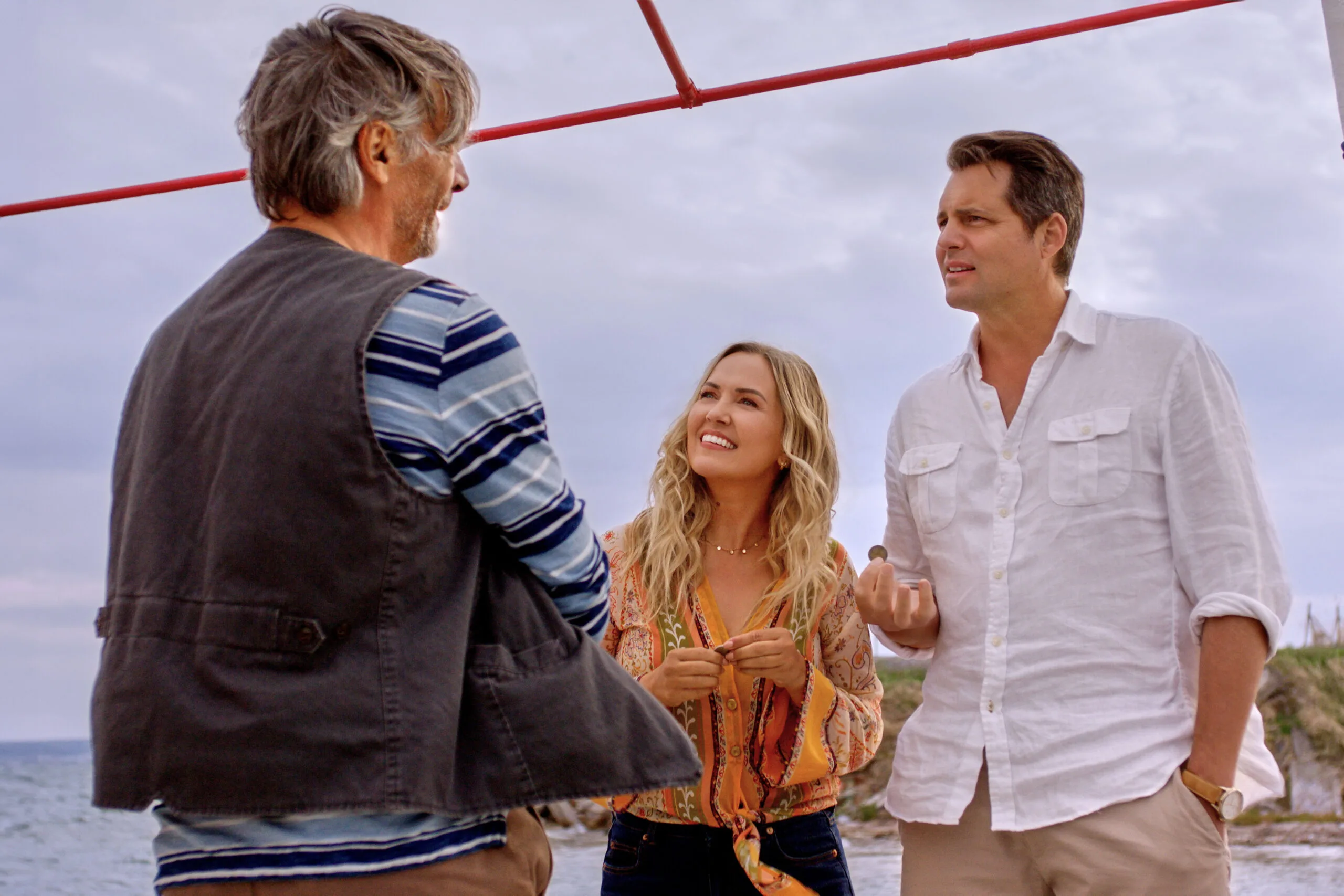
Their dynamic forms a secondary romance that echoes the central plot. Orlando Seale appears in dual roles as twin agents stationed at different ports. Each performance carries a shared irritability that sharpens the bureaucratic hurdles facing Parker and Kelly.
Dr. Vulcano enters briefly as an unconventional healer treating Parker’s back pain, adding an offbeat note to the journey. Adam experiences a clear transformation by the final act, shifting toward an outlook that values his workforce. This shift enables the film’s resolution. These supporting roles function as active forces within the story. They create friction and momentum while reflecting the world Parker and Kelly aim to return to.
Structural Logic and The Road to Resolution
The narrative unfolds in defined stages. Early sections emphasize urgency through repeated travel failures. Later passages slow as the characters settle into a clearer understanding of each other. Plot progression depends on coincidence. The strike and the storm extend their time together in ways the story requires. Travel times across Italy appear compressed, particularly during sequences involving a moped and a private boat.
The business storyline anchors the final conflict. Resolution arrives in a boardroom setting, keeping the focus on professional stakes. The closing stretch links personal decisions with corporate outcomes. Kelly confronts the consequences of missing her assignment, and Parker answers for the instructions he followed. The film addresses these threads directly. It closes by reshaping their working lives alongside their relationship, aligning career and emotion within the same narrative frame.
Missing the Boat premiered on the Hallmark Channel on January 31, 2026, serving as the grand finale of the network’s “Winter Escape” programming event. The film reunites fan favorites Kristoffer Polaha and Emilie Ullerup, who last worked together nearly a decade ago, for a scenic romantic comedy set against the backdrop of the Mediterranean. It follows two strangers who are accidentally left behind in Sicily during a cruise stop and must navigate the Italian coast to catch up with their ship. Currently, viewers can watch the movie on the Hallmark Channel during scheduled encores or stream it on the Hallmark+ platform.
Full Credits
Title: Missing the Boat
Distributor: Hallmark Channel
Release date: January 31, 2026
Rating: TV-G
Running time: 84 minutes (1 hour 24 minutes)
Director: Maclain Nelson
Writers: Judith Berg, Sandra Berg, Maclain Nelson
Producers and Executive Producers: Maclain Nelson, Kristoffer Polaha, Hallmark Media
Cast: Kristoffer Polaha, Emilie Ullerup, Amy Louise Pemberton, Trey Warner, Orlando Seale, Laurence Bouvard
Director of Photography (Cinematographer): Alexander Krumov
The Review
Missing the Boat
Missing the Boat succeeds because the lead actors anchor a familiar premise with genuine charm. The reliance on linguistic humor and physical setbacks creates a grounded experience within the predictable structure. While the technical production of the ship scenes remains inconsistent, the location work in Italy provides a scenic anchor. It remains a solid entry for the vacation romance genre.
PROS
- Excellent chemistry between the lead performers.
- Sharp dialogue and consistent wordplay.
- Stunning Italian landscapes.
- Engaging supporting roles.
CONS
- Jarring digital effects in early scenes.
- Restricted scale of ship interiors.
- Unrealistic travel durations between cities.







