
























![Kingdom Hearts Collection [I-III] Review](https://gazettely.com/wp-content/uploads/2026/10/Kingdom-Hearts-Collection-I-III-1-360x180.webp "Kingdom Hearts Collection [I-III] Review: KHII Holds Steady as Newer Entries Fluctuate 37")



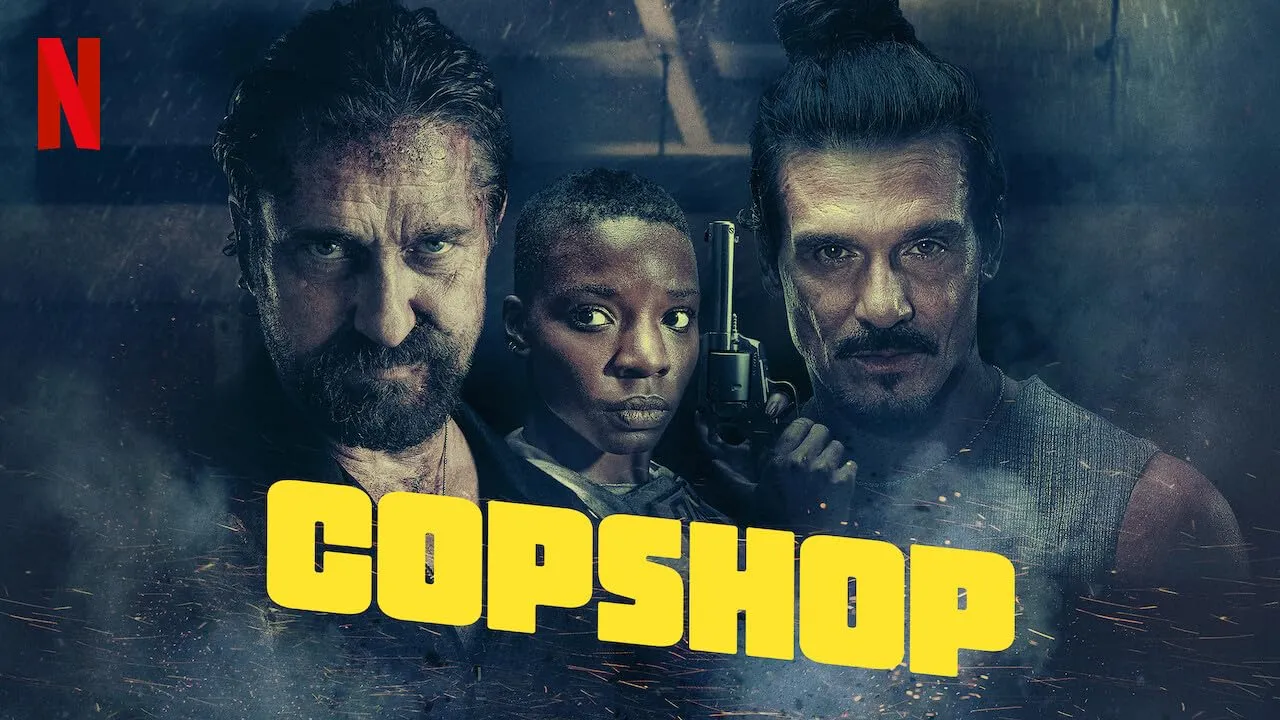

The film opens on a Nevada expanse that feels less like scenery than judgment. Wide shots hold the horizon with indifference, as if the desert has already seen every version of this story and stopped taking notes. Into that emptiness walks Teddy Murretto, chasing the strangest form of safety: incarceration.
The camera treats his sprint toward the Sun Creek City station like a confession in motion, handheld urgency tightening into steadier frames once the building swallows him. Inside, the palette turns clinical. Fluorescents flatten faces, bleaching warmth from skin and making every lie look premeditated.
Officer Valerie Young enters as a tonal disruption. Her posture and measured gaze suggest belief in procedure, which reads as almost eccentric in a world this sour. Then Bob Viddick arrives and the premise reveals its perversity. He stages his own arrest with the calm of a man reserving a seat at a show he paid for.
The precinct becomes a noir stage without the romantic shadows, a place where menace hides in plain light. Dialogue lands like thrown cutlery, sharp and casually personal. Even pauses feel armed. The tension works because the film understands a basic truth about fear: you do not need darkness to imagine what is waiting. You just need a locked door and the sense that it might open on the wrong schedule.
The Brutalist Geometry of the Cage
Sun Creek City’s station rejects the expected grime and instead leans into a corporate sterility that makes violence feel obscene. High concrete ceilings and glass partitions create hard planes that slice the frame into compartments. Joe Carnahan shoots the building like architecture with a pulse, favoring clean sightlines that become tactical problems. The cellblock is the visual thesis. Two cages face each other at an intimate distance, forcing confrontation as a default state. It is a chessboard where the pieces can sweat.
The lighting is the cruel joke. Fluorescents erase secrecy, so the film compensates with composition. Faces get boxed by bars, bisected by doorframes, trapped in rectangles inside rectangles. Chiaroscuro arrives in a modern key, less candlelit glamour, more security-camera severity. Slow push-ins weaponize proximity. Static wide shots dare the audience to scan corners, to anticipate movement that may never come. Sound design does the rest. A key turn becomes prophecy.
Footsteps in the hallway stretch into a metronome of dread. The station’s quiet reads as pressure rather than peace, and the desert outside guarantees no cavalry, no comforting cutaway to another plotline. This is a siege story that refuses the luxury of elsewhere. The building becomes a moral container, and everyone inside keeps discovering they do not like the shape of it.
The Ethics of the Professional Scumbag
Valerie Young functions as the film’s moral instrument, tuned to duty even as the room detunes around her. Alexis Louder plays her with a calm diction that feels practiced, as if she has already decided panic is a wasted resource. The camera frequently grants her the cleanest compositions, centered, level, stable. It is visual ethics. Against her, the men arrive as competing philosophies in human form.
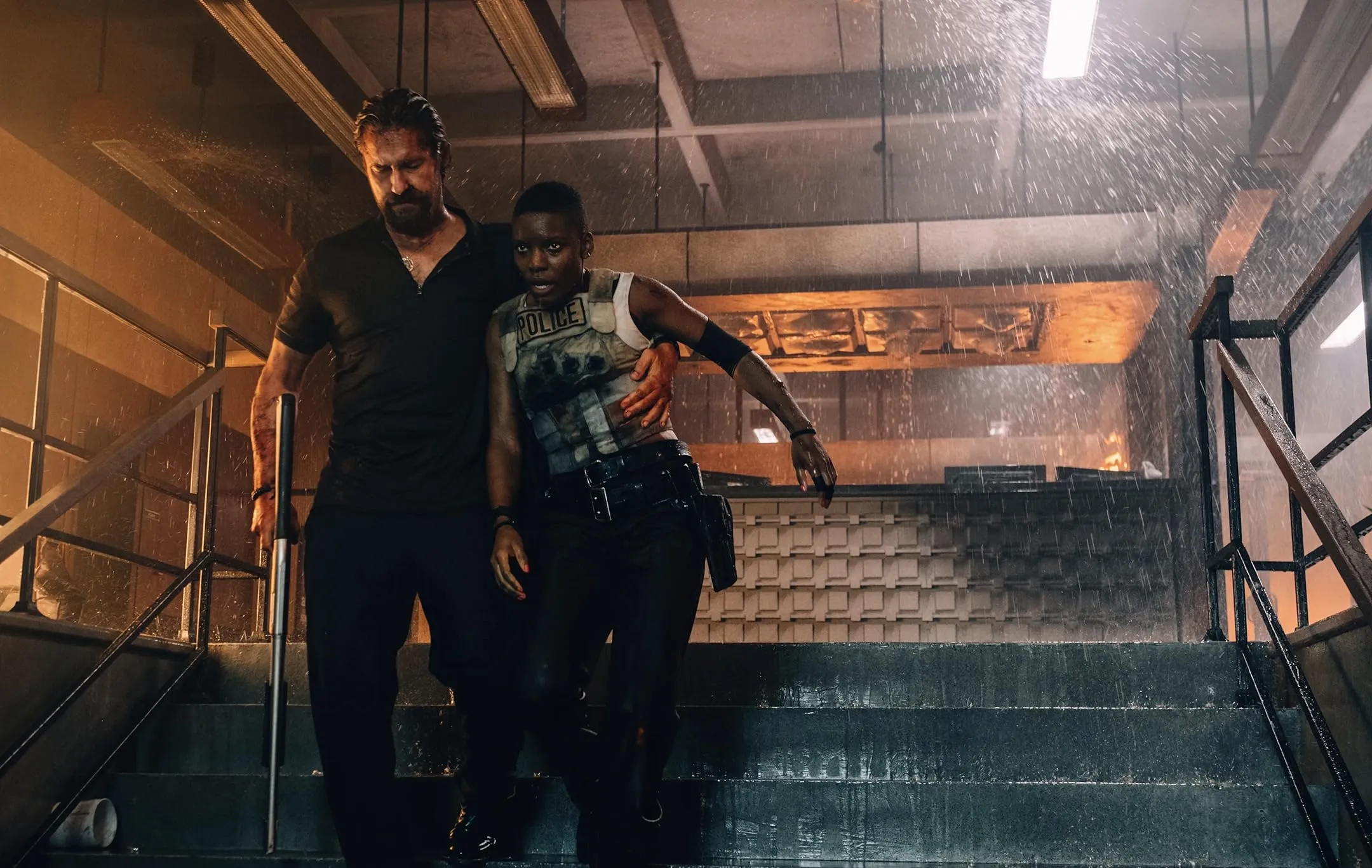
Bob Viddick carries himself like a craftsman. Gerard Butler gives him a heavy physical presence, a moving wall that speaks in controlled increments. He claims a code, and the film lets that claim hang in the air long enough for the audience to test it.
Teddy Murretto is something slipperier. Frank Grillo performs him as a fixer who treats sincerity like a temporary disguise, vanity included. Their cage-to-cage exchanges become a courtroom where no verdict is clean. They argue survival, guilt, entitlement, and the strange pride men take in their own damage. The standoff reads like an existential seminar held at gunpoint, which is still a seminar, technically.
Young watches with a skepticism that keeps puncturing their posturing. Her restraint becomes its own kind of force, and the film quietly suggests that moral clarity is a skill, not a mood. The men talk about honor the way gamblers talk about luck. She treats it like a job description.
The Arrival of a Demented Chaos
The first act simmers, then Anthony Lamb detonates it. Toby Huss enters with birthday balloons and a submachine gun, which is the film’s way of announcing that tonal stability has been revoked. Carnahan shifts gears into pure survival cinema, and the editing tightens accordingly. Cuts become percussive. The camera hugs corners and doorways, adopting the anxious logic of someone trying to live through the next ten seconds. Lamb’s chatter brings a grim levity, the kind that makes you laugh and then immediately distrust yourself for laughing.
A secondary rot spreads inside the badge itself through Officer Huber, a corrupt variable that turns procedure into performance. The standout hallway sequence behind bulletproof glass is constructed like a countdown. The film crosscuts a nine-digit keypad reset with impacts of gunfire on glass, each hit a dull punctuation mark. The sound is raw, metallic, and close, designed to spike the audience’s body before the mind can file an opinion. This is audience psychology by blunt instrument, and it works.
The station becomes an Alamo of bad choices. Standoffs stop being verbal. Heavy weapons replace rhetoric. Bodies drop with a clinical lack of ceremony, framed without lyrical rescue. Noir tradition lingers in the geometry and the fatalism, even as the film swaps cigarette smoke for muzzle smoke. The joke, if you want one, is that the balloons might be the most honest thing in the building. They at least admit they are full of hot air.
Pulp Craft, Antique Convictions
Carnahan leans into pulp with the confidence of someone who knows exactly what he is serving. The aesthetic is hearty, direct, and unashamed, like genre comfort food prepared with real technique. Sound design does a lot of the seasoning. The score rides electronic textures and percussive thumps that evoke a hardboiled seventies mood through modern circuitry. Pacing stays lean, stripping away ornamental detours so the pressure never dissipates.
Valerie Young’s old-style revolver becomes a visual statement, precision amid volume. It links her to a stricter code, a belief that intent matters, that aim is ethical as well as practical. In contrast, everyone else seems to carry tools designed for erasing consequences, which is a tidy metaphor for the film’s ethical gray zones.
Identity becomes a role you rehearse until bullets demand a rewrite. Convictions buckle, sometimes quietly, sometimes with fireworks. The keypad sequence captures a digital-age anxiety without abandoning noir lineage, updating fatalism into something that feels algorithmic. Doors lock. Numbers reset. Time runs out with bureaucratic efficiency.
The film’s pleasure is how cleanly it balances craft and brutality. It keeps its frames crisp even when the world inside them turns feral, and it trusts the audience to feel the moral discomfort without being instructed where to place it.
Copshop premiered in the United States on September 17, 2021, after an earlier international release in the United Kingdom and Ireland. The film provides a high-stakes, single-location thriller experience that centers on a small-town police station. As of today, February 5, 2026, you can watch the film on major streaming platforms like Netflix and Hulu in various regions. It is also available for rent or purchase on digital storefronts such as Amazon Prime Video, Apple TV, and the Google Play Store.
Full Credits
Title: Copshop
Distributor: Open Road Films, Briarcliff Entertainment, STXfilms
Release date: September 17, 2021
Rating: R
Running time: 107 minutes
Director: Joe Carnahan
Writers: Kurt McLeod, Joe Carnahan, Mark Williams
Producers and Executive Producers: Mark Williams, Tai Duncan, Warren Goz, Eric Gold, Joe Carnahan, Frank Grillo, Gerard Butler, Alan Siegel, James Masciello, Matthew Sidari, Tom Ortenberg
Cast: Gerard Butler, Frank Grillo, Alexis Louder, Toby Huss, Chad L. Coleman, Ryan O’Nan, Jose Pablo Cantillo, Kaiwi Lyman-Mersereau, Robert Walker-Branchaud, Tracey Bonner, Christopher Michael Holley, Marshall Cook, Keith Jardine
Director of Photography (Cinematographer): Juan Miguel Azpiroz
Editors: Kevin Hale
Composer: Clinton Shorter
The Review
Copshop
Joe Carnahan delivers a visceral, neon-drenched siege that prioritizes spatial tension over narrative complexity. The film succeeds as a gritty exercise in style, anchored by a breakout performance from Alexis Louder who commands the screen with a quiet, lethal authority. While the third act dissolves into a somewhat chaotic scramble, the sharp dialogue and rhythmic violence provide a satisfying punch for fans of hardboiled cinema. It is a lean, mean slice of B-movie entertainment that manages to feel both nostalgic and fresh within its desert-bound confines.
PROS
- Alexis Louder provides a magnetic and grounded lead as Officer Valerie Young.
- The clever use of the facing jail cells creates a unique and claustrophobic pressure cooker.
- The gunfights are loud, raw, and possess a distinct 1970s grit.
- Toby Huss injects a terrifying and dark humor into the second half of the film.
CONS
- The transition from a slow-burn character study to a frantic shootout feels slightly jarring.
- Several subplots involving political corruption and character motivations remain unresolved.
- The final sequences feel somewhat disjointed, suggesting significant alterations in the cutting room.







