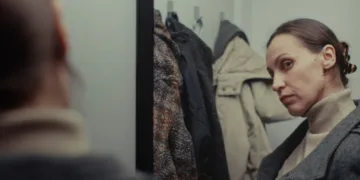
























Under the bright, artificial glow of a television studio, Leah Caldwell is introduced as a person engineered for pressure. Her professional identity is built from rigid competence, the kind that turns airtime into a sequence of timed decisions and quiet compromises. Working as a lead producer for Better Day USA, Leah treats the newsroom as a controlled ecosystem where disorder is managed through preparation, polish, and a refusal to flinch.
The film punctures that control with the arrival of Jarrett Roy, a figure from Leah’s romantic past whose infidelity left a durable imprint on how she reads risk and sincerity. His presence would be destabilizing in any context. Here, it becomes combustible because the threat is structural. Jarrett is positioned as competition for the executive producer role Leah has long pursued, turning unresolved personal harm into a career hazard with a badge and a job title.
Their forced collaboration on a Valentine’s Day special, anchored to a viral faith-based dating book, creates friction that cannot be filed neatly under workplace rivalry. The studio setting becomes an arena where ambition and lingering trauma intersect inside corporate media’s sterile efficiency. What could have played as a simple enemies-to-lovers framework is reshaped into a study of proximity: how the past reverberates when two people are required to perform professionalism while privately auditing every gesture for motive, every apology for strategy.
The Friction of Performance and Presence
Kelly Rowland plays Leah with precision that communicates exhaustion without asking for pity. Leah moves through the newsroom with deliberate focus, her intelligence carried in the quick calibration of her gaze and the restraint of her body language. The performance understands something central about competence in high-pressure spaces: it can be armor, it can be currency, and it can be a cage built from one’s own standards. Rowland avoids caricature. Leah’s drive reads as adaptation to an industry that punishes hesitation and rewards the appearance of total control.
When Jarrett returns, Rowland allows the smallest rupture, a flicker of disbelief that hardens into defiance. It is an acting choice that refuses melodrama and favors something sharper: the instant recalculation of someone who knows exactly what this disruption could cost. Leah’s emotional life is present, yet it is filtered through the discipline of someone trained to keep the machine running.
Opposite her, Clifford Smith gives Jarrett a magnetic ease that fills space without needing to announce itself. His masculinity is presented as revised rather than reinvented, less reckless and more persistently calm, a charm that suggests rehearsal and intention. The film keeps him in a morally grey register, making his claim to a new compass feel plausible while remaining difficult for Leah to accept. That tension becomes the point. The chemistry is carried by clipped dialogue and long, silent evaluations, moments where attraction and suspicion occupy the same breath.
Robin Thede and Annie Gonzalez broaden the film’s emotional map by grounding the central conflict in adjacent lives. Brenda, an anchor confronting the stagnation of a long-term relationship, and Treese, worn down by the churn of digital dating, operate as mirrors for Leah, reflecting different angles of the same question: what does connection cost when competence is already expensive? Their presence keeps the story from becoming a sealed two-hander. It becomes a small ecosystem of women measuring desire against fatigue, hope against routine, and intimacy against the demands of public-facing success.
A Visual Homage to Millennial Romance
Linda Mendoza directs with a saturated, glossy aesthetic that nods to early twenty-first-century romantic comedy brightness, where high-definition clarity and optimistic color palettes translate longing into something almost touchable. The studio and city apartments are treated as heightened spaces, locations that could have felt mundane but instead become stages for emotion. The look suggests a belief that romance, to matter on screen, should also be sensory. Light, texture, and polish function as part of the storytelling vocabulary.
Mendoza uses movement as emotional translation. A spontaneous dance break with the three female leads becomes a small manifesto of solidarity, filmed with a fluidity that contrasts with the static, role-bound posture of the workplace. It reads as release and reclamation, a reminder that the body holds feelings the résumé cannot list.
The road trip sequence shifts the film into a tighter intimacy. The car interior forces Leah and Jarrett into sustained proximity, compressing their conflict into glances, pauses, and the kind of reluctant warmth that can surface when escape routes disappear. Their sing-along works as a sonic bridge, connecting the frost of the present to the memory of earlier ease, and it does so without needing exposition to explain what the music is doing to them.
The soundtrack becomes a vital engine of tone, blending contemporary hits with R&B classics to give the story a rhythmic heartbeat. A duet by the leads underscores how music is used here as social language, a way of admitting feeling while still keeping some protective distance. At 90 minutes, the pacing moves quickly and with confidence, keeping the instructional elements from slowing the emotional momentum.
The Scripting of Intentional Connection
The film’s narrative is threaded tightly to Michael Todd and the philosophy presented through his viral teachings. Dating with intention is framed as a corrective to the drift and disposability of modern romance, a framework that asks for standards, clarity, and accountability. The script builds the Valentine’s Day segment around these ideas so that Leah and Jarrett cannot treat the book as mere content. Producing the message forces them to confront its implications, turning professional obligation into a mechanism for uncomfortable honesty.
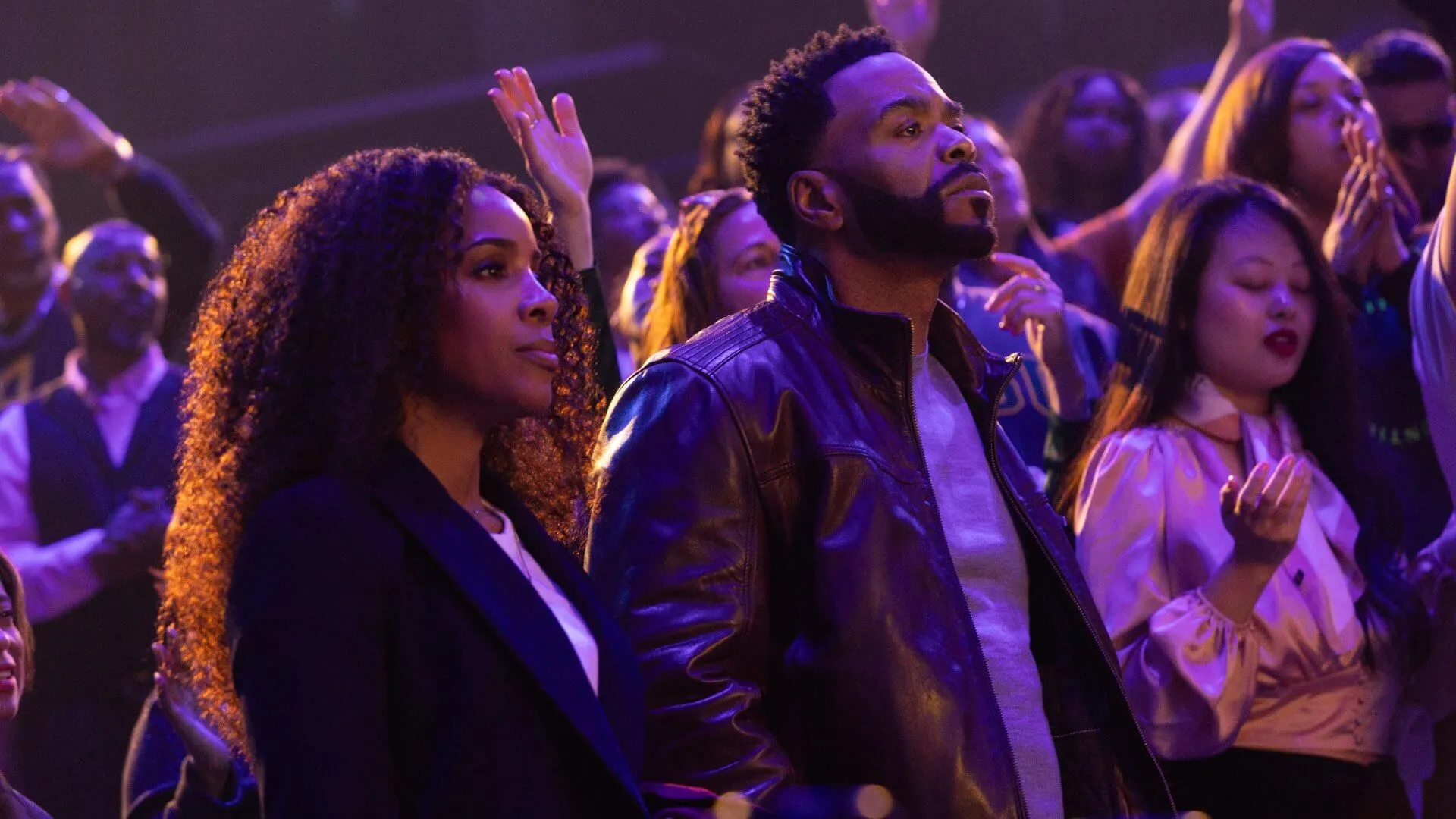
Todd appears as himself, which introduces a layer of meta-commentary: the film is aware of its own didactic charge and chooses to stage it directly. The church in Oklahoma serves as a physical pivot point, a place that pulls the characters out of their New York bubble and into a different rhythm of life, one shaped by community and explicit moral language. The setting matters because it disrupts the story’s corporate sterility. It introduces a social world that speaks plainly about responsibility, repair, and the conditions under which forgiveness can be considered.
Faith and traditional values lend moral weight to familiar romantic-comedy beats, and the film’s most pointed claim is that forgiveness is deliberate rather than spontaneous. Growth is tied to standards, and a second chance is framed as courage, something chosen with eyes open rather than granted in a rush of feeling.
The story keeps returning to the idea that seeking partnership should follow self-security and principled living, rather than serving as a substitute for them. The result is a romance that aims to feel disciplined and deeply felt, with love depicted as a practice shaped by expectations, accountability, and the willingness to do repair work in public-facing lives that rarely allow for private mess.
Relationship Goals premiered globally on Prime Video on February 4, 2026. Inspired by Pastor Michael Todd’s bestselling book, the film is a faith-centered romantic comedy that explores the complexities of modern love and professional ambition within the high-stakes environment of a New York morning news program. You can currently stream the movie exclusively on the Prime Video platform.
Full Credits
Title: Relationship Goals
Distributor: Amazon MGM Studios, Prime Video
Release date: February 4, 2026
Rating: PG-13
Running time: 93 minutes
Director: Linda Mendoza
Writers: Michael Elliot, Cory Tynan, Laura Lekkos
Producers and Executive Producers: DeVon Franklin, Kelly Rowland, Bart Lipton, Michael Todd
Cast: Kelly Rowland, Cliff “Method Man” Smith, Robin Thede, Annie Gonzalez, Dennis Haysbert, Matt Walsh, Ryan Jamaal Swain, Melanie Leishman, DeVaughn Nixon
Director of Photography (Cinematographer): Federico Cantini
Composer: Dara Taylor
The Review
Relationship Goals
Relationship Goals serves as a polished, nostalgic excursion into the mechanics of the heart. While it leans heavily on its instructional source material, the magnetism of Kelly Rowland and Cliff Smith provides a necessary human anchor. It is a work that prioritizes comfort and traditional values over narrative subversion. For those seeking a breezy, faith-adjacent romance with a rhythmic, R&B-infused pulse, the experience delivers exactly what it promises. It is a competent, if predictable, celebration of second chances.
PROS
- Strong, charismatic lead performances.
- High-energy, nostalgic visual style.
- Vibrant and effective soundtrack.
- Brisk, engaging 90-minute pacing.
CONS
- Heavily didactic, infomercial-like tone.
- Predictable, by-the-numbers script.
- Shallow development of supporting cast.
- Occasionally feels like a brand exercise.