















A $500 HOA fee feels less outrageous once the neighborhood association starts issuing demon-slaying duties. That is the best joke in Hold the Fort, and William Bagley understands the value of placing it under the clean, false light of suburbia. Gruber Hills has the look of a planned community built to suppress personality: tidy houses, polite visits, invisible rules, and neighbors who smile with the practiced menace of people who have read the bylaws.
Lucas and Jenny arrive with the usual dream-home anxieties. He wants the new house to mean stability. She sees the HOA as a red flag with landscaping requirements. Then Jerry, the association president, appears at the door with a mustache, a grin, and an invitation to the annual equinox party at the clubhouse. His warning to arrive at 7 p.m. sharp carries the eerie cheer of a man announcing a potluck during a hostage negotiation.
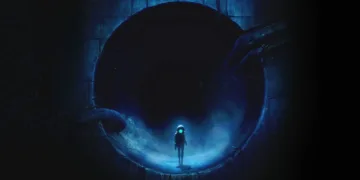
The party is not a party. Gruber Hills sits near a portal to Hell, and once a year the residents gather at Fort Gruber to hold back whatever crawls, flies, stomps, or evaporates through it. Homeownership has many traps. This one has kamikaze bats.
Fine Print and Bad Faith
The film’s moral architecture is comic, but it is still architecture. Lucas signs the HOA agreement without properly reading it or discussing it with Jenny, and Bagley treats that small domestic betrayal as the first crack in the foundation.
It is funny because no reasonable person expects “annual Hellmouth defense” in a real estate contract. It also works because Lucas has already ignored Jenny’s distrust of the arrangement. The portal simply literalizes the danger he waved away.
That gives Hold the Fort a sharper edge than its splatterhouse surface first suggests. The residents accept their bizarre duty because the property values are manageable and the rules, absurd as they are, have kept the neighborhood alive. Jerry frames apocalypse management as standard procedure. The joke lands because HOA culture already turns petty governance into ritual. Bagley simply adds teeth, wings, claws, and a mortality rate.
The script moves fast, sometimes too fast for its own benefit. At roughly 75 minutes, it wastes little time getting Lucas and Jenny from unpacked boxes to the clubhouse siege. That speed keeps the film from sagging, yet it also limits the emotional pressure. The first monster wave arrives quickly and disappears almost as quickly. Several neighbors die before the film gives them the courtesy of being people. Blood can fill a frame. It cannot fill a character.
Faces in the Bylaws
Chris Mayers plays Lucas as a man whose optimism curdles into panic one bad decision at a time. His uselessness with a shotgun becomes a running visual argument against his own self-image. He wants to be the kind of husband who can smooth over conflict, make friends, and handle the fine print. Instead, he becomes the man repeatedly spattered with other people’s blood because he stood in the wrong place at the wrong time. Suburban masculinity, reduced to windshield mist.
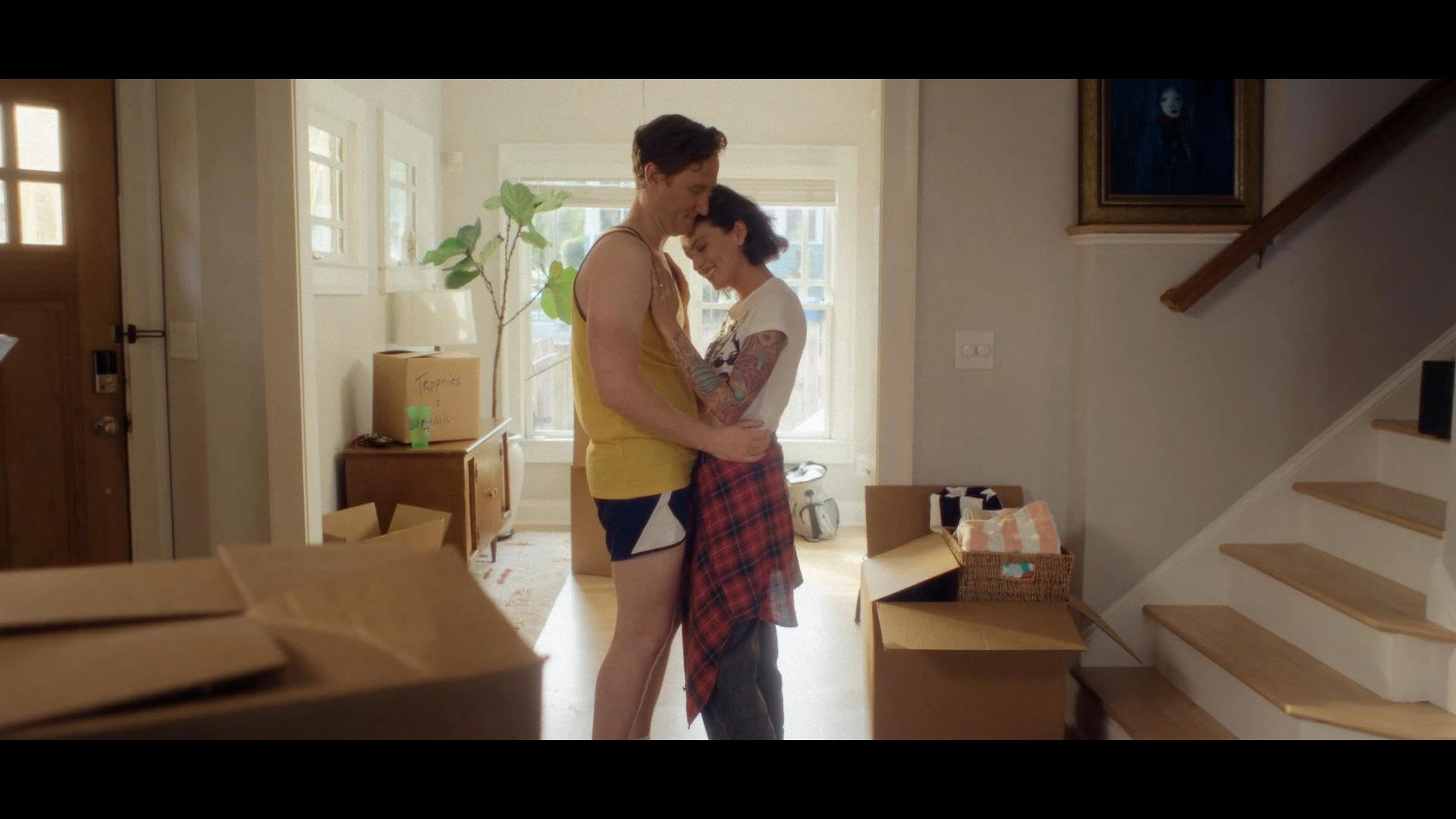
Haley Leary gives Jenny the cleaner comic line. Her skepticism feels earned from the first HOA complaint, and her response to Jerry’s creepy politeness gives the film one of its better early jolts. Once Annette’s moonshine enters the picture, Jenny’s irritation shifts into reckless courage, which helps the couple avoid becoming a simple coward-and-voice-of-reason pairing. She is often the audience’s sanity, then the film lets her become part of the madness.
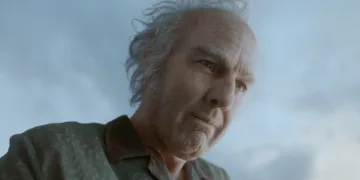
Julian Smith’s Jerry is the standout. He has the physical stillness of a committee chair and the vocal brightness of someone trying to make a massacre sound neighborly. The performance is funniest when he treats demon protocol with bureaucratic patience. Jerry is exactly the kind of man who would measure grass height before explaining how to kill a witch.
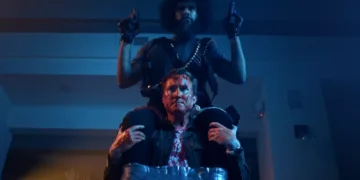
Hamid-Reza Benjamin Thompson’s McScruffy has the silhouette of a hired gun from a siege thriller, the resident professional with the steady aim and mythic name. The problem is placement. A figure built for decisive action spends too much of the film inactive, leaving a comic gap where a sharper action rhythm could have formed. Annette, Ted, and the older residents bring welcome oddity, yet the film keeps killing or sidelining its liveliest textures before they can bruise the story.
Blood in Warm Light
Bagley’s craft is at its strongest when the practical effects take command. The film knows the value of a close-up on goo, a body puncture, a head burst, and a blood spray that arrives with rude enthusiasm. The clubhouse becomes a defensive grid: windows as firing stations, residents as panicked militia, the portal as a distant wound in the landscape. This is siege cinema with lawn care anxiety.
Alex Allgood’s cinematography gives the low-budget setting a richer surface than expected. The warm clubhouse lighting does not create dread in the classic noir sense, but it does something slyer. It makes horror look communal. Faces glow under soft practical light while characters discuss Hell like a neighborhood maintenance issue. The contrast between domestic warmth and bodily rupture carries much of the film’s comedy.
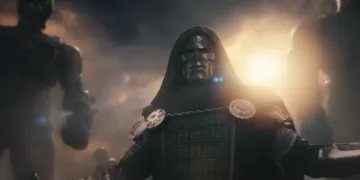
The creature parade has obvious highs. The bats are frantic enough to justify the film’s sillier impulses. The witches, kung fu zombies, werewolf, Stick Man, and robed Grim Reaper-like figure give the night a creature-feature rhythm, each new arrival changing the rules before the last gag has cooled. The final dark-robed figure, with its melting face and pointed teeth, briefly brings the movie closer to nightmare than punchline.
The digital effects cannot always keep up. Green bolts, purple creature poofs, and certain portal touches look thin beside the practical carnage. The werewolf costume carries a Halloween-store bluntness that may charm some viewers and break the spell for others. Bagley’s editing keeps the action legible, but some fights end before they develop weight. A monster movie can move quickly. It still needs impact.
Hold the Fort works best as a scrappy midnight siege where every geyser of blood arrives with a bad joke and every HOA rule hides a survival clause. Its satire is sharper in concept than execution, its characters could use longer shadows, and its effects swing between inventive and fragile. Yet the film has a pulse, a sense of play, and enough practical nastiness to make Fort Gruber feel worth defending for one very messy night.
The independent horror-comedy Hold the Fort originally debuted to glowing reviews on the global festival circuit in mid-2025, screening at prestigious genre events like Fantasia, Sitges, and Beyond Fest. Distributed across North America by Sunrise Films and internationally via Vertigo Releasing, the gory satire launched its digital home entertainment rollout on June 23, 2026. The high-energy plot centers on Lucas and Jenny, a young couple who think they have secured their dream suburban home, only to discover their neighborhood Homeowners Association doubles as an armed defense force. They quickly find themselves trapped in a wildly absurd fight for survival when a local portal opens up, unleashing an absolute onslaught of zombies and monsters from hell directly into their front yard.
Where to Watch Hold the Fort (2025) Online





Full Credits
Title: Hold the Fort
Distributor: Sunrise Films, Vertigo Releasing, Blue Finch Film Releasing
Release date: July 2025 (Fantasia Film Festival), June 23, 2026 (Digital HD Release)
Running time: 74 minutes
Director: William Bagley
Writers: William Bagley, Scott Hawkins
Producers and Executive Producers: William Bagley, Julian Smith, Tim Reis, Matt Dodd, Scott Hawkins, Luke Michael Williams
Cast: Chris Mayers, Haley Leary, Julian Smith, Mark Ashworth, Luke Michael Williams, Levi Burdick
Director of Photography (Cinematographer): Alex Allgood
Editors: William Bagley
The Review
Hold the Fort
Hold the Fort turns HOA bureaucracy into a blood-soaked defense pact, and its best scenes glow with that absurd civic menace. The practical gore has snap, Jerry’s committee-chair composure is a comic weapon, and the clubhouse siege gives the film a clean shape. The weak digital effects, rushed deaths, and thin character work leave shallow wounds where deeper cuts should be. Still, this is scrappy midnight fun with enough splatter, quips, and suburban rot to earn its place on the block.
PROS
- Strong HOA horror premise
- Fun practical gore
- Julian Smith’s Jerry
- Fast clubhouse siege
- Clever suburban satire
CONS
- Thin character depth
- Uneven digital effects
- Rushed monster waves
- McScruffy underused
- Some deaths lack weight