
















![Kingdom Hearts Collection [I-III] Review](https://gazettely.com/wp-content/uploads/2026/10/Kingdom-Hearts-Collection-I-III-1-360x180.webp "Kingdom Hearts Collection [I-III] Review: KHII Holds Steady as Newer Entries Fluctuate 37")



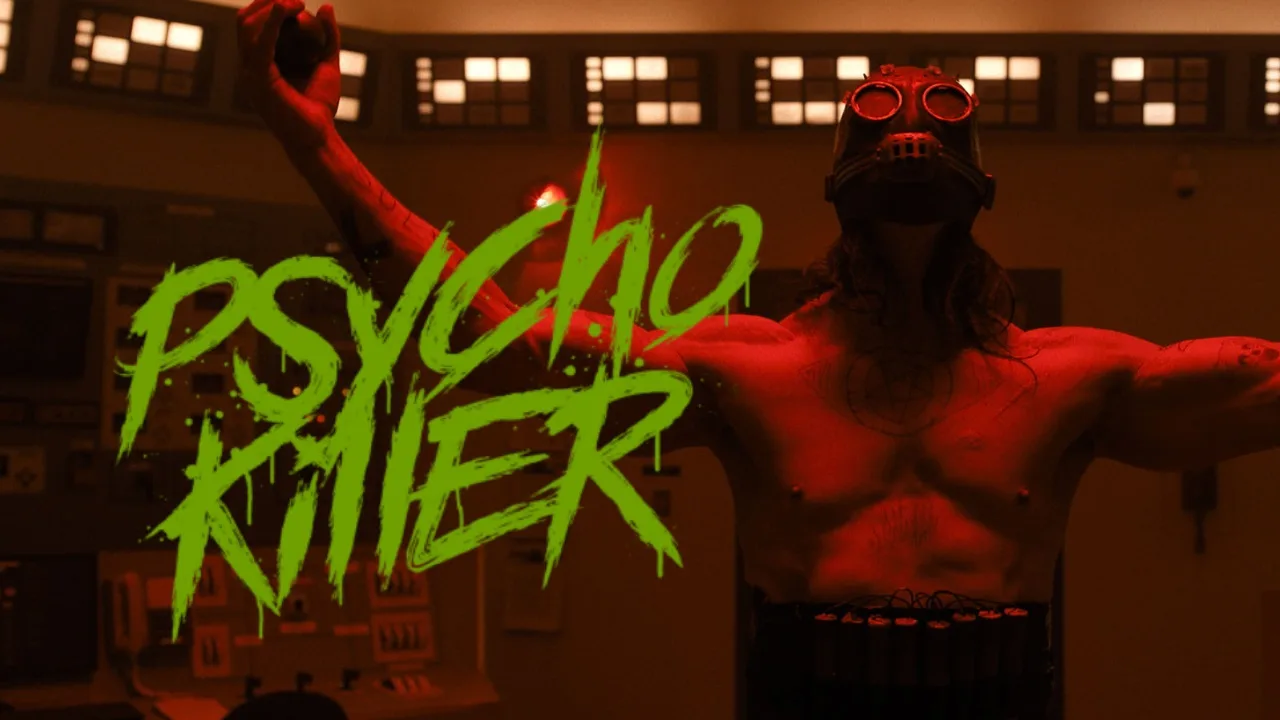

The American highway in Psycho Killer plays like a lawless artery, a strip of asphalt where the horizon offers little comfort. The opening leans hard on the vast, punishing flatness of Kansas, and that geography carries its own kind of American solitude. There is nowhere to tuck yourself away, nowhere for the land to soften what is coming. A routine traffic stop turns into sudden, permanent trauma for highway patrol officer Mike Archer.
His wife, Jane Archer, sits in her own vehicle and watches a masked figure kill him with calm, practiced efficiency. That burst of violence becomes the motor of a story that spent two decades moving through different stages of development. Andrew Kevin Walker, associated with bleak screenwriting, imagined this long before it reached first-time director Gavin Polone.
The killer, known as the Satanic Slasher, reads as a slide toward primal ritual. He crosses the empty geography with purpose that feels ancient and predatory. Jane shifts in an instant from law officer to pure pursuit. That pivot reshapes the film’s lane markings too, steering away from procedural routine and into an obsessive character study. The Slasher becomes the fixed point of her life, a silent force pulling her across indifferent state lines, where jurisdiction feels like paperwork and grief feels like fuel.
Jane Archer and the Tactical Hunt
Georgina Campbell gives Jane Archer a quiet intensity that keeps the performance from tipping into genre theatrics. She holds the film together through physical competence and inward grief, letting the body do much of the speaking. Her choice to abandon official duties in favor of a rogue mission signals a collapse of faith in the professional safety net she is meant to represent. Jane works between institutional law and personal justice, territory familiar in international revenge cinema, where the system becomes another obstacle and the hunter carries the moral cost alone.
Jane leans on training to read clues that larger agencies miss. Her clashes with the FBI and local task forces point to a rigid, male-dominated failure of imagination, with protocol treated like armor and curiosity treated like a threat. Those agencies move stiffly inside their own rules. Jane stays adaptive and attentive. The chase runs through anonymous motels and gas stations, building a map of misery across the heartland. In early encounters, survival comes from her ability to turn environment into advantage, and the resourcefulness lands as practiced competence instead of convenient scripting.
This is a female lead built around technical skill and tactical thinking. Jane keeps her private emotions guarded and aims for a form of closure the legal system cannot deliver. The trip lays bare gaps in America’s infrastructure of protection. She becomes a kind of ghost in the machine, moving through the same liminal spaces the murderer uses.
The pursuit demands mental hardening, and Campbell plays that with controlled detail, keeping Jane professional even as her methods slide into vigilante territory. The film frames her isolation as power gained through loss. The badge falls away, and a terrifying clarity takes its place. That shift lets the story look squarely at modern policing’s limits, with Jane embodying an older, personal model of accountability.
Physicality of the Satanic Slasher
James Preston Rogers brings a massive physical presence that sets the tempo in every scene he enters. His professional wrestling background shows in the weight of his movement, heavy and deliberate, built around inevitability. The Slasher’s design leans on gas masks, hoods, and sunglasses, wiping away the human face and leaving a blank surface where identity should sit.
His voice adds another shock: thick modulation that feels misaligned with his body, like sound dropped onto the image from somewhere else. The effect makes him register as a glitch in the world, hovering between technological distortion and something that borders on the supernatural.
He communicates through coded newspaper advertisements and ritual symbols left behind at crime scenes, gestures that suggest he wants witnesses to his private devotion. His killings rely on blunt instruments such as sledgehammers and axes, and the brutality carries a blunt directness that steers clear of the slick theatrics often given to modern screen monsters. The Slasher seems driven by rigid internal logic, tied to a specific interpretation of belief. Small habits, like listening to certain radio broadcasts, place him inside a particular cultural moment of extremist thought.
He also operates as a shadow partner to Jane’s fixation, a silent counterweight in a dance across the heartland. The film treats him as an elemental force, relentless and functional. Psychological explanation remains peripheral, with emphasis placed on his immediate utility as terror. His actions read like a rejection of modern social contracts in favor of older blood rites. The mask carries symbolic weight beyond concealment, marking total commitment to destruction as practice and identity.
Analog Paranoia and 2007 Aesthetics
Gavin Polone draws on producer experience to shape a look that can move from grounded realism into a heightened, eerie register. The 2007 setting matters. It places the story in a hinge period where digital tools are arriving while analog habits still govern daily life. People search for payphones. Research happens in physical libraries. Tangible objects add friction and weight to the chase, the kind of material drag many contemporary thrillers bypass.
The camera favors long takes and slow motion during key acts of violence, choices that keep the viewer sitting with consequences instead of racing past them. Framing often pins characters against vast, indifferent highway backdrops, pressing isolation into the image and making the struggle feel exposed. Gore stays controlled.
The violence lands as brutal without sliding into pornography. Certain sequences use digital blood effects that introduce an artificial note. That unreality can be read as part of the film’s interest in performance and ritual, with the Slasher’s crimes staged for meaning as much as for damage.
Lighting shifts from the hard sun of the plains to the sickly neon of roadside motels, tracking Jane’s psychological slide as she travels farther from the brightness of her former life. Production design catches the texture of forgotten middle America, full of rust and quiet, a landscape that feels abandoned by progress. Muted browns and greys dominate, echoing industrial decay. That consistency helps keep the story grounded even when the script edges toward the ridiculous.
The Satire of Performative Evil
The arrival at Mr. Pendleton’s estate triggers a sharp tonal pivot. Malcolm McDowell plays the cult leader with playful, drug-fueled malevolence, and the sequence turns into satire aimed at organized evil as pastime for the bored and wealthy. Pendleton performs Satanism like a costume, while the Slasher carries a quieter devotion that reads as lived practice. Inside the mansion, the film allows a pocket of dark levity. Logan Miller, playing the assistant, feeds that air of absurdity.
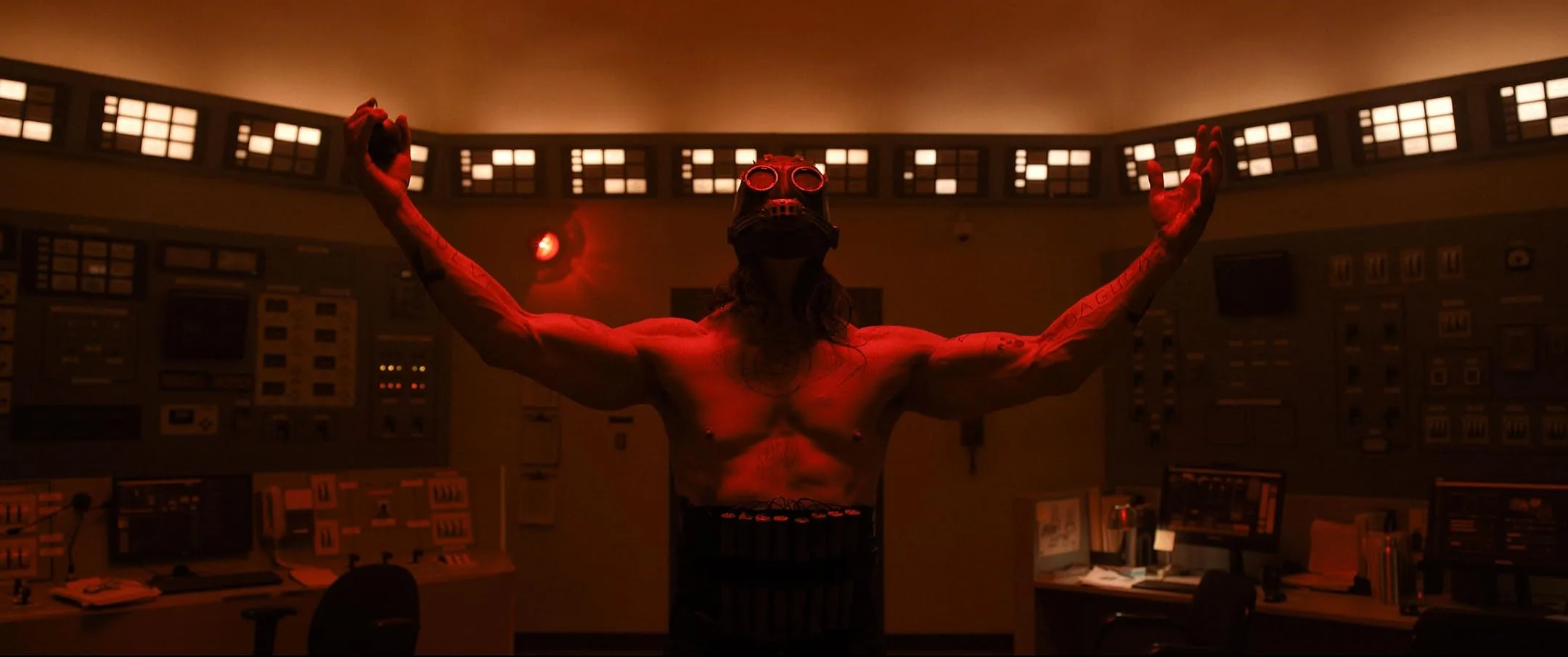
The Slasher moves through the decadent rooms with predatory focus, and his behavior signals disdain for the cult’s theatrical pageantry. This section frames belief as lifestyle against belief as calling, with the mansion acting like a showroom for one and a battlefield for the other. The social bubble bursts in a sudden eruption of violence.
He kills the cult members during an orgy, and the scene pairs extreme brutality with the mundane detail of Chinese takeout containers. The collision makes the cult’s world look small, even silly, and it pushes a critique of how darkness gets consumed and commodified.
Pendleton’s group treats the left-hand path like a game of symbols, and they prove unprepared for someone who lives that violence as doctrine. The film drifts into grotesque commentary here, then uses the pause as breathing room before the heavy industrial finish. The mansion plays like a tomb, a relic of a different American obsession.
The violence arrives quick and messy, stripping glamour from ritual. McDowell’s presence carries a sense of cinematic history, making Pendleton feel like a survivor from an earlier horror era. His performance becomes the second act’s high point, bridging grim realism and the final industrial nightmare.
Nuclear Anxiety and Industrial Finality
The story turns toward Harrisburg, Pennsylvania, for its final escalation, bringing the chase into the vicinity of Three Mile Island. That location carries historical dread that the film taps directly, and the industrial scale changes the movie’s visual language. The Slasher’s endgame ties to this site of nuclear trauma, rooting the climax in regional history shaped by fear.
Jane’s last pursuit unfolds inside skeletal industrial structures, with the power plant’s enormity dwarfing the human conflict. The confrontation becomes a grueling physical ordeal, stripped of clean cinematic triumph. It plays as survival fought in a world already marked as poisoned. The resolution emphasizes finality over catharsis. Jane reaches the end of her hunt, and the world waiting beyond remains the same world that failed her.
The ending suggests the Slasher’s trauma will linger in the landscape after his removal, like contamination that outlasts the event. The industrial setting works as metaphor for modern life built atop hidden hazards, with safety presented as a thin surface over deeper risk. The film closes on quiet exhaustion.
Jane stands as witness to horror the system never had tools to meet. Final frames lean into the site’s silence, leaving the audience with the cold weight of what has played out. The film chooses a definitive bleak finish, and it asks the viewer to sit with the permanence of Jane’s loss.
Psycho Killer made its long-awaited theatrical debut yesterday, February 20, 2026, following a decades-long journey through development. Directed by Gavin Polone and written by the acclaimed Andrew Kevin Walker, the film follows a highway patrol officer who embarks on a relentless cross-country hunt for a ritualistic serial killer after witnessing her husband’s murder. Currently, the movie is playing exclusively in theaters across the United States and Germany, with a streaming release date yet to be announced. Viewers looking for a gritty, R-rated blend of crime and slasher horror can catch it on the big screen throughout its opening weekend.
Where to Watch Psycho Killer (2026) Online






Full Credits
Title: Psycho Killer
Distributor: 20th Century Studios, Constantin Film
Release date: February 20, 2026
Rating: R
Running time: 92 minutes
Director: Gavin Polone
Writers: Andrew Kevin Walker
Producers and Executive Producers: Arnon Milchan, Roy Lee, Matt Berenson, Andrew Kevin Walker, Eric Newman, Eli Roth, Miri Yoon, Robert Kulzer
Cast: Georgina Campbell, James Preston Rogers, Malcolm McDowell, Logan Miller, Grace Dove, Stephen Adekolu, Aaron Merke, Joshua Banman, Cassandra Ebner, David Tomlinson
Director of Photography (Cinematographer): Magnus Jønck
Editors: Kevin Greutert
Composer: Sven Faulconer
The Review
Psycho Killer
Psycho Killer is a disjointed exploration of American malaise that struggles to reconcile its gritty procedural roots with a descent into campy satire and industrial horror. While Georgina Campbell provides a grounded, tactical performance and James Preston Rogers offers an imposing physical threat, the film suffers from a lack of tonal cohesion. The script reaches for profound themes of nuclear anxiety and institutional failure but frequently settles for horror clichés and distracting audio choices. It remains a curious, albeit flawed, artifact of developmental limbo that offers flashes of brilliance amidst a largely uneven execution.
PROS
- A stoic, disciplined portrayal of a woman shaped by trauma and tactical necessity.
- The physical presence of the Satanic Slasher is genuinely formidable and visually striking.
- Adds a much-needed layer of dark, satirical wit to the middle act.
- Effective use of the 2007 timeline and industrial Pennsylvania landscapes to create a sense of unease.
CONS
- The shift from serious revenge thriller to campy cult satire feels jarring and unearned.
- The heavily redubbed and distorted voice for the killer is more distracting than menacing.
- Digital effects often undercut the visceral impact of the practical violence.
- Despite the pedigree of the writer, the dialogue and plot progression often feel dated and predictable.