










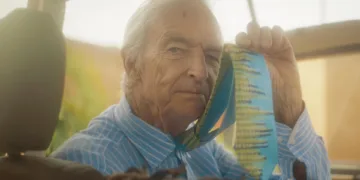

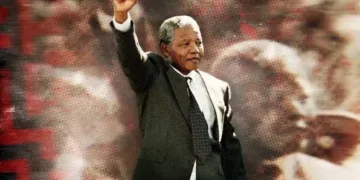

















Director Alexander Bocchieri frames this as a sunlit procedural, treating the Shaka as a case file rather than a throwaway surf-culture shorthand. Steve Sue serves as investigator and narrator, guiding the film with the steady curiosity of a detective working a seaside beat.
The aesthetic leans bright and cheerful, with the genre posture of noir present in attitude and structure instead of heavy shadowplay. The Shaka is presented as a specific island tradition, a thumb-and-pinky sign tied to a philosophy of kindness. The production wants that spirit to travel beyond the islands, pitched as a sincere counterweight to present-day social friction.
The craft keeps its polish in view. High-definition contemporary imagery sits beside grainier archival footage, creating a layered sense of time without stranding the story in nostalgia. Henry Kapono’s energetic soundtrack pulses under the visuals and keeps the momentum tight. This is a study of a symbol, and an attempt to trace the soul of a place through a small physical motion, delivered with the confidence of a film that knows a hand gesture can carry a surprising amount of meaning.
Reverse Engineering a Cultural Mythos
The film adopts a “whodunnit” design that moves backward through time, stripping away pop culture noise to reach quieter origins. Sue follows a trail of clues through an eclectic lineup of interview subjects, including used-car salesmen, eccentric mayors, and scholars. The investigation even picks up a spectral flourish as the ghost of Elvis Presley drifts at the edges of the story, as if celebrity itself counts as evidence.
The narrative settles into the story of Hamana Kalili, a North Shore figure who lost several fingers in a mill accident. His remaining digits become the physical blueprint for the gesture, grounding the mythology in the blunt fact of injury and adaptation. The script resists historical dogmatism and works through six different origin stories, giving space to Japanese plantation workers, the Mormon Church, and local children who adopted the sign.
It also takes clear satisfaction in myth-busting, stating that the Shaka has no link to Zulu tribes or Buddhist mudras and asserting Polynesian roots. The detective logic points to a collective creation, shaped by shared moments that refuse neat timelines. History, the film argues, arrives as accumulation, not choreography.
The Secret Language of Survival
The emotional gravity comes through the kupuna. Testimony from elders like Aunty Kekela Miller offers a firsthand sense of the sign’s early days, and those interviews tilt the project from breezy inquiry toward questions of identity.

The Shaka’s evolution is described as movement from local signal to a tool for survival, with a focused segment on a Hawaiian military infantry unit. In combat, soldiers used the gesture as a secret form of sign language, a practical code shaped by battlefield limits.
That pivot reframes the gesture as philosophy in motion, a way of holding connection steady inside chaos. The film’s roster of people reinforces the point: surfers and politicians share the same vocabulary, and the shared motion collapses social distance for a beat.
The documentary presses on the existential comfort of belonging, asking how a gesture can bear the weight of a culture. The human stories supply the ballast that the sunlit imagery would otherwise lack, keeping the film from floating away on charm alone.
Legislation of the Human Spirit
Late in the film, the inquiry expands into institutional consequences, tracking how a documentary can become a real-world initiative. The passage of Senate Bill 3312 marks a turning point: the Shaka becomes the official state gesture of Hawaii in 2024, transforming a casual greeting into a formal symbol of pride. The nonprofit “Project Shaka” is presented as a direct outgrowth of the production, distributing stickers and running educational programs meant to teach the sign’s nuance.
The film carries a palpable optimism, arguing that a smile paired with the gesture can improve interpersonal interactions. It is a big swing for a 72-minute feature, and the ambition lands with a straight face that feels intentional.
As a cultural ambassador for the islands, the documentary offers a taste of Aloha for viewers moving through difficult or stressful days. The pacing stays steady while the story tracks this shift from private tradition to public policy, treating legislation like the final clue that locks the case into place.
Shaka: A Story of Aloha is a cultural documentary that investigates the origins and global impact of Hawaii’s iconic hand gesture. While the film made its world premiere at the Visual Communications Film Festival on May 2, 2024, it transitioned to a broader digital debut on January 16, 2026. You can currently watch the film on various streaming and VOD platforms, including Apple TV, Amazon Prime Video, and Fandango at Home.
Full Credits
Title: Shaka: A Story of Aloha
Distributor: Freestyle Digital Media
Release date: January 16, 2026 (Digital/VOD Release), May 2, 2024 (World Premiere)
Running time: 80 minutes
Director: Alexander Bocchieri
Writers: Steve Sue
Producers and Executive Producers: Steve Sue, Bryan Spicer, Sean Morris, Jill Kuramoto, Ryan Ozawa, Rob Webb, Rebecca Teresia, Minette Lew-McCabe
Cast: Steve Sue, Kekela Miller, Brook Mahealani Lee, Kenneth S. Hara, Frank De Lima, Fred Hemmings, Henry Kapono, Moana Jones Wong, Peter Townend, Ian Cairns
Director of Photography (Cinematographer): Alexander Bocchieri, Kristle Backe, Abraham Williams, Prahlad Strickland, Johnathan Walk
Editors: Alexander Bocchieri, Shaun Oliquiano, Sara Brekke
Composer: Henry Kapono
The Review
Shaka: A Story of Aloha
This film successfully transforms a physical signal into a profound meditation on social cohesion. It treats history as a living entity rather than a static record. It avoids the cynicism of traditional noir. It maintains a rigorous curiosity that honors the complexity of island life. It is a necessary document of cultural resilience.
PROS
- Rich archival texture that anchors the narrative in historical reality.
- Rhythmic pacing that keeps the detective work moving forward.
- Deeply human testimonies from community elders that provide emotional weight.
CONS
- The bright aesthetic might alienate viewers seeking traditional cinematic grit.
- Some origin theories feel anecdotal rather than definitive.