
























![Kingdom Hearts Collection [I-III] Review](https://gazettely.com/wp-content/uploads/2026/10/Kingdom-Hearts-Collection-I-III-1-360x180.webp "Kingdom Hearts Collection [I-III] Review: KHII Holds Steady as Newer Entries Fluctuate 37")




Matt Taylor lands in Rome as an art teacher with a wedding on the calendar and exits that trip with a different curriculum: the practice of being by himself. He is quiet in a way that reads like caution. He is also standing at the edge of a new life when his fiancée, Heather, disappears minutes before the ceremony. No scene of confrontation follows. A text message becomes the only post-mortem the relationship receives, which feels depressingly current, like love processed through an app’s customer-service portal.
The “two-becomes-one” honeymoon package is paid for and non-refundable, a romantic slogan that turns into a financial prank. Matt stays. Rome surrounds him with its couple-friendly choreography, and he walks through it as a single figure in a city built for paired footsteps. The premise watches a man hit sudden emotional insolvency. The film keeps its volume low, refusing the fireworks that many breakup stories treat as mandatory.
It tracks Matt trying to stand upright among ruins that have outlasted empires, which makes his private catastrophe look small, then painfully human again. He becomes an everyman on an unwanted pilgrimage, learning how to exist as an individual in a place that sells togetherness as a civic virtue. Moving forward looks messy here, especially once the person “holding the map” has already left the room.
The Economy of Abandonment
The opening montage offers a sugar-coated exhibit of love, a greatest-hits reel that feels curated for an audience that never gets the missing footage. The relationship ends without a face-to-face explanation, and that absence operates like a modern ghost story. Matt is alone in Italy in a way that feels designed, almost engineered. No groomsmen appear. No siblings hover nearby with jokes or tactical distractions. He has grief, a phone, and the echo of a plan that collapsed.
The prepaid honeymoon becomes a physical object lesson. Even romance comes with receipts. Watching Matt ride a tandem bicycle by himself works as a blunt visual gag and a bleak thesis statement. The image lands because it is ridiculous and because it is true: partnership machinery keeps moving even after one rider steps off. The comedy sits right next to the sting. The world does not refund failed dreams, and the film treats that as a kind of casual cruelty, the sort baked into everyday systems.
At first, Matt drifts through the streets in a slump, like a ghost haunting his own vacation. Calls with his mother show him performing wellness while he buckles internally, a ritual familiar to anyone who has ever said “I’m fine” with the enthusiasm of a hostage. The turn toward participation begins at a local cafe. Early conversations there suggest a shift in posture. He stops living entirely inside the wreckage of a dead future and starts noticing the present tense, one awkward interaction at a time.
This search for meaning never arrives as a single epiphany. It shows up as small decisions that keep the lungs working: get out of bed, walk outside, order something, answer a question, return the next day. The film treats survival as logistics. That is its small act of seriousness, and it plays like an antidote to the genre’s usual sugar rush.
The Everyman in the Piazza
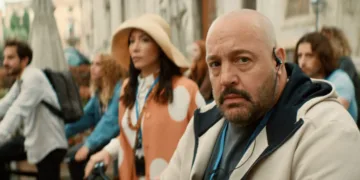
Kevin James gives a performance that removes the familiar slapstick shell and leaves the soft parts exposed. The vulnerability can feel startling, partly because he does not lean on caricature as a safety net. Matt is a wreck. He is also recognizably human, and the film refuses to turn him into a clown for easy relief.

This is “vulnera-comedy” (a term for humor generated straight from the protagonist’s pain, with no cushioning). The laughs come from the friction between what Matt thought his life would be and what he now has to carry through crowded streets. James makes the anguish of a middle-aged art teacher legible. There is weight in how he moves, as if his body memorized a single outcome and now has to re-learn gravity.
Nicole Grimaudo plays Gia as a light that cuts through Matt’s gloom. She runs a cafe and faces her own form of professional extinction. Her optimism reads like a practiced choice, something she actively does, not a quirk she passively owns. That detail matters, because it gives her agency and stops her from functioning as a decorative fix.
The chemistry between James and Grimaudo feels gentle and unforced. Shared heartache becomes the bridge. Attraction arrives as a quieter after-current, something that grows once they recognize each other’s bruises. Their connection takes its time. It becomes a partnership shaped by mutual fragility and mutual consent to keep showing up. Gia has stakes that belong to her, which steers the story away from the manic pixie shortcut and gives the romance a sturdier spine.
The Architecture of Rebound
Matt becomes the “fifth wheel” around two couples with very different relationship philosophies. Julian and Meghan embody the “revolving door” theory of marriage. They have divorced and remarried each other three times, treating commitment as endurance sport. Julian plays mentor with the stubbornness of a man who refuses to accept finality as a fact, which is either generous or exhausting, sometimes both within the same scene.
Then there is Neil and Donna, a pairing with a murkier ethical footprint. A therapist marrying her patient is the kind of narrative choice that earns skepticism on arrival. The film invites that reaction, then lets it hang in the air. Together, these couples sketch out the absurdity of modern relationships, where ideology, habit, and desperation can all wear the same wedding band.
The group functions like social gravity. They tug Matt out of isolation by sheer proximity and momentum, dragging him into meals, conversations, and the sensory clutter of Italy. Through them, the film studies marriage as a foundational social structure. Even the most dysfunctional pairs here defend the institution, sometimes with the zeal of people defending their own sunk costs.
They serve as a mirror for Matt’s desires. He watches people stay together, fracture, repair, fracture again. The communal energy pushes him toward a hard thought: his life continues, even after one chapter shuts. The film sounds almost optimistic in these moments, then catches itself and returns to the awkward reality of learning how to speak again after silence becomes a habit.
The Cinematic Tourist
The Kinnane brothers show growth in craft. Their treatment of Rome carries a reverence that was absent from their earlier broad comedies. The pacing stays deliberate, allowing the setting to function as something beyond postcard scenery. The cinematography catches the elegance of the city and the nearby countryside, lingering long enough to make the beauty feel earned.
That beauty creates a sharp dissonance with Matt’s inner weather. A person can feel miserable in the most beautiful place on earth. The film repeats that idea without hammering it. Rome becomes an indifferent witness, ancient stone watching one man’s private collapse, which is a quietly historical joke in itself.
Much of the humor comes from Matt as a cultural outsider. He tangles with Italian pronunciation and customs in classic fish-out-of-water beats, and those moments keep the story anchored in recognizable embarrassment. The film spends time in lived-in spaces, not just tourist traps. The cafe feels like it has history, and that sense of place grounds the romance. Italy appears as a romantic setting and a working setting, full of people doing jobs and carrying their own worries. The film’s tonal balance depends on that duality, light beside shadow, laughter beside discomfort.
The Narrative Pivot
The script treats heartbreak with unusual maturity. Matt gets room to experience grief in a healthy way, which sounds like faint praise until you remember how often romantic comedies treat grief like an obstacle course. There are no scenes of him stalking Heather. There are no scenes of him demanding a return to the old plan. He feels sad, and the film lets that sadness exist without turning him into a punchline.
The writing prioritizes character growth over the mechanical checklist of a meet-cute. That interior focus feels like a smart fit for a film anchored by a major comedic actor. It trusts the audience to sit with discomfort and to find humor inside it, not around it.
Late in the film, a twist introduces a new pressure point. The surprise shift forces a reappraisal of earlier scenes and pokes at the expectations attached to romantic-comedy grammar. The move can feel jarring. It can also feel like the film finally admitting what it has been circling: second chances come with terms, and self-worth is part of the contract.
Matt has to find his footing before commitment becomes possible again. The payoff focuses on the quiet win of a man learning solitude without sliding into loneliness, which is a smaller victory than a wedding, and a harder one to fake.
Solo Mio is a romantic comedy drama that follows Matt Taylor, an art teacher whose life is upended when his fiancée leaves him at the altar in Rome. Facing a non-refundable honeymoon package, Matt decides to navigate the Italian journey alone, eventually finding a new perspective on life and love through the help of eccentric fellow travelers and a local barista named Gia. The film was released in theaters across the United States on February 6, 2026. Viewers can currently watch the film exclusively in theaters, with future streaming expected on the Angel Studios platform for “Angel Guild” members.
Full Credits
Title: Solo Mio
Distributor: Angel Studios
Release date: February 6, 2026
Rating: PG
Running time: 96 minutes
Director: Charles Kinnane, Daniel Kinnane
Writers: Kevin James, Patrick Kinnane, John Kinnane
Producers and Executive Producers: Mark Fasano, Jeffrey Greenstein, Kevin James
Cast: Kevin James, Alyson Hannigan, Nicole Grimaudo, Kim Coates, Jonathan Roumie, Julee Cerda, Julie Ann Emery, Alessandro Carbonara
Director of Photography (Cinematographer): Jared Fadel
Editors: Pete Kinnane
Composer: Joy Ngiaw
The Review
Solo Mio
Solo Mio succeeds as a "vulnera-comedy" that swaps slapstick for sincerity. Kevin James anchors the film with a grounded, relatable performance, while the Roman backdrop adds a layer of timeless elegance to a modern story of abandonment. It avoids the loudest genre tropes to focus on the quiet, messy work of self-recovery. While the supporting couples lean into the absurd, the central bond between Matt and Gia feels authentic and earned. It is a mature, surprisingly honest look at how one person navigates the wreckage of a planned life to find a new path.
PROS
- Kevin James effectively pivots to a vulnerable leading man role.
- The Roman locations feel authentic and lived-in rather than like a postcard.
- The script treats male heartbreak and recovery with unexpected respect.
- The slow-burn connection between Matt and Gia feels natural and unforced.
CONS
- The secondary couples occasionally feel like ethical caricatures.
- The initial relationship with Heather lacks depth, making the loss feel abstract.
- Despite a late-film twist, the story follows a well-worn emotional map.







