




























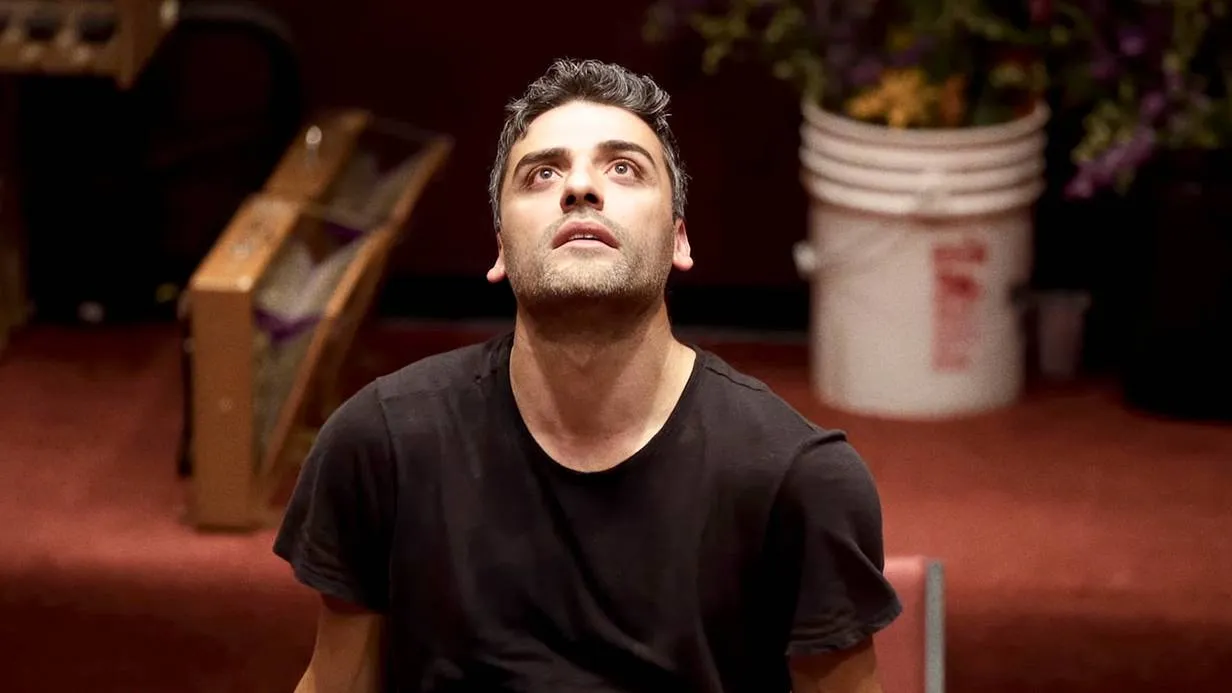

Elvira Lind’s documentary King Hamlet captures a tight, high-pressure stretch in 2017, when Oscar Isaac stepped away from a galaxy far, far away and into Shakespeare’s most exhausting role. With Sam Gold directing, the Off-Broadway production plays like a deliberate stress test: intimate, risky, physically punishing.
Lind uses the access that comes with being Isaac’s wife to follow him from the clean precision of massive blockbuster sets into the grit of a New York City rehearsal room. The film keeps returning to the squeeze between the Public Theater’s demands and the quieter, often painful realities waiting at home.
Isaac is trying to take on a role that has carried centuries of expectation, while his own life shifts in ways he cannot compartmentalize. The result is a behind-the-scenes record and a personal portrait of an artist working at full capacity during a period of real vulnerability. Performance becomes something practical here, a way to stay upright.
Life Imitating the Bard
The documentary’s charge comes from the parallels between the play and Isaac’s circumstances. While he works through the grief of a son mourning a dead father, he is also facing the illness and passing of his own mother. Lind records these days with a plain, unforced patience. Hospital bedside time sits next to the intellectual grind of the rehearsal hall, and the film lets the two spaces bleed into each other.

The arrival of his first child shifts the emotional math again. Fatherhood gives Isaac a new way to read the text, pressing questions of legacy and family bonds into the foreground. I kept thinking about how certain books land differently before and after a family shift. The words stay the same. The reader’s timing changes, and the rhythm of the work changes with it.
One of the film’s sharpest passages comes when Isaac reacts to a specific profile in the press. His resistance feels immediate and reasonable: he pushes back against the effort to package private sorrow as an acting tool. That moment opens onto a cultural anxiety the documentary keeps brushing up against, the hunger to consume personal tragedy as content.
Isaac tries to keep grief in its proper place, owned and protected, instead of folded into a marketing story. He rejects the idea that his mother’s death exists to power a nightly four-hour performance. That refusal carries a blunt integrity, and it asks the viewer to consider the ethics of curiosity about public figures. Lind holds the line by keeping the camera trained on work and on the quiet intervals between rehearsals, where the cost shows up without being framed as spectacle.
The physical and mental toll is visible in frame after frame. Isaac juggles hospital visits, funeral arrangements, and parental duties while still showing up for eight-hour rehearsal days. The film presents acting as labor here, a day-to-day grind that offers very little glamour. Isaac looks like someone trying to stay standing while the ground keeps shifting. Lind treats these pressures as part of the creative act, not a sidebar to it. Shakespeare’s lines start to echo in Isaac’s daily speech, and the verse becomes a working language for feelings that would otherwise stay jammed behind the ribs.
Chaos in the Creative Process
On the technical level, the stage production is a study in bold, unconventional choices. Gold’s concept places the audience in an intimate arena where they sit nearly on top of the actors, closing the distance that theater often uses as a kind of protective buffer. The staging includes startling props, including a toilet, and it asks the cast for serious physical endurance.
Isaac often performs in his underwear, beating a lasagna in a literal and figurative mess. Gayle Rankin’s Ophelia takes a sustained beating as well, hauling potted plants and rolling in actual mud. Lind finds a vein of lively tension in the presence of composer Ernst Reijseger, whose eccentricities and massive pedal instruments turn rehearsals into something like a moving negotiation.
The documentary tracks the actors’ frustration as Reijseger’s avant-garde interruptions threaten to swallow dialogue. He waltzes around the stage, climbs into the rafters, and lands in a tonal space that often sits awkwardly against the verse. The clash creates one of the film’s clearest looks at collaboration under pressure. Friction becomes the engine, and the movie stays honest about how exhausting that can be.
Gold comes across as patient to the point of sainthood, with a sense of strain gathering behind his eyes. Watching rehearsals spiral and re-form reminded me of the messy, disorganized energy of independent film sets I’ve visited. Chaos has its own kind of order, and it can generate a particular magic that big-budget studio environments rarely allow.
A late hurdle like Isaac losing his voice lands as a blunt reminder of how precarious live performance can be. Lind follows the full arc from the first hesitant table reads to the physical and vocal exhaustion of opening night, with an attention to process that keeps the film’s narrative moving even when the setting stays the same.
The handheld camera catches sweat and dirt up close, and that texture makes the cost of the work feel immediate. The production becomes a conversation between performers and audience separated by almost no space. The crowd’s energy shifts every night, and the actors have to stay grounded inside that moving current, keeping the verse alive while the room changes around them.
The Lens of Intimacy
Lind shoots with a handheld, observational style that makes the viewer feel like a quiet guest during late-night line runs and early morning moments with a newborn. Because the subject is her husband, Isaac carries a comfort in front of the lens that a stranger would struggle to earn.
He appears shirtless, tired, and unguarded, and the film treats that openness as part of the story’s texture rather than a hook. The pacing moves between mourning’s heavy silence and the joyful noise of a growing family. Visually, the documentary favors proximity over spectacle, and the small-scale intensity calls to mind the pressures and pleasures of independent cinema.
Lind also shows how art can hold pain without turning it into performance for the camera. She stays close enough to catch authentic reactions from the people in the room, while still shaping a coherent throughline. The cinematography remains clear and easy to track even with the handheld approach, and the film plays like a sequence of lived memories.
The Shakespearean text sits in the background as a working document, something handled and tested in real time. The documentary keeps its attention on the emotional truth of the people carrying the production, and it watches what it takes to sustain a demanding career while private life reshapes itself day by day.
The final result offers a view of acting grounded in human endurance. Shakespeare’s language comes through as a source of wisdom for people moving through hard periods, and the film returns to the idea of life as a cycle of loss and renewal. The sting of watching a loved one die sits beside the joy of a new life arriving.
King Hamlet plays as a comfort watch for anyone interested in the intersection of art and reality, with a steady eye on creation as a way of living through immense pressure. The documentary lands on resilience, and it treats that resilience as something built in rehearsal rooms, kitchens, hospital corridors, and the few quiet seconds a performer can find before walking back into the lights.
King Hamlet is an intimate documentary that premiered at the Telluride Film Festival in late 2025 before making its California debut at the Palm Springs International Film Festival on January 4, 2026. The film follows actor Oscar Isaac during a transformative period in 2017 as he prepares for a modernized production of Hamlet at NYC’s Public Theater while simultaneously navigating the loss of his mother and the birth of his first child. Viewers can currently stream the film on Mubi, where it offers a raw, fly-on-the-wall perspective of the collision between high-stakes art and personal vulnerability.
Full Credits
Title: King Hamlet
Distributor: Mubi
Release date: August 29, 2025 (Telluride Premiere), January 4, 2026 (Palm Springs International Film Festival)
Running time: 90 minutes
Director: Elvira Lind
Writers: Elvira Lind
Producers and Executive Producers: Sara Stockmann, Sofia Sondervan, Elvira Lind, Oscar Isaac, Gena Konstantinakos, Sam Gold, Ethan Hawke, Ryan Hawke, Adam Nielsen
Cast: Oscar Isaac, Sam Gold, Gayle Rankin, Ernst Reijseger, Keegan-Michael Key, Roberta Colindrez, Ritchie Coster, Peter Friedman, Charlayne Woodard, Matthew Saldivar, Anatol Yusef
Director of Photography (Cinematographer): Elvira Lind, Benitha Vlok, Arseni Khachaturan
Editors: Adam Nielsen
Composer: Ernst Reijseger
The Review
King Hamlet
King Hamlet succeeds as a stripped-back look at the messy intersection of high art and heavy grief. Elvira Lind avoids the typical polish of celebrity profiles. She offers a grounded view of an actor finding his way through personal loss. The film captures the raw energy of the theater while staying anchored in domestic reality. It serves as a reminder that creation can be a form of healing. This is a vital watch for those who appreciate the physical and emotional cost of a performance.
PROS
- The handheld visual style creates a close, lived-in feeling.
- The lead actor offers an unguarded look at his creative process.
- The friction with the eccentric composer provides authentic drama.
- The film stays clear of the typical glossy marketing approach.
CONS
- The tight focus leaves little room for the supporting cast.
- Some private scenes might feel invasive to certain viewers.
- The loose structure lacks the rhythm of a standard theatrical documentary.







