





















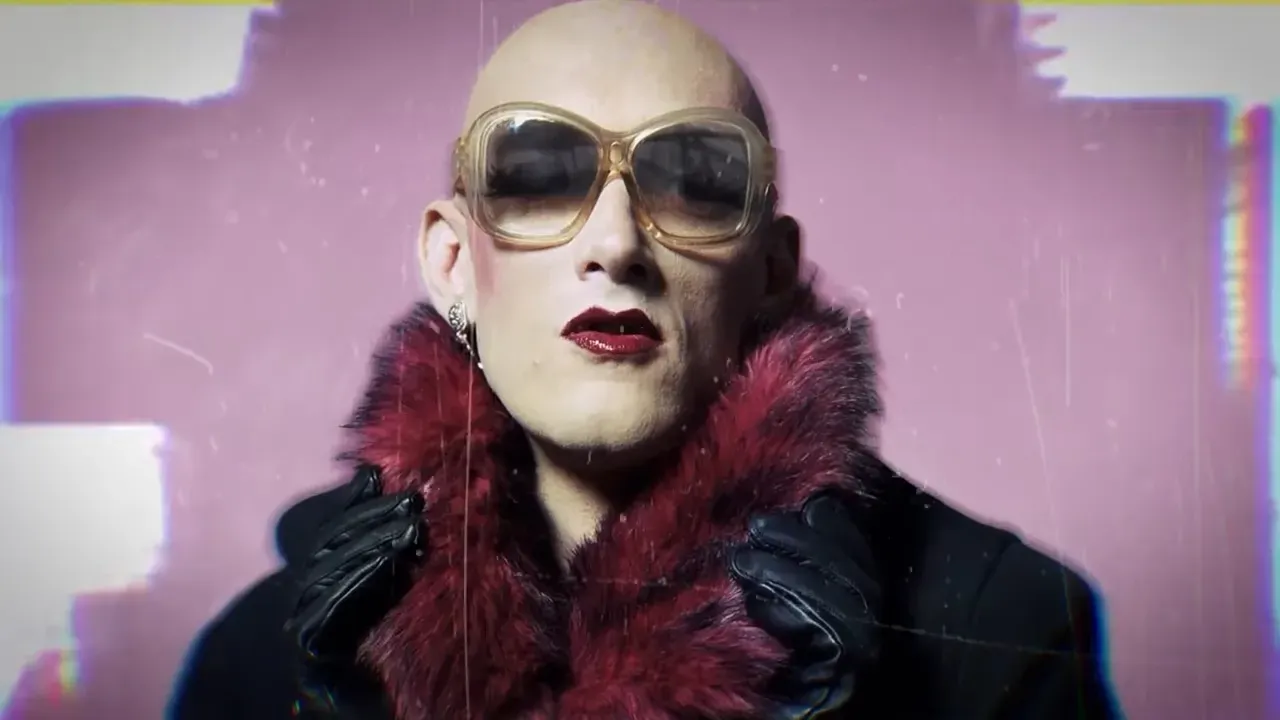

Lola Rock’N’Rolla frames her documentary, The Big Johnson, as an act of retrieval. It brings Dean Johnson back into view as a figure whose body and self-presentation carried the same unmistakable force as his politics. He stood six feet and six inches tall, often in high heels, with a shaved head and leather on his back, and he remained a fixture of New York City for decades. The film tracks his path from an NYU student in 1979 into a life that refused a single lane: musician, drag performer, sex worker.
Premiering at the Slamdance Film Festival, the documentary plays like a time capsule for a Manhattan that has slipped out of reach. Rock’N’Rolla’s approach keeps sentimentality on a short leash. She stays with the grit of the 1970s through the early 2000s and builds the story around how Johnson moved through that world in plain sight.
His openness reads as a deliberate stance, even within progressive circles where visibility still came with limits. During the peak of the AIDS crisis, Johnson kept his identity public, turning daily existence into protest. The film’s first commitment is simple: his defiance gets preserved, and the record gets passed forward.
A Career Defined by Defiance
Johnson’s music career gives the documentary its cleanest narrative spine, because it carries a familiar arc with a stubborn refusal to behave. Through his bands, Dean and the Weenies and The Velvet Mafia, he found real momentum and brushed against the machinery of the mainstream. His track “Fuck You” climbed the college charts and led to a contract with Island Records. The film treats that turning point with clear-eyed attention to cause and effect. The closer the industry came, the narrower its tolerance became.
Rock’N’Rolla organizes this section around a recurring tension: underground art thrives on self-definition, while corporate structures prefer a version of identity that can be packaged without friction. Major labels had trouble with Johnson’s refusal to soften his queer presentation or mute his activism.
The documentary lets that stalemate speak for itself, and it also uses it to point toward a storytelling trend in music culture that feels familiar now. The persona-forward career model, built through community as much as commerce, has become a recognizable template. The film names Lady Gaga as part of that lineage, reading Johnson as someone who sketched the blueprint long before it became marketable.
The documentary also makes room for his place in the Queercore movement, and it treats that affiliation as more than a footnote. Johnson reclaimed stages like CBGB for LGBTQ+ performers, and the film frames those efforts as practical work: building rooms where people could be loud, strange, and safe enough to perform.
Away from the stage, the narrative stays grounded in the parts of his life that carry less glamour and more consequence. His addiction and his work as a sex worker appear with directness and without evasive editing. Rock’N’Rolla keeps these realities in frame because they belong to the same story as the music. The result is a portrait that holds contradictions together, which feels like the only honest way to approach a subject who made contradiction part of his public language.
The Gritty Magic of the East Village
Rock’N’Rolla’s strongest world-building arrives in her recreation of the Lower East Side at its most volatile. The film describes the era as a “plutonium age” of Greenwich Village, where creativity flourished amid violence and decay. That phrasing tells you what the documentary is chasing: a sense of danger that fed invention, and an invention that survived the danger.
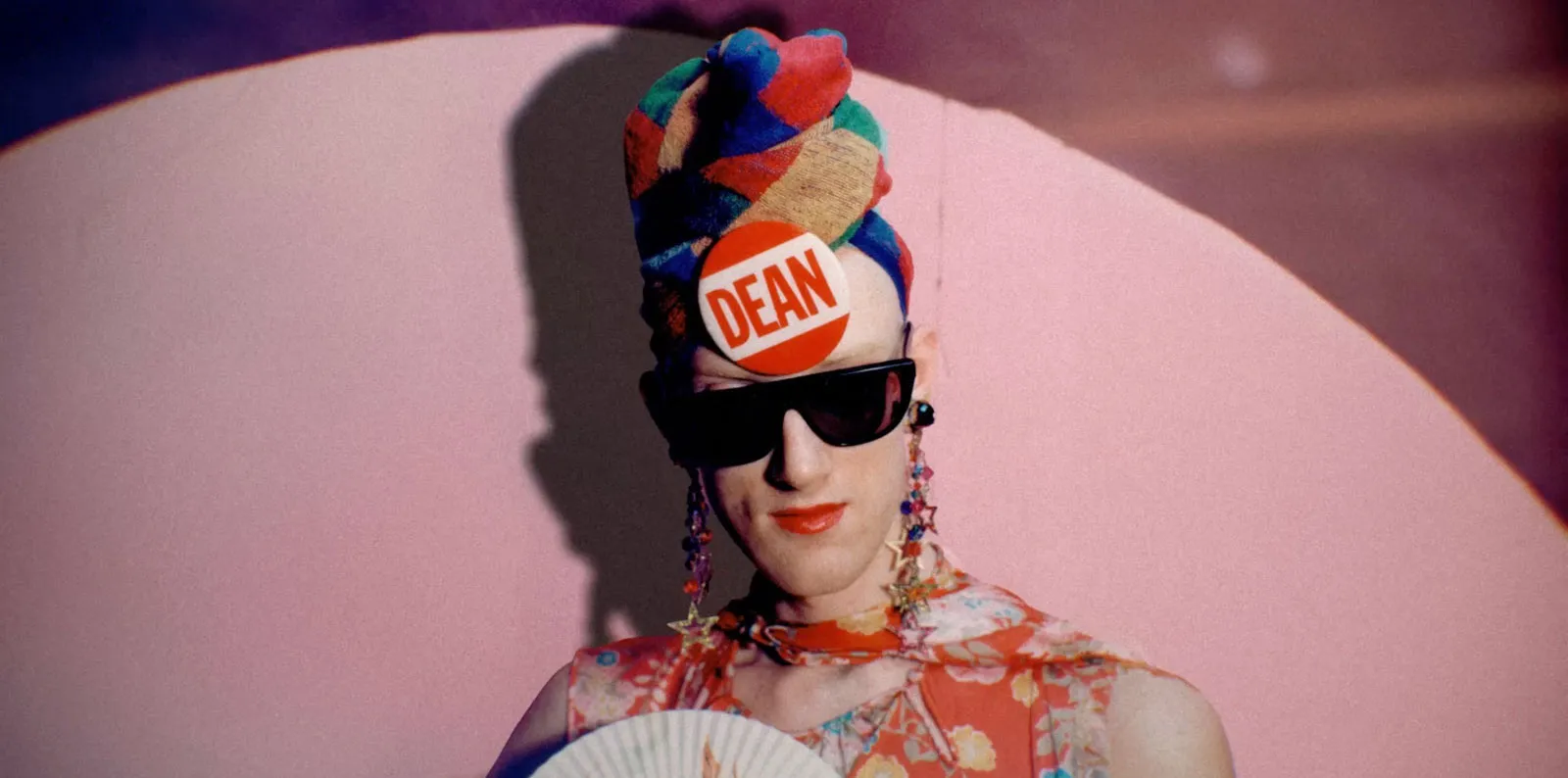
The present-day city appears polished and expensive beside the streets the film resurrects. Johnson moves through a social orbit that included Andy Warhol, Keith Haring, and Jean-Michel Basquiat, and the documentary uses those connections to mark the scale of the cultural moment around him. It also traces a map of landmarks that no longer hold the same meaning, moving from the stages of Wigstock to the dance floors of Danceteria.
Nightlife becomes a narrative engine here, not decorative wallpaper. The film captures the frantic permissiveness of the Rock and Roll Fag Bar parties Johnson hosted on Tuesday nights, treating these gatherings as both release valve and community infrastructure. Rock’N’Rolla balances that energy with the hard truth sitting in the same time period: the AIDS epidemic. Archival footage carries a visceral sense of loss, and one striking sequence shows activists throwing the ashes of their friends onto the White House lawn. That moment locks the film to its political stakes. Freedom, in this story, comes with a cost that stays visible.
Texture and Technique in Retrospect
The documentary’s formal strategy matches its subject: mixed media, shifting registers, and a refusal to smooth out the rough edges. Archival VHS tapes of Johnson’s live performances provide much of the visual pull. The footage has degraded with time, yet his stage presence still lands with raw immediacy. Rock’N’Rolla treats the worn texture as part of the point. The past arrives with damage, and the film does not pretend otherwise.
To cover gaps in the visual record, Rock’N’Rolla incorporates animations by Lance Tooks. These sequences use a raunchy, edgy style to visualize entries from Johnson’s personal diaries, giving the film access to interior material without pretending it can recreate it cleanly. The animations also keep the documentary from leaning too heavily on archive as proof. They act as a reminder that history includes private narration, not only public documentation.
Contemporary interviews serve as counterweight to the archival chaos. Friends and collaborators share anecdotes that land as funny and deeply intimate, and the film builds a sense of Johnson as both kind and provocative without forcing a tidy reconciliation between those traits. The editing keeps a brisk pace that maintains narrative momentum while still leaving room for reflection.
Rock’N’Rolla bookends the story with the mystery of Johnson’s death in 2007, and that structural choice changes the film’s shape. It gives the narrative a question to carry alongside the chronology: how could someone this influential end up filed away as an unknown John Doe. The documentary holds that unresolved weight to the end, which fits a subject who spent his life refusing to be made easy.
The Big Johnson follows the life of Dean Johnson, a performer and activist who served as a central figure in the New York City underground scene for decades. The film held its world premiere at the 2025 Slamdance Film Festival and recently completed a limited theatrical run that began on January 23, 2026, at the Quad Cinema. Starting February 27, 2026, the documentary will be available to watch on North American digital platforms, including Amazon, Apple TV, Google Play, and YouTube Movies.
Full Credits
Title: The Big Johnson
Distributor: Freestyle Releasing, Freestyle Digital Media
Release date: January 2025 (World Premiere), January 23, 2026 (Theatrical), February 27, 2026 (Digital)
Running time: 95 minutes
Director: Lola Rocknrolla
Writers: Lola Rocknrolla
Producers and Executive Producers: Lola Rocknrolla, Patty Lovemore, Beth Johnson, Mitch del Monico, Leon Chase, Hugh Mackey, Anthony Michael Morone, Samantha Schutz
Cast: Lady Bunny, Jackie Beat, Sherry Vine, Taylor Mac, Kevin Aviance, Penny Arcade, Michael Musto, Miss Guy, World Famous Bob, Legs Malone, Mike Albo, Josh Atkins, DJ Tennessee, Daniel Nardicio
Director of Photography (Cinematographer): Sergei Franklin, Hugh Mackey, Samantha Schutz
Editors: Leon Chase, Ray Hubley, Anthony Michael Morone, Samantha Schutz
Composer: Curtis Heath, Gina Volpe
The Review
The Big Johnson
The Big Johnson serves as a vivid, necessary record of a man who lived at full volume. By blending raw archival tapes with sharp animation, Lola Rock’N’Rolla creates a narrative that feels as chaotic and vibrant as the era it depicts. While the mystery of the ending leaves some questions unanswered, the film succeeds in its primary mission: ensuring a pioneer of queer resistance is no longer a footnote in history. It is a striking, honest tribute to an artist who traded comfort for total authenticity.
PROS
- Fearless portrayal of addiction and sex work
- Exceptional use of raunchy, stylish animation
- Authentic preservation of 80s NYC club culture
- Powerful, rare archival protest footage
CONS
- Minimal background on Johnson’s early childhood
- The ending feels somewhat abrupt
- Traditional interview segments can feel familiar
- Brief treatment of the final investigation