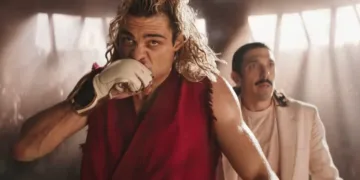


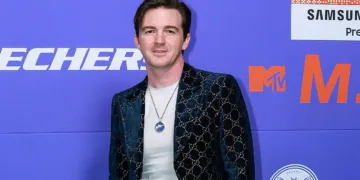
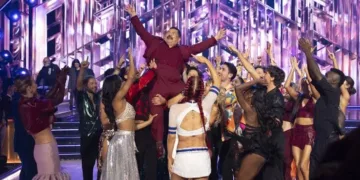



















Rickey stands for a familiar American dead zone: stalled ambition, class shame, and the performance of success as daily survival. He was once a Rhode Island hockey prospect, then a car accident erased that future. He now works as a janitor, and the job itself becomes a wound in his self-image.
For a full year, he sustains an elaborate lie for his girlfriend Kelly, telling her he works as a professional bounty hunter. The lie says plenty about him, and it says plenty about the culture around him too. Status becomes morality in this setup. Paid labor gets read as personal failure. Rickey absorbs that logic and builds his life around hiding from it.
The collapse arrives fast. Kelly, who is an actual star on the U.S. women’s hockey team, visits the school where Rickey works and sees the truth. The breakup happens immediately. Rickey then drops into a lethargy that plays like a clinical shutdown. His answer to humiliation is spectacularly misguided and almost touching for a minute (almost): he decides he will qualify for the World Games with the U.S. men’s curling team. He treats an unfamiliar sport like a machine for romantic repair. It is a redemption fantasy built from panic.
The movie raises the stakes in a way that feels both dangerous and very local. Rickey’s father, recently out on parole, gets a ten-thousand-dollar entry fee from the Plow King, a local gangster played by Mickey Rourke. Money arrives, and danger arrives with it. The arrangement carries the kind of pressure that hangs over every scene after that, even when the movie is busy clowning around.
Archetypes of the Frat-Boy Ethos
Darin Brooks plays Rickey with a kind of slacker vacuity that keeps the audience at arm’s length. The performance leans into smugness, and the energy feels derivative by design. Rickey runs on deception for most of the film, which creates a real structural problem for the redemption arc. The script asks the audience to root for someone who treats truth like a decorative item he can put on or take off. That can work in comedy. Here, it leaves a residue.
Justin Chatwin, playing Coach Troy, supplies a grotesque and strangely memorable counterweight. With blinding white veneers and hockey hair, he lands as a caricature of hyper-masculine stupidity. He pursues Kelly with predatory focus and takes visible pleasure in shredding Rickey’s already unstable ego.
Chatwin commits fully to the bimbo-fication of the male athlete. The performance is loud, abrasive, and impossible to ignore, which gives the film a jolt it rarely generates elsewhere. In a movie that often settles into beige rhythms, he arrives like a neon hazard sign.
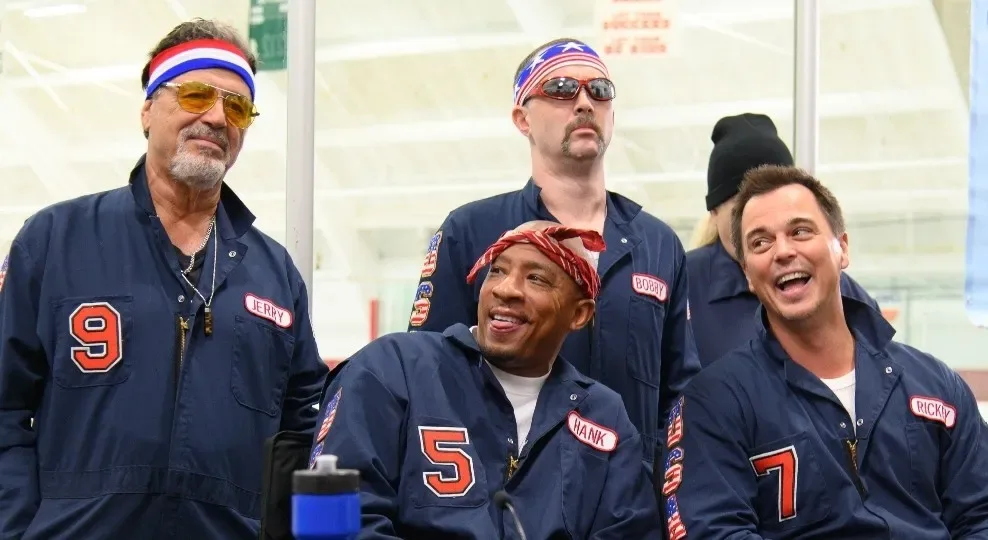
The supporting team is built from janitorial misfits. Eddie Kaye Thomas plays Bobby, the eccentric brother with a military history. John Fiore appears as Uncle Jerry, a shuffleboard hustler whose expertise exists mostly in theory. Antwon Tanner plays Hank, the supportive co-worker who rounds out the group. William Forsythe and Mickey Rourke help ground the movie in a mob-meets-sports mood. Their presence supplies veteran grit to material that often feels shaped like a light sitcom episode stretched to feature length.
Echoes of the Farce-Decade
The film operates as a retro-farce, chasing the low-brow comic register associated with the late nineties, where slapstick and crude humor functioned as the main currency. Writer-director Tom DeNucci leans on stupid-man tropes that play like artifacts from another cultural moment. The frat-boy energy is specific and persistent. The joke design favors fast, easy payoff. Thoughtfulness sits on the bench.
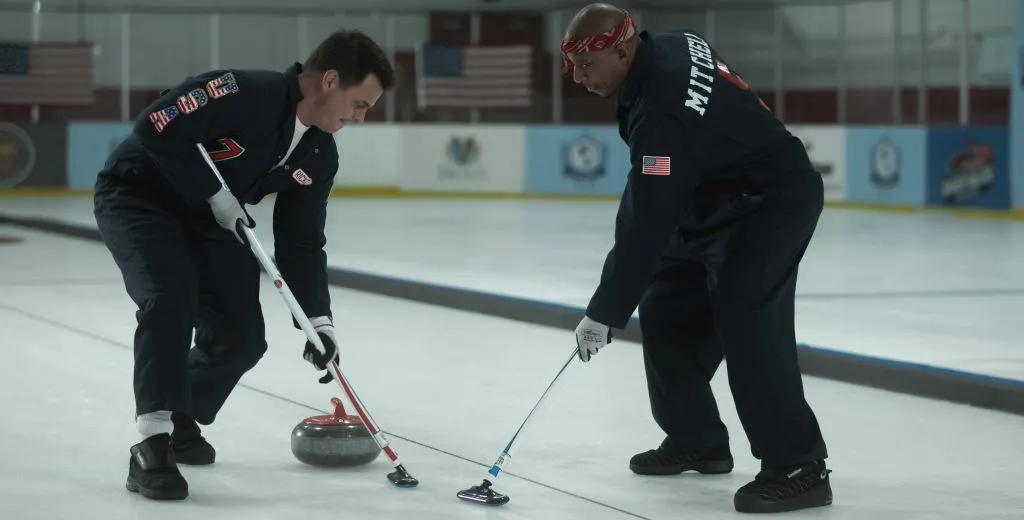
Then the film performs a late serio-pivot. The final act shifts from goofy slapstick into the earnest cadence of an inspirational sports drama. That move creates tonal whiplash strong enough to flatten the comedy. After ninety minutes of fart jokes, the big-game stakes arrive with a request for sincerity the movie has not earned. The transition feels engineered rather than grown from the material.
Visually, the production remains modest. The movie never finds the scale an international sporting event usually demands. Its look is broadcast-functional, with the texture of a television pilot from 2004. That limitation throws extra weight onto the writing, and the writing keeps returning to familiar clichés.
The romance tension comes from a lie, which can sustain a story for a while, yet the narrative here feels thin and derivative across long stretches. The running time starts to feel heavy because the film never settles on a stable identity. Sports comedy, romance, mob subplot, underdog fable, locker-room farce: all are present, and none fully take command.
The Frictionless Ice of Inauthenticity
Curling itself gets treated like a punchline. The film approaches the sport as inherently funny, then struggles to invent sharp satire from that assumption. It spends surprisingly little time engaging with the game in a meaningful way. A strange avoidance sets in. We are pulled away from the ice so often that the central premise begins to feel secondary, almost like a poster idea the script forgot to develop. That leaves a thematic void right in the middle of the movie.
The training section runs on what could be called absurdist-skimping. Rickey’s father learns the sport through online research. The team is made up of janitors with no athletic background, yet they rise into national contention.
The film turns meritocracy into fantasy and pushes that fantasy past the point of coherence. Even the small-town rink setup invites questions the movie does not want to answer, particularly the idea of a four-man janitorial team working there as if labor costs carry no weight in this universe. (A generous staffing model, if nothing else.)
By the time the World Games climax introduces Team Russia as the threatening opponent, the film moves into a dated Dodgeball-style exaggeration. A gambling subplot tied to the Plow King adds pressure from the outside, though it feels imported rather than organic. The weak sense of realism around curling mechanics becomes increasingly distracting.
The movie stages the noise of competition, the shouting and posturing, while the sport itself remains underdeveloped. What remains is a strained meditation on mediocrity, with characters chasing dignity through performance, deception, and spectacle on a sheet of ice the film never fully trusts.
The Roaring Game is a sports-themed romantic comedy that follows a down-on-his-luck janitor who attempts to win back his ex-girlfriend by forming a misfit curling team to compete in the World Games. After premiering at the Rhode Island International Film Festival on August 9, 2025, the film was released across North America on February 6, 2026. As of today, February 25, 2026, you can watch the movie in select theaters or stream it through video-on-demand services such as Prime Video, Fandango at Home, and Apple TV.
Where to Watch The Roaring Game (2025) Online
Full Credits
Title: The Roaring Game
Distributor: Brainstorm Media
Release date: February 6, 2026
Running time: 95 minutes
Director: Tom DeNucci
Writers: Tom DeNucci
Producers and Executive Producers: Chad A. Verdi, Michelle Verdi, Chad A. Verdi Jr., Paul Luba, Anthony Gudas
Cast: Darin Brooks, Fivel Stewart, Eddie Kaye Thomas, Justin Chatwin, Antwon Tanner, John Fiore, William Forsythe, Mickey Rourke, Rob Gronkowski, Vanessa Angel
Director of Photography (Cinematographer): Marcus Friedlander
Editors: Paul Stamper
Composer: David Bateman
The Review
The Roaring Game
The Roaring Game operates as a "retro-farce" that feels like a misplaced transmission from the early 2000s. While it attempts to weaponize the inherent goofiness of curling for comedic effect, the result is a friction-thin narrative that relies heavily on a protagonist whose central trait is pathological dishonesty. The tonal pivot from crude slapstick to sincere sports inspiration feels unearned and conceptually hollow. It is a work of "strained mediocrity" that fails to find the heart of the sport or the humanity of its characters.
PROS
- His over-the-top, caricatured performance provides the film's few genuine laughs.
- William Forsythe and Mickey Rourke add a layer of much-needed grit to the local mob subplot.
- The choice of curling offers a rare, if underutilized, backdrop for an underdog story.
CONS
- Rickey’s prolonged deception makes it difficult to root for his romantic redemption.
- The shift from low-brow humor to "big game" sincerity is jarring and ineffective.
- The movie spends too little time on the actual mechanics and strategy of curling.
- The reliance on dated tropes and "stupid man" clichés feels unoriginal.