























Imagine waking up each morning on the only island that exists. Your father sails out each day and comes back with fish, reinforcing what you already understand: the horizon holds no new shore. Dragon Quest VII Reimagined opens on that kind of quiet certainty, then uses it to flip the usual JRPG stakes. The task here centers on restoration. The world already slipped away, and the game asks you to piece it back together.
You play a fisherman’s son who sets out with his childhood friends to find out why the world has collapsed into a single landmass. The trail leads to magical tablet fragments scattered across time. Gather enough pieces and the game lets you step into the past of a vanished island, resolve a historical crisis, and bring that land forward into the present.
This marks the third version of a game that first launched on PlayStation in 2000, and Square Enix treats the “Reimagined” label as literal. Systems have been rebuilt, and the slow stretches that defined the original’s reputation have been cut down through heavy editing and redesign. The result plays as a clear entry point for newcomers, with trade-offs that change what “Dragon Quest” feels like moment to moment.
Stories Scattered Across Time
The time-travel structure gives Dragon Quest VII a strange cadence for the series. Every restored island plays like a contained short story that tends to run for hours. You step into the past, pick up the shape of a local crisis, resolve it through a boss fight, then return to the present to see how centuries of consequences settled after your вмешали. Bit by bit, the world map stops being empty water and starts behaving like a real place again, which matches the game’s fixation on rebuilding what was stolen.
This anthology framing calls to mind Chrono Trigger, another time-hopping RPG with Akira Toriyama’s character designs. The key distinction sits in pacing and connectivity. Chrono Trigger links its eras into a single, interlocking chain of cause and effect. Dragon Quest VII treats most islands as separate episodes, so momentum rises and falls in chunks. The larger storyline about the Roamers and their push to restore the Almighty is present, yet it spends long stretches off to the side.
There is real pleasure in watching the map transform from blank ocean into a set of continents you earned into existence. Individual islands swing at different ideas, including the reliability of oral history, the self-destruction that comes from hubris, and the way cultures mutate over time. The format also keeps introductions fresh, since you are constantly meeting new faces and learning a new community’s rules. That structure also creates uneven arcs. Some island stories land in the first scene and carry you through. Others start slow and stay slow. Progression is tied to clearing these episodes, so a weaker chapter still blocks the road forward.
Square Enix cut several islands completely, including El Ciclo, Gröndal, and Providence, and trimmed some dungeons heavily. The edited version rarely shows obvious holes, which points to a script and structure that benefited from tightening. The narrative moves with fewer stalls, and longtime fans will still clock the missing material.
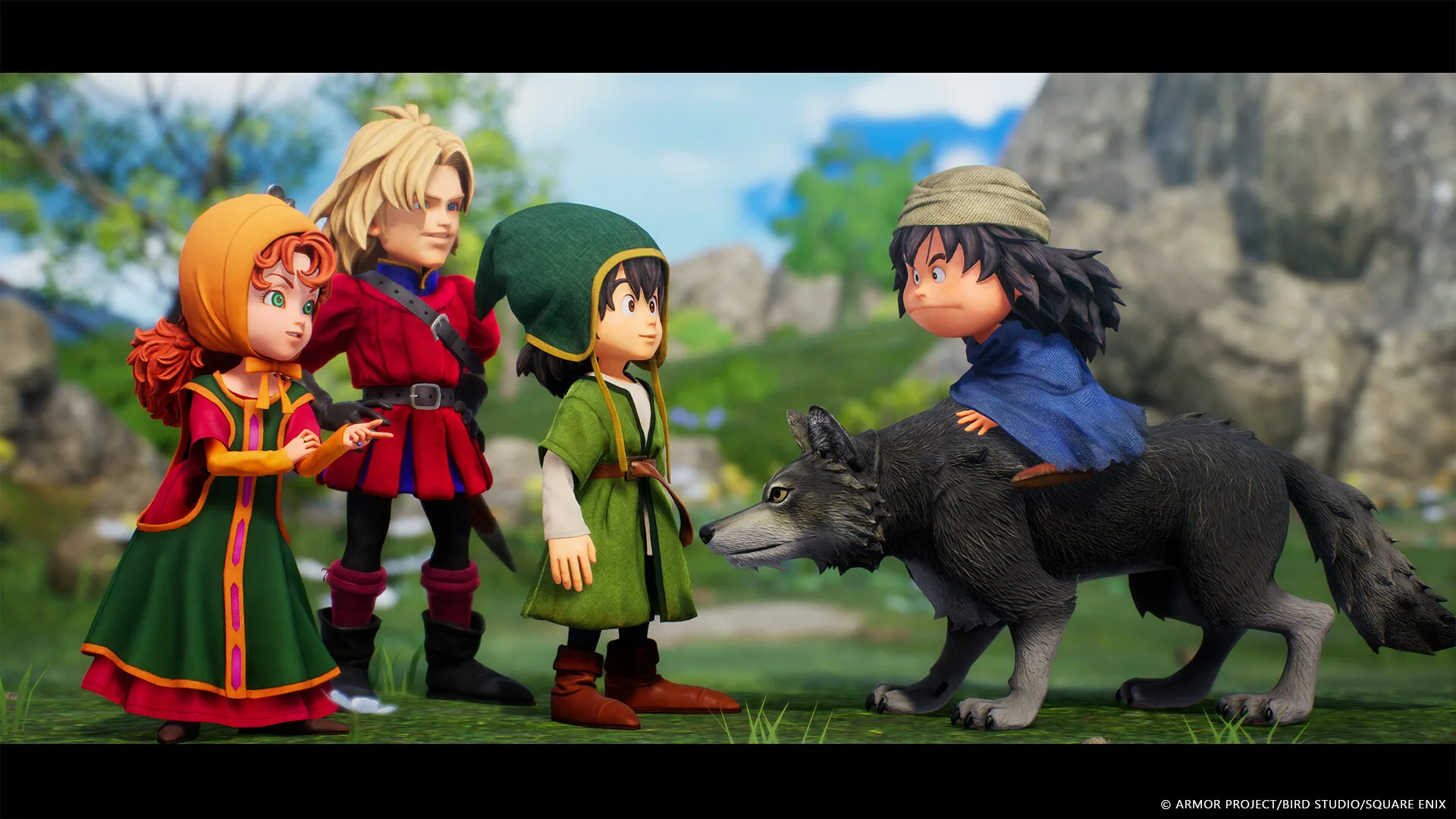
The main party gains a lot from stronger character work. Maribel’s sharp tongue and Kiefer’s rebellious charm read like genuine friendship rather than default “support character” energy. Voice acting helps each person register as distinct without turning scenes into performance showcases. Later additions such as Ruff the Wolf Boy help the group feel like a complete party.
The biggest surprise comes from NPC writing. Townspeople update what they say based on events, era, and your progress. They reference your actions and keep conversational threads going, which turns NPC talk from routine box-ticking into real world texture.
The tone also runs darker than many Dragon Quest entries. These stories often circle civilizations that collapsed or disappeared. You arrive after the damage is done and end up managing the aftermath, limiting the harm instead of preventing it. That persistent melancholy gives the adventure a heavier emotional register.
Puppets and Dioramas
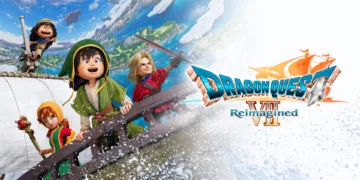
Square Enix built this remake around a diorama look created by scanning handcrafted figurines. Characters come across tactile and toylike, and clothing shows fabric texture in a way that keeps the models feeling physical. The chibi proportions lean harder than before, with big heads and small bodies, and that choice will split players.

It hit as jarring early on. The muted palette replaces the vivid, anime-coded color that many people associate with Dragon Quest. Characters that would usually pop in bright primaries now sit in softer hues. Details like Kiefer’s facial work and the visible stitching on Maribel’s outfit signal careful craft, yet it took hours before the style started to feel natural.
The aesthetic has clear strengths. For remakes that will not chase ultra-HD realism, this provides a coherent visual direction. Diorama staging fits environments especially well, giving spaces a handcrafted intimacy. Monster designs keep their inventiveness, and new enemy encounters stayed a steady highlight. The sense of scale recalls the PlayStation original and surpasses the 3DS version’s compressed presentation.
My family reacted immediately to how cute everything looked, which suggests the look reaches younger viewers. This version clearly aims at an entry point that reads as “My First Dragon Quest,” and the toy presentation supports that intent. The 3DS version’s vocation outfit changes are gone, and that loss stings. Some players will never warm up to the look. The project also reads like a single experiment rather than a direction that Square Enix plans to repeat.
Combat Systems and Customization
Dragon Quest VII sticks to turn-based combat that classic JRPG fans will read instantly. Each character attacks, uses skills, uses items, or defends. Progression stays grounded next to many peers. Characters wrap the main story near level 50 with HP around 400–500, and damage scales in step. Early fights and late fights share the same fundamental shape, anchored by the same core elemental spells across the full run.
Reimagined adds combat speed settings and a smart auto-battle that can clear routine encounters without babysitting. You can also strike visible overworld enemies to delete them instantly if your party outclasses them, which removes entire battles. These quality-of-life changes shave down grinding without rewriting the underlying rules of combat.
The job system opens around 11–12 hours in and brings 20 vocations split across three tiers. Basic jobs like Mage, Priest, and Warrior behave as expected. Tier-2 vocations require mastery combinations, and this is where the system starts to sing. Armamentalist leans into elemental magic and high resistances. Paladin turns into a defensive pillar. Monster Masher calls iconic Dragon Quest creatures such as Slimes. A single Tier-3 vocation caps the ladder.
Skills depend on your active vocation instead of sticking permanently, which makes party building a real commitment choice. The new Moonlighting system lets you equip two vocations at once, earn proficiency for both, and draw on both skill sets and stat bonuses. That opens flexible builds. A Priest/Warrior can bring healing spells and physical pressure in the same kit. The system carries no trade-off in this version, so the result is straight customization freedom.
Let Loose abilities act like Limit Breaks and trigger after you take enough damage. Born Again (Priest) fully heals the party and revives everyone. Divide (Champion) makes three copies that all execute your selected action. Critical Stance (Monk) guarantees your next physical hit will crit, and it becomes brutal next to Multifist’s seven-hit attack. These mechanics encourage broken combos, and pulling them off feels great.
Equipment plays a larger role than many Dragon Quest games. Secondary properties such as elemental resistances and passive effects turn gear into real decision-making. Monster Heart accessories add strong modifiers, including one that drops MP to zero and doubles strength. The system still has friction points. Vocation changes require summoning a priestess who repeats the same dialogue each time, and the shop equipment interface felt clumsy enough that I stopped using it.
Smoothed Edges and Removed Friction
The original Dragon Quest VII waited hours before its first real combat. Reimagined moves fast. Monsters show up within 30 minutes, and vocations arrive around 11–12 hours. I checked my progress against a 3DS save at the same story point. In Reimagined I sat five levels higher and had mastered twice as many vocations, and I reached that state in half the time. My run ended a little over 40 hours, compared to 70–100+ hours in earlier versions.

Some removals stand out. Dungeons lost floors, the Sunken Citadel became a corridor, and full islands disappeared. The streamlined path rarely feels like it is missing critical beats, and the narrative moves with fewer stalls. Fast travel does a lot of the heavy lifting by letting you jump instantly between restored islands.
Reimagined piles on convenience tools until resource management nearly disappears. Free healing statues show up often. HP/MP items respawn across the world. Characters fully heal on level-up. Dead party members come back after battles with 1 HP, which drops the old coffin parade visual. The death penalty is a flat 1,000 gold, replacing the older half-your-money hit. By the time I took a game over in the final dungeon, that fee felt trivial.
Individual inventory bags were replaced by shared storage. Cursed gear is gone. Enemy weakness indicators appear during spell selection. Tablet fragment spots display as map markers, turning exploration into a checklist. Difficulty options include three presets plus detailed toggles for damage, monster strength, experience gain, and more. You can even stop monsters from attacking.
On normal difficulty, I stayed far from a game over until the last stretch. Free healing, automatic revival, and soft penalties create a loop where failure barely exists. MP conservation and careful routing stop mattering. Quest goals show as map icons. Party members explain puzzle solutions through dialogue before you get time to think. The discovery-driven feel tied to Dragon Quest gets sanded down.
That design choice stands out next to last year’s HD-2D remakes of Dragon Quest I and II. Those projects improved accessibility and kept challenge intact. Reimagined removes most sources of friction. Over time the intent became clear: a “My First Dragon Quest” entry point for newcomers and younger players. Once I accepted that framing, the story and characters went down easier. Veterans are likely to miss the older philosophy.
Words and Voices
The localization may be the game’s standout achievement. The writing keeps Dragon Quest humor intact and gives each region its own personality. Regional accents show up throughout, including French-inspired, Russian-inspired, Irish-influenced, and Arabic-influenced cultures, rendered through dialect work that avoids caricature. Characters sound rooted in place without sliding into stereotype.
Spell and monster names lean hard into groan-worthy puns: Coral Grief, Gritty Ditty, Tongue Fu Fighter, Grinade, Slaughtomaton. The comedy stays broad enough for a smile and keeps its tonal balance with the tragedy without tonal whiplash. Voice acting reinforces that work with performances that underline individuality. Maribel’s sharp wit and Kiefer’s earnest charm come through clearly in delivery. The English dub matches the care of the written text, and the craft is easy to miss because it sounds natural.
Technical Friction Points
The game plays smoothly for most of its runtime, yet small issues accumulate. On Switch, button mapping inconsistencies mean the B button changes behavior depending on context. Fast dialogue tapping can lead to accidentally declining quests, while the same button acts as confirmation with certain NPC interactions. The problem stays minor on paper and grows irritating through repetition.
A bit of sequence breaking also shows up. In my playthrough, Kiefer mentioned the Demon King before any NPC explained who that was, which disrupted the flow of information. Vocation switching still forces repeated dialogue with the priestess every time you change jobs, adding unnecessary drag to a system built for frequent use. Shop equipment management felt clunky enough that I stopped selling old gear entirely.
None of these issues break the package, yet they stack up over dozens of hours. A game that reworks so many systems for smoothness feels inconsistent when these rough edges remain.
Dragon Quest VII Reimagined is a comprehensive remake of the classic role-playing game Dragon Quest VII: Fragments of the Forgotten Past, originally released in 2000. Released on February 5, 2026, this version modernizes the experience with a unique “handcrafted” diorama visual style, where characters and environments resemble wooden dolls and miniature sets. The game features a streamlined narrative, removing some of the original’s slower pacing while adding new story scenarios, and introduces updated gameplay mechanics such as the “Moonlighting” system, which allows characters to equip two vocations simultaneously. It is available to play on PlayStation 5, Xbox Series X/S, Nintendo Switch, Nintendo Switch 2, and PC (via Steam and Microsoft Store).
Full Credits
Director (Creative/Game Director): Masato Yagi
Writers (Lead Writer/Narrative Designer): Sayaka Takagi (Lead Scenario Writer), Yuji Horii (Original Scenario/General Director)
Producers/Studio Leadership: Takeshi Ichikawa (Producer), Yuji Horii (Creator/General Director)
Lead Voice Cast: Kouki Oosuzu, Mamoru Miyano, Aoi Yuuki, Mutsumi Tamura, Asami Imai, Shigeru Chiba (Japanese Cast); Isaac Rouse, Nicholas Boulton, Clare Corbett (English Cast)
Art Director/Lead Artist: Akira Toriyama (Original Character Design), Masato Yagi (Visual Direction/Diorama Style Concept)
Key Engineering/Technical Leads: HEXADRIVE Inc. Team
Composer/Sound Director: Koichi Sugiyama (Original Composer), Sugiyama Kobo
Developer, Publisher: Square Enix / HEXADRIVE Inc., Square Enix
Release Date: February 5, 2026
The Review
Dragon Quest VII Reimagined
Dragon Quest VII Reimagined successfully transforms a notoriously bloated classic into an accessible 40-hour adventure, but aggressive streamlining comes at a cost. The diorama aesthetic charms despite initial awkwardness, the Moonlighting system revitalizes the job progression, and the world-class localization elevates every conversation. However, the complete elimination of challenge, exploration, and resource management strips away what makes Dragon Quest special. This works brilliantly as "My First Dragon Quest" for newcomers and families, but veterans seeking the series' traditional sense of discovery and accomplishment should look elsewhere.
PROS
- Moonlighting system adds exceptional customization depth
- World-class localization with distinct regional personalities
- Pacing dramatically improved (40 hours vs 100+)
- Diorama aesthetic creates unique visual identity
- Smart auto-battle and quality-of-life features streamline grinding
- Strong character development and voice acting
CONS
- Challenge almost completely eliminated on normal difficulty
- Exploration reduced to checklist completion with map markers
- Uneven island story quality due to anthology structure
- Divisive toylike art style with muted colors
- Vocation outfit changes removed from 3DS version