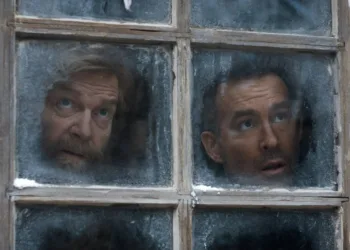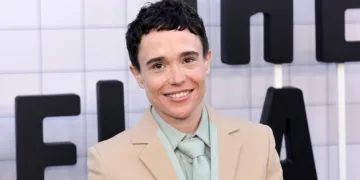

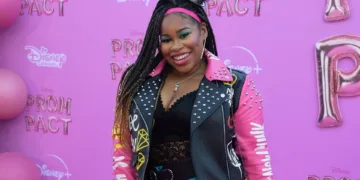


























Maggie steps into what she stages as her “stable girl era,” a campaign of aggressive normalcy built from retinol discipline and meal-kit efficiency. This phase reads like a private Renaissance after the Dark Ages of last season, when a medical error triggered a terrifying stretch of lithium poisoning. She is still a playwright in London, still trying to impose middle-class order on a mind that keeps resisting neat arrangement.
The move away from the jagged, hallucinatory despair of season one and toward manic comic velocity feels like a kind of reconstructuralism, a desperate rebuilding project for a self that has already splintered. Eddie lingers over the story like a ghost with a passport, silent in America after their friendship buckled under the force of Maggie’s instability.
The narrative tracks Maggie’s effort to repair that platonic breakup while living under the stigma-shadow of her diagnosis. What emerges is a portrait of someone trying to demonstrate sanity to people who have already filed their verdict. The tone carries more light than the previous finale, yet the pressure of her precarious balance keeps tightening the screws.
The Wellness Industrial Complex and Platonic Decay
Whitney’s arrival introduces a trust-scarcity that shakes the old architecture of Maggie and Eddie’s bond. Whitney, a California soul-influencer, personifies the contradiction at the center of contemporary spiritual grift. She denounces technology, yet her whole persona depends on social-media performance. Maggie clocks the fraud immediately, reads it as a spirit-scam, and fixates on unmasking Whitney as a way of saving Eddie. That impulse is comic, sad, and a little grandiose.
Their friendship now exists in a fossilized phase, burdened by accumulated failures that have hardened with time. Eddie carries lasting anger because Maggie vanished during a crucial medical procedure years earlier, and mania cannot wipe that slate clean. Poor Will drifts through this emotional battlefield with the kind of casual contempt society often reserves for the unremarkably kind, which is a bleak detail and a very funny one.
The show studies how childhood intimacy can decay into something poisonous with age. Flashbacks in the finale return to the origin point of Maggie and Eddie’s connection, suggesting a history that works as life raft and prison at once. It is a harsh account of outgrowing the people who once knew you most completely.
The Stigma Shadow and the Comedy of Ancestry
The episode understands that society demands a polished performance of wellness, one with no space for the daily fact of chronic illness. Maggie wears a “junior” bridesmaid sash at an upper-class wedding, and the image lands as a neat metaphor for her reduced status in the eyes of the respectable and the sane.

She is assigned the job of removing leeches from a fountain, an indignity that mirrors the repetitive drudgery of emotional repair. Then her father arrives and the episode starts sketching a hereditary map of her distress. He is a celebrated comedian whose success rests on profound selfishness, which feels less like a quirk than a family curse with excellent timing.
Their restaurant scene offers a sharp lesson in familial-friction, making clear that Maggie’s struggle has been handed down by a narcissistic patriarch who turned ego into career. She tries to stay composed in front of him, locked in a quiet-war against the expectation of collapse.
The show is very sharp here. It points to the way behavior gets pathologized in the neurodivergent and renamed eccentricity in the successful. Maggie moves through the episode like someone screaming silently inside a very well-maintained skincare regimen. “Normal” keeps shifting, usually at the whim of whoever holds the social power to define it.
Emotional Elasticity and the Art of the Millennial Malaise
Nicola Coughlan gives Maggie a startling emotional-elasticity, moving from slapstick farce to existential terror in a single beat. The comic rhythm is quick and unruly, leaning into maximalist absurdism in sequences like the Surrey wedding. Hannah Onslow plays Whitney as a precise piece of satire aimed at the wellness-industrial machine, with an accent so exact it becomes deliciously irritating.
Even small parts register. Rupert Everett’s camp cameo sticks in the mind long after it passes. Each episode feels like a narrative-island with its own weather system, yet each still feeds the season’s larger shape. The series keeps locating comedy in the psyche’s grimmest corners, using wit like a scalpel. It catches a distinctly millennial malaise in London, where friendship has become the last meaningful currency in a city that feels priced beyond human scale.
The writing stays sharp and resists sentimentality, choosing mess, rawness, and truth. The portrait of survival it offers refuses easy resolution. The humor becomes resistance, pushing back against trauma-narratives that so often dominate stories about mental health. What remains is chaotic, necessary praise for the un-normal.
The second season of the British dark comedy-drama Big Mood premiered on April 16, 2026. This season continues the story of best friends Maggie and Eddie as they navigate the complexities of long-term friendship and mental health a year after their previous fallout. Viewers in the United Kingdom can watch the series on Channel 4, while audiences in the United States and Canada can stream it via Tubi. The show has been praised for its sharp wit and its honest portrayal of the “stable girl era” in the face of ongoing personal and social challenges.
Where to Watch Big Mood Season 2 Online




Full Credits
Title: Big Mood Season 2
Distributor: Channel 4, Tubi, Stan
Release date: April 16, 2026
Rating: TV-MA
Running time: 25–30 minutes per episode
Director: Rebecca Asher
Writers: Camilla Whitehill
Producers and Executive Producers: Lotte Beasley Mestriner, Laurence Bowen, Chris Carey, Camilla Whitehill, Rebecca Asher, Nicola Coughlan, Lydia West, Nadia Jaynes, Georgie Fallon
Cast: Nicola Coughlan, Lydia West, Robert Gilbert, Amalia Vitale, Eamon Farren, Ukweli Roach, Hannah Onslow, Robert Lindsay, Rupert Everett, Marina Bye, Munroe Bergdorf, Luke Fetherston, Niamh Cusack, Rebecca Lowman, Stephen Sobal
Director of Photography (Cinematographer): Daniel Stafford-Clark
Editors: Robin Peters
Composer: Jeremy Warmsley
The Review
Big Mood Season 2
The season succeeds as a sharp observation of the "stable girl era" performance. It avoids the sentimental traps often found in recovery stories. The tension between Maggie’s fragile order and the chaotic "spirit-scams" of modern wellness creates sharp comedic friction. It remains a painful, funny study of how we outgrow our own histories. The Whitney character is occasionally thin. The emotional weight of the central rift provides a necessary groundedness.
PROS
- Nicola Coughlan’s exceptional emotional range and timing.
- Sharp satire of the wellness industry and social media influencers.
- Honest, unsentimental portrayal of platonic breakups.
- Memorable guest performances that provide depth to the backstory.
CONS
- The Whitney character occasionally feels like a caricature.
- The treatment of certain supporting characters like Will is uncomfortable.