















The world here has been dead for ages, and it wears that fact on every surface. Sand and iron stretch across the frame. Rain has slipped into myth. Civilization survives as jagged ruins, with rusted tankers and hollow skyscrapers baking under a merciless sun. In this 1990s wasteland, cruelty blows through the air like dust. Kenshiro crosses it like a ghost carrying the discipline of an older age.
Seven scars sit on his chest in the shape of the Great Dipper. They mark him as a representative of the Hokuto Shinken school, a martial art designed to destroy the body from within. People cling to life in the shadows of the old world, terrified of marauding gangs that treat human beings like disposable goods. Kenshiro stands apart through stillness and purpose. Glory means nothing to him. He is searching for a way through slaughter while trying to preserve a soul in a place that no longer remembers mercy.
Precise Violence and Accidental Allies
This opening movement begins in the wet gloom of a village cell. Kenshiro sits in silence. Bat, a frantic young thief, fills the space with nonstop chatter. Bat captures the kind of quick thinking required to survive one more day in the dirt. He lives through trickery. Rin changes the mood the moment she enters. She is an orphan whose trauma has taken her voice. Kenshiro restores her speech with one exact touch to her pressure points. That act of healing gives the material a human pulse before the bloodletting resumes.
Then the Zeed gang tears through the village. These bikers bring lawless ego into every frame. They raid for a few drops of water and crush the weak with casual disregard. Kenshiro breaks free and answers them through the precise logic of Hokuto Shinken. The technique targets the Hidden Channeling Points of the nervous system, and the damage arrives a few terrible seconds later.
That delay matters. It gives the gang members time to understand what has happened before their bodies fail. The choreography plays this with patience. Kenshiro reads as a surgical force moving through men who solve every problem with bulk and aggression.
The early episodes also plant the larger feud with Shin. He enters as a malevolent aristocrat, carrying blonde elegance and a terrifying capacity for violence. He is the source of Kenshiro’s suffering, and his arrival makes the rivalry personal at once.
That choice sharpens the pacing. The village attack lands as immediate danger, and Shin’s presence hangs over it as the promise of a larger collision between two masters of destruction. Even the village elder feels the weight of it, watching as the stars of death align. Justice in this place arrives with terrifying speed and from deep inside the body.
The Aesthetic of Rupture
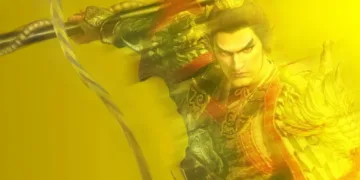
The visual design commits fully to a hybrid style. Cel-shaded 3D character models stand against detailed 2D backgrounds, producing a severe, high-contrast image that recalls the ink-heavy illustrations of the original manga. Kenshiro benefits the most from that choice.
The thick lines across his muscles give him the weight of a monument dropped into the desert. Harsh lighting bakes every scene under the dead earth’s sun, and deep shadows keep the atmosphere grim. Ochre sands sit beside grey ruins, and the whole palette looks scorched.
Combat scenes adopt their own visual grammar. Backgrounds often vanish and give way to solid colors or white voids. That move keeps the action readable, which matters in a style built on finger strikes, split-second impacts, and delayed destruction.
The violence is graphic and uncensored, and the series commits to that with startling calm. When a body starts to distort, the camera stays with it. The staging follows the internal pressure building until the skin finally breaks. The presentation has a clinical precision that suits Hokuto Shinken perfectly. Messy deaths, very tidy framing.
Editing and camera movement keep tightening that effect. The biker raids push forward with frantic motion, then the tempo slows almost to stillness for the fatal strikes. That rhythmic control shapes the impact of each sequence. Fast cuts create panic. The drawn-out final beats create dread. The result turns the wasteland into a field of blood, shadow, and anticipation, with each burst of gore landing like an intentional mark on a manga page.
A Symphony for the End Times
The soundscape carries the same heavy mood as the image track. Yuki Hayashi’s score swells with dark, operatic force, building pressure during standoffs and then surging into high-octane material once the fights erupt. The music keeps returning to the idea of a world stripped of justice.
The Japanese voice cast locks into that tone with real power. Shunsuke Takeuchi gives Kenshiro a voice like stone grinding against stone, loaded with the burden of a man who has already seen the world end. Daiki Yamashita brings Bat a higher, more erratic energy, and that pairing gives the early scenes texture and pace.
The sound design treats Hokuto Shinken with supernatural reverence. Every blow lands with an impact that feels enormous, almost unreal, as if the strike tears through reality before it tears through flesh. Around that, the series layers the growl of biker engines and the whistle of wasteland wind.
The opening theme by Alexandros supplies a modern charge, and the remix of the classic series anthem links this adaptation to its past while keeping it in motion. The quiet may be the sharpest choice of all. During the iconic moments, the effects pull back and leave silence hanging after Kenshiro has finished his work. That hush gives real weight to a man fighting for peace in a graveyard. Can one fighter ever silence an age built on chaos?
Fist of the North Star premiered on April 10, 2026, marking a notable return for the legendary martial arts franchise. Viewers can watch the show on Amazon Prime Video, which provides global streaming access. It serves as a modern version of the story, following Kenshiro as he travels through a post-nuclear wasteland. The production combines digital techniques with a gritty aesthetic to capture the spirit of the original source material.
Where to Watch Fist of the North Star Online


Full Credits
Title: Hokuto no Ken: Fist of the North Star
Distributor: Amazon Prime Video, Tokyo MX, BS11, Warner Bros. Japan
Release date: April 10, 2026
Rating: TV-MA
Running time: 24 minutes
Director: Hiroshi Maeda
Writers: Buronson, Tetsuo Hara, Kazuhiko Inukai
Producers and Executive Producers: Akio Matsuda, Ayumu Hoshino, Masahide Tsuji, Nobuhiko Horie, Tomonari Sakai, Tsuneo Takechi, Hinako Watanabe, Makoto Nakamura, Mikihiro Miyashita, Naofumi Shiotani, Ryota Suzuki, Yuki Maeda
Cast: Shunsuke Takeuchi, Daiki Yamashita, M.A.O, Koji Yusa, Saori Hayami, Yuichi Nakamura, Taiten Kusunoki, Wataru Takagi, Tsuguo Mogami, Ruriko Aoki, Koichi Yamadera
Director of Photography (Cinematographer): Yuki Takahashi
Editors: Yoshinari Kanayama
Composer: Yuki Hayashi
The Review
Fist of the North Star
This reboot traverses a difficult path between retro brutality and modern digital hurdles. The hybrid visuals might alienate some purists. However, the sheer impact of the storytelling remains undeniable. It honors the heavy spirit of a martial arts legend with surprising grace. If you can tolerate the occasional digital stiffness, the reward is a visceral return for Kenshiro. It is a loud, bloody reminder of why this wasteland became a cultural landmark in the first place.
PROS
- Accurate depiction of the original manga story.
- Graphic and impactful combat scenes.
- Strong Japanese vocal performances.
- High-energy score by Yuki Hayashi.
CONS
- Technical inconsistency in the animation.
- Stiff movement outside of action sequences.
- Visual style may polarize the audience.