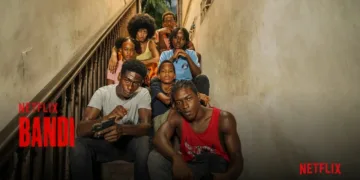


























The French drama Bandi opens on Martinique, an island filmed in rich, inviting images that sit beside a far harsher daily life shaped by poverty and crime. Its story follows the LaFleur family, a household of eleven siblings thrown into crisis after their mother, Marilyn, dies in a sudden road accident.
Marilyn held the family together through discipline and a clear moral code. She demanded honest work and rejected the drug economy pulling at the area’s young people. Once she is gone, survival becomes the family’s first problem. The siblings have to resist a relative who wants them separated, and they have to face bills that their patchwork jobs cannot pay.
Marvin, the eldest brother, tries to hold the family in place through legal work and sheer determination. His younger brothers move in darker directions. Kingsley, impulsive and easy to spot, turns to reckless robberies and low-level dealing.
Kylian, sixteen years old, builds a secret second life as Milord, an unseen drug boss whose reach grows fast enough to touch international cartels. The series builds its drama from that split. Family loyalty pulls the siblings together. The narcotics trade pulls them apart. Their fight to keep the house becomes the frame for a story about what happens when necessity starts rewriting principle.
The Erosion of the Matriarchal Moral Guard
Marilyn dominates the opening stretch of the story, even before her absence starts shaping every choice that follows. She stands for a hard ethical line that appears workable for as long as she is alive to enforce it. Her decision to burn Kingsley’s drug money at the dinner table lands with the force of a household decree. The scene sets the terms for life inside the LaFleur home.
Stay here, and you live by her rules. Once she dies, that heat leaves the story at once, replaced by a financial emptiness that the series renders in physical detail. The broken stove and bare cupboards do more than fill space in the frame. They give the family’s collapse a concrete form. Water, electricity, and insurance bills keep piling up. So do the medical needs of the youngest children, including Mathis’s required CT scan.
Pressure arrives from outside through Aunt Regine and the state social workers. Their concern for the younger children places the family under a deadline. Financial stability becomes the standard they have to meet if they want to remain together.
That threat changes the way the older siblings read their choices. The drug trade stops looking like temptation and starts looking like a tool. Marvin still tries to protect his mother’s sense of honor, yet the conditions around him strip that position of any practical comfort.
The series handles this shift with care. The siblings tell themselves they are protecting the family. Their move into the black market becomes an act they frame as love, even as it violates the values Marilyn defended to her last day. In story terms, this is where Bandi sharpens its argument. Poverty shrinks moral choice until survival becomes the only measure left.
A Conflict of Criminal Philosophies
Kylian and Kingsley give the series its clearest internal conflict, and the writing is strongest when it studies how each brother responds to pressure. Kylian, still a student at sixteen, is drawn with a cool, almost frightening precision. Under the alias Milord, a name taken from a dead brother’s gaming handle, he grasps the value of invisibility.

He keeps up his school routine, stays quiet, and conducts business with international cartels from the shadows. His authority comes from planning, logistics, and expansion. He treats the drug trade as a business operation and pursues it with discipline. That self-control protects him from the ego that often ruins young men in crime stories.
Kingsley serves as his natural counterweight. He is loud, rash, and permanently exposed. His crimes happen in plain sight through robberies of local shops and street-level fights. He has no patience for a plan that takes time to unfold. His decision to pull the younger children into a robbery shows how little thought he gives to consequence.
The tension between the brothers reaches its peak once Kingsley’s recklessness brings police scrutiny and rival attention to the family. Their fight in the hostel works because it is built from character logic. Kingsley reads Kylian’s secrecy as treachery. Kylian reads Kingsley’s vanity as a path to ruin.
That split places Bandi in a familiar current of modern crime drama, where one figure tries to professionalize criminal life and another remains driven by impulse and pride. The theft of the burner phone by Kingsley gives this conflict a precise narrative function.
A single act joins Kylian’s carefully managed operation to Kingsley’s disorder and puts the whole structure at risk. Each brother believes he is protecting the LaFleur name. Kylian builds protection through money and control. Kingsley tries to defend it through force and presence. The series lets those positions collide until their bond can no longer hold steady.
The Mechanics of the Trade
One of the show’s steadier strengths lies in the way it traces Kylian’s climb through the drug trade. The plotting follows his rise step by step, which gives the criminal side of the story a deliberate shape. His three-phase plan signals an unusual degree of strategic thought for someone his age.

He recognizes that local street dealing leads nowhere and pushes toward large-scale export through the Martinique docks. That move widens the story and gives Kylian a new challenge in JC, the dock worker who controls access to a larger market. Their dynamic turns on leverage. Kylian has to work on JC’s dissatisfaction with his own professional life to gain cooperation.
The arrival of the Venezuelan cartel widens the danger from neighborhood conflict to something international and far less manageable. The violence Kylian sees on the yacht serves as a brutal education. The remains of a snitch force him to see that this trade runs on blood, not just calculation. His response matters.
He regains composure quickly, which reveals how quickly he adapts to terror. Sherkhan brings the story back to street reality. Kingsley’s theft of Sherkhan’s stash creates a crisis that ripples across the family name and leaves Kylian using his resources to contain damage he never chose.
Annabelle’s role as a mule exposes another weakness in the operation. Her trip to Paris is written as a tense passage built on inexperience and poor judgment. She places the shipment in danger by trusting Xhesus, a man she barely knows, for the sake of a brief sense of connection. That detail says a great deal about the family’s criminal enterprise. It lacks the discipline of a real professional network.
These are people improvising under pressure and hoping loyalty can hold the structure together. The successful Paris delivery offers a momentary easing of tension, yet the business still rests on chance and desperation. The show understands that point well. Its criminal machine never feels stable. It feels patched together, vulnerable, and one bad decision away from collapse.
The Scenery of Despair
Martinique is not treated as decorative background. The series uses the island with clear dramatic intent, turning its beauty into an active part of the storytelling. Lush greenery and clear water stand beside a world marked by neglect and hardship. That contrast gives the setting a bitter charge. The island looks like paradise and plays like a place where the LaFleurs are hemmed in from every side.
The dead continue to shape that atmosphere. Dylan’s memory forms the base of Kylian’s criminal identity, since he takes his brother’s alias as his own. The choice suggests that grief and power have been linked in this family for a long time. Kylian borrows the name as a form of borrowed strength, still learning how to carry it.
The bleakest turn belongs to Leo. His readiness to shoot a man, followed by bragging about it on social media, lands as one of the series’ sharpest observations about how environment molds the young. Leo carries none of the hesitation that troubles his older siblings. Violence, for him, has already become display and status. The line from Kingsley’s influence to Leo’s behavior is drawn with painful clarity. Marilyn’s hopes for her children fade further with that shift.
The final betrayal comes through the biological father. From prison, he tries to extort Kylian and demands a large cut of the profits while offering threats and nothing else. The character works as a reminder that family ties offer no built-in safety here.
Danger comes from cartels, from social workers, and from the people who should have protected the LaFleurs first. The series keeps tightening that pressure until the family seems locked in a cycle with no stable ground beneath it. Every move toward escape sinks them further into the same mire they are trying to leave.
Bandi is a gritty French crime drama series that premiered globally on Netflix on April 9, 2026. Set on the island of Martinique, the eight-episode production serves as a “Caribbean western,” centering on eleven siblings who are forced into the criminal underworld to keep their family together following the sudden death of their mother. The series was spearheaded by Éric Rochant, the acclaimed creator of The Bureau, and features a cast predominantly composed of local talent from the West Indies. As of today, April 21, 2026, the entire first season is available for streaming exclusively on Netflix.
Where to Watch Bandi Online


Full Credits
Title: Bandi
Distributor: Netflix
Release date: April 9, 2026
Rating: TV-MA
Running time: 51–63 minutes per episode
Director: Jimmy Laporal-Trésor, Eric Rochant, Mathilde Vallet
Writers: Eric Rochant, Capucine Rochant, Gwenola Balmelle, Khris Burton, Jimmy Laporal-Trésor
Producers and Executive Producers: Olivier Hélie, Capucine Rochant, Eric Rochant
Cast: Djody Grimeau, Rodney Dijon, Ambre Bozza, Hay-Lee-Jah Caloc, Amah Fofana, Kahela Borval, Cédric Camille, Teyvan Misat, Liyem Lostau, Nahël Demar, Jonathan Zaccaï, Remy Laquittant, Rudgy Pajany, William Paul-Joseph, Evan Lienafa, Sandrine Velayoudon
Director of Photography (Cinematographer): Boris Abaza, Khris Burton, Crystel Fournier
Editors: Data unavailable
Composer: Marcus Norris
The Review
Bandi
Bandi provides a sharp look at the intersection of extreme poverty and criminal ambition. It succeeds by treating its Martinique setting with honesty. The narrative avoids typical genre tropes by focusing on the specific logistical challenges of a large family in crisis. It remains a stark exploration of how survival demands the sacrifice of integrity.
PROS
- The script offers a methodical look at the mechanics of international drug trafficking.
- Authentic performances capture the desperation of life on the margins of society.
- The script creates effective tension through the conflicting philosophies of the two lead brothers.
- The Caribbean setting is used as a functional part of the plot rather than a mere backdrop.
CONS
- The impulsive decisions made by Kingsley occasionally strain the logic of the story.
- The sub-plot involving Leo and his social media presence feels slightly forced to create conflict.
- Certain supporting characters lack the depth found in the central LaFleur siblings.