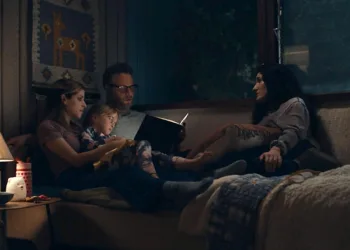








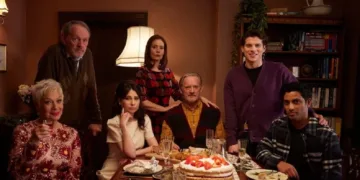

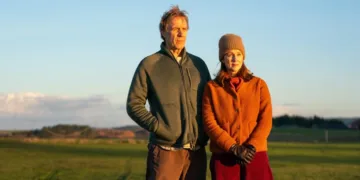











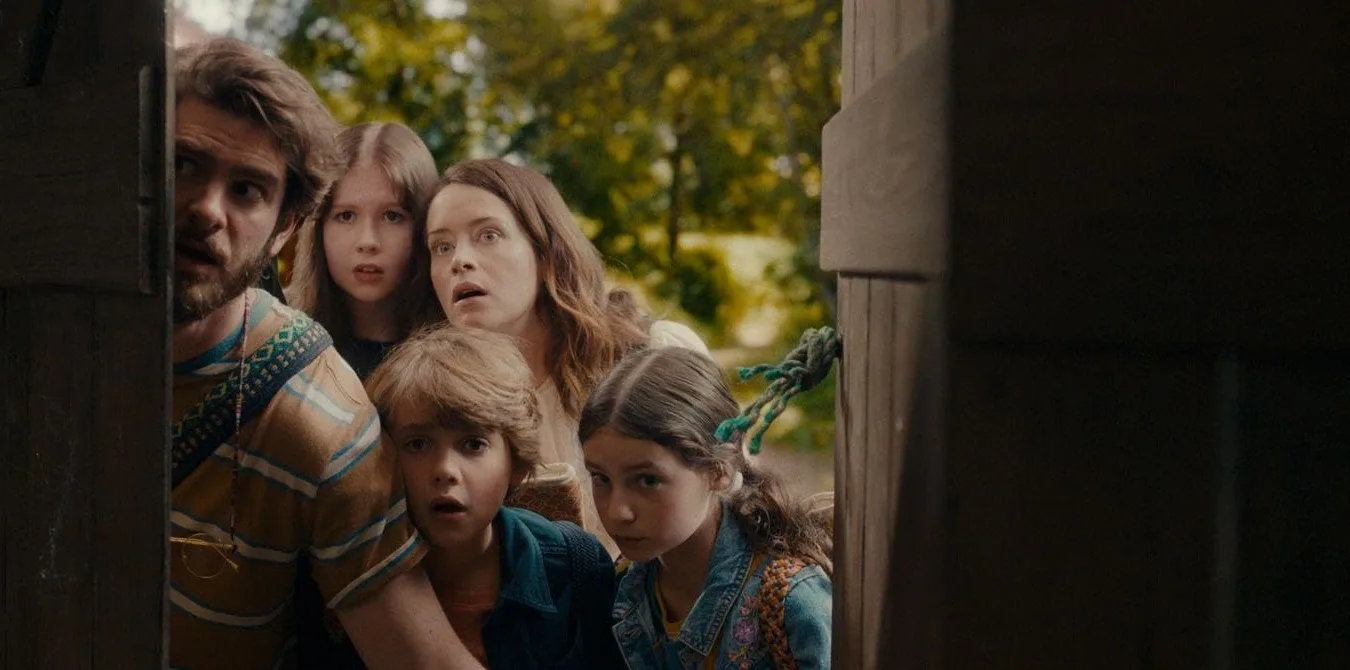

The move away from London cuts the Thompson family loose from a life shaped by the constant murmur of data. Polly Thompson leaves her career in electronics after clashing with a corporate power over the surveillance functions of a smart fridge.
That act of refusal sets the family on a new course. Her husband Tom treats the rupture as permission to pursue a quiet ambition of his own and make artisanal pasta sauce in the countryside. Their destination is a dilapidated barn in Netherbridge, a place stripped of the conveniences that had structured daily life. The children meet the absence of a wireless signal with instant irritation.
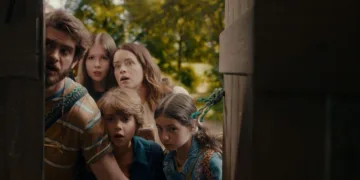
Out of that silence comes the film’s first true opening. Young Fran wanders into ancient woods and discovers a tree of impossible scale, a living gateway rising out of the landscape. The setting gives notice at once. Here, the physical world presses forward and takes precedence over the digital one. The relocation functions as a forced reset. The Thompsons pass from interconnected devices into a life shaped by soil, timber, and age.
Translating the Mid-Century Pastoral
The source material from the middle of the twentieth century offers a chain of episodic adventures with little unified narrative pull. Simon Farnaby’s script solves that problem by shifting the emotional weight toward the inner condition of the Thompson family. The adaptation leaves behind the simple whimsy of the original books and builds a story with a stronger pulse.
Polly’s conflict with her former employers sharpens the film’s view of invasive technology. It gives the parents a concrete reason to abandon city life and seek another pattern of living. Tom carries his own motivation into the move. He wants a link to his father’s legacy, and that desire gives the relocation an intergenerational charge.
The film also speaks directly to the pace of 2026. The enchanted wood becomes a refuge for people worn thin by acceleration and permanent connectivity. Its argument is plain. Separation from the internet creates room for a person to recover some interior quiet. That idea could have drifted into easy sermonizing, yet the script keeps it grounded in household pressures, parental strain, and the restless moods of children who have never known life without signal.
Structure matters a great deal here. The rotating lands could have produced shapeless whimsy, a parade of oddities with no accumulating force. Farnaby arranges them into a sequence that gradually tightens tension. The first meetings with the tree’s residents play like a procession of strange introductions, each one widening the rules of the place.
By the final act, the arrival of a clear antagonist supplies the stakes needed for a cinematic climax. The pacing gives the audience time to absorb the magical logic before the pressure rises. That patience serves the film well. It allows wonder to settle, then lets conflict arrive with weight.
This version keeps the charm associated with the original material and gives it urgency. The repetitive pattern of the books recedes. In its place stands a narrative line that carries the family toward some reckoning with its own fractures. The magical setting never drifts away from the domestic story. Its purpose lies in changing the way these people see one another, speak to one another, and understand the life they share. Fantasy operates here as a means of rearranging human perspective.
The Human and the Fantastic
Claire Foy and Andrew Garfield give the film its grounding. Foy plays Polly as a woman shaped by intellect and principle. The performance avoids reducing her to a stock image of maternal frustration. Polly emerges as someone intent on preserving the autonomy of her family against forces that wish to catalogue and monitor it. Foy gives that conviction gravity without turning it rigid. She makes Polly’s resistance feel moral, practical, and deeply rooted.
Garfield brings buoyancy to Tom. His optimism has a slightly offbeat charm, and it keeps the character’s ambition from tipping into folly. A man chasing the dream of an artisanal pasta sauce business could register as a joke. Garfield gives the pursuit the texture of an earnest quest.
Tom’s investment in the project speaks to memory, inheritance, and the wish to make something tangible with his hands. The chemistry between Foy and Garfield gives the family narrative a reliable foundation. Their scenes hold the film steady whenever the fantasy threatens to float away.
The three children occupy clearly marked positions within the family arrangement. Beth stands for the skepticism of the modern age. Her attachment to her phone forms a barrier, and the magical world must wear that barrier down.
Joe brings restless energy, a quick current of motion that keeps the household from settling into stillness. Fran serves as the primary witness. Her innocence lets her recognize the tree without the crust of doubt that clouds the others. Fran’s role could have slipped into saintly sentiment. The film keeps her grounded by making her curiosity active and decisive.
The residents of the Faraway Tree sit at a deliberate angle to the Thompson family’s realism. Nicola Coughlan’s Silky carries airy precision and a lightness that never dissolves into vagueness. Nonso Anozie gives Moonface a splendid sense of self-importance, and that touch of vanity feeds much of the dry humor in his exchanges.
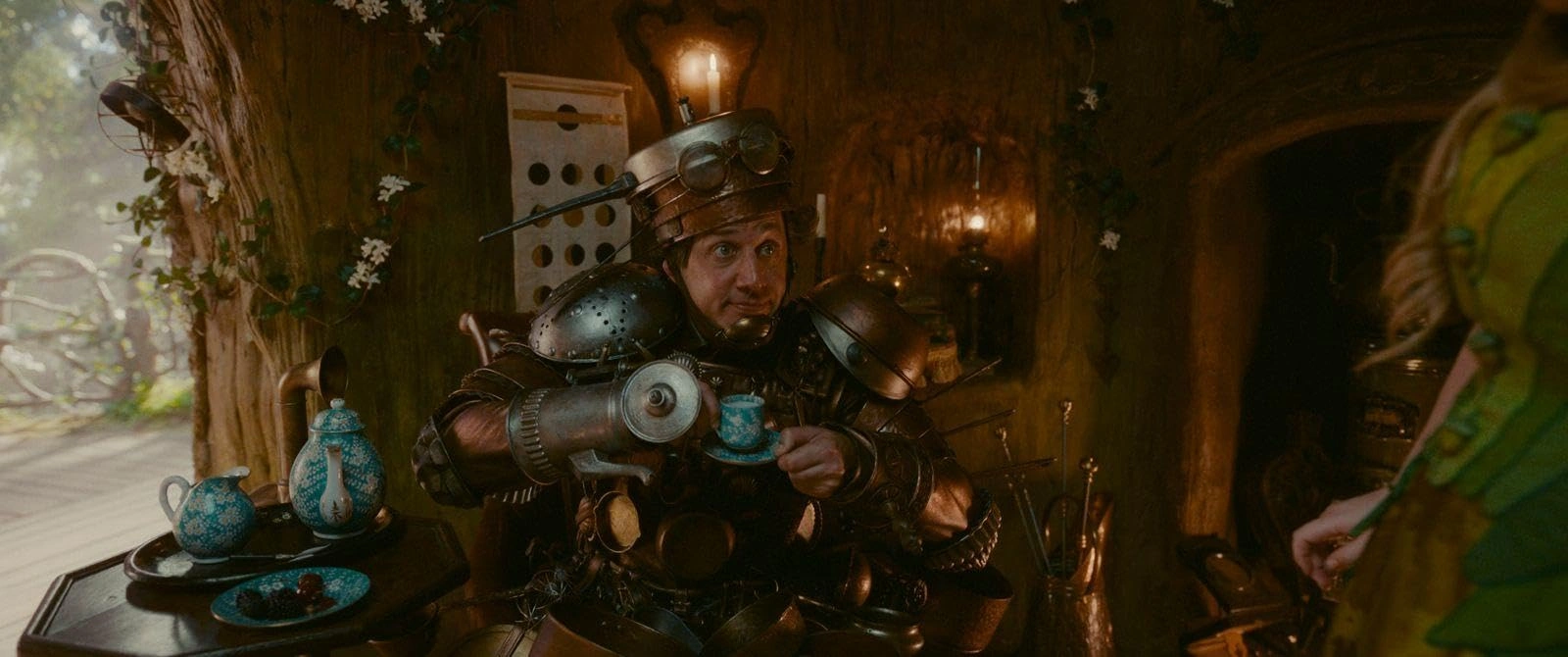
Dustin Demri-Burns turns Saucepan Man into a rhythmic comic presence, his kitchenware costume lending the character a tactile absurdity. Jessica Gunning’s Dame Washalot brings steady industry, a feeling of constant labor folded into fantasy. These figures feel like old spirits translated into a contemporary register.
Rebecca Ferguson enters as Dame Snap and alters the atmosphere at once. Her villainy is stylized and sharp, pitched with enough force to give the family a common threat. Jennifer Saunders appears as the grandmother, embodying a cold and judgmental vision of the world. That character supplies the external pressure that makes the rural escape feel necessary. The ensemble as a whole gives the film a populated strangeness. The world feels inhabited, not decorated.
The Texture of the Unreal
The production design leans hard into physical presence. That choice shapes the entire fantasy. The Faraway Tree appears massive, rough, and ancient, a structure with the feel of centuries in its bark. It has mass. It occupies space with conviction. That tactile quality matters because the film refuses the polished thinness that often comes with heavy digital imagery. Practical sets let the actors touch, climb, and move through the environment in ways that register as lived experience.
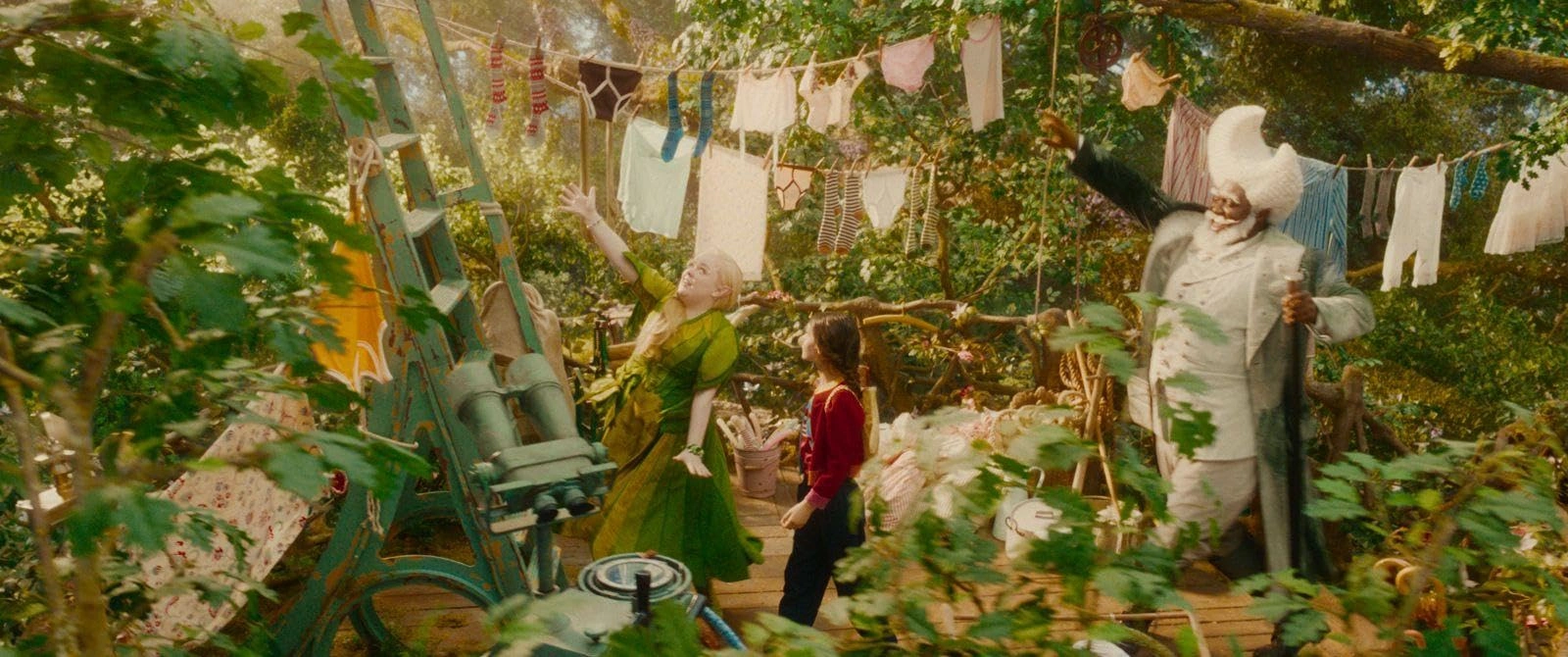
Small details deepen that impression. Marshmallow trees and a model yellow airplane lend the magical world a handmade quality, almost as if it has been assembled through care, craft, and memory. The rotating lands open room for shifts in visual language.
The Land of Goodies glows with excessive color and light, capturing the sensory flood of a child’s dream. The Land of Birthdays moves in another direction and adopts a darker, more somber look. That turn enriches the fantasy by admitting moods beyond delight. The magical world gains tonal variety and a faint edge of menace.
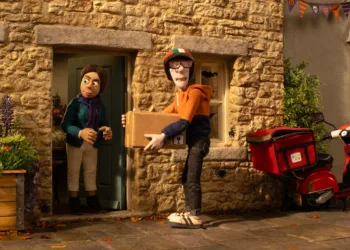
Costume design does much of the character work. Saucepan Man appears assembled from the contents of a kitchen, a figure built from domestic objects and comic eccentricity. Dame Snap’s hairstyle becomes an expressive piece of design, projecting her inner distortion through shape and silhouette. These choices make the inhabitants of the tree instantly legible and clearly separate them from one another. The film understands that fantasy depends on specificity. Generalized whimsy fades quickly. Strange details endure.
The sound design supports the wood’s atmosphere with equal care. Isabella Summers provides a score that turns away from the expected orchestral swell. Her music works through a delicate, ethereal palette and mirrors the wonder the children feel during exploration. The score threads its way through the changing magical lands and gives the film emotional continuity. It does not demand awe. It invites it. That restraint suits the material.
Across all these elements, the technical strategy remains consistent. The film wants magic to feel tangible. It wants the audience to sense weight, texture, and physical nearness. The enchanted environment becomes a presence that can press against skin and breath. That conviction gives the fantasy its hold.
The Digital Exodus and the Wild Mind
The film’s themes circle the strain between technological saturation and the natural world. The Thompson barn becomes a testing ground for a life no longer shaped by the ceaseless intake of data. The children’s early discomfort makes their dependence plain. They have been trained by screens to expect permanent stimulation, immediate diversion, and constant connection. The forest offers another form of attention. It asks for presence, patience, and openness to what cannot be predicted in advance.
The film argues that imagination requires room. Pre-packaged entertainment fills every pause and leaves little space for the mind to roam. The Faraway Tree stands as a place where wandering thought can exist outside algorithmic guidance. That idea could have turned pious in weaker hands. Here it remains tied to action. The magical adventures help repair the family’s fractures because shared danger and discovery force these people into forms of communication they had avoided. Healing arrives through movement, effort, and mutual support.
The children are not passive recipients of wisdom from adults. The story gives them agency, and Fran initiates the family’s contact with the magical realm. Her lack of cynicism opens the door for everyone else. The narrative treats belief in the impossible as a mode of resistance against a world that has grown rigid, monitored, and overdetermined. The enchanted wood becomes a place of recovery, almost a remedy for spiritual exhaustion.
There is a clear critique here of the habit of treating progress as synonymous with technology. The film proposes another measure of value. Soil, imagination, manual work, silence, and shared physical experience carry their own richness. The countryside gives the Thompsons a fresh sense of purpose. Connection returns to the body, to speech, to collective action, to place. By the end, the family has moved toward renewed unity and a sharper understanding of one another. The film leaves them facing the ancient and the wild with newly opened eyes.
The Magic Faraway Tree premiered in cinemas across the UK and Ireland on March 27, 2026, following its Australian release on March 26. As of today, April 21, 2026, the film is currently in its theatrical run and can be watched at major cinema chains such as Cineworld, ODEON, and HOYTS. This live-action adaptation modernizes Enid Blyton’s classic stories, following the Thompson family as they relocate to the countryside and discover a magical portal within an ancient tree.
Where to Watch The Magic Faraway Tree (2026) Online
Full Credits
Title: The Magic Faraway Tree
Distributor: Entertainment Film Distributors, HOYTS, Vertical, All3Media
Release date: March 27, 2026
Rating: U, G
Running time: 105 minutes
Director: Ben Gregor
Writers: Simon Farnaby, Enid Blyton
Producers and Executive Producers: Pippa Harris, Nicolas Brown, Danny Perkins, Jane Hooks, Melanie Davis
Cast: Andrew Garfield, Claire Foy, Nonso Anozie, Nicola Coughlan, Jessica Gunning, Jennifer Saunders, Rebecca Ferguson, Dustin Demri-Burns, Delilah Bennett-Cardy, Billie Gadsdon, Phoenix Laroche, Mark Heap, Oliver Chris, Lenny Henry, Michael Palin, Simon Russell Beale, Hiran Abeysekera, Pippa Bennett-Warner, Simon Farnaby, Claire Keelan
Director of Photography (Cinematographer): Zac Nicholson
Editors: Gary Dollner
Composer: Isabella Summers
The Review
The Magic Faraway Tree
The production succeeds as a spirited modernization of Enid Blyton’s world. It anchors its fantasy in a recognizable domestic struggle. The performances of Andrew Garfield and Claire Foy provide a steady emotional focus. The visual world-building remains tactile and imaginative. Some narrative elements feel thin. The pacing occasionally falters during the transition between magical realms. The film remains an earnest celebration of childhood wonder and digital disconnection. It offers a refreshing departure from cynical family entertainment. The final result is a charming expedition into the branches of the past.
PROS
- Strong performances from the lead and supporting cast.
- Thoughtful modernization of 1940s themes for a 2026 audience.
- Tactile production design that favors practical elements over digital polish.
- Effective critique of modern technological dependency.
CONS
- Occasional lack of narrative depth in the episodic structure.
- Inconsistent pacing between the rotating magical lands.
- Some visual choices may appear simplistic to mature viewers.