





















Michael Mason lives in a desolate lighthouse on the jagged edge of the Outer Hebrides. He has chosen exile, a ghost inside a machine-run era, spending his days playing chess against his own shadow and drinking vodka under the dim light of something that feels like the last page of a century.
The spell breaks when a violent storm wrecks a supply boat near his rocks and he hauls a young girl, Jessie, out of the Atlantic’s churn. One rescue becomes a signal flare, drawing attention from the forces he has spent years avoiding. Mason once worked for MI6. His death was staged to bury a past built on state-approved violence.
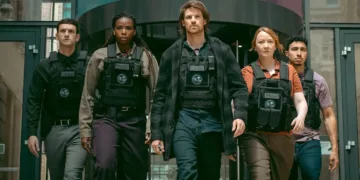
His return sparks a massive, high-tech manhunt from a government that treats him like a loose thread in a digital net. He runs from coastal isolation to London’s tightened streets, carrying lethal instincts into a new job description: protector. Every camera turns into testimony. Every shadow carries an unpaid bill.
The Alchemy of the Anachronistic Stoic
Casting Jason Statham as Michael Mason reads like a pointed farewell to a certain brand of screen masculinity. He plays an anachronistic stoic, a man shaped by silence. In a culture of chatter and oversharing, Mason becomes an information vacuum.
He communicates through a “precision operative” mode that treats violence like high-stakes sculpture. Between fights, he sketches or stares out at the horizon, as if the view can explain the century that left him behind. This Statham-esque monasticism makes Mason feel like a monument built from his own history, a relic from a pre-surveillance world where disappearance could still qualify as an actual plan.
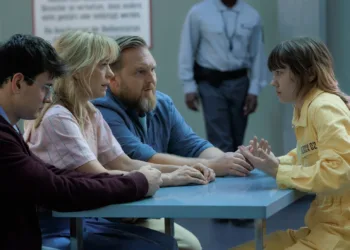
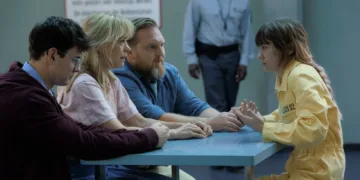
Jessie arrives like a thrown stone in that still water. Bodhi Rae Breathnach plays her with a soulful intensity that refuses to sit quietly in the frame. Jessie is a thirteen-year-old orphan and the film’s emotional anchor, a presence that pushes against Statham’s granite-faced stillness.
She becomes the channel through which Mason’s humanity returns, expressed through rawness, quick feeling, and a kind of stubborn life-force that holds steady beside his physical gravity. She becomes his ward and his catalyst. She even pushes him to name his dog. The dog becomes Jack, and that small act carries surprising weight. Naming turns attachment from theory into practice, a private admission that parts of this world still count.
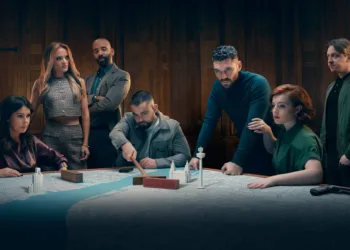
The antagonists supply the moral and intellectual friction that keeps the story from sliding into pure mechanics. Roberta Frost, played by Naomi Ackie, embodies a cold, tech-driven future of espionage. She is a bureaucrat of death, running the hunt from behind glowing monitors, and she treats data like the sharpest weapon on the table. Steven Manafort represents the older model.
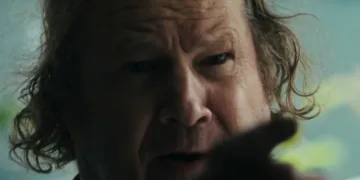
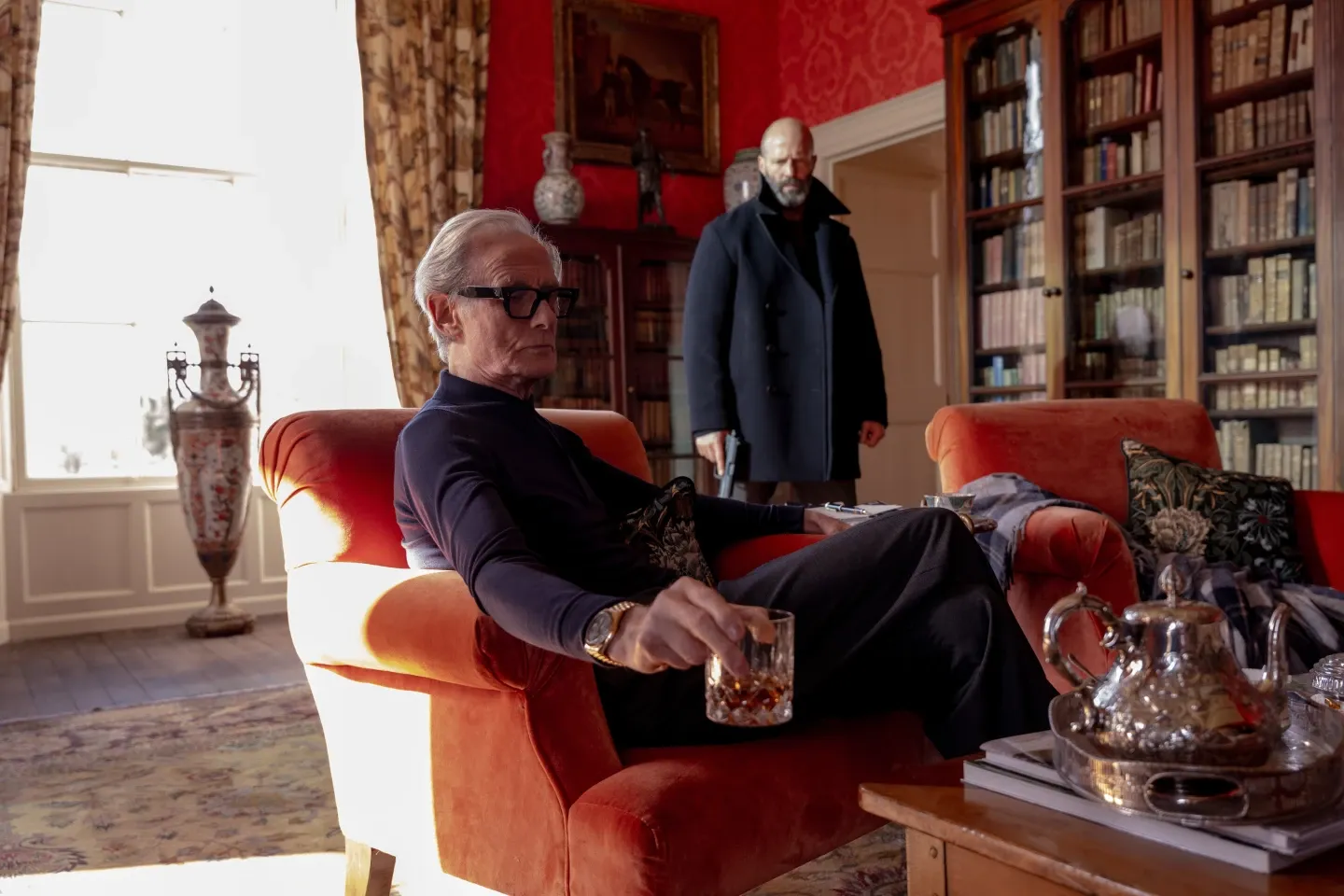
Bill Nighy plays him with venal, commanding grace, a man who sees the world as a chessboard and keeps his hands clean by moving other people like pieces. He also carries a deep personal debt to Mason, which gives his power games a sour intimacy. Together they sketch a portrait of the modern state: machine efficiency powered by human malice.
Workman appears as the physical embodiment of the threat, the “Black Kite” assassin. Bryan Vigier brings a relentless, T-1000 style energy, a forward-motion menace that feels engineered to keep coming. He matches Mason physically and reflects what Mason used to be before exile turned him inward. Daniel Mays plays Arthur Booth as the loyal friend facing a terminal diagnosis, the man who provides escape logistics and stands as a reminder that loyalty has a price tag paid in bodies. His presence injects “mortality-horror” into the film, the slow collapse of flesh running beside the faster collapse of safety.
The Tactile Symphony of Industrial Brutalism
Director Ric Roman Waugh has built a visual language that fits the phrase “industrial brutalism.” He rejects the weightless digital sheen that has become a default setting for contemporary action and opts for something heavy, rough, and physical.
This is “thump-thump” cinema, designed to make every blow land in the audience’s bones. The aesthetic runs on low-rent grit that makes the world feel lived-in and dangerous. The Outer Hebrides setting, filmed in County Wicklow, gives the opening act a bleak beauty, a coastline that looks like it could sandpaper a person down to essentials. London follows, tighter and louder, neon-soaked and claustrophobic, squeezing the story into a higher-pressure container.
The violence plays like a brawl. Ugly. Improvised. Human. Mason’s tools come from the debris of working life: boat oars, nail guns, martini glass stems, industrial hooks. The film frames this as “proletarian-martial-artistry,” a style of combat rooted in whatever the nearest environment can provide. Sound design matters here, emphasizing wet bone-crunch and the heavy thud of boots on concrete. The movie wants the viewer to feel the weight of impact, not admire the geometry of spectacle.
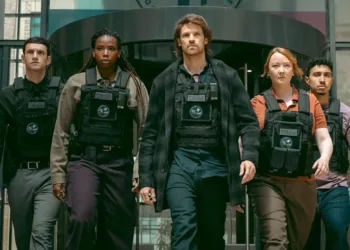
Several sequences show that dedication to physicality. The island siege turns the dilapidated lighthouse into a booby-trapped fortress and plays like a grim, adult version of a home invasion thriller. A nighttime raid has Mason cutting through a SWAT team in darkness, shot with a clarity that emphasizes his efficiency.
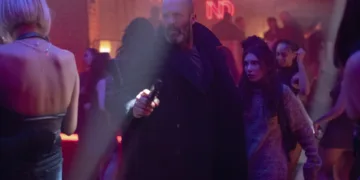
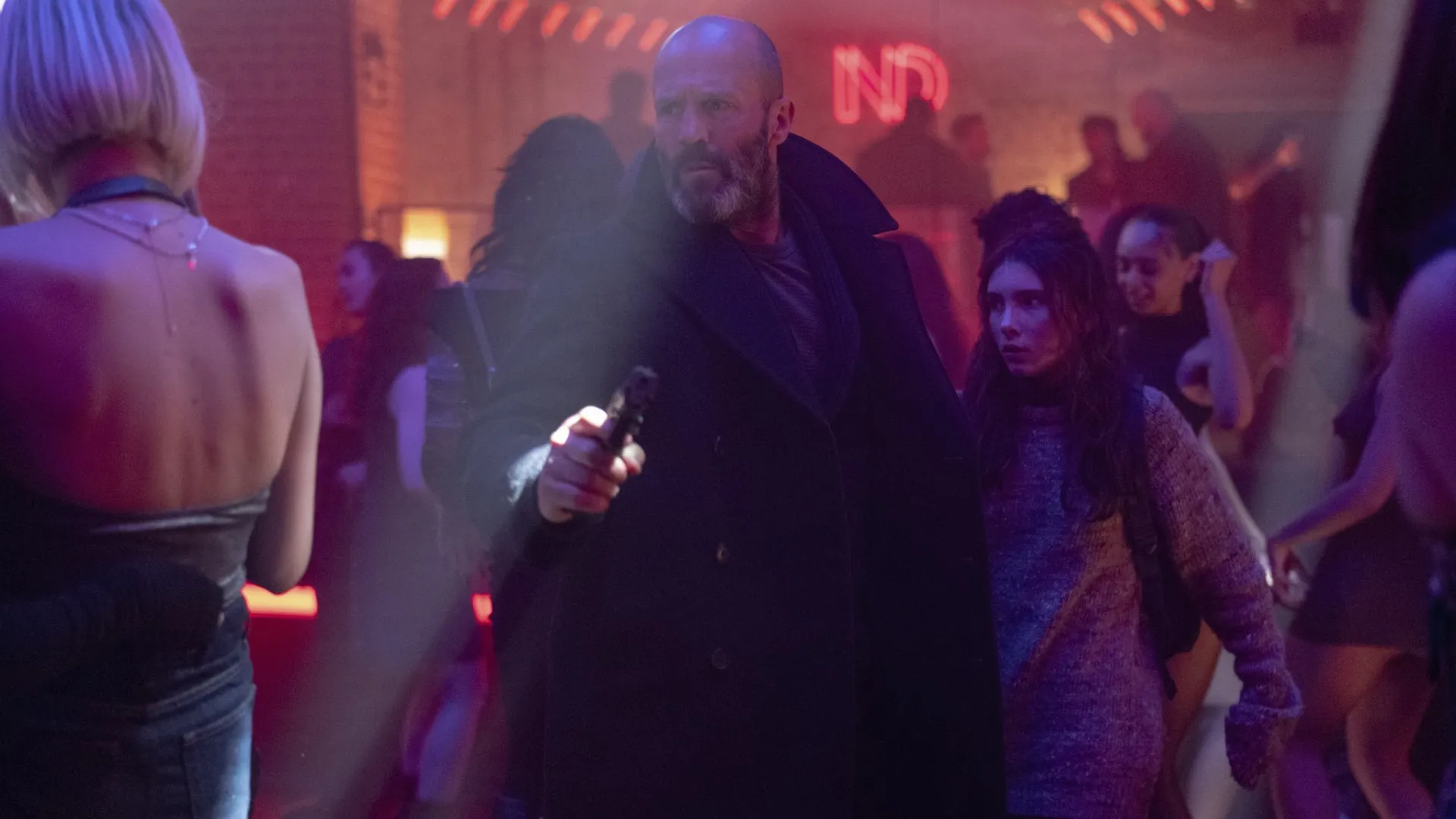
The nightclub brawl goes for a riskier mood. Mason moves through a crowd of oblivious dancers, neutralizing threats with surgical precision that edges into the macabre. Pulsing music and silent efficiency collide, creating a disorienting, dreamlike haze where violence becomes a private act performed in public.
The physical crescendo arrives with the countryside chase and the barn fight that follows. The chase runs on straining steel and revving engines, with cars treated like battering rams instead of toys. The barn confrontation between Mason and Workman becomes a brutal settling of accounts.
Agricultural tools and factory chains turn the space into a junkyard arena where two men try to tear each other apart. The spy-genre varnish falls away. Survival takes over. The film’s commitment to practical stunts and tactile violence draws a line between itself and the gravity-agnostic action that dominates many of its peers.
The Panopticon and the Ghost in the Machine
The story’s logic rests on T.H.E.A., a surveillance system named “Total Human Engagement Analytics.” It functions as the film’s digital panopticon, tapping dashcams, phones, and security cameras across the United Kingdom and turning the country into a high-definition trap.
This technology fuels the pace. “Laying low” becomes a fantasy phrase in a society where the act of watching has been automated. Mason runs from men, and he runs from an algorithm. The movie taps into a modern anxiety about privacy’s collapse, the sense that personal life has become a dataset waiting for a trigger.
There is also an extra-judicial conspiracy that reaches the level of the Prime Minister, implying that surveillance exists as much for political self-preservation as for public safety. Ward Parry’s script leans into that idea while still using familiar genre mechanics. The “Lone Wolf and Cub” dynamic gets updated for a world of satellites and constant tracking. Mason’s invincibility becomes a thematic requirement. In a system built to automate pursuit, the protagonist needs to function as an “unstoppable-variable,” a glitch that refuses correction.
The screenplay is packed with sterile warfare language. “Kill on sight.” “Eliminate.” “Self-deleting code.” These phrases build a vocabulary that matches the inhuman coldness of the surveillance apparatus. Jessie cuts through it with raw emotional outbursts, bringing blood-and-breath feeling into rooms filled with glowing screens. Their bond forms fast, with a cinematic immediacy that can feel almost too sudden. It still plays as the movie’s only reliable heat source. Call it a “desperation-bond,” born from shared trauma and the constant pressure of pursuit.
The film also argues that modern technology has aged the traditional spy out of relevance. Frost and Manafort represent a period where espionage happens through analysis, screens, and managed violence. Mason remains the ghost in the machine, proof that human skill and will can still disrupt sophisticated systems.
The movie suggests that the digital eye can see everything and still fail at comprehension. Human desperation stays messy. Unpredictable. Hard to model. That clash between the automated state and the unpredictable individual becomes the thriller’s main intellectual engine, with the film hinting that the best defense against the panopticon is to become the kind of problem its math cannot solve.
The Melancholy of the Aging Enforcer
A cold sadness hangs over the film, a sense of existential exhaustion that action cinema rarely lingers on for long. Mason feels like a man reaching the end of his own myth. The pursuers behind him look like younger, emptier versions of the same profession, bodies shaped into weapons and then discarded when convenient.
That theme of aging and obsolescence gives the film weight that rises above its B-movie roots. The opening stretch on the island builds a mood of profound isolation, with the lighthouse serving as a blunt metaphor: a structure built to guide others, left to rot in darkness.
The pacing stays relentless at 107 minutes, moving from a slow, meditative coastal start into a high-stakes hunt in London without losing its tonal shape. The film scratches a reptilian itch for a protector figure, the “father-warrior” who stands against a faceless threat.
It plays like a bargain-bin cousin to the Bourne films, yet the grit feels honest, even proud of its scuffs. Its aim is effectiveness. Its ambitions stay practical. That attitude mirrors Statham’s performance, competent in a way that can feel resigned, like the character has accepted the job and the damage as part of the same contract.
The emotional punch comes from quiet moments threaded between the carnage. The camera lingers in extreme close-up on Statham’s “glowering wrinkles” and Breathnach’s “spunky freckles,” creating intimacy pressed against the massive scale of the surveillance hunt.
Faces carry bruises, fatigue, fear, and the daily cost of survival. Mason reaches a point where island life becomes impossible. He trades solitude for the burden of a surrogate family. The arc runs from “man-of-zero-attachments” to “man-with-everything-to-lose,” and the film treats that shift as the most dangerous move he makes.
The story frames reclamation as expensive. Mason burns down his old life so Jessie can have something resembling a future. The final stretch suggests escape from immediate danger, then replaces relief with a harsher truth: the target stays on him.
Quiet exile becomes a life on the run. Jessie stays with him. “Shared-survival” becomes the closing note, bittersweet in a world that sees everything. The movie leaves Mason walking forward with someone beside him, and the struggle continues, reshaped by the fact that he finally has something worth fighting for that reaches past his own skin.
Shelter is an intense action thriller that officially premiered in select international territories today, January 29, 2026, and is set for a wide theatrical release in the United States and United Kingdom tomorrow, January 30, 2026. The film follows a former MI6 operative living in self-imposed exile on a remote Scottish island who is forced back into a world of high-tech surveillance and lethal conspiracies after rescuing a young girl from a shipwreck. Directed by Ric Roman Waugh, the movie is currently available to watch in theaters across various global markets, with a digital release expected to follow its theatrical window.
Full Credits
Title: Shelter
Distributor: Black Bear Pictures, Encore Films, TOBIS Film
Release date: January 30, 2026
Rating: R
Running time: 107 minutes
Director: Ric Roman Waugh
Writers: Ward Parry
Producers and Executive Producers: Jason Statham, John Friedberg, Brendon Boyea, Greg Silverman, Jon Berg, Ric Roman Waugh, Rachael Cole, Teddy Schwarzman, Michael Heimler, Andrew Golov, Mike Shanks, Volodymyr Artemenko, Yevgen Stupka, Victor Hadida, Gideon Yu, Elizabeth A. Bell
Cast: Jason Statham, Bodhi Rae Breathnach, Bill Nighy, Naomi Ackie, Daniel Mays, Harriet Walter, Bryan Vigier, Gordon Alexander, Bronson Webb, Billy Clements, Tom Wu
Director of Photography (Cinematographer): Martin Ahlgren
Editors: Matthew Newman
Composer: David Buckley
The Review
Shelter
Michael Mason’s journey from a silent lighthouse to the surveillance-clogged streets of London is a masterclass in industrial-age action. It succeeds as a tactile, "thump-thump" thriller that prioritizes physical stakes over digital spectacle. While the plot leans heavily on established spy tropes, the soulful connection between Statham and Breathnach provides a necessary heartbeat. It is a gritty, "B-movie" tragedy that effectively examines the loss of anonymity. It does not reinvent the genre, but it executes its violent mission with a resigned, professional competence that is increasingly rare.
PROS
- The use of practical stunts and "found-object" weaponry creates a visceral experience.
- Breathnach provides a vital emotional anchor to Statham’s stoic performance.
- Ric Roman Waugh’s "low-rent" aesthetic feels grounded and heavy.
- Explores relevant anxieties regarding the "digital-panopticon" and surveillance.
CONS
- Relies on familiar "Lone Wolf and Cub" and "corrupt government" clichés.
- Follows a standard genre roadmap with few narrative surprises.
- Actors like Bill Nighy and Naomi Ackie are largely confined to monitor-filled rooms.