

















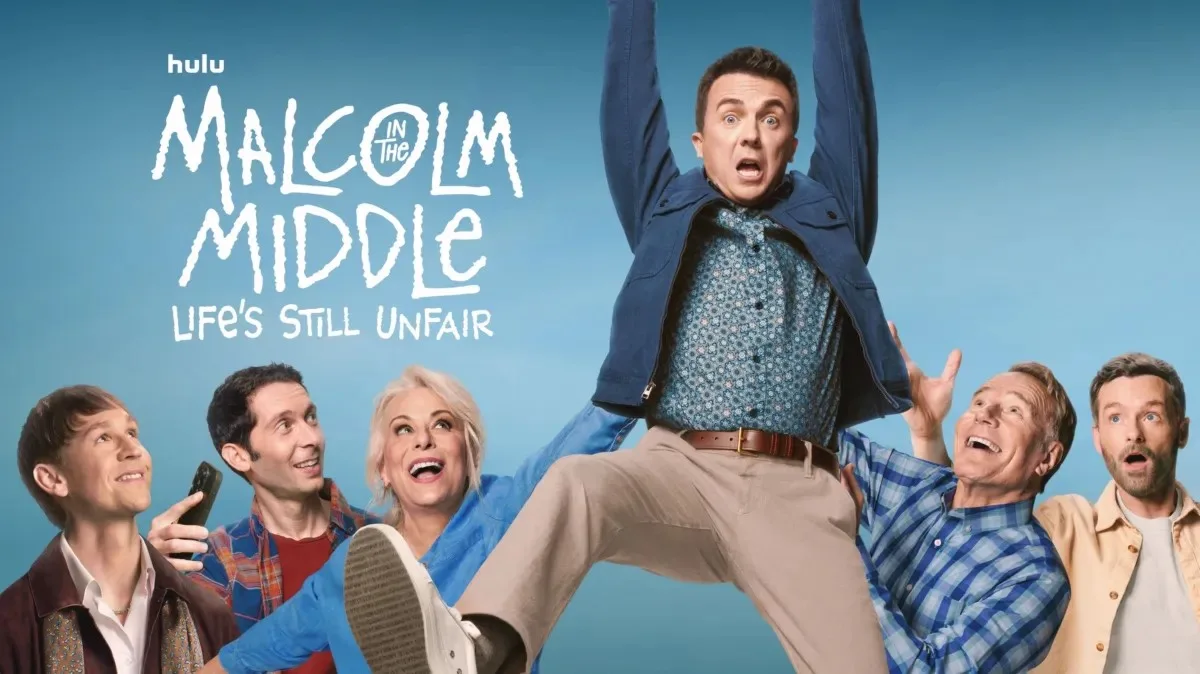

There is something philosophically loaded about a sitcom revival. The premise asks us to believe that people we watched freeze in amber, week after week, have somehow continued living in our absence. Malcolm in the Middle ran from 2000 to 2006, a single-camera, direct-address sitcom that felt genuinely strange among its contemporaries: too loud, too physical, too honest about how families grind each other down. It was funny the way a controlled explosion is funny. Now, nearly two decades later, Hulu and Disney+ have brought it back as a four-episode miniseries titled Life’s Still Unfair, and the title alone tells you everything about the show’s self-awareness. It knows what it owes you. It knows what you came for.
The returning ensemble, Frankie Muniz, Bryan Cranston, Jane Kaczmarek, Christopher Masterson, Justin Berfield, and a recast Caleb Ellsworth-Clark stepping into Erik Per Sullivan’s shoes as Dewey, reassemble around a central idea with real psychological weight: that the most gifted child in a chaotic family might choose survival over connection. The revival earns genuine praise. It also has real unevenness. Both things are true, and the show, to its credit, would probably agree.
An Escape Artist Caught by His Own Design
Malcolm Wilkerson is now a man of respectable purpose. He runs a food bank charity, deploys advanced logistics systems to redirect surplus food to shelters, and has, by any external measure, built a life of quiet dignity. He also has a teenage daughter, Leah, played with sharp instinct by Keeley Karsten, whose existence he has hidden from his entire family. His girlfriend, Tristan, played by Kiana Madeira, exists in a separate compartment entirely. Malcolm has not so much grown up as constructed an elaborate architecture of distance, a system as carefully engineered as his charity’s supply chain, designed to keep the version of himself that his family produces locked safely away.
This is, when you sit with it, a genuinely melancholy premise dressed in a comedy’s clothing. The idea that self-knowledge might lead someone to quarantine rather than heal is darker than the show fully pauses to examine, but it hums beneath everything. The pressure point arrives in the form of Hal and Lois’s 40th wedding anniversary, which functions less as a celebration and more as a gravitational event that pulls every scattered orbit back into collision.
When Hal and Lois appear unannounced at Malcolm’s door, discovering both Leah and the years of deliberate erasure, the show snaps back into its original register almost immediately: accusation, chaos, regression. By episode four, Leah and Tristan have effectively conspired to force Malcolm to the party, where reconciliation waits with the inevitability of a punchline you saw coming and laughed at anyway.
The four-episode structure is one of the revival’s shrewdest decisions. There is no filler, no subplot that outstays its welcome. The pacing moves with clean purpose: episode one re-establishes, episode two escalates, episode three detonates, episode four reconciles. Some characters receive less space than they deserve within that compression, but the emotional payoffs land because the architecture is tight. This feels like an epilogue, not a pitch. That distinction matters more than it might seem.
The Ones Who Made You and the Ones You Made
Frankie Muniz’s Malcolm is a man held together by competence and denial in roughly equal measure. Muniz’s range has limits that the show occasionally bumps against: the furrow-and-flail mode he defaults to under pressure works as comedy but leaves some of the heavier scenes underserved. And yet, in the confrontation with Lois that anchors the final episode, something genuinely raw surfaces. His face changes. His composure dissolves in layers rather than all at once. It is a reminder that he was, before he became a racing driver and a curiosity, a legitimately gifted performer.
Bryan Cranston is the revival’s center of gravity, which is saying something given that Jane Kaczmarek’s Lois is the character who structurally holds the family together. Cranston operates at full throttle across all four episodes: singing, dancing, dissolving into physical comedy with the abandon of someone who has nothing left to prove and therefore everything to enjoy. The third episode’s psychedelic self-therapy sequence, in which Hal, naked and undone by a drug-fueled existential crisis, confronts multiple versions of himself in a void, is the revival’s comedic and perhaps philosophical peak.
It is the kind of scene that only works if the actor commits completely and finds the genuine anguish inside the absurdity. Cranston does both. The final scene involving Hal, which this review will not detail, is excruciating in the precise way the show has always aimed for: you feel sorry for the man at the exact moment you cannot stop laughing at him.
Kaczmarek’s Lois is a brittle, overwhelming force who has spent four decades keeping this family from full structural collapse, and the toll of that labor is written into every overcorrection she makes. Her scenes with Christopher Masterson’s Francis, who is still clawing for her attention despite being a middle-aged man expecting his own child, retain real comedic chemistry. Justin Berfield’s Reese, secretly filming Hal’s domestic disasters for online money, is a nicely contemporary update of his original anarchy instinct.
Dewey, recast with Caleb Ellsworth-Clark and largely confined to video calls from his European concert tour, is handled capably but sparingly. Given the volume of discussion that surrounded the recast, the character’s limited screen time feels like an opportunity avoided.
Among the new arrivals, Leah is the revival’s most considered addition. She breaks the fourth wall exactly as her father once did, carries his social awkwardness into a new generational context, and receives substantially more emotionally intelligent counsel than Malcolm ever got. Vaughan Murrae’s Kelly, the non-binary teenager whose existence was seeded in the original finale, brings chaotic fresh energy, particularly in a rivalry with Reese that captures the mischievous spirit of the original run. Tristan appears peripheral early on, then quietly accumulates weight. By the final episodes, she has earned her place in the ensemble rather than merely occupying it.
Slapstick as Existential Condition
Malcolm in the Middle always understood something that cleaner, more emotionally coherent family comedies did not: that tenderness and humiliation arrive in the same moment, that love expresses itself through chaos, and that the people most capable of devastating you are the ones who raised you. The revival holds onto this understanding.

The opening montage of violence and dysfunction from the original series reorients the audience within the first minute. This is not a softened version of the show. The slapstick retains its cartoon logic, consequence-free in the physical sense and absolutely loaded in the emotional one. The decision to allow occasional profanity, jarring at first against the memory of the original’s network-era constraints, quickly resolves itself: these are adults now, and adult language fits adult damage.
The bathroom scene, in which Malcolm’s long-deferred confrontation with Lois unfolds against a backdrop of loud, persistent, catastrophic digestive distress from an unseen third party, is the revival’s purest philosophical statement. Emotional catharsis will not be granted a clean stage. Significance and absurdity share the same room, always.
The comedy flags in places. By episode four, certain recurring bits have exhausted themselves. The jokes about Hal and Lois’s appetite for each other, effective once, grow mechanical with repetition. The anniversary party cameos from original supporting characters are warm in the way that nostalgia is warm: pleasant, thin, and fading quickly. Stevie’s single running gag wears out its welcome before the episode ends. These are the seams that appear when a show has already spent 151 episodes on its premise and is now working with whatever remains.
The revival is careful, for the most part, to earn its emotional beats rather than simply declare them. Heartfelt moments are nearly always undercut by something ridiculous, which is both faithful to the original and occasionally frustrating when a scene had earned the right to breathe. The final image of Hal is exactly this: a man who deserves sympathy and receives, instead, our helpless laughter.
A Comedy That Chose to Be Just a Comedy
The streaming era has developed a particular habit of burdening revivals with the weight of relevance. Shows return having absorbed new anxieties, new politics, new genre clothing. They arrive as hybrids: sitcom-plus-mystery, comedy-plus-grief-drama, nostalgia-plus-social-commentary. Life’s Still Unfair does none of this. It commits to being a comedy about a dysfunctional family, and in the current television landscape, that commitment reads almost as a provocation.
The original Malcolm in the Middle helped establish direct-address, single-camera comedy as a mainstream format. That format is now standard practice, which means the revival cannot claim the same structural novelty. What it can claim is that honest, working-class family dysfunction, rendered without romanticization or contempt, remains worth watching. The show’s portrait of a family that is genuinely harmful to one another and genuinely irreplaceable to one another has not aged into quaintness. If anything, the idea that your family of origin shapes a self you spend your adult life negotiating with feels more urgent now than it did in 2000.
The four episodes do not add unnecessary weight to the original’s 151-episode legacy. They function as a coda: brief, purposeful, resonant in the right registers. Leah’s fourth-wall address and Kelly’s volatile energy position the show’s world for continuation, and the door is left open without insistence. That restraint is wise, because the revival has stretched the remaining comedic material close to its structural limit. To push further would require new ideas, and new ideas would require a new show, which is perhaps what this was quietly auditioning to become all along.
Malcolm in the Middle: Life’s Still Unfair is a four-episode revival special that premiered on April 10, 2026. The series picks up two decades after the original show ended, following an adult Malcolm who is now a father himself. The story centers on Malcolm being pulled back into his family’s chaotic orbit when his parents, Hal and Lois, demand his presence at their 40th anniversary party. The special is currently available to stream on Hulu and Disney+, bringing back almost the entire original main cast to explore the same dysfunctional family dynamics for a new generation.
Where to Watch Malcolm in the Middle: Life’s Still Unfair Online

Full Credits
Title: Malcolm in the Middle: Life’s Still Unfair
Distributor: Hulu, Disney+
Release date: April 10, 2026
Rating: TV-14
Running time: 30–40 minutes per episode
Director: Linwood Boomer, Ken Kwapis
Writers: Linwood Boomer, Alex Reid, Andy Bobrow
Producers and Executive Producers: Linwood Boomer, Bryan Cranston, Tracy Katsky, Michael Glouberman
Cast: Frankie Muniz, Jane Kaczmarek, Bryan Cranston, Christopher Masterson, Justin Berfield, Caleb Ellsworth-Clark, Emy Coligado, Keeley Karsten, Vaughan Murrae, Kiana Madeira
Director of Photography (Cinematographer): Levie Isaacks
Editors: Nancy Morrison
Composer: They Might Be Giants, Charles Sydnor
The Review
Malcolm in the Middle: Life’s Still Unfair
Life's Still Unfair is a revival that respects its audience enough to remain exactly what it always was: loud, messy, occasionally transcendent, and honest about the damage families do to each other. Cranston and Kaczmarek are extraordinary. The structural tightness of four episodes works in its favor. It runs out of fresh material by the end, and some characters deserved more room. A rare streaming revival that functions as a genuine epilogue.
PROS
- Bryan Cranston delivers career-highlight physical comedy
- Tight four-episode structure keeps the pacing sharp
- Leah and Kelly are strong, credible new additions
- Emotionally honest without becoming sentimental
- Faithful to the original's tone and comic philosophy
CONS
- Muniz's performance is uneven in heavier scenes
- Dewey is significantly underused despite the recast attention
- Recurring jokes wear thin by episode four
- Sibling arcs largely retread familiar emotional ground
- Fan-service cameos add warmth but little substance